PaintingProGuide is reader-supported. When you buy through links on this page we may earn an affiliate commission at no extra cost to you.
Liquitex is an acrylic company first, and that matters if you are shopping for a Liquitex watercolor brush. The Liquitex brush set that is easy to buy on Amazon is the Liquitex Basics six-piece set, which the listing describes as white nylon with medium-soft bristles designed for soft- to medium-bodied acrylics. It can push watercolor around, but it was not built to hold a big, wet charge of water the way a dedicated watercolor brush is.
So this review does two jobs. First, it looks honestly at the Liquitex Basics set: what is in it, how its nylon fiber compares with watercolor fibers, and when it is a sensible choice for watercolor anyway. Then it compares five brush sets designed around watercolor, from synthetic squirrel wash brushes to goat-hair rounds, so you can pick the right tool for washes, glazes and detail.
Quick answer: The Liquitex Basics 6-piece set is a good value for acrylic and for occasional, small watercolor work, but it is not a dedicated watercolor brush. For watercolor itself, the ARTEGRIA 10-piece synthetic squirrel set is the most complete pick, with rounds from #0 to #12 plus a dagger, oval wash and flats. On a tight budget, the Transon goat-hair rounds give large bellies for holding water, and the Fuumuui 10-piece synthetic squirrel set is a strong middle option.
Our Top Picks at a Glance
- Liquitex Basics Paintbrush Set of 6 — Best Liquitex option for acrylic and light watercolor sketching
- ARTEGRIA Watercolor Brush Set (10 Synthetic Squirrel) — Best overall dedicated watercolor set
- Fuumuui Watercolor Brushes (10 Synthetic Squirrel) — Best mid-priced set with wash and dagger shapes
- Transon Goat Hair Round Watercolor Brushes (8) — Best budget rounds that hold lots of water
- MEEDEN Synthetic Squirrel Watercolor Brushes — Best for travel, with individually wrapped brushes
- Sdanart Watercolor Brushes (10 Piece) — Best low-cost mixed-shape set for practice
| Product | Best For | Key Spec | Key Strength | Price Tier |
|---|---|---|---|---|
| Liquitex Basics (6) | Acrylic, light watercolor | White nylon; Round 1, 4; Flat 2; Fan 4; Bright 3, 6 | Durable, easy to clean | $ |
| ARTEGRIA (10) | Full watercolor range | Rounds #0–#12, dagger, oval wash, flats | High water capacity | $$ |
| Fuumuui (10) | Washes and lines | Rounds, flats, cat’s tongue, dagger | Wide shape variety | $$ |
| Transon Goat Hair (8) | Budget rounds | Rounds #1–#16; goat hair | Large bellies hold water | $ |
| MEEDEN Synthetic Squirrel | Travel, plein air | Synthetic squirrel; beech handles | Individually wrapped | $$ |
| Sdanart (10) | Practice on a budget | Rigger, rounds, filbert and more; nylon | Lowest cost per brush | $ |
How We Chose
This comparison is based on the Amazon listing details and specifications checked in October 2026, how well each set’s fiber, shapes and sizes fit watercolor painting, and how widely each product is reviewed by Amazon buyers. We have not painted with these brushes. Notes on how nylon, synthetic squirrel and goat hair behave with water reflect well-established watercolor practice.
For watercolor, we weighted:
- Water capacity — how much liquid a brush can carry for long washes.
- Point — whether rounds come back to a sharp tip for detail.
- Snap versus softness — springy fibers control detail; soft fibers lay smooth washes.
- Shape range — rounds plus at least one wash brush.
- Build quality — crimped ferrules and handles suited to close work.
Liquitex Watercolor Brush Options Reviewed
1. Liquitex Basics Paintbrush Set of 6 — Best for acrylic and light watercolor sketching

The Liquitex Basics set contains six white nylon brushes: Round 1, Round 4, Flat 2, Fan 4, Bright 3 and Bright 6. The listing says the bristles are medium-soft and tuned for soft- to medium-bodied acrylics, that the brushes are durable, easy to clean and hold ample color, and that they pair with Liquitex acrylics and mediums. One bullet calls them long-handled while the contents line says short handle, so check the photos if handle length matters to you.
For watercolor, white nylon has more snap and less water capacity than synthetic squirrel or goat hair. That is fine for small sketches, sharp edges, lifting color and dry-brush texture, but larger washes will need frequent reloading. Painters who use both acrylic and watercolor occasionally can get by with this set; dedicated watercolorists will want one of the sets below.
Best suited for: Acrylic painters who sometimes dabble in watercolor; students who need one inexpensive set for both media; sketchers working small.
Key features:
- Six white nylon brushes
- Round 1, Round 4, Flat 2, Fan 4, Bright 3, Bright 6
- Medium-soft bristles for soft and medium-body acrylic
- Durable and easy to clean
Pros:
- Lowest price tier from a major paint brand
- Nylon snap is good for edges and lifting
- Useful for both acrylic and small watercolors
Cons and limitations:
- Not designed for watercolor; limited water capacity
- No large wash brush in the set
- Handle length described inconsistently in the listing
Buying consideration: Never move brushes freely between acrylic and watercolor without thorough washing; dried acrylic residue in the hairs will spoil watercolor washes.
Dedicated Watercolor Brushes Worth Comparing
2. ARTEGRIA Watercolor Brush Set, 10 Soft Synthetic Squirrel Brushes — Best for a complete watercolor kit

ARTEGRIA’s set covers the full range of watercolor work with fine-tipped rounds in #0, #3, #6, #8, #10 and #12, a 3/8-inch dagger striper, a 3/4-inch oval wash (cat’s tongue) and flats. The listing describes soft synthetic squirrel bristles with great liquid-holding capacity and smooth flow, spring and shape-holding for control, and double-crimped ferrules.
Extras include a storage tube, a black velvet travel bag, a mini guide and an ebook. For someone moving from an acrylic set to proper watercolor brushes, this one set covers washes, detail and expressive strokes.
Best suited for: Watercolor painters at any level who want one set that covers washes, rounds and specialty strokes.
Key features:
- Rounds #0, #3, #6, #8, #10, #12
- Dagger striper 3/8 in; oval wash 3/4 in; flats
- Soft synthetic squirrel bristles
- Double-crimped ferrules
- Storage tube and travel bag
Pros:
- Full size run of rounds
- Includes a true wash brush
- High water capacity
- Widely reviewed by Amazon buyers
Cons and limitations:
- Middle price tier
- Soft fibers have less snap than nylon for scrubbing
Buying consideration: Synthetic squirrel lays beautiful washes but dislikes scrubbing; use an old nylon brush for lifting and texture.
3. Fuumuui Watercolor Brushes, 10 Synthetic Squirrel — Best for washes and line work on a mid budget
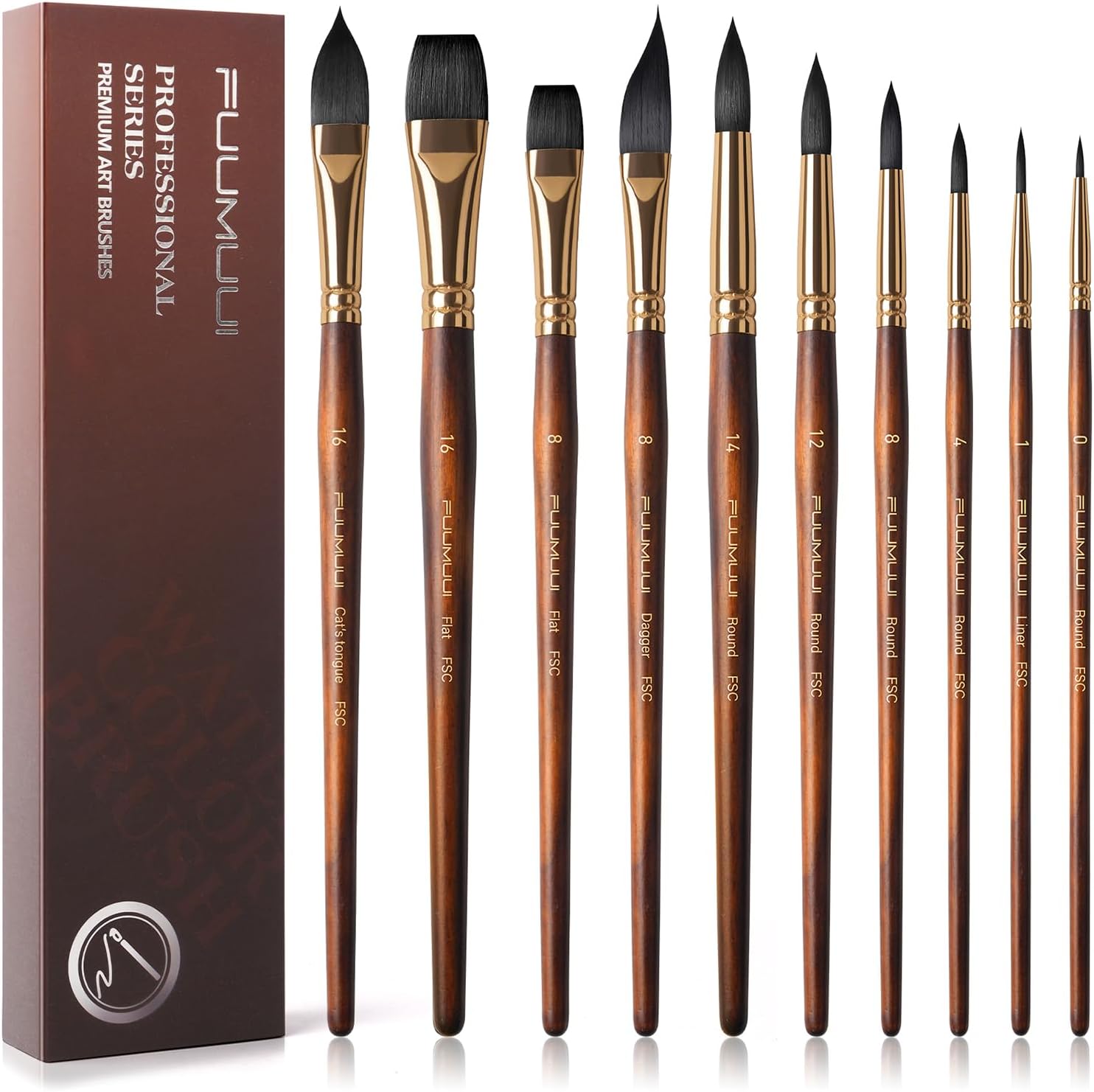
Fuumuui’s ten-piece set uses synthetic squirrel hair in pointed rounds, flats, cat’s tongue, dagger and oval wash shapes. The listing emphasizes control and even color flow from the point, aluminum ferrules that resist corrosion, polished birch handles and short ergonomic handles for close work.
It also names gouache, ink and fluid acrylic, making it a flexible set for water-based media.
Best suited for: Watercolor and gouache painters who want varied shapes without the top tier price.
Key features:
- 10 brushes: rounds, flats, cat’s tongue, dagger, oval wash
- Synthetic squirrel hair
- Aluminum ferrules, birch handles
Pros:
- Good shape variety
- Short handles for control
- Suits watercolor, gouache and ink
Cons and limitations:
- Sizes not fully itemized in the listing
- Similar to ARTEGRIA with fewer extras
Buying consideration: Use the cat’s tongue for soft-edged shapes and skies, and the dagger for grasses and branches.
4. Transon Round Watercolor Brush Set, 8 Goat Hair — Best for budget rounds that hold water

Transon offers eight goat-hair rounds in sizes #1, #4, #5, #8, #10, #12, #14 and #16, with large bellies designed to hold plenty of pigment and water for long strokes, tapered tips for detail, nickel-plated copper ferrules and champagne-colored handles.
Goat hair is soft and very absorbent, which suits loose washes and expressive strokes. Its point is usually less crisp than a springy synthetic, so pair it with one fine synthetic round for detail.
Best suited for: Loose, expressive watercolor painters and beginners who want natural-hair water capacity at a low price.
Key features:
- Eight rounds, #1 to #16
- Goat hair with large bellies
- Double-crimped nickel-plated copper ferrules
Pros:
- Large sizes for big washes
- Lowest tier for natural hair
- Very widely reviewed
Cons and limitations:
- Softer point than synthetics
- Rounds only, no flat wash brush
Buying consideration: Natural hair needs gentle cleaning with mild soap and should dry flat; never leave it standing in water.
5. MEEDEN Synthetic Squirrel Watercolor Brushes — Best for travel and plein air

MEEDEN’s watercolor brushes use synthetic squirrel fibers designed to mimic natural squirrel water capacity, with polished beech handles and deeply crimped ferrules. Each brush is individually wrapped. Note that the listing title says 4 pack while a bullet mentions nine brushes, so confirm the count on the product page.
The listing positions them for watercolor, gouache and ink, in studio, plein air or travel use.
Best suited for: Travel and plein air watercolorists, and painters who want neatly packaged brushes as a gift.
Key features:
- Synthetic squirrel fibers
- Beech wood handles
- Individually wrapped
- For watercolor, gouache and ink
Pros:
- Good water retention for washes
- Packaging protects tips
- Comfortable handles
Cons and limitations:
- Brush count unclear in listing
- Shapes and sizes not itemized
Buying consideration: Check the product images for the shapes included before buying, since the listing text is inconsistent.
6. Sdanart Watercolor Brushes, 10 Piece — Best for low-cost mixed-shape practice

Sdanart’s ten-piece set includes a #1 rigger and fine-tip rounds in #2, #10, #12 and #16 among other shapes, in nylon bristles with a glossy mahogany-color handle. The listing names watercolor, acrylic, oil, gouache and ink across many surfaces.
As a nylon set it behaves more like the Liquitex Basics than like synthetic squirrel, but it adds a rigger and larger rounds at a very low price.
Best suited for: Students and beginners practicing watercolor and mixed media on a tight budget.
Key features:
- 10 brushes including rigger and rounds #2–#16
- Nylon bristles
- Lacquered wooden handles
Pros:
- Lowest tier
- Rigger included for lines
- Larger rounds than Liquitex Basics
Cons and limitations:
- Nylon holds less water than squirrel or goat
- Generic listing details
Buying consideration: A good practice set; upgrade your most-used round to synthetic squirrel when you find your favorite size.
Nylon vs Synthetic Squirrel vs Goat Hair for Watercolor
White nylon, like the Liquitex Basics fiber, is springy and tough. It is excellent for crisp edges, lifting color and dry-brush texture, but its smooth filaments hold relatively little water. Synthetic squirrel fibers are engineered to be softer and to trap more liquid, so they carry long washes and release paint evenly. Goat hair is natural, very soft and absorbent, ideal for loose washes, with a less precise point.
Many watercolorists combine fibers: a soft wash brush for skies and large areas, a synthetic round with a good point for shapes and detail, and a nylon brush for lifting and corrections. That is why a Liquitex nylon set still earns a place in a watercolor kit even though it should not be your only brush.
When the Liquitex Basics Set Is the Right Call
There are good reasons to reach for the Liquitex set even for watercolor. Urban sketchers working in small sketchbooks often prefer springy nylon because it controls small, precise marks and survives being thrown in a bag. Painters who combine watercolor with ink or colored pencil rarely lay big washes, so water capacity matters less. And for lifting out highlights, softening hard edges or scrubbing texture into dry paper, a firm nylon flat such as the Bright 3 or Bright 6 does the job better than a soft squirrel brush.
The fan brush in the set is also useful in watercolor for foliage, grasses and dry-brush effects. Where the set struggles is any passage that needs one continuous wet stroke across a large area: a graded sky, a flat background wash, or wet-in-wet blooms across half a sheet.
A Three-Brush Watercolor Starter Kit
| Role | What to look for | Where it comes from |
|---|---|---|
| Wash brush | Oval wash or wide flat, soft fiber | ARTEGRIA or Fuumuui set |
| Main round | #8–#12 round with a good point | ARTEGRIA, Fuumuui or Transon |
| Lifting and edges | Small firm nylon flat or bright | Liquitex Basics Bright 3 or 6 |
Built this way, the Liquitex set and one dedicated watercolor set complement each other instead of overlapping, and you can expand later with a rigger or dagger for lines.
Buying Guide: How to Choose a Watercolor Brush
Start with a round
A medium round such as a #8 or #10 that holds water and comes to a point does most watercolor work. Buy that first.
Add a wash brush
An oval wash (cat’s tongue) or wide flat lays even skies and backgrounds. The ARTEGRIA and Fuumuui sets include one; Liquitex Basics does not.
Check the point
Wet the brush, flick it, and the tip should come to a clean point. Listings mention “fine tip”; photos and buyer images help confirm it.
Handle length
Short handles suit seated work at a table, which is how most watercolor is painted.
Keep media separate
If you use a brush for acrylic, keep it for acrylic. Acrylic residue is nearly impossible to remove fully and will affect watercolor washes.
Care and storage
Tubes, cases and roll-ups protect points. Dry brushes flat or tip-up, never tip-down.
Practice Your Brushwork
To get more from fine rounds and riggers, see how to use a liner brush for detail work, and use how to paint dots with a round brush as a quick control exercise.
Common Mistakes to Avoid
- Using an acrylic brush for watercolor without cleaning. Residue repels water and streaks washes.
- Choosing only small brushes. Small brushes make watercolor fussy; a large round or wash brush keeps it fresh.
- Scrubbing with soft squirrel brushes. Use nylon for lifting and keep soft brushes for flowing color.
- Leaving brushes in the water jar. Tips bend and ferrules loosen.
- Buying by piece count. Five good shapes beat twenty you never use.
FAQs
Does Liquitex make watercolor brushes?
Liquitex is primarily an acrylic brand. The Liquitex Basics brush set available on Amazon is designed for soft- to medium-bodied acrylics, though it can be used for light watercolor work.
Can I use acrylic brushes for watercolor?
Yes, if they are clean, but nylon acrylic brushes hold less water than watercolor brushes, so washes need more reloading.
What is the best fiber for watercolor brushes?
Synthetic squirrel and natural goat or squirrel hair hold the most water. Firmer synthetics give better control for detail and lifting.
What is a cat’s tongue brush?
A cat’s tongue, or oval wash, brush has a rounded, flattened shape that lays washes and also comes to a soft point for shapes.
How many watercolor brushes do beginners need?
Three is enough to start: a medium round, a small round, and a wash brush. Sets such as ARTEGRIA include all three.
How should I clean watercolor brushes?
Rinse in clean water, wash occasionally with mild soap, reshape the tip, and dry flat or tip-up.
Final Recommendation
If you already paint in acrylic and only dabble in watercolor, the Liquitex Basics set is an inexpensive brush that can cover both, as long as you keep acrylic and watercolor brushes separate once you commit. For dedicated watercolor painting, choose the ARTEGRIA set for the most complete range, Fuumuui for a mid-priced alternative, Transon goat hair rounds for budget water capacity, MEEDEN for neatly packaged travel brushes, or Sdanart for low-cost practice.