Quick answer: Painting on wood vs canvas comes down to rigidity versus flexibility. Wood panels are rigid, so paint layers are less likely to crack over time, they take fine detail and smooth glazes well, and they suit oil, acrylic and egg tempera, but they are heavier and need sealing and priming. Canvas is light, textured and easy to transport or make very large, with a springy feel many painters like, but the fabric flexes and can let thick or brittle paint crack over decades. Choose wood for small, detailed or archival work and canvas for large, loose or portable work.
Both surfaces have centuries of masterpieces behind them. Panel painting dominated European art until roughly the 1500s, when stretched canvas took over for its lighter weight and lower cost. Today, painting on wood vs canvas is a genuine choice again, because modern hardboard and cradled panels have made wood easy and affordable. The right answer depends on your paint, your style and how large you want to work.
If you are weighing surfaces because you collect or plan to sell oil work, the guide to oil paintings on canvas for sale shows how finished canvas pieces look across vintage and modern styles.
Wood vs Canvas at a Glance
| Factor | Wood panel | Stretched canvas |
|---|---|---|
| Rigidity | Rigid; no flex | Flexible; bounces under the brush |
| Surface texture | Smooth to lightly textured (depends on primer and sanding) | Visible weave; fine to coarse |
| Detail and glazing | Excellent | Good on fine-weave canvas |
| Weight | Heavier, especially large panels | Light |
| Practical maximum size | Moderate; large panels get heavy and need bracing | Very large is easy |
| Crack resistance of paint film | Generally better, since the support does not flex | Older or thick, brittle films can crack with flexing |
| Prep required | Seal, then prime (unless pre-primed) | Usually sold pre-primed |
| Framing | Thin panels need a frame or cradle | Gallery-wrap canvases can hang unframed |
| Transport and storage | Bulky, but resists dents | Light, but punctures and dents |
| Best suited for | Small to medium, detailed, archival work; egg tempera; encaustic | Large, expressive, textured work; portability |
What Counts as “Wood” for Painting?
- Hardboard (such as tempered or untempered high-density fiberboard). The most common modern panel. Smooth, stable and inexpensive. Many artists prefer untempered boards, since tempered ones historically used oils that could affect adhesion; manufacturers’ painting panels are made to address this.
- Plywood (such as birch or Baltic birch). Lightweight for its strength and less prone to warping than solid wood, though thin plywood can bow without bracing.
- Solid wood boards. Traditional, but they expand, shrink and can split with humidity changes. Best kept small, or cradled and well sealed.
- MDF. Very smooth and cheap but heavy and sensitive to moisture at the edges. Fine for studies when sealed on all sides.
- Cradled panels. Any of the above glued to a wooden frame on the back. The cradle stops warping and gives a deep edge like a gallery-wrapped canvas.
Painting on Wood: Pros and Cons
Advantages
- Stability. A rigid support does not flex, so paint layers are under less mechanical stress. This is a key reason panels are favored for archival work.
- Smooth surface for detail. Sanded gesso on a panel can be almost glass-smooth, ideal for fine brushwork, photorealism and thin glazes.
- Works with demanding media. Egg tempera and encaustic wax need rigid supports; they can crack on flexible canvas.
- Resistant to knocks. A panel will not puncture if a corner of a table hits it.
- Easy to cut to custom sizes and shapes.
Drawbacks
- Weight. Large panels are heavy to move and hang.
- Prep work. Raw wood needs sealing to block acids and resins, then priming.
- Warping. Thin, unbraced panels can bow, especially if only one side is primed.
- Feel. Some painters miss the give of canvas when working with loose, gestural strokes.
Painting on Canvas: Pros and Cons
Advantages
- Light and scalable. Huge canvases are practical; they can even be rolled for transport once removed from stretchers.
- Texture. The weave catches dry-brush strokes and adds visual interest, especially in impasto and loose painting.
- Springy feel. The slight bounce under the brush suits expressive, energetic handling.
- Ready to use. Most canvases are sold pre-stretched and pre-primed.
- Display-ready. Gallery-wrapped canvases with painted edges hang without a frame.
Drawbacks
- Movement. Fabric expands and contracts with humidity and flexes when handled. Over time, this can contribute to cracking in thick or brittle paint films.
- Vulnerable to damage. Punctures, dents and sagging are common risks.
- Weave interferes with fine detail unless you choose a fine portrait-grade canvas or add extra gesso layers.
Oil vs Acrylic Painting on Canvas and Wood
Your paint type shifts the balance between the two surfaces.
Oil paint
Oil films become more brittle as they age, so a rigid support has a long-term advantage. That said, oil on well-prepared canvas has lasted for centuries; using flexible enough layers, following fat over lean and avoiding excessively thick passages all help. Linen canvas is traditionally preferred over cotton for oils because it is stronger and less responsive to humidity.
Acrylic paint
Acrylic films remain flexible, so they are comfortable on canvas. They also work well on wood and are a natural fit there, since acrylic gesso seals and primes in one product family. Acrylic’s fast drying makes smooth blending trickier on slick panels; slightly more tooth from sanding with a coarser grit can help.
Acrylic vs oil paint on canvas: a quick comparison
| Factor | Acrylic on canvas | Oil on canvas |
|---|---|---|
| Drying time | Minutes to an hour | Days to weeks |
| Film flexibility over time | Stays relatively flexible | Becomes more brittle |
| Blending | Quick work or retarders needed | Long, easy blending |
| Cleanup | Water and soap | Solvent, then soap |
| Canvas preference | Cotton or linen | Linen often preferred |
How to Prepare Canvas for Oil Painting
Most pre-primed canvases are coated with acrylic gesso, which is widely used under both oil and acrylic. For oil, a few extra steps improve results:
- Tighten the canvas with stretcher keys if it sags.
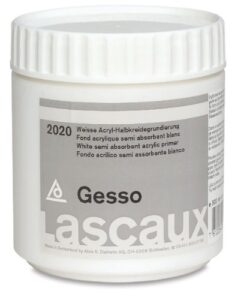
- Add one or two thin coats of acrylic gesso, brushing each coat at right angles to the last, if the existing priming feels thin or absorbent.
- Sand lightly between coats for a smoother surface if you paint fine detail.
- Tone the canvas with a thin, lean wash, such as raw umber thinned with solvent, to kill the white glare.
- Begin with lean layers and add more oil medium in later layers.
Traditional oil grounds use rabbit-skin glue size followed by an oil-based primer. Size seals the fabric so oil does not reach and rot the fibers. Modern synthetic sizes are often used in its place because hide glue reacts strongly to humidity.
How to Prepare a Wood Panel for Painting
- Sand the face lightly and wipe off dust.
- Seal the wood with an acrylic size or a sealer designed for panels. This blocks support-induced discoloration, where resins or acids from wood migrate into the ground and yellow it.
- Prime with several thin coats of acrylic gesso. Alternate brush directions and sand between coats for smoothness.
- Coat the back and edges too, or at least seal them, to balance moisture exchange and reduce warping.
- Let it cure before painting, following the gesso label.
How Each Surface Changes the Look of the Paint
The same tube of paint can look noticeably different on wood and canvas. On a smooth, sanded panel, paint lies flat and reflects light evenly, so glazes look deep and jewel-like and fine edges stay crisp. Brushstrokes still show, but they read as marks in the paint rather than interactions with the surface. On canvas, the weave breaks up light. Thin paint sinks into the valleys of the weave while the peaks catch dry-brush highlights, giving a slightly broken, lively texture. That texture flatters loose landscapes and impasto, but it can fight against smooth skin tones or polished metal reflections unless you build up the gesso.
Absorbency matters too. A panel primed with several coats of gesso is usually less absorbent than a thinly primed budget canvas, so colors stay glossier and more saturated. If paint looks dull and patchy after drying (often called “sinking in”), the ground may be too absorbent; another coat of gesso or a thin layer of medium before painting helps.
Cost, Framing and Hanging
Price depends heavily on brand and size, but some general patterns hold. Small hardboard panels are often cheaper than stretched canvases of the same size, and you can cut your own from a large sheet for even less. At larger sizes, cradled panels become more expensive and heavier, while canvas stays relatively affordable and light. Linen canvas and linen mounted on panel sit at the premium end.
Framing differs as well. A thin flat panel needs a frame or at least a cradle for hanging, though it fits standard frames neatly. Gallery-wrapped canvases, with the fabric stapled on the back and edges painted, can hang straight on the wall. Large panels need sturdy hanging hardware such as a French cleat, while even big canvases usually hang from a simple wire.
Painting on Wood vs Canvas for Beginners
For most beginners, inexpensive canvas panels or small stretched canvases are the easiest start: they are ready to paint and forgiving of loose strokes. Once you notice the weave getting in the way of detail, try a pre-primed hardboard panel and compare. Painting the same simple subject on both surfaces in one week is the quickest way to learn which one suits your hand.
Which Surface Should You Choose?
| If you… | Choose |
|---|---|
| Paint small, detailed or realistic work | Wood panel |
| Paint large, loose or textured work | Canvas |
| Use egg tempera, encaustic or heavy collage | Wood panel |
| Paint plein air and need to carry several pieces | Thin panels or canvas boards |
| Want to hang work unframed | Gallery-wrapped canvas or cradled panel |
| Are on a tight budget for practice | Canvas panels or hardboard offcuts |
| Prioritize long-term archival stability for oil | Rigid panel or linen on a rigid backing |
The middle ground: canvas boards and mounted linen
Canvas panels (fabric glued to cardboard or hardboard) and linen mounted on wood combine canvas texture with rigidity. Cheap canvas boards with cardboard cores are fine for practice but can warp and are not archival. Linen mounted on a proper panel is a premium option many oil painters prefer.
Oil Painting Ideas on Canvas vs Wood
Matching subject to surface can lift the result:
- On wood: small still lifes with crisp reflections, miniature portraits, botanical studies, detailed birds, icon-style gilded work.
- On canvas: big skies and seascapes, abstract palette-knife work, expressive figure paintings, impasto florals.
Common Mistakes
- Painting oils directly onto raw wood or raw canvas without size or primer.
- Priming only one side of a thin panel, causing it to bow.
- Using very thick, inflexible paint layers on a loose canvas.
- Storing canvases leaning against sharp objects or stacked face to face.
- Assuming all “wood” is equal; unsealed construction lumber can bleed sap and acids.
FAQs
Is it better to paint on wood or canvas?
Neither is universally better. Wood suits detailed, small or archival work and rigid-only media; canvas suits large, textured and portable work.
Do oil paintings last longer on wood?
Rigid panels reduce the flexing that can crack aging oil films, so they are often considered more stable. Well-made oil paintings on canvas can also last centuries with proper care.
Do you need to prime wood before painting?
Yes. Seal the wood first, then apply gesso or another primer. This protects the paint from wood resins and acids and gives better adhesion.
Can you use acrylic paint on wood?
Yes. Acrylic works very well on sealed and primed wood, and acrylic gesso makes preparation simple.
Why do some artists prefer canvas?
Canvas is light, comes ready to paint, can be very large, and has a springy texture that suits loose and expressive brushwork.
Is hardboard good for oil painting?
Yes, when sealed and primed. Hardboard is smooth, rigid and affordable, which makes it a popular modern panel for oil.
Final Thoughts
Wood gives you stability, smoothness and detail; canvas gives you lightness, scale and texture. Many painters keep both on hand and choose per project. Start with the size and style of the piece, then let the paint you use settle the question.
If you love the look of canvas oil work and want inspiration for your own walls, explore this collection of vintage and modern oil canvas wall art to see how different painters handle the surface.