PaintingProGuide is reader-supported. When you buy through links on this page we may earn an affiliate commission at no extra cost to you.
Pre-stretched canvases stop making sense somewhere around four feet. They get expensive, they are awkward to ship, and the sizes rarely match the wall you are painting for. The best canvas roll for large projects solves all three problems: you buy fabric by the width and length, cut exactly what the piece needs and stretch it yourself on bars you choose.
The catch is that roll width sets your ceiling. A 48-inch roll can never become a 60-inch-tall painting without a seam. So this guide starts with width, then weight, then priming, and only then brand.
Quick answer: For most big paintings, the PHOENIX 72-inch x 18-foot triple gesso primed cotton roll is the strongest all-round choice: wide enough for six-foot pieces and heavy enough (11 oz) to stretch tight. For murals, backdrops or a studio that goes through canvas fast, the Wholesale Arts and Frames 84-inch x 75-foot 13 oz roll is the professional bulk option. On a tighter budget, the Kinlop 48-inch x 10-foot double primed roll covers one or two large pieces without overbuying.
Our Top Picks at a Glance
- PHOENIX 72 Inch x 18 Feet Canvas Roll — Best overall canvas roll for large paintings
- Wholesale Arts and Frames 84″ x 25 Yd 13 oz Primed Roll — Best for murals, backdrops and high-volume studios
- DPDIAN 48 Inch x 20 Feet Primed Cotton Roll — Best for long series and multi-panel work up to four feet tall
- Kinlop 48 Inch x 10 Feet Double Primed Roll — Best budget roll for one or two big pieces
- U.S. Art Supply 63″ x 6′ Unprimed 7 oz Roll — Best for painters who want to size and prime their own surface
- CabWork 34 in x 16 ft 10 oz Triple Primed Roll — Best for long, narrow formats and medium-large practice pieces
| Product | Best For | Key Spec | Key Strength | Price Tier |
|---|---|---|---|---|
| PHOENIX 72″ x 18 ft | Large studio paintings | 100% cotton, 11 oz, triple gesso | Six-foot width, heavy weight | $$$ |
| Wholesale Arts 84″ x 75 ft | Murals, backdrops, bulk | 13 oz cotton duck, triple primed | Widest and longest roll here | $$$ |
| DPDIAN 48″ x 20 ft | Series and multi-panel sets | Primed cotton blend | Lots of length for the width | $$$ |
| Kinlop 48″ x 10 ft | One-off large pieces | Double primed cotton | Low entry cost | $$ |
| U.S. Art Supply 63″ x 6 ft | Custom priming | 100% cotton duck, 7 oz, unprimed | Full control of ground | $$ |
| CabWork 34″ x 16 ft | Narrow or panoramic formats | 10 oz cotton, triple gesso | Heavy weight for the price tier | $$ |
How We Chose
These picks are based on the Amazon listing details and specifications checked in October 2026, on how well each roll’s width, length, weight and priming fit large-format painting, and on how widely each product has been reviewed by Amazon buyers. We did not stretch or paint on these rolls. We removed one listing from consideration because it was a polyester inkjet printing canvas, which is made for printers rather than paint.
- Usable width: the single biggest constraint for large work, after allowing for stretching margins.
- Fabric weight: heavier canvas generally stretches tighter and resists sagging on big frames.
- Priming: whether the roll is ready to paint, how many gesso coats the listing states, or whether it is raw.
- Fiber: 100% cotton duck versus cotton blends.
- Length versus need: enough yardage for a series without paying for fabric that sits in a corner for years.
Best Canvas Roll for Large Projects Reviewed
1. PHOENIX 72 Inch Wide x 6 Yard Canvas Roll — Best Overall for Large Paintings
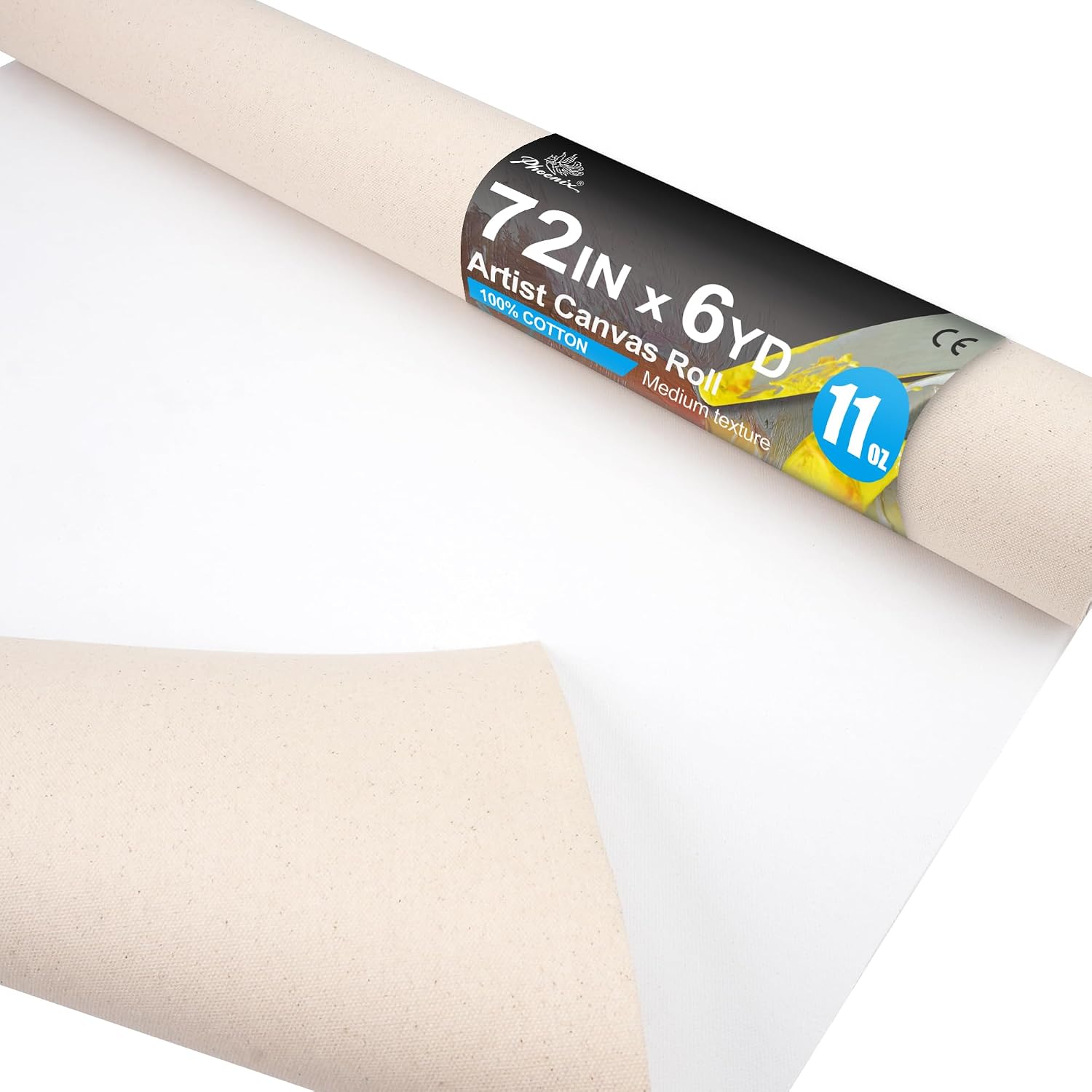
Seventy-two inches of width is where large painting becomes comfortable. After you leave a few inches on each side to wrap around the stretcher bars, you can still build a painting well over five feet tall from this roll without a seam. The listing describes 100% cotton with a heavy-duty 11 oz, triple gesso primed, medium-grain surface that is ready to use straight off the roll.
The 18-foot length is a practical amount for a painter who makes a handful of big canvases a year. It is enough for three or four large pieces, or one very long horizontal work, without committing to the cost and storage of a bulk roll.
Best suited for: oil and acrylic painters making statement pieces, commissions or exhibition work in the four-to-six-foot range.
Key features
- 72-inch width, 18-foot (6-yard) length
- 100% cotton, 11 oz weight
- Triple gesso primed, medium grain
- Suitable for stretching, stapling, tacking or wrapping per the listing
Pros
- Width covers most large studio formats with margin to spare
- Heavy weight helps on big stretcher frames
- Triple priming means no extra gesso before you start
Cons and limitations
- A 72-inch roll is bulky to store and handle alone
- Medium grain may feel coarse for very fine portrait detail
- Higher entry cost than narrower rolls
Buying consideration: measure the largest painting you plan, add wrap margins on both sides, and confirm 72 inches covers it. If it does, this is the most balanced roll in the group.
2. Wholesale Arts and Frames 84″ x 25 Yd 13 oz Primed Canvas Roll — Best for Murals and Bulk Use

This is the heavyweight of the list in every sense: 84 inches wide, 75 feet long and 13 oz cotton duck. The listing says the cotton rolls are triple primed with professional-grade gesso and ready for oil, acrylic, gouache and alkyds. The same seller lists other widths, weights and linen options, so make sure the size you select is the one you want before ordering.
A 75-foot roll only makes sense if you will use it. Mural painters, scenic and backdrop makers, art teachers outfitting a studio, and painters who produce large work steadily will get real value. A hobbyist making one big canvas a year will be storing most of this roll for a long time.
Best suited for: murals on canvas, theater or photo backdrops, art schools and professionals who buy surfaces in bulk.
Key features
- 84-inch width, 25-yard (75-foot) length
- 13 oz cotton duck, primed
- Triple gesso priming on cotton per the listing
- Acid-free, sold for professional use
Pros
- The widest and longest roll in this guide
- Heaviest cotton weight here, good for large tensioned surfaces
- Lowest cost per square foot if you use it all
Cons and limitations
- Large upfront cost and serious storage needs
- Heavy roll is hard to cut accurately without a big table
- Overkill for occasional large paintings
Buying consideration: plan where the roll will live. Canvas stored flat or rolled face out, off the floor and away from damp, stays usable for years; a roll leaning in a damp garage does not.
3. DPDIAN 48 Inch x 20 Feet Primed Cotton Canvas Roll — Best for Series and Multi-Panel Work

Twenty feet of length on a 48-inch roll is a useful ratio for painters who work in sets. Triptychs, a run of matching 36 x 48 canvases, or one long panoramic piece all fit comfortably. The listing describes a high-density cotton blended material with a tight, uniform weave that lays flat after unrolling and needs no pre-treatment.
Note the wording: cotton blend, not 100% cotton. That does not make it unusable, but if archival fiber content matters to you or a client, choose a roll that states pure cotton.
Best suited for: multi-canvas wall sets, series work and painters whose largest dimension stays under about 44 inches after wrapping.
Key features
- 48-inch width, 20-foot length
- Primed, ready-to-stretch surface
- Listed for acrylic, oil, watercolor, tempera and gouache
- Item weight around 5.5 pounds per the listing
Pros
- Generous length for the width and price tier
- Ready to paint after stretching
- Easier to handle than 72-inch and wider rolls
Cons and limitations
- Cotton blend rather than pure cotton
- No fabric weight in ounces stated on the listing
- 48 inches limits the short side of a painting
Buying consideration: if you mostly paint up to four feet and want plenty of fabric for a series, this roll makes sense. For one huge painting, go wider.
4. Kinlop 48 Inch x 10 Feet Double Primed Cotton Canvas Roll — Best Budget Roll

Ten feet of 48-inch canvas is enough for two good-sized paintings or one long horizontal piece. The Kinlop listing describes a mainly cotton roll, double primed and white, that can be cut to shape and stretched on a frame. It also suggests using a light iron to relax the roll after shipping, which is a reminder that rolled canvas can arrive with a curve or creases that need attention.
Double priming is lighter than the triple-primed rolls above. Many painters add one more coat of gesso to a double-primed roll anyway, especially for oil, which raises the real cost slightly but improves the ground.
Best suited for: first-time canvas stretchers, students and anyone testing large formats before committing to a bigger roll.
Key features
- 48-inch width, 10-foot length
- Double primed, white
- Mainly cotton construction
- Cut to any size; stretchable on frames
Pros
- Low cost of entry for large-format work
- Short length means little waste for occasional use
- Manageable to cut on an ordinary table
Cons and limitations
- “Mainly cotton” is less specific than 100% cotton
- Double rather than triple priming
- No fabric weight stated in the listing
Buying consideration: treat this as a practice and learning roll. If your first large stretch goes well and you want to keep going, step up to a heavier, triple-primed roll.
5. U.S. Art Supply 7-Ounce Unprimed Canvas Roll, 63″ x 6′ — Best for Custom Priming

Raw canvas is for painters who want to decide the ground themselves: acrylic gesso, oil ground, clear primer to keep the natural color, or no primer at all for stain painting with thinned acrylic. The listing describes 100% cotton duck at 7 oz, 63 inches wide and 6 feet long, natural color and unprimed.
Seven ounces is a light-to-medium weight. It is fine for pieces up to a few feet and for stain techniques, but on very large frames a heavier canvas usually holds tension better. The 63-inch width is still useful for a five-foot painting.
Best suited for: stain painters, painters who prefer a specific gesso or oil ground, and anyone wanting a natural, unprimed look.
Key features
- 63-inch width, 6-foot length (2 yards)
- 100% cotton duck, 7 oz
- Unprimed, natural color
- Prime as desired or use raw
Pros
- Full control over the painting ground
- Wide enough for five-foot work
- Low cost for the width
Cons and limitations
- Must be sized and primed before oil painting
- Lighter weight than the primed rolls here
- Only 6 feet long, so one large piece per roll
Buying consideration: budget the time and materials for priming. Raw canvas shrinks and tightens as it takes water-based gesso, which is a feature if you plan for it and a nuisance if you do not.
6. CabWork 34 in x 16 ft 10 oz Triple Gesso Primed Canvas Roll — Best for Narrow and Panoramic Formats

At 34 inches wide, this is not a roll for tall paintings. Its strength is length and weight: 16 feet of 10 oz cotton, triple gesso primed, at a modest price tier. That combination suits long horizontal compositions, banner-style pieces, and steady practice on medium-large canvases.
The listing positions it for oil, acrylic and mixed media, and mentions cutting it for canvas boards as well as stretching. Mounting cut pieces on rigid boards is a good use of a narrow roll.
Best suited for: panoramic landscapes, long narrow formats and painters who want a heavy primed canvas for medium-large work without a big outlay.
Key features
- 34-inch width, 16-foot length
- 10 oz cotton
- Triple gesso primed
- For oil, acrylic and mixed media
Pros
- Heavy weight and triple priming at an approachable tier
- Long enough for very wide horizontal pieces
- Easy to handle and cut
Cons and limitations
- Narrow width caps the short side at around 30 inches after wrapping
- Not suitable for tall large-format work
Buying consideration: pick this when your large project is long rather than tall.
Buying Guide: How to Choose a Canvas Roll for Large Projects
Start with the usable width
Subtract the wrap allowance from the roll width before you compare. On standard 3/4-inch stretcher bars you need roughly two inches per side to grip and staple; on deep 1.5-inch gallery bars, closer to three inches or more. A 48-inch roll therefore gives you a painting of about 42 to 44 inches on its short side. Wider rolls give more freedom.
Choose weight for the frame size
Canvas weight is usually given in ounces per square yard. Lighter cotton (around 7 oz) is fine for small to medium paintings and stain work. For large stretched pieces, 10 to 13 oz cotton is common because it holds tension better and resists the drum-skin flex that develops in big, light canvases.
Primed, double primed, triple primed or raw
Triple-primed rolls are ready for most acrylic and oil painting. Double-primed rolls work but often benefit from one more coat. Raw canvas needs sizing and priming before oil, since oil paint in direct contact with cotton fiber degrades it over time; acrylic gesso or a proper size and ground solves that.
Cotton, cotton blend or linen
Pure cotton duck is the standard choice for large work because it is affordable and stretches evenly. Blends can be fine but say less about long-term behavior. Linen is stiffer, more stable and more expensive; most large-format painters on a budget stay with heavy cotton.
Grain and texture
Medium grain suits most painterly work. Very fine detail and portraiture benefit from smoother surfaces, which you can create by adding and sanding extra gesso layers on any primed roll.
Length versus actual plans
List the paintings you intend to make this year and add up the areas, including wrap margins and a little waste for squaring the cut. Buy the roll that covers that total. Bulk rolls save money only when they get used.
Stretcher bars and tools
Big canvases need sturdy stretcher bars, cross braces past about 36 inches on a side, canvas pliers and a staple gun. These add real cost, so include them when you compare a roll against buying a pre-stretched large canvas.
Plan the Painting Before You Cut
Large formats magnify layout mistakes. Our guide on gridding a canvas to transfer a design accurately is worth reading before you sketch a six-foot composition. If you are splitting a roll into a matching set, see how to paint a multi-canvas wall art set, and keep our tips for repairing a ripped canvas handy, because large stretched surfaces are easier to puncture during moving and hanging.
Common Mistakes to Avoid
- Buying by roll width without subtracting the stretching margin.
- Choosing light canvas for a very large frame and fighting sagging later.
- Painting oil directly onto raw, unprimed cotton.
- Cutting off the grain. Square your first cut to the weave so the canvas stretches evenly.
- Stretching one side completely before the others. Work from the center of each side outward, alternating opposite sides.
- Skipping cross braces on big frames, which lets bars bow inward as the canvas tightens.
- Storing a roll with the primed face crushed inward for long periods, which can crack thick priming.
FAQs
What width canvas roll do I need for a 60-inch painting?
Add your wrap allowance to both sides. For a 60-inch short side on standard bars, you need roughly 64 inches or more, so a 72-inch roll is the comfortable choice. A 63-inch roll is too tight for most stretching methods at that size.
Is primed or unprimed canvas better for large paintings?
Primed canvas saves time and is ready for acrylic and oil. Unprimed canvas gives you control over the ground and suits stain techniques, but it adds priming work, which is significant on large pieces.
What canvas weight is best for large stretched paintings?
Many painters choose 10 to 13 oz cotton for large frames because it holds tension and resists sagging better than lighter fabric. Lighter canvas is fine for smaller work.
Is a canvas roll cheaper than pre-stretched canvas?
Per square foot, usually yes, especially at large sizes. Once you add stretcher bars, braces and tools, the gap narrows, but custom sizes and big formats still tend to favor rolls.
Can I use a canvas roll without stretching it?
Yes. Many painters tape or staple canvas to a wall or board, paint, and stretch or mount it later. This is also a common way to make murals and backdrops.
How do I remove the curl from a rolled canvas?
Unroll it face up, weight the corners and let it relax for a day. Some listings suggest a light iron on the back; test on an offcut first, because heat can affect priming.
Final Recommendation
For a single large painting or a few big pieces a year, the PHOENIX 72-inch roll offers the best mix of width, weight and ready-to-paint priming. If you paint murals or work at scale constantly, the Wholesale Arts and Frames 84-inch bulk roll is the efficient professional option, provided you have room to store it.
Painters working in series up to four feet should look at the DPDIAN 48-inch roll for its length, while beginners testing large formats will waste the least with the Kinlop 10-foot roll. Choose the U.S. Art Supply raw canvas if you want to control the ground yourself, and the CabWork roll when your project is long and narrow. Width first, weight second, then priming: get those right and the brand question mostly answers itself.