
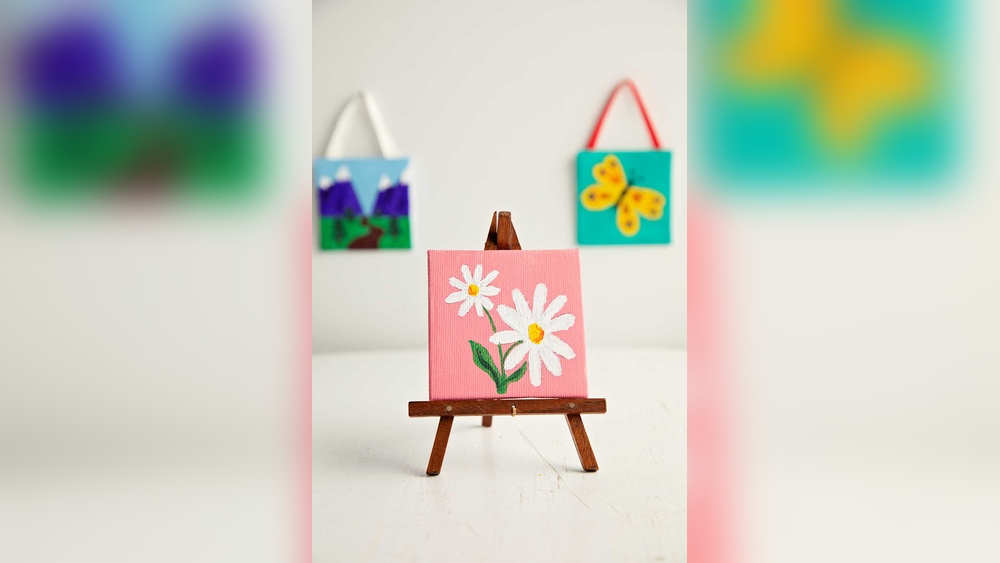
Quick answer: Simple small canvas painting ideas include a single strawberry, a tiny moon phase, a mushroom, a hot air balloon, a heart made of brushstrokes, a mini landscape with one tree, a succulent, a pastel sunset, a pet portrait in silhouette, and a bold abstract color block. On canvases from 2 x 2 to 6 x 6 inches, the best subjects are one clear shape centered or cropped tightly, painted with three to four colors and a small brush.
Small canvases are a quiet superpower for painters. They are cheap, quick to finish, easy to store, and they force you to simplify, which is one of the most valuable skills in painting. A 4 x 4 inch piece can be completed in half an hour and still look charming on a shelf or mini easel.
Painting small has its own rules, though. Brushes feel oversized, details turn into blobs, and compositions that work on a big canvas look cluttered. This guide gives you simple small canvas painting ideas organized by size, plus the techniques, brush choices, and display ideas that help tiny paintings look intentional.
Common Small Canvas Sizes and What They Suit
| Size (inches) | Format | Best subjects | Typical time |
|---|---|---|---|
| 2 x 2 to 3 x 3 | Mini, often with a tiny easel | One icon: a heart, a moon, a single fruit | 10 to 20 minutes |
| 2 x 3 to 3 x 4 | Mini rectangle | Tiny landscapes, simple portraits of pets | 15 to 30 minutes |
| 4 x 4 | Square | Florals, abstracts, food, small animals | 20 to 45 minutes |
| 5 x 7 | Rectangle | Landscapes, seascapes, lettering | 30 to 60 minutes |
| 6 x 6 | Square | Still life, series pieces, gifts | 30 to 60 minutes |
| 8 x 10 | Small standard | Fuller scenes; bridge to larger work | 1 to 2 hours |
Small canvases come as stretched canvas, canvas panels, and boards. Panels are flat and fit in standard frames, while mini stretched canvases stand nicely on small easels. Quality varies a lot at this scale, from flimsy bars to thin priming, so it is worth knowing what to look for. Our guide to canvas for small paintings compares the options.
How Painting Small Is Different
- Fewer elements. One main subject usually beats three. A single strawberry reads clearly; a fruit bowl at 3 x 3 inches turns into confusion.
- Bigger shapes relative to the canvas. Let the subject fill much of the surface, or crop it off the edges for impact.
- Brush size matters. A size 2 or 4 round and a 1/4 inch flat handle most work. Keep a liner or 10/0 detail brush for tiny highlights.
- Value contrast does the heavy lifting. Tiny paintings are viewed quickly, so strong lights and darks help the image read from across a room.
- Edges count. On a small piece the sides are a large share of the object. Paint them a solid color or continue the image around.
Simple Small Canvas Painting Ideas: Mini (2 x 2 to 3 x 4 Inches)
These are meant to be fast, iconic, and charming on a mini easel.
- Strawberry: A red heart shape, small yellow dots for seeds, and a green leafy cap.
- Moon phase: A dark navy square with a single pale crescent or full moon.
- Red mushroom: A rounded red cap with white dots on a short cream stem.
- Heart of brushstrokes: Three or four short, curved strokes in pink and red forming a heart.
- Tiny cactus: One green paddle shape in a terracotta pot.
- Hot air balloon: A striped teardrop with a tiny basket against a pale sky.
- Single star: A gold star on a deep blue background, with a few tiny dots around it.
- Mini pet silhouette: Paint the outline of a cat or dog in black against a bright background.
Mini paintings make sweet party favors, ornaments, and desk decor. Paint several in a batch: lay in all the backgrounds first, let them dry, then add subjects.
Small Canvas Ideas for 4 x 4 and 6 x 6 Squares
Square formats are balanced and work well for centered subjects and patterns.
Florals
- A single daisy viewed from above, petals radiating from a yellow center
- A sprig of lavender against a soft gradient
- A pink peony made of loose, swirling strokes
- A sunflower head cropped so petals run off the edges
Food and kitchen
- Half an avocado with its round pit
- A slice of watermelon
- A cup of coffee viewed from above, with a heart in the foam
- A lemon cut in half on a blue background
Abstract and pattern
- Four color blocks divided by painter’s tape
- Concentric circles in harmonious tones
- A single bold brushstroke across a textured background
- Gold leaf or metallic accents over a dark base
Nature
- A lone tree on a hill with a pastel sky
- A wave curling in Japanese print style
- A monstera leaf on cream
- A bumblebee close-up
Simple Ideas for 5 x 7 and 8 x 10 Canvases
Rectangles suit horizons and scenes, giving a bit more room without losing the speed of small work.
- Beach horizon: Sky, sea, and sand in three bands, with a little white foam.
- Mountain layers: Three ridges, each darker as they come forward.
- Lighthouse: A tall striped tower on a rocky point with a soft sky.
- Window view: A painted window frame looking out on a simple landscape. Our guide on painting small window frames on a canvas explains how to keep the frame lines straight and convincing.
- City at night: Dark building shapes with tiny rectangles of yellow light.
- Short quote: Two or three words in clean lettering over a watercolor-style wash.
- Pond with lily pads: Horizontal blue-greens with flat green ovals and a single pink bloom.
Step by Step: A 4 x 4 Inch Moon Over Pines
This takes about 30 minutes and uses only blue, black, and white.
- Background: Mix ultramarine with a touch of black and paint the whole canvas, including the edges. Lighten the bottom third slightly with white for a gentle glow. Let it dry about 10 minutes.
- Moon: Trace a small coin in the upper third, a little off-center. Fill it with off-white using a small round brush. Two thin coats look smoother than one thick one.
- Glow: While the moon is still wet, soften its edge outward with a dry brush and a hint of light blue.
- Pines: With a size 2 round and black, paint three or four tree silhouettes of different heights along the bottom. Start with a vertical line, then add short downward strokes, wider near the base.
- Stars: Dot a few tiny stars with the tip of a toothpick or a detail brush.
Palettes That Work Well at Small Sizes
Color choices matter more on a tiny canvas because there is no room for a busy mix to settle down. A few combinations reliably look clean and intentional:
- Navy, cream, and gold: Elegant for moons, stars, and botanical silhouettes.
- Terracotta, sage, and off-white: Warm and earthy, popular for cacti, leaves, and abstract shapes.
- Coral, mint, and soft yellow: Fresh and playful for fruit, florals, and summer themes.
- Black, white, and one accent color: High contrast with a single pop, such as a red strawberry or a yellow lemon.
- Analogous blues and violets: Calm and cohesive for night skies, water, and mountains.
Mix each color in a small batch before you start, and keep a little extra of the background tone. Touch-ups on small paintings are common, and a fresh mix rarely matches exactly.
Small Canvas Gift Ideas
Small paintings make thoughtful, personal gifts because they are easy to display anywhere. A few ideas that tend to land well:
- A pet silhouette in the recipient’s favorite color
- The birth flower for someone’s birth month
- A simple painting of a meaningful place, such as a beach, cabin, or city skyline
- Initials surrounded by small leaves or dots
- A set of three minis on a single tiny easel or ledge
Sign and date the back, add a short note, and seal the front with varnish so it survives handling.
Turn Small Paintings Into a Series
Small canvases look especially striking in groups. Try:
- Grid of nine: Nine 4 x 4 inch canvases arranged in a three-by-three square, each with a different flower or color.
- Four seasons: The same tree painted in spring, summer, fall, and winter.
- Color study set: One subject painted in warm, cool, monochrome, and complementary palettes.
- Split image: One landscape painted across several small canvases placed side by side.
- Daily painting habit: A small painting every day for a month. Many painters credit this practice with rapid improvement because it builds finishing skills.
Small Canvas Painting Kits: What to Expect
Kits that bundle mini canvases, a tiny easel, paints, and brushes are a convenient start, especially for kids or parties. The paint in such kits is usually student or craft grade, and brushes may be basic. They are fine for casual fun. If you find yourself painting small regularly, upgrading to better brushes and a few tubes of artist-grade paint makes a noticeable difference in coverage and control.
Displaying Small Canvas Art
- Mini easels: Perfect for 2 x 2 to 5 x 7 inch pieces on desks, shelves, and windowsills.
- Floating shelves: Lean a row of small paintings on a narrow picture ledge and rotate them often.
- Gallery wall clusters: Group small canvases tightly, keeping 1 to 2 inches between them so they read as one piece.
- Shadow boxes: Place a mini canvas inside a deep frame for a museum-like presentation.
- Ornaments and magnets: Glue a ribbon loop or magnet to the back of a mini canvas.
Tips for Better Small Paintings
- Tape the canvas to a larger board or hold it on a stand so your hand does not smudge wet paint.
- Use slightly thicker paint than usual; thin paint shows the canvas weave strongly at small sizes.
- Keep a damp palette, since small amounts of paint dry fast.
- Rest your painting hand on a mahl stick or a clean book for steady details.
- Step back often. Small paintings are judged at a glance, so check the overall read, not just details.
- Finish with varnish to unify the sheen and protect against handling.
Common Mistakes
- Cramming in too many objects
- Using a brush too large for the details, or too small for the background
- Forgetting to paint the sides
- Low contrast, which makes small paintings look muddy from a distance
- Rushing layers before they dry, causing lifting
FAQs
What can I paint on a small canvas?
Choose a single, recognizable subject: a strawberry, a moon, a mushroom, a flower, a cactus, a tiny landscape, or a simple abstract. Fill most of the canvas with that one shape and keep the background simple.
What size is considered a small canvas?
Generally, anything up to about 8 x 10 inches is considered small, with minis ranging from 2 x 2 to 4 x 4 inches. Medium sizes often run from about 11 x 14 to 18 x 24 inches, and anything bigger is considered large.
What brushes are best for painting on a small canvas?
A small round (size 2 to 4), a 1/4 inch flat for backgrounds, and a fine liner or detail brush for highlights cover most needs. Soft synthetic brushes give smoother strokes on tiny surfaces.
Are small canvases good for beginners?
Yes. They are affordable, quick to finish, and teach you to simplify. Finishing many small paintings builds confidence and skill faster than struggling with one large piece.
Should I use canvas panels or stretched canvas for small paintings?
Both work. Panels are thinner, fit standard frames, and are easier to store. Mini stretched canvases look finished on a small easel without a frame. Choose based on how you want to display the piece.
How do I keep details sharp on a 4×4 canvas?
Let underlayers dry completely, use slightly thicker paint for details, and work with a fine liner or detail brush. Steady your hand by resting it on a support, and add the smallest details last.
Final Thoughts
Small canvas paintings reward simplicity: one subject, a few colors, strong contrast, and finished edges. Paint them in batches, group them into series, and you will improve quickly while building a collection worth displaying. The surface makes a bigger difference at this scale than many expect, so when you stock up, see our picks of the best small canvases and mini panels for budding artists.


One Comment