Quick answer: What is STEAM art? STEAM stands for Science, Technology, Engineering, Arts, and Mathematics. STEAM art is the “A” in that framework: creative projects that are deliberately connected to a science, technology, engineering, or math idea, so children learn a concept by making something. Mixing paint colors to see how pigments combine, painting with pendulums to watch gravity trace patterns, or building a geometric mural from measured shapes are all STEAM art. The point is not to decorate a science lesson; it is to use the creative process itself as the way of understanding.
The acronym STEM has been in schools for two decades. STEAM, with the arts folded in, arrived a little later and has sometimes been misunderstood as “STEM plus a coloring sheet.” Done well, it is something much more interesting: a way of teaching where observing, experimenting, and designing are treated as artistic skills as much as scientific ones, and where a painting can be a record of an experiment.
This explainer defines STEAM art precisely, shows how it differs from ordinary art class and from STEM, breaks down what each letter contributes to an art project, walks through concrete examples at different ages, and gives a simple framework for turning any painting activity into a STEAM one. Parents and teachers looking for materials built around this approach can find them in our guide to the best STEAM paint sets for kids.
Defining STEAM Art
STEAM art is any art-making activity in which a concept from science, technology, engineering, or mathematics is an intended learning outcome, not a coincidence. A child painting a sunset is making art. A child painting a sunset after mixing their own oranges from red and yellow, then recording which ratios produced which shades, is making STEAM art. The painting may look identical. The learning does not.
Three features distinguish it from a general art lesson:
- An explicit concept. Something from the other four letters is named and explored: color theory as light and pigment, symmetry, pattern, measurement, structural strength, chemical reaction, simple machines, or coding logic.
- A process that tests or demonstrates it. The making involves observation, prediction, trial, or iteration. Children find out what happens rather than being shown.
- Reflection. There is a moment, even a brief one, where the child articulates what they noticed. “The blue spread further than the red” or “the tower fell when I made it taller” is the learning becoming conscious.
The arts side is not limited to painting and drawing. Music, dance, theater, sculpture, and design all count. In practice, visual art and especially paint-based activities dominate STEAM programming for young children because paint is cheap, immediate, and inherently scientific: it mixes, flows, dries, resists, and reacts.
STEAM vs STEM vs Art Class
| Traditional art class | STEM activity | STEAM art | |
|---|---|---|---|
| Primary goal | Creative expression, technique, art history | Understanding a scientific or technical concept | Understanding a concept through creative making |
| Outcome | An artwork | A result, model, or solution | An artwork that is also evidence of learning |
| Role of aesthetics | Central | Incidental | Central, and used as a thinking tool |
| Role of experimentation | Present but usually about technique | Central | Central, framed as creative exploration |
| Typical question | “How can I make this look the way I want?” | “Why does this happen?” | “What happens if I try this, and what does the result show me?” |
| Assessment | Quality of expression and skill | Correctness of understanding | Both: the work and what the child can explain about it |
Neither art class nor STEM is lesser. The case for STEAM is that creativity and analysis reinforce each other: children retain concepts they have physically made, and they take more creative risks when the activity has a question at its center rather than a “right” picture to copy.
What Each Letter Brings to an Art Project
Science
Paint is applied chemistry and physics. Pigments absorb and reflect light; binders dry by evaporation or polymerization; water carries pigment by capillary action across wet paper; oil and water refuse to mix. Science-linked art projects include color mixing and color wheels, chromatography with markers and coffee filters, wet-on-wet watercolor diffusion, salt crystals on wet paint, oil-and-water marbling, and baking-soda-and-vinegar “fizzing” paint.
Technology
Technology in STEAM art means tools, from simple to digital. Using a straw to blow paint, a pipette to drop it, a salad spinner to fling it, or a tablet and stylus to paint digitally all count. Older children can program a simple drawing robot or use a stop-motion app to animate paintings. The concept is that tools extend what hands can do, and choosing a tool changes the result.
Engineering
Engineering is design under constraints. Build a paintbrush from found materials and test which fibers hold the most paint. Design a marble run that drops painted marbles onto paper. Construct a cardboard easel that can hold a wet painting without tipping. Make a pendulum from string and a cup with a hole in it and adjust the hole size to control line thickness. Each is a build-test-improve loop with an artwork as the output.
Arts
The arts provide the methods of observation, composition, color, pattern, and expression. They also provide the motivation. Children will repeat a pendulum experiment a dozen times because each painting is different and beautiful, where they might lose interest in the same pendulum swinging over sand. Aesthetic judgment is a skill in its own right: deciding which result is most pleasing and why is a form of analysis.
Mathematics
Symmetry, tessellation, measurement, fractions, geometry, and pattern are visual by nature. Folding paper and painting one half to make a symmetrical print, measuring and mixing paint in ratios (1 part blue to 3 parts white), painting a tessellated tile pattern, drawing with a compass, or mapping a grid to enlarge a drawing all build math understanding through making.
STEAM Art Examples by Age
Ages 2 to 4
- Primary color mixing in bags. Two primary colors in a sealed zip bag, squished together, shows the secondary color appearing with no mess. Concept: combining.
- Ice cube painting. Frozen colored water cubes melt as they are dragged across paper. Concept: states of matter.
- Texture rubbings. Crayon over leaves, coins, and bark. Concept: surfaces and observation.
Ages 5 to 7
- Coffee filter chromatography. Marker dots on a filter, dipped in water, separate into their component dyes. Concept: mixtures can be separated.
- Symmetry prints. Paint one half of a folded sheet, press closed, open. Concept: reflection symmetry.
- Salt on wet watercolor. Salt sprinkled on wet paint pulls water and pigment toward each crystal, leaving star shapes. Concept: absorption.
- Straw-blown paint. Drops of thinned paint pushed across paper with breath. Concept: air pressure and force.
Ages 8 to 11
- Pendulum painting. A cup with a hole, filled with thin paint, swinging from a tripod over paper. Concept: gravity, period, and how changing string length changes the pattern.
- Color wheel with measured ratios. Mixing tertiary colors in recorded proportions. Concept: ratios and fractions.
- Oil-and-water marbling. Oil-based color floated on water, transferred to paper. Concept: density and immiscible liquids.
- Tessellation design. Cut a shape from an index card, trace it in a repeating grid, paint. Concept: geometry and pattern.
- Homemade paintbrush challenge. Build brushes from yarn, sponge, feathers, and twigs, then compare which holds the most paint and which makes the finest line. Concept: material properties and testing.
Ages 12 and up
- Digital painting with layers and blend modes. Exploring how a screen mixes light (additive) versus how paint mixes (subtractive). Concept: light versus pigment.
- Grid enlargement. Scaling a small drawing to a large mural using proportional grids. Concept: ratio and scale.
- Painted circuits. Conductive paint joining a battery to an LED within an artwork. Concept: closed circuits.
- Fibonacci and spiral compositions. Constructing a golden spiral and painting within it. Concept: sequences in nature.
Many more projects organized by concept are collected in our list of STEAM art activity ideas for kids.
How to Turn Any Painting Activity Into STEAM Art
You do not need a special kit or curriculum. A four-step pattern converts almost any art project.
- Name the concept. Before starting, decide what idea the project touches. Painting leaves? Concept: symmetry, or how veins branch, or seasonal color change. Painting a pot? Concept: how glaze and paint bond to a porous surface, or how circumference relates to diameter when planning a band design.
- Add a variable. Give the child one thing to change and compare. More water versus less. Thick brush versus thin. Short string versus long. One variable, so the effect is visible.
- Predict before doing. “What do you think will happen if…?” A guess, even a wrong one, makes the result meaningful.
- Reflect after. One question at the end: “What surprised you?” or “Which one worked best and why?” Write or draw the answer next to the artwork if possible.
This is the same loop scientists and designers use, scaled to a kitchen table. The artwork becomes a lab notebook page that happens to be worth hanging up.
Materials That Support STEAM Art
The right supplies make experimentation visible rather than frustrating.
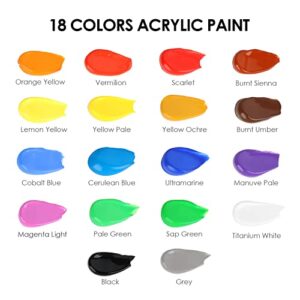
- Primary-color paint sets rather than many premixed colors, so mixing is necessary and the results belong to the child. Washable tempera for young children; student acrylics for older ones who want permanence.
- Clear mixing cups or palettes with wells so proportions can be seen and compared side by side.
- Measuring tools: pipettes, small measuring spoons, syringes without needles, rulers.
- Varied applicators: brushes of several sizes, sponges, droppers, straws, rollers, combs, and found objects.
- Papers of different absorbency: watercolor paper, copy paper, coffee filters, cardstock. Comparing how one paint behaves on each is itself a lesson.
- Reactive extras: salt, baking soda, vinegar, dish soap, oil, rubbing alcohol (with supervision), and glue.
- A place to record: sticky notes, a notebook, or a phone camera to capture stages.
Pre-assembled sets built around these principles save the hunt for components; our roundup of STEAM-focused paint kits for young artists compares what each includes and which ages they suit.
Common Misunderstandings About STEAM Art
“It is just art class with a science word attached”
That is the failure mode, not the definition. If the concept is announced but nothing in the activity lets the child test or observe it, it is decoration. The test is whether the child could explain something about how the world works by pointing at their artwork.
“The art has to look scientific”
No. Pendulum paintings look like abstract expressionism. Symmetry prints look like butterflies and monsters. The science is in the process and the reflection, not the subject matter.
“It replaces proper art instruction”
STEAM art and skills-based art instruction (drawing from observation, color theory as craft, art history) complement each other. Children still need to learn to control a brush, and STEAM projects often teach that control as a side effect of experimentation.
“It needs technology”
The T in STEAM is frequently misread as “screens.” A straw is technology. A pendulum is technology. Digital tools are welcome but not required.
“Older kids will find it babyish”
The concepts scale. Younger children explore what happens; older children quantify it, control variables, and connect it to formal ideas such as ratios, light physics, or circuit logic.
What STEAM Art Builds Beyond the Concept
Educators who use this approach point to several outcomes beyond the specific science or math idea in each project.
- Comfort with uncertainty. Experiments do not always work. Children learn that an unexpected result is information, not failure.
- Observation skills. Noticing how paint spreads, how colors shift, how a structure flexes trains attention that transfers to reading, science, and drawing from life.
- Vocabulary. Words like absorb, dissolve, symmetrical, ratio, and prototype enter everyday speech through use.
- Iteration. Making something, judging it, and making it again is the core of both design and art practice.
- Ownership. Children who mixed their own green from blue and yellow care more about the green.
Setting Up a Home STEAM Art Session
A practical format for a 30- to 45-minute session at home:
- Pick one concept and one project from the age lists above.
- Lay out materials on a washable surface with water, rags, and a drying area ready.
- Ask the prediction question and let the child answer before touching anything.
- Let the child run the activity with as little intervention as safety allows. Resist correcting technique unless asked.
- Encourage one deliberate change and a second attempt.
- End with the reflection question and label the finished work with the date and one sentence about what was learned.
Repeat favorites. A pendulum painting on three different days with three string lengths teaches more than three unrelated projects.
FAQs
What does STEAM stand for in art?
Science, Technology, Engineering, Arts, and Mathematics. In STEAM, the arts are treated as an equal partner, and art-making is used as a way to explore the other four disciplines.
What is the difference between STEM and STEAM?
STEM covers science, technology, engineering, and math. STEAM adds the arts, on the principle that creativity, design, and aesthetic judgment are part of how people learn and solve problems in every field.
What is an example of a STEAM art project?
Pendulum painting: a cup of thinned paint swings from a string over paper, and children change the string length or hole size to see how the pattern changes. The painting is abstract art and a record of gravity and motion.
Is STEAM art only for young children?
No. Concepts scale from simple color mixing for toddlers to light-versus-pigment theory, circuit painting, and proportional scaling for teenagers.
Do you need special supplies for STEAM art?
Primary-color paints, mixing cups, varied applicators, and some kitchen extras like salt and oil cover most projects. Kits assembled around these principles are convenient but not essential.
How is STEAM art assessed?
By both the artwork and what the child can explain about it. A good STEAM art project leaves a child able to describe what they changed, what happened, and why they think it happened.
Final Thoughts
STEAM art is a way of making where the question “what happens if?” matters as much as “how does it look?” Name a concept, give the child one variable to change, ask for a prediction, and finish with a reflection. The result is a painting that doubles as proof of understanding. If you want materials chosen with that loop in mind, the primary-color sets, mixing tools, and reactive extras in our guide to the top STEAM paint sets for children are a ready starting point.