PaintingProGuide is reader-supported. When you buy through links on this page we may earn an affiliate commission at no extra cost to you.
Painting is one of the few activities where a child can learn science, math, history and language without noticing that a lesson is happening. Mixing yellow and blue is a chemistry demonstration. Folding a wet butterfly print is a symmetry lesson. Copying a cave painting is a history class. The trick to fun and educational painting projects for kids is to keep the fun in front and let the learning ride along quietly.
Below are projects organized by the school subject they reinforce, each with an age range, materials and the concept it teaches. After that, we review six books and kits on Amazon that give parents and teachers a ready supply of projects, from Art Lab for Kids to a squeegee painting kit that teaches pattern and motion.
Quick answer: For a full year of projects in one book, Paint Lab for Kids and Art Lab for Kids each offer 52 creative adventures, one for every week. For a hands-on kit that kids ages 5 and up can run themselves, the Educational Insights Squeegee Art Kit teaches pattern and color layering with almost no setup.
Science Through Painting
Color mixing lab (ages 3 to 8)
Give children only red, yellow and blue, plus white. Ask them to predict what will happen when two colors meet, then test it. Older kids can make a color wheel and record “recipes.” The concept: primary and secondary colors, and how mixing works.
Salt and watercolor (ages 4 to 10)
Paint a wet watercolor wash and sprinkle table salt on it. As it dries, the salt pulls pigment and water toward it, leaving starburst patterns. Kids learn about absorption in a way they will remember. Shake the salt off once fully dry.
Walking color (ages 5 to 10)
Paint thick lines of washable watercolor on a paper towel strip, dip one end in water and watch the color climb. This shows capillary action, the same process that moves water up a plant stem.
Shadow tracing and painting (ages 5 to 9)
Set a toy animal in the sun, trace its shadow onto paper in the morning and again in the afternoon, then paint both shapes. The shift in shadow length becomes a lesson on the movement of the sun.
Math Through Painting
Symmetry butterflies (ages 3 to 7)
Fold paper in half, paint blobs on one side, fold and press. The mirrored print introduces symmetry. Ask children to find the line of symmetry and add matching details on both sides.
Mondrian grids (ages 6 to 12)
With tape and a ruler, create a grid of rectangles, then fill some with red, yellow and blue. Kids practice measuring, recognizing rectangles and squares, and planning area. Remove the tape for crisp black-white lines, or paint the lines in black afterward.
Pattern stripes (ages 4 to 8)
Paint repeating stripe patterns such as ABAB or ABCABC. Younger kids learn sequencing; older kids can design their own pattern rule for a friend to continue.
Shape monsters (ages 4 to 7)
Start with a painted circle, triangle or square, then turn it into a creature. It reinforces shape names while giving complete creative freedom.
Language and Literacy Through Painting
Illustrate a story (ages 4 to 10)
Read a picture book, then ask children to paint a scene that is not in the book: what happened before the story started, or after it ended. It builds comprehension and sequencing.
Alphabet painting (ages 3 to 6)
Paint a giant letter and fill it with things that start with that sound: an “S” covered in painted snakes and suns.
Emotion palettes (ages 5 to 10)
Ask kids which colors feel happy, angry, calm or scared, and paint an abstract picture for each. Then have them describe it in words. This is a gentle way to build emotional vocabulary.
History and Culture Through Painting
Cave painting (ages 5 to 12)
Crumple brown paper bags, flatten them and paint animals in earth tones with fingers and sponges. Talk about how early people painted with natural pigments.
Dot painting (ages 4 to 10)
Using cotton swabs or the end of a brush, build images from dots. Discuss how artists in different cultures and art movements have used dots, from Pointillism to traditional designs, and encourage kids to design their own pattern.
Artist of the month (ages 7 to 12)
Each month, look at one famous painter and try their approach: swirling skies like Van Gogh, cut-paper shapes like Matisse, simple bold flowers like O’Keeffe. Children learn that there are many right ways to paint.
Fine Motor and Life Skills
Painting builds hand strength, grip and coordination. Small brushes encourage the tripod grip used for writing. Cleaning up teaches responsibility: rinse brushes, wipe palettes, put caps back on. Make cleanup part of every project instead of something adults do afterward. For more ideas sorted by age, see our list of easy acrylic painting projects for kids of all ages.
Our Top Picks at a Glance
- Paint Lab for Kids — Best book for a year of weekly painting projects
- Art Lab for Kids — Best for mixed media, printmaking and drawing alongside painting
- Educational Insights Squeegee Art Kit — Best hands-on kit kids can run independently
- Klutz Canvas Painting Studio — Best book-and-kit combo for canvas painting
- Painting with Bob Ross for Kids — Best for step-by-step landscape lessons
- JOYIN 12 Wooden Magnet Painting Kit — Best for the youngest painters
| Product | Best For | Key Spec | Key Strength | Price Tier |
|---|---|---|---|---|
| Paint Lab for Kids | Weekly projects | 52 painting and mixed-media adventures | A year of ideas | $$ |
| Art Lab for Kids | Broad art education | 52 adventures across five art forms | Beyond painting | $ |
| Educational Insights Squeegee Art Kit | Ages 5+ | Tray, squeegee, 5 x 2 oz paints, 30 sheets | Independent play | $$ |
| Klutz Canvas Painting Studio | Canvas beginners | Book and activity kit, hardcover | Guided and supplied | $$ |
| Painting with Bob Ross for Kids | Landscape lessons | Licensed simple lessons | Familiar, step-by-step | $ |
| JOYIN 12 Wooden Magnets | Ages 3-8 | 12 wood magnets, palette, brush | Display-ready results | $ |
How We Chose
We reviewed Amazon listings checked in October 2026, prioritizing books and kits that supply many projects or teach a clear skill, suit the age range given in the listing, and are widely reviewed by Amazon buyers. Where a book has no detailed listing beyond its title and format, we describe only what the title and publisher state.
- Number of projects or reuse value.
- Educational angle: color, pattern, technique or art history.
- Age range and independence level.
- Price tier relative to how long it will be used.
Best Books and Kits for Educational Painting Projects Reviewed
1. Paint Lab for Kids — Best for a year of weekly painting projects

Stephanie Corfee’s Paint Lab for Kids promises 52 creative adventures in painting and mixed media for budding artists of all ages. Fifty-two is exactly one per week for a year, which makes planning simple for homeschoolers and teachers.
Its focus is painting specifically, so it is the deepest pure-painting resource in this list.
Best suited for: Homeschool families, art clubs and parents who want a ready weekly plan.
Key features:
- 52 painting and mixed-media projects
- For all ages
- Paperback, part of the Lab for Kids series
Pros:
- Year-long structure
- Reusable for multiple children
- Strong painting focus
Cons and limitations:
- Supplies not included
- Some projects may need materials beyond basic paint
Buying consideration: Read a few projects ahead and buy materials in batches to keep weekly sessions easy.
2. Art Lab for Kids — Best for mixed media, printmaking and drawing alongside painting

Susan Schwake’s Art Lab for Kids, with photographs by Rainer Schwake, covers 52 creative adventures in drawing, painting, printmaking, paper and mixed media. It is volume 1 of the Lab for Kids series.
If your goal is broad art education rather than painting alone, this is the better choice. Printmaking and paper projects reinforce the same color and composition ideas.
Best suited for: Teachers and parents building a general art curriculum.
Key features:
- 52 projects across five art forms
- Photographed projects
- Paperback
Pros:
- Broadest curriculum
- Low price tier
- Works with mixed ages
Cons and limitations:
- Less painting depth than Paint Lab
- Supplies not included
Buying consideration: Pair with Paint Lab for Kids if painting is your child’s favorite activity.
3. Educational Insights Squeegee Art Kit — Best for a hands-on kit kids can run independently

Educational Insights includes a non-slip tray, a squeegee tool, five 2 oz paint bottles, a guide and 30 sheets of paper with guided templates and blanks. Kids add paint, then scrape downward to reveal a design. The listing gives ages 5 and up.
It teaches color layering and pattern in a satisfying, repeatable way, and the paint gutter in the tray contains splatter. The listing says it works with paper and paint from craft stores, so it can be refilled.
Best suited for: Kids 5 and up who like quick, surprising results.
Key features:
- Non-slip tray with paint gutter
- Squeegee tool
- 5 x 2 oz paints, 30 sheets
Pros:
- Independent play
- Refillable with standard supplies
- Contained mess
Cons and limitations:
- Single technique
- Mid price tier
Buying consideration: Use it to teach how colors interact when dragged across each other, then try the same idea with a piece of cardboard on a large sheet.
4. Klutz Canvas Painting Studio — Best for a book-and-kit combo for canvas painting

Klutz’s Canvas Painting Studio is a hardcover book and activity kit, so instructions and supplies arrive together. Klutz is known for kits aimed at independent kids, which suits children who want to follow directions on their own.
Check the listing photos for exactly what supplies are included, as kit contents can change between editions.
Best suited for: Kids roughly 8 and up who want to paint on canvas with guidance.
Key features:
- Book and kit combined
- Hardcover
- Canvas painting focus
Pros:
- Everything to start in one package
- Good gift
- Encourages independence
Cons and limitations:
- Limited supplies compared with a full paint set
- One-time materials
Buying consideration: When the included supplies run out, the book remains useful with your own acrylics and canvas panels.
5. Painting with Bob Ross for Kids — Best for step-by-step landscape lessons
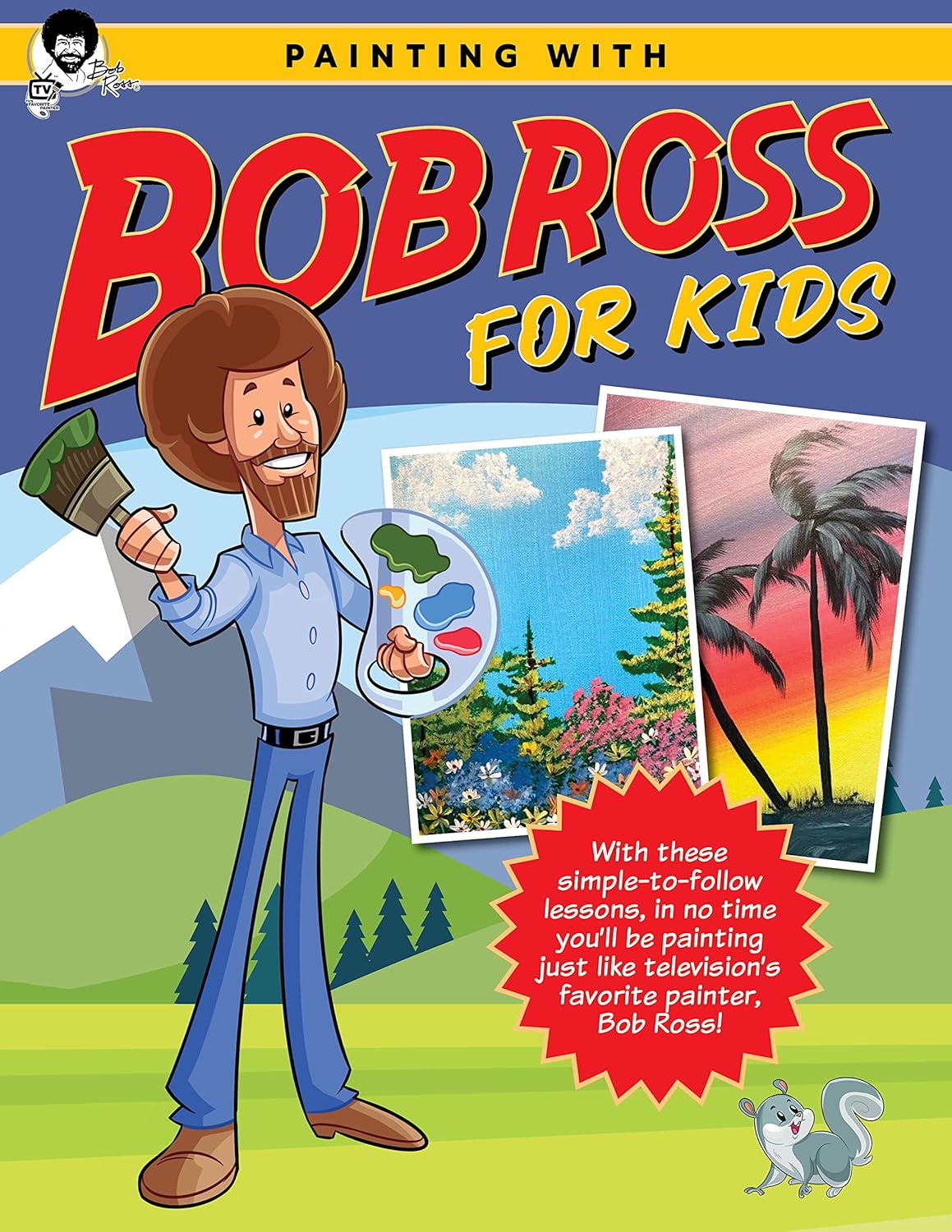
This licensed book from Bob Ross Inc promises simple-to-follow lessons so kids can paint in the style of the famous television painter. Landscapes are an excellent educational subject: they teach layering from back to front, atmospheric distance and color temperature.
Many parents grew up watching Bob Ross, which makes it a natural shared project.
Best suited for: Kids who like following steps and want a recognizable result.
Key features:
- Licensed Bob Ross lessons
- Simple, sequential steps
- Paperback
Pros:
- Teaches layering and depth
- Low price tier
- Fun to do as a family
Cons and limitations:
- Narrow focus on landscapes
- Materials not included
Buying consideration: Use acrylic rather than oil for kids, and simplify to five or six colors.
6. JOYIN 12 Wooden Magnet Painting Kit — Best for the youngest painters

JOYIN includes 12 wooden magnets, a paint palette, a brush and glitter glue with an instruction sheet, for ages 3 and up. The listing describes the materials as non-toxic, BPA-free and lead-free, meeting US toy standards.
Small, finished magnets are a great first lesson in completing a project and displaying it.
Best suited for: Preschoolers and early elementary kids.
Key features:
- 12 wooden magnets
- Paint palette and brush
- Glitter glue, instructions
Pros:
- Low price tier
- Safety claims in listing
- Instant display value
Cons and limitations:
- Only one brush
- Small surfaces
Buying consideration: Add a second brush so a parent and child can paint together.
Buying Guide: Choosing Educational Painting Resources for Kids
Decide on breadth or depth
Painting-only resources like Paint Lab go deeper; Art Lab spreads across drawing, printmaking and paper.
Check the age range
Kits like JOYIN start at age 3; squeegee and canvas kits suit 5 and up or 8 and up. Books can usually stretch across ages with adult help.
Consider supplies
Books need you to provide materials. Kits include them but run out. Many families combine one book with one good paint set.
Look for project count
A book of 52 projects is a year of material. A single-technique kit is a few weeks of fun.
Think about independence
Kits with trays and guides let kids work alone. Books often need an adult to read and set up.
Match to learning goals
Want color theory? Choose color mixing projects. Want fine motor skills? Choose detailed small surfaces.
A Sample Four-Week Plan
If you want to try this at home without buying a curriculum, here is a simple month that rotates through subjects. Each session runs 30 to 45 minutes.
| Week | Project | Subject | What to talk about |
|---|---|---|---|
| 1 | Color mixing lab and color wheel | Science | Which two colors make green? What happens if you add white? |
| 2 | Symmetry butterflies | Math | Where is the line of symmetry? Are both wings exactly the same? |
| 3 | Illustrate the ending of a favorite book | Literacy | What happened next? Why did you choose those colors? |
| 4 | Cave painting on paper bags | History | What would you paint if you had no brushes? What do the animals tell us? |
In the second month, swap in salt watercolor, Mondrian grids, emotion palettes and dot painting. By month three, let your child choose the subject and explain the concept to you. Teaching it back is the clearest sign the lesson stuck.
Setting Up a Kid-Friendly Painting Station
A permanent or semi-permanent station removes most of the friction that stops families from painting. Choose a wipeable table, keep a plastic tablecloth folded underneath, and store paint, brushes, paper and smocks in one bin. A drying rack, or simply a clear shelf, gives wet paintings somewhere to go. When setup takes two minutes instead of fifteen, painting happens far more often.
More Projects to Try
Once kids are comfortable, move on to subjects with clear steps. Our guide to painting a ladybug introduces circles and symmetry, while painted rock critters brings the lesson outdoors.
Common Mistakes to Avoid
- Turning it into a test. Ask questions; do not quiz. “What do you think will happen?” beats “What is a secondary color?”
- Doing the project for them. Demonstrate on your own paper, not theirs.
- Overplanning. One concept per session is enough.
- Using expensive paper too soon. Experiments need cheap, plentiful surfaces.
- Ignoring the mess plan. Set up cleanup before you start.
- Skipping the conversation. The learning often happens when a child explains their painting.
FAQs
What painting activities are educational for preschoolers?
Color mixing with primary colors, symmetry butterfly prints and shape monsters teach color theory, symmetry and shape recognition while staying playful.
How can painting teach science to kids?
Salt on watercolor shows absorption, walking color shows capillary action, and color mixing demonstrates how pigments combine. Each takes less than an hour.
What books have painting projects for kids?
Paint Lab for Kids and Art Lab for Kids each offer 52 projects. Painting with Bob Ross for Kids focuses on step-by-step landscapes.
What paint is best for educational projects at home?
Washable tempera for younger kids and non-toxic acrylic for older kids. Washable watercolor is ideal for science experiments like salt painting.
How often should kids do painting projects?
Once a week is a sustainable rhythm for families. A 52-project book fits that schedule exactly.
Can painting help with handwriting?
Holding small brushes and making controlled strokes builds the same grip and hand strength used in writing, which is one reason painting is common in early-years classrooms.
Final Recommendation
For parents and teachers who want a ready plan, Paint Lab for Kids is the strongest single book because it gives a full year of painting-focused projects. Choose Art Lab for Kids if you want painting mixed with drawing, printmaking and paper. If your child likes to work alone, the Educational Insights Squeegee Art Kit is the best independent activity here, and the JOYIN magnets are the right first project for preschoolers. Whatever you choose, keep one simple rule: let the child lead, and the learning will follow.