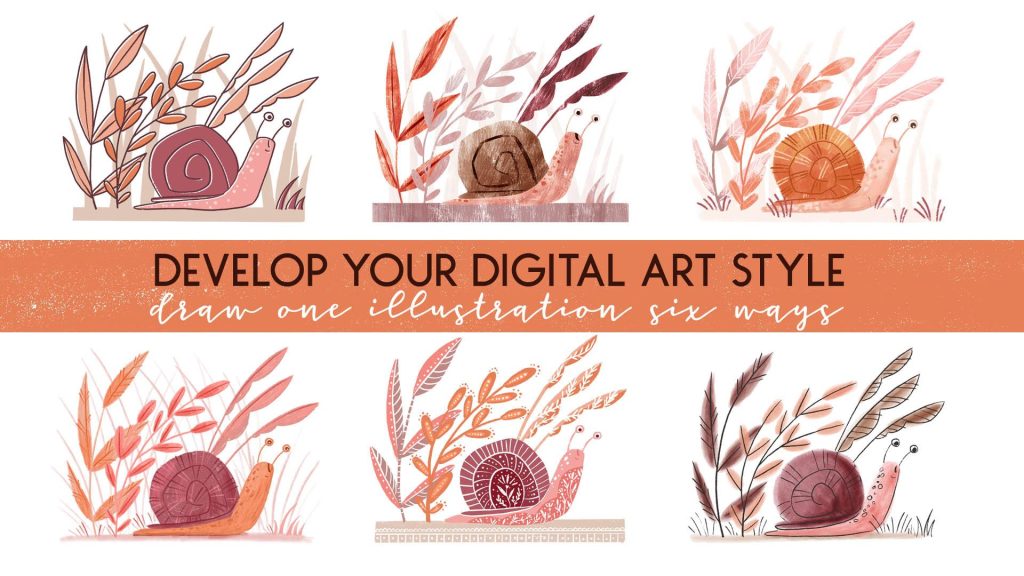
Quick answer: Learning how to develop your style in digital painting comes down to building strong fundamentals, studying many artists rather than copying one, noticing which choices you keep making naturally, and then narrowing those choices on purpose: a consistent palette, a limited brush set, a preferred level of detail, recurring subjects, and a repeatable process. Style is the sum of decisions you make again and again. It emerges from volume of work and reflection, not from a single technique or brush pack.
“Find your style” is some of the most repeated and least helpful advice in art. It makes style sound like something hidden that you either discover or do not. In reality, a painter’s style is a pattern of preferences: the colors they reach for, how much they render, the edges they leave, the subjects they return to. Those preferences can be noticed, encouraged and refined deliberately.
This guide breaks down how to develop your style in digital painting as a practical process. It covers what style actually consists of, exercises to uncover your tendencies, how to borrow from influences without copying, and how to make your choices consistent. Fundamentals come first throughout, and a good book is one of the most efficient ways to build them; our list of recommended digital painting books includes options focused on color, light and composition.
What “Style” Actually Means
When people recognize an artist’s work at a glance, they are responding to a combination of visual decisions. Breaking style into components makes it easier to work on.
| Component | Examples of choices |
|---|---|
| Shape language | Round and soft vs angular and sharp; exaggerated vs realistic proportions |
| Line | Bold outlines, thin lines, broken lines, or no lines at all |
| Color | Saturated vs muted; warm vs cool; limited vs wide palettes |
| Value | High contrast and dramatic vs soft and light |
| Edges | Crisp and graphic vs soft and painterly |
| Rendering level | Flat color, cel shading, semi-realistic, fully rendered |
| Texture and brushwork | Smooth vs visibly textured; tight vs loose strokes |
| Subject and mood | Recurring themes, characters, settings and emotional tone |
| Composition | Centered and iconic vs dynamic and cinematic |
A recognizable style is usually consistent across several of these components. You do not need to define them all at once. Start by noticing where your work already leans.
Why Fundamentals Come Before Style
Many popular styles look simple, but they rest on solid understanding of anatomy, perspective, value and color. Simplification works only when the artist knows what is being simplified. Painters who try to adopt a style before learning fundamentals often find their work looks stiff or inconsistent, because they are imitating surface features without the underlying structure.
The core fundamentals to keep practicing:
- Drawing and construction: building forms from simple shapes.
- Perspective: placing objects convincingly in space.
- Anatomy: for figures and creatures, even stylized ones.
- Value: controlling light and dark for readability.
- Color: harmony, temperature, saturation.
- Composition: arranging elements to guide the eye.
The good news: fundamentals and style develop together. Studies build skill, and the way you approach studies already reveals preferences.
Step 1: Build a Visual Library of Influences
Style grows from influences. The goal is many influences rather than one.
- Collect work you love. Save images from illustrators, painters, films, games, comics, photography and even graphic design into a folder or board.
- Include non-digital art. Traditional painters, printmakers and sculptors can offer ideas digital artists rarely explore.
- Annotate what you like. For each image, write a short note: “the limited orange-teal palette,” “the loose brushwork in the background,” “how faces are simplified.”
- Look for patterns. After 30–50 images, read your notes. Recurring words point to your taste: maybe you keep noting muted colors, strong silhouettes, or textured brushwork.
This exercise often reveals that your taste is more specific than you thought.
Step 2: Do Master Studies, Then Synthesize
Master studies, meaning careful copies of artworks for learning, are a time-tested way to absorb techniques. The key is to study for understanding, not to produce copies to present as your own.
How to study effectively
- Choose one specific aspect to study per piece: palette, edges, brushwork or composition.
- Study small and quickly, around 30–60 minutes each.
- Write down what you learned afterward.
- Study at least three different artists for each aspect.
Synthesize: the “steal like a magpie” approach
Take one element from several sources and combine them in an original piece: one artist’s palette approach, another’s shape language, a third’s level of detail. Combining influences from different sources is one of the most reliable ways to arrive at something that feels like your own.
Always credit influences when sharing studies, and keep studies separate from your original portfolio.
Step 3: Notice Your Natural Tendencies
Your style is already partly there in the choices you make without thinking. Uncover them with a few experiments.
The same subject, ten times
Paint the same simple subject, such as a cup, a tree or a face, ten times quickly, without references, over a few days. Lay them out together. What stays consistent? Perhaps you always simplify the hands, always reach for warm shadows, or always leave the background loose.
Review your past work
Put your last 20 pieces side by side. Mark the ones you like most. What do they share? Often the pieces you enjoy most reflect your authentic preferences.
Paint fast
Speed exercises strip away overthinking and reveal instinctive choices. Timed sessions of 15–30 minutes force you to commit to big decisions. Our guide to digital speed painting explains how to structure these sessions.
Step 4: Make Deliberate Constraints
Once you have a sense of your tendencies, narrow your choices. Constraints are what make a style consistent.
- Limit your palette. Choose a palette approach, such as warm lights and cool shadows, or three dominant hues, and use it for a series.
- Limit your brushes. Choose three to six brushes and use only those for a month. Brushwork consistency is a major part of style.
- Decide on line treatment. Commit to lines, colored lines or lineless for a series. Lineless painting in particular creates a distinctive, painterly look; our guide on lineless digital painting covers how to build images from shapes alone.
- Set a rendering level. Decide how far you will take forms: flat, cel shaded, or fully rendered, and keep it consistent.
- Choose recurring subjects or themes. Subject matter is part of style. Many artists become known for specific themes or moods.
Constraints might feel limiting at first, but they force creative problem-solving within a defined space, which is exactly what sharpens a recognizable look.
Step 5: Work in Series
Single pieces vary too much to show a style. Series build consistency.
- Choose a theme with five to ten pieces: seasons in a city, characters from a story, animals as mythical creatures.
- Define the rules for the series: palette, brushes, canvas size, rendering level.
- Complete all pieces before evaluating.
- Lay them out together and note what feels cohesive and what does not.
- Adjust the rules for the next series.
Step 6: Refine Your Process
Style is also a process. A consistent workflow leads to consistent results.
- Create a template canvas with your preferred size, layers and palette.
- Write down your typical steps: thumbnails, block-in, color, render, finish.
- Save custom palettes and brush sets for each style or series.
- Note techniques that worked well in each piece so you can repeat them.
Common Style Directions in Digital Painting
These are broad directions rather than boxes, but they help frame what you are drawn to.
| Direction | Typical traits | Fundamentals to emphasize |
|---|---|---|
| Painterly realism | Visible brushwork, accurate light, rich color | Value, color temperature, edges |
| Semi-realistic illustration | Stylized proportions, polished rendering | Anatomy, shape design, color harmony |
| Cel-shaded / anime-influenced | Clean lines, hard shadow shapes, bright color | Line quality, simplified light logic |
| Flat graphic | Bold shapes, limited palettes, minimal shading | Composition, shape language, color |
| Textured storybook | Soft palettes, paper textures, gentle shapes | Texture control, color harmony, mood |
| Cinematic concept art | Dramatic lighting, atmosphere, scale | Perspective, value, atmospheric effects |
Dramatic lighting scenarios, such as night scenes, neon, firelight or a single window, are a great test for any direction. How you handle strong light, whether with hard graphic shadows or soft atmospheric glow, quickly becomes a signature in its own right.
A 30-Day Style Development Plan
If you want structure, this four-week plan combines the steps above into a routine that fits around other commitments.
| Week | Focus | Daily practice (30–60 minutes) |
|---|---|---|
| 1 | Influences | Collect and annotate five images; one quick study of a single aspect |
| 2 | Tendencies | Paint the same subject fast each day; review on day 7 |
| 3 | Constraints | Choose a palette and three brushes; paint small pieces using only those |
| 4 | Series | Create a five-piece mini series with your chosen rules; evaluate together |
At the end of the month, write a short “style sheet” for yourself: your palette approach, brushes, line treatment, rendering level and favorite subjects. Treat it as a draft that you will revise after the next series.
Use Feedback Without Losing Your Voice
Feedback speeds growth, but not all of it applies to style. Separate the two kinds:
- Fundamental feedback concerns readability: confusing values, wonky perspective, anatomy errors, muddy color. Take this seriously, because it strengthens any style.
- Taste feedback concerns preference: “I’d make it more colorful,” “I prefer realistic proportions.” Consider it, but you do not have to follow it if it moves you away from what you are aiming for.
Asking specific questions, such as “Does the focal point read?” or “Does the palette feel cohesive across these three pieces?”, produces more useful answers than “What do you think?”
Common Mistakes When Developing a Style
- Copying one artist exclusively. This leads to a derivative look. Study widely and synthesize.
- Forcing a style too early. Locking in a style before fundamentals are solid can limit growth. Allow style to evolve.
- Changing everything every piece. Constant experimentation without consolidation prevents a style from forming. Balance experiments with series.
- Relying on brushes or filters for identity. A brush pack used by thousands of others will not make your work distinctive on its own.
- Chasing trends. Trendy looks change quickly. Build on what genuinely interests you.
- Comparing yourself to others constantly. Their style reflects years of choices. Focus on your own patterns.
How Long Does It Take to Develop a Style?
There is no fixed timeline. Style emerges through volume of work, often over years, and it continues to change. Many established artists’ work looks very different from what they made a decade earlier. A useful mindset: focus on making a lot of work with deliberate reflection, and style will follow.
It also helps to accept that style shifts with your goals. A painter who moves from personal illustration into game concept work, or from portraits into landscapes, will see their style adapt. That is not a loss of identity; the underlying preferences, such as how you see color, simplify shapes or handle edges, usually carry through. Keeping an archive of older work makes this evolution visible and can be encouraging on days when progress feels slow.
FAQs
How do I find my art style in digital painting?
Collect work you love, note what attracts you, do studies of several artists, and review your own work for recurring choices. Then use constraints and series to make those choices consistent.
Is it okay to copy other artists to learn?
Studying artists by copying is a long-standing learning method. Keep studies for practice, credit the original when sharing, and do not present copies as original work.
Should I develop my style before learning fundamentals?
Fundamentals should come first or alongside. Style built on solid drawing, value and color is more flexible and convincing.
Can I have more than one style?
Yes. Many artists work in several styles for different purposes. Consistency within each body of work matters more than having a single style.
Do brushes determine my style?
Brushes contribute to texture and mark-making, but style comes from many decisions, including shape, color, value and subject. A limited brush set helps consistency.
How do I know when I have a style?
When people can recognize your work without seeing your name, or when your own pieces look cohesive side by side, you have a style. It will continue to evolve.
Next Step
Start today with the visual library exercise: collect 30 images you love and annotate why. Then pick one constraint, such as a limited palette or a small brush set, and complete a five-piece series with it.
Pair that practice with focused learning on fundamentals. Our selection of the best digital painting books for beginners can guide your studies in color, light and composition so your style grows on a solid base.