Sunflowers are a gift to anyone learning to paint flowers. The center is a big, bold circle, the petals radiate in a predictable pattern, and the saturated yellow looks cheerful on almost any wall. Even a loose, imperfect sunflower reads instantly, which takes a lot of pressure off a first attempt.
Here is a complete method for how to paint a sunflower for wall art in acrylic, with petal-layering order, mixing recipes for natural yellows, layouts for single blooms and bouquets, and a troubleshooting section for the problems that come up most often.
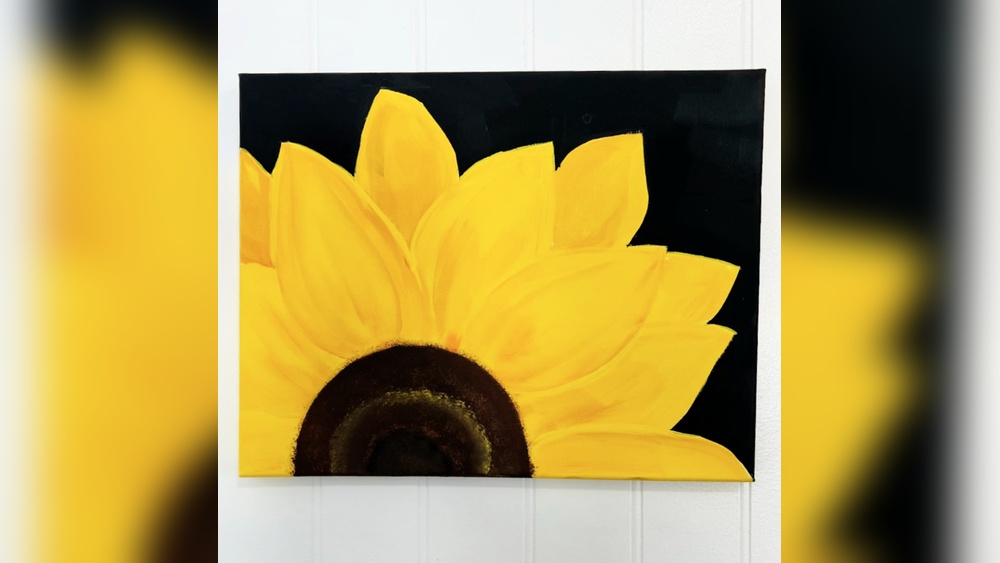
Quick answer: To paint a sunflower for wall art, paint the background, sketch a circle for the center, and paint it dark brown. Add a ring of back petals in a deeper golden yellow, then a front ring of brighter yellow petals that overlap them, each painted with a pointed teardrop stroke. Shade petal bases with orange, highlight the tips with pale yellow, and texture the center with dots of brown, orange, and gold. Add a green stem and broad leaves to finish.
Understanding Sunflower Structure
Before painting, it helps to know what you are looking at. A sunflower head is actually made of hundreds of tiny florets packed into a spiral pattern in the center, surrounded by the larger yellow ray petals. Painters do not need to reproduce the spiral exactly, but suggesting it with curved rows of dots makes a center look more convincing than a flat brown disk.
The petals grow in overlapping layers, usually two or more rings. Back petals peek out between front petals and sit partly in shadow. When the flower faces you, petals radiate evenly. When it turns sideways, the center becomes an oval and the petals on the far side shrink and overlap more. Choosing the angle is one of your first design decisions.
Materials for a Sunflower Canvas
- Canvas: Primed, 12 x 12 or 16 x 20 inches. Square canvases suit a single front-facing bloom.
- Acrylic colors: Cadmium yellow medium (or hue), lemon yellow, yellow ochre, cadmium orange, burnt sienna, burnt umber, sap green or another green, ultramarine blue, and titanium white.
- Brushes: 1-inch flat, size 8 filbert for petals, size 4 round, size 0 liner, and an old stiff brush for stippling the center.
- Extras: Pencil, a round object to trace (a cup or lid), palette, water, paper towels, and varnish.
Yellow is the most difficult color to get right with inexpensive paint. Many low-pigment yellows are semi-transparent, so they take three or four coats to cover a dark sketch or background. To find paints with strong, opaque yellows that work well on canvas, look at our comparison of the best paints for wall art.
Choose a Background and Layout
| Background | Look | Tip |
|---|---|---|
| Bright sky blue | Classic summer field | Blue is the near-complement of orange-yellow, which makes petals glow |
| Deep navy or teal | Modern, dramatic | Underpaint petals in white first so yellow stays bright |
| Warm cream | Farmhouse, vintage | Lower contrast; strengthen the center and petal shadows |
| Black | Bold, high contrast | Very striking for kitchens and modern spaces |
| Rustic wood or burlap texture | Country style | Paint directly on a primed wood board |
For layout, a single large bloom placed slightly off center is the simplest. A bloom cropped by the canvas edge feels contemporary and bold. Three sunflowers at different heights and angles make a classic bouquet composition.
How to Paint a Sunflower for Wall Art: Step by Step
- Paint the background. Apply two coats of your background color with the flat brush, letting the first dry for about 30 minutes. A slightly lighter area around where the flower will sit can create a subtle glow.
- Sketch the flower. Trace a cup or lid for the center, about one-third the diameter of the full flower. Lightly sketch petal tips as a larger circle around it to mark how far petals extend. Add the stem line and leaf outlines.
- Underpaint petals in white (if using a dark background). Fill the petal ring roughly with white or a pale yellow. This makes later yellow layers much brighter.
- Paint the back petals. Mix yellow ochre with cadmium yellow and a touch of orange. With the filbert, paint petals starting at the edge of the center and pulling outward, pressing down at the base and lifting to a point at the tip. Space them so they fill the ring, then let them dry for about 10 minutes.
- Paint the front petals. Mix cadmium yellow medium with a little white. Paint a second ring of petals over the first, placing each front petal between two back petals. Vary lengths and let some petals curl or bend slightly.
- Shade the petal bases. Mix cadmium orange with a little burnt sienna. Using the round brush, paint a short stroke at the base of each front petal where it meets the center, then blend outward with a damp brush.
- Highlight petal tips. Mix lemon yellow with white. Add a thin stroke along one edge and the tip of each front petal, on the side facing your light source.
- Paint the center base. Fill the center circle with burnt umber. Make the edge slightly irregular where petals overlap it.
- Texture the center. Using the stiff brush or the round brush tip, stipple burnt sienna in the middle and toward the light side. Add small dots of orange and yellow ochre in curved rows suggesting the spiral pattern. Keep the outer ring of the center darker and add a few bright gold dots near the inner edge where florets catch light.
- Add a center highlight and shadow. Darken one side of the center with umber and a touch of blue. On the opposite side, add a few lighter dots to round the disk.
- Paint the stem and leaves. Mix sap green with yellow ochre for a sturdy stem. Paint leaves as large heart or spade shapes with serrated edges. Add a darker green on one half of each leaf and a light green vein down the middle.
- Final details and varnish. Add a few thin dark lines to separate overlapping petals where needed. Let the painting cure for at least 24 hours, then varnish.
Mixing Natural Sunflower Yellows
Real sunflowers are not one flat yellow. Petals range from lemon at the tips to deep golden orange at the base. Mixing at least three yellows creates that variety:
- Shadow gold: cadmium yellow + yellow ochre + a little orange.
- Mid yellow: cadmium yellow medium straight or with a touch of white.
- Light tip: lemon yellow + white.
- Deep base: orange + burnt sienna.
Avoid darkening yellow with black, which turns it olive green. Use orange, ochre, or sienna instead. For petal shadows that sit in cool light, a tiny touch of purple (the complement of yellow) can mute yellow without greening it, but test it on your palette first.
DIY Sunflower Layout Ideas
| Idea | Canvas | Notes |
|---|---|---|
| Single giant bloom | 24 x 24 in | Let petals run off two edges for a modern crop |
| Sunflower in a mason jar | 16 x 20 in | Farmhouse style; paint glass with transparent blue-gray and white highlights |
| Field at sunset | 18 x 36 in horizontal | Large flowers in front, smaller ones fading into the distance |
| Trio of panels | Three 12 x 12 in | Front-facing, side view, and back view of a sunflower |
| Abstract sunflower | Any | Loose palette-knife petals and textured center |
Painting a Sunflower Field
For a field, paint the sky first, then a distant line of hills or trees in cool, muted color. Dot tiny yellow and green shapes at the horizon to suggest far-off flowers. Increase flower size as you move toward the bottom of the canvas, and paint two or three detailed sunflowers in the foreground. Atmospheric perspective, where distant objects get paler and cooler, makes the field feel deep.
Palette Knife Sunflowers
A palette knife gives thick, sculptural petals that catch light. Load the knife edge with yellow, press its tip near the center, and drag outward to form each petal. Layer back and front petals the same way as with a brush. For the center, dab thick burnt umber and texture it by pressing and lifting the knife flat. Heavy-body acrylic or a modeling paste mixed with paint holds knife marks best. Thick layers need longer to dry, often a day or more before varnishing.
Common Sunflower Painting Mistakes
Petals all the same length and color. Real petals vary. Mix lengths, angles, and the three yellows so the flower feels alive.
Center looks flat. Add shadow on one side, highlights on the other, and textured dots in curved rows.
Yellow looks dull or green. Contamination from green or blue on the brush is a common cause. Use a clean brush and water for yellows.
Petals look stiff. Straight petals look like spokes. Curve some slightly and let a few fold or twist.
Leaves overpower the flower. Keep leaves darker and less detailed so the bloom stays the focal point.
Tips by Skill Level
Beginners: Start with a front-facing flower on a blue background. Use only two petal yellows and a simple dark center with dots.
Intermediate: Paint a three-quarter view where the center becomes an oval. Shorten and overlap the far petals, and lengthen the near petals.
Advanced: Paint a backlit sunflower against a sunset, with light glowing through petal edges. Use warmer, almost orange petals and a thin rim of pale yellow along the edges.
Sunflowers pair naturally with other organic subjects in a gallery grouping. The soft movement in our pampas grass painting tutorial complements a bold sunflower, especially in a neutral boho room.
Painting a Side-View or Drooping Sunflower
Mature sunflowers often hang their heads, and a side-view bloom adds personality to a bouquet. Draw the center as a narrow oval or even a shallow dome, tilted downward. Petals on the near side appear long and fan toward you, while petals on the far side are mostly hidden behind the center, showing only their tips.
From behind, a sunflower shows a green, cup-like back covered in pointed bracts, which are small leaf-like scales. Paint them as overlapping green triangles around a circle, with petal tips peeking out around the rim. Mixing one front view, one side view, and one back view in the same arrangement makes a bouquet look observed from life rather than repeated from a template.
Sealing and Hanging
Once cured, apply two thin coats of varnish. Gloss varnish intensifies yellows and makes the center look rich and deep, while satin offers a balanced look with less glare. Kitchens, breakfast nooks, entryways, and sunrooms are natural homes for sunflower art. Hang so the center of the canvas sits roughly at eye level, about 57 to 60 inches from the floor.
Related Reading
FAQs
What colors do I need to paint a sunflower?
Cadmium yellow, lemon yellow, yellow ochre, orange, burnt sienna, burnt umber, a green, and white cover everything. Add blue for a sky background and a little purple for subtle petal shadows.
How do I paint sunflower petals easily?
Use a filbert brush and a press-and-lift stroke: press near the center, then pull outward while lifting so the petal tapers to a point. Paint a back ring of darker petals first, then front petals in brighter yellow.
How do I paint the center of a sunflower?
Fill the circle with dark brown, then stipple lighter browns, orange, and gold in curved rows. Darken one side and lighten the other so the center looks rounded rather than flat.
Why does my yellow paint look streaky?
Many yellows are naturally transparent. Underpaint petals with white or pale yellow, apply multiple thin coats, or choose a more opaque yellow paint.
What background color makes sunflowers stand out?
Blues, from sky blue to deep navy, contrast strongly with yellow and orange. Black and teal are also very striking. Cream backgrounds look softer but need stronger shading on the flower.
Can I paint sunflowers on wood instead of canvas?
Yes. Sand the wood, seal it with gesso or primer, and follow the same steps. Wood signs with sunflowers are a popular farmhouse decor item.
Final Thoughts
A sunflower is built from three simple parts: a textured dark center, layered petals in several yellows, and sturdy green leaves. Paint the back petals first, overlap them with brighter front petals, and give the center real dimension, and you will have a canvas that brightens any room.
Strong, opaque yellows save you time and coats. Before your next floral piece, browse our picks for acrylic and craft paints that perform well on canvas wall art so your sunflowers stay as vivid as the real thing.