PaintingProGuide is reader-supported. When you buy through links on this page we may earn an affiliate commission at no extra cost to you.
A finished acrylic painting often looks a little uneven. Dark passages dry flatter than light ones, glazes shine while thick white areas look chalky, and dust settles into the texture within weeks. Varnish fixes all of that. A good clear coat evens out the sheen across the whole surface, deepens darks, and puts a protective layer between your paint and the world.
The best varnish for acrylic paintings dries clear and stays clear, does not yellow, stays flexible on canvas, and gives the sheen you actually want, whether that is high gloss, satin or something in between. We compared seven brush-on varnishes, from Liquitex’s archival satin to a liter-size pump bottle for classrooms, and explain how to choose a finish, how much to buy and how to apply it without streaks or bubbles.
Quick answer: For most painters, Liquitex Professional Satin Varnish is the best choice: archival, non-yellowing, flexible and a satin sheen that flatters nearly every painting. For a budget gloss that you can blend with matte, Liquitex BASICS Gloss Varnish is excellent. Varnishing many canvases? The Nicpro 33.8 oz gloss varnish with pump is built for volume.
Our Top Picks at a Glance
- Liquitex Professional Satin Varnish, 8 oz — Best overall varnish for acrylic paintings
- Liquitex BASICS Gloss Varnish, 8.4 oz — Best budget gloss with mixable sheen
- Nicpro Gloss Varnish, 33.8 oz with Pump — Best for classrooms and frequent painters
- GRANOTONE High Gloss Acrylic Varnish, 100 ml — Best for metallic and gold finishes
- MCTRHG Clear Acrylic High Gloss Sealer — Best self-leveling wet look for pours and rocks
- Bluebird Signature Gloss Varnish — Best low-cost non-yellowing gloss
- Nozerix Gloss Acrylic Varnish — Best low-odor option for small studios
| Product | Best For | Key Spec | Key Strength | Price Tier |
|---|---|---|---|---|
| Liquitex Professional Satin | Fine art paintings | 8 oz, satin, archival | Non-yellowing, flexible | $$ |
| Liquitex BASICS Gloss | Budget fine art | 8.4 oz, gloss, mixable with matte | ASTM D4236, ACMI certified | $ |
| Nicpro Gloss 33.8 oz | Volume | 1000 ml with pump and brush | Coverage guidance in listing | $$ |
| GRANOTONE High Gloss | Metallic art | 100 ml, high gloss | UV and yellowing resistance claims | $ |
| MCTRHG High Gloss | Pours, rocks | Brush-on, self-leveling | Wet-look shine | $ |
| Bluebird Gloss | Budget | Gloss, quick drying | Non-yellowing claim | $ |
| Nozerix Gloss | Low odor | High gloss, water-based | Mild formula | $ |
How We Chose
We did not varnish test paintings for this review. The picks are based on Amazon listing details and specifications checked in October 2026, how well each varnish’s sheen, clarity claims, flexibility and volume suit acrylic paintings, and how widely each product is reviewed by Amazon buyers. Claims about non-yellowing and UV protection are the manufacturers’ own.
- Clarity: dries clear without haze; non-yellowing claims.
- Flexibility: stays flexible on canvas to resist cracking.
- Sheen options: gloss, satin, or the ability to mix sheens.
- Application: self-leveling, brush-on ease and drying time.
- Volume: enough for your typical painting size and count.
Should You Varnish Acrylic Paintings?
Acrylic paint dries into a durable film, so varnish is not strictly required. But it is recommended for most finished paintings for three reasons: it protects against dust, grime and handling; it evens out the sheen so the painting reads as one surface; and it can intensify darks and color. We look at the arguments on both sides in should you varnish an acrylic painting or not and explain the protection question in more depth in does acrylic paint need varnish.
Gloss, Satin or Matte?
| Sheen | Look | Best For | Watch Out For |
|---|---|---|---|
| Gloss | Deep, saturated, reflective | Vivid color work, pours, abstracts | Glare under lights and in photos |
| Satin | Soft sheen, rich darks | Most paintings, portraits, landscapes | Slightly less color pop than gloss |
| Matte | Flat, no reflection | Photographing art, modern decor | Can dull darks; may haze if applied thickly |
A Note on Removable Varnish and Isolation Coats
Conservators prefer a removable varnish over an isolation coat, a clear layer of acrylic medium that seals the paint so the varnish can be cleaned off and replaced decades later without disturbing the painting. Most brush-on acrylic varnishes sold to hobbyists, including the Liquitex Professional Satin listed here as non-removable, are permanent. For gifts, decor and most hobby work, a permanent varnish is fine. If you sell paintings and care about long-term conservation, research isolation coats and removable varnishes before your final coat.
Best Varnish for Acrylic Paintings Reviewed
1. Liquitex Professional Satin Varnish, 8 oz (237 ml) — Best for fine art paintings
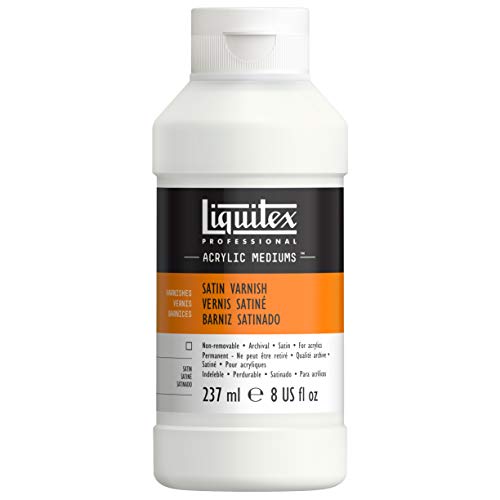
Liquitex is one of the best-known acrylic brands, and its Professional Satin Varnish is a dependable default. The listing describes it as archival and permanent with a satin gloss finish, lightweight and non-toxic, drying to a non-tacky, hard, flexible surface that is non-yellowing and water-resistant when dry. It is non-removable.
Satin is the sheen most painters end up preferring: it evens out flat and shiny patches, deepens darks noticeably, and reduces glare compared with gloss. An 8 oz bottle covers several medium canvases in two thin coats.
Best suited for: Painters finishing landscapes, portraits and still lifes for display or sale.
Key features:
- 8 oz (237 ml)
- Satin finish
- Archival, permanent, non-removable
- Non-yellowing and water-resistant when dry
- Hard, flexible, non-tacky film
Pros:
- Trusted brand
- Flattering satin sheen
- Flexible on canvas
Cons and limitations:
- Not removable for future conservation
- Highest price per ounce here
- Satin may haze if applied too thickly
Buying consideration: Stir rather than shake; shaking adds bubbles that can dry into the surface.
2. Liquitex BASICS Gloss Varnish, 8.4 oz (250 ml) — Best for a budget gloss you can customize

Liquitex BASICS is the brand’s student line, and its gloss varnish is a strong value. The listing describes a permanent gloss varnish that dries clear and non-yellowing, best applied with a large soft brush, and notes that it can be mixed with matte varnish to vary the sheen.
That mixability is useful: combine gloss and matte to make your own satin or semi-gloss. It is ACMI certified, conforms to ASTM D4236 and is labeled safe for educational use, which also makes it a good classroom choice.
Best suited for: Students and hobbyists who want a reliable brand at a low price, and anyone who likes to mix a custom sheen.
Key features:
- 8.4 oz (250 ml)
- Gloss finish
- Can be mixed with matte varnish
- Clear, non-yellowing
- ACMI certified, ASTM D4236
Pros:
- Low price for a known brand
- Custom sheen by mixing
- Classroom-safe labeling
Cons and limitations:
- Gloss alone can glare
- Permanent
- Requires a soft wide brush for best results
Buying consideration: Mix one part matte to two parts gloss for a satin-like finish, and test on a scrap painting first.
3. Nicpro Clear Acrylic Gloss Varnish, 33.8 oz with Pump — Best for classrooms and frequent painters

Nicpro’s liter-size bottle (33.8 oz) comes with a pump and a soft brush. The listing gives unusually specific coverage guidance: one bottle typically covers 18 to 22 8×10 canvases with heavy coats, or up to 35 to 40 with thin layers.
It is described as water-based, non-toxic and odorless, forming a clear, flexible, non-tacky high-gloss surface that protects against dust, UV and yellowing. Each thin coat dries in 1 to 2 hours, and the listing recommends 2 to 3 layers and leaving the piece flat for 24 hours.
Best suited for: Art teachers, workshop leaders and prolific painters who varnish many canvases.
Key features:
- 33.8 oz (1000 ml)
- Pump dispenser and soft brush
- High gloss
- Coverage guidance: 18-40 8×10 canvases
- 1-2 hour dry time per coat
Pros:
- Best volume per purchase
- Clear application guidance
- Pump reduces waste
Cons and limitations:
- Gloss only
- Bottle is large to store
- Listing also targets non-art uses like countertops, which are outside our scope
Buying consideration: Pump a small amount into a dish rather than dipping the brush into the bottle, to keep the varnish clean.
4. GRANOTONE High Gloss Acrylic Varnish, 100 ml — Best for metallic and gold finishes

GRANOTONE’s high-gloss varnish is described as crystal clear and streak free, creating a smooth, mirror-like finish without cloudy haze. The listing says it resists yellowing, fading and UV damage, and specifically mentions helping gold finishes and metallic artwork keep their appearance.
It is an acrylic polymer emulsion, brush-on, and suitable for canvas, wood, clay and resin. The listing advises testing first on porous or unprimed surfaces such as bare foam.
Best suited for: Painters using metallic paints or gold leaf effects who want maximum shine.
Key features:
- 100 ml
- High gloss
- Acrylic polymer emulsion
- Non-yellowing and UV resistance claims
- Canvas, wood, clay, resin
Pros:
- Mirror-like shine
- Suits metallic work
- Low price tier
Cons and limitations:
- Small bottle
- High gloss can glare
- Test needed on porous surfaces
Buying consideration: Varnish metallic paint gently with a soft brush; scrubbing can drag metallic particles.
5. MCTRHG Clear Acrylic Paint Sealer, High Gloss — Best for a wet look on pours and rocks
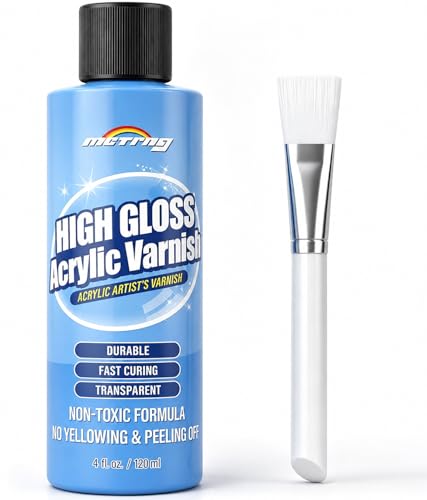
MCTRHG’s sealer is designed for a crystal-clear, wet-look gloss. The listing describes a self-leveling, fast-drying formula that minimizes streaks, bubbles and brush marks, leaving a glass-like finish without sticky residue, and a clear, non-yellowing protective coat.
It is aimed at acrylic paintings, paint pours, painted rocks, textured artwork, wood crafts and decorative clay. The self-leveling quality is especially helpful on fluid art, where brush marks would spoil the smooth surface.
Best suited for: Acrylic pour artists, rock painters and crafters who want a high-shine finish.
Key features:
- High gloss, wet look
- Self-leveling
- Non-yellowing claim
- Brush-on
- Pours, rocks, canvas, wood, clay
Pros:
- Self-leveling reduces brush marks
- Strong shine
- Low price
Cons and limitations:
- Volume not stated in excerpt
- Gloss only
- Lesser-known brand
Buying consideration: Apply thin coats in a dust-free room; self-leveling varnish shows every speck that lands on it.
6. Bluebird Signature Gloss Varnish — Best for a low-cost non-yellowing gloss

Bluebird’s gloss varnish is described as providing a protective layer against dust, moisture and UV damage, enhancing color vibrancy and depth, drying quickly and staying non-yellowing. The product title also lists anti-crazing.
It is suitable for canvas, wood and paper, according to the listing, and sits at the lowest price tier here. It is a reasonable choice for craft projects, practice paintings and gifts.
Best suited for: Hobbyists and crafters who want an inexpensive protective gloss.
Key features:
- Gloss finish
- Quick drying
- Non-yellowing claim
- Anti-crazing in title
- Canvas, wood, paper
Pros:
- Very low cost
- Simple to use
- Broad surface list
Cons and limitations:
- Volume not stated in excerpt
- Gloss only
- Limited technical detail
Buying consideration: Test on a practice painting before using it on important work.
7. Nozerix Gloss Varnish for Acrylic Painting — Best for low-odor small studios

Nozerix describes its varnish as water-based with a low-odor, mild formula suited to extended sessions in a studio. The listing also describes a long-lasting gloss that restores vibrant color, a clear, resilient layer that helps reduce the impact of light exposure, and flexibility that helps reduce cracking or peeling.
It is listed for canvas, wood, ceramic and mixed media. For painters working in a bedroom or shared space, a mild-smelling water-based varnish is a practical advantage over solvent-based options.
Best suited for: Painters varnishing indoors in small rooms or shared spaces.
Key features:
- High gloss
- Water-based, low odor
- Flexibility claim
- Canvas, wood, ceramic, mixed media
Pros:
- Comfortable to use indoors
- Flexible film claim
- Low price
Cons and limitations:
- Gloss only
- Volume not stated in excerpt
- Limited brand track record
Buying consideration: Even with low-odor products, open a window and let the painting dry somewhere dust-free.
Buying Guide: How to Choose Varnish for Acrylic Paintings
Choose the sheen first
Decide how you want the painting to look under typical lighting. Satin is the safest all-round choice; gloss maximizes color; matte suits photography and modern decor.
Look for non-yellowing and flexibility
Water-based acrylic varnishes are generally non-yellowing. On canvas, flexibility prevents cracking as the canvas moves with humidity.
Brush-on vs spray
Brush-on varnish gives thicker protection and is easy to control. Spray varnish gives very even coats and suits textured surfaces but needs ventilation. All products here are brush-on.
Volume
An 8 oz bottle covers several medium canvases. Classrooms and prolific painters save money with liter-size bottles.
Removable or permanent
Permanent varnishes are simpler. Removable varnishes over an isolation coat are better for paintings intended to last generations.
Special finishes
For metallics, pours and rocks, a self-leveling high-gloss varnish gives the cleanest look.
How to Varnish an Acrylic Painting
- Wait for full cure: thin paintings can be varnished after a few days; thick impasto needs longer.
- Clean the surface: remove dust with a soft, dry brush.
- Lay the painting flat: this prevents drips and helps self-leveling.
- Use a wide soft brush: apply thin coats in one direction, overlapping slightly.
- Avoid overworking: do not go back over areas that have started to set.
- Dry dust-free: cover loosely with a box if needed.
- Apply a second coat: brush at 90 degrees to the first for even coverage.
For a full illustrated walkthrough, see our guide on how to varnish an acrylic painting. If you also work in oils, the process is different; read how to varnish an oil painting correctly. And if you want to adjust sheen during painting rather than at the end, see what medium to use with acrylic paint.
Common Mistakes to Avoid
- Varnishing too soon: trapped moisture can cloud the finish.
- Shaking the bottle: it creates bubbles; stir gently instead.
- Applying one thick coat: two thin coats dry clearer and more evenly.
- Varnishing upright: drips and runs form on vertical canvases.
- Using a stiff or dirty brush: it leaves streaks and bristles in the finish.
- Applying matte varnish thickly: matte agents can create a cloudy haze over darks.
FAQs
What is the best varnish for acrylic paintings?
For most paintings, a water-based, non-yellowing satin varnish from an established brand, such as Liquitex Professional Satin, is a safe choice. Gloss and matte versions suit specific looks.
How long should acrylic paint dry before varnishing?
Thin paintings are usually ready after a few days. Thick or textured paintings may need a week or more to cure fully. Varnishing too soon can trap moisture and cause haze.
Is gloss or satin varnish better?
Satin is the most versatile; it deepens color with less glare. Gloss gives maximum color saturation but reflects light. Choose based on how and where the painting will be displayed.
Can I use Mod Podge as a varnish?
Mod Podge is a glue and sealer designed for decoupage. It can protect craft projects but is not designed as an archival varnish for fine art paintings.
How many coats of varnish should I apply?
Two thin coats are usually enough. Some products recommend two to three. Let each coat dry fully before the next.
Does varnish protect against UV fading?
Some varnishes include UV protection claims, which can help. Keeping paintings out of direct sunlight is still the most effective way to prevent fading.
Final Recommendation
Liquitex Professional Satin Varnish is the best all-round choice for finished acrylic paintings. Liquitex BASICS Gloss is the budget pick and lets you mix your own sheen with matte. Teachers and frequent painters will get the most value from Nicpro’s liter pump bottle. Use GRANOTONE for metallic work, MCTRHG for pours and rocks, Bluebird for low-cost crafts and Nozerix when low odor matters most.