PaintingProGuide is reader-supported. When you buy through links on this page we may earn an affiliate commission at no extra cost to you.
Watercolor asks more of a brush than any other paint. The brush has to soak up a large load of water, release it slowly and evenly across the paper, and still spring back to a sharp point for the next stroke. A brush that is too stiff scrubs and lifts the layer underneath; one with too little belly runs dry halfway across a sky. The best brushes for watercolor painting balance water capacity, point and snap, and they come in the shapes that watercolor techniques actually use.
This guide compares six affordable synthetic brush sets sold on Amazon, from soft synthetic squirrel sets with mop-style oval wash and cat’s tongue shapes to a full run of rounds. It also explains the brush anatomy that matters, which shapes to buy first, and when it is worth stepping up to premium brushes.
Quick answer: For most watercolor painters, the Fuumuui 10-piece synthetic squirrel set with wide flat, rounds, dagger and cat’s tongue covers every core technique, from flat washes to fine lines, in soft, water-holding synthetic hair. If you mainly paint with rounds, the FENORKEY 12-piece round set gives every size from 1 to 12 at a budget price. For a first set on the tightest budget, the Sdanart 10-piece set adds a rigger and dagger to a mix of rounds.
Our Top Picks at a Glance
- Fuumuui Professional Watercolor Brushes, 10 pc (Wide Flat, Rounds, Dagger, Cat’s Tongue) — Best overall watercolor brush set
- Fuumuui Watercolor Brushes, 10 pc with Oval Wash — Best for loose washes and expressive strokes
- FENORKEY 12 pc Round Watercolor Brushes — Best budget run of rounds
- Sdanart Watercolor Brushes, 10 pc — Best low-cost mixed-shape starter
- Benicci 12 pc Artist Paint Brush Set — Best for painters who also work in acrylic
- AROIC 10 pc Paint Brush Set — Best for kids and classroom use
| Product | Best For | Key Spec | Key Strength | Price Tier |
|---|---|---|---|---|
| Fuumuui 10 pc (DS46) | All core watercolor techniques | Rounds 2-14, wide flat, dagger, cat’s tongue | Synthetic squirrel, copper ferrules | $$ |
| Fuumuui 10 pc (DR8H) | Washes and loose painting | Pointed rounds, flats, dagger, cat’s tongue, oval wash | High water capacity shapes | $$ |
| FENORKEY 12 Rounds | Round-brush painters | Rounds sizes 1-12 | Every round size | $ |
| Sdanart 10 pc | Budget starter | Rigger, rounds, dagger and more | Variety for little cost | $ |
| Benicci 12 pc | Watercolor plus acrylic | Flat, round, fan, filbert | Durable nylon | $ |
| AROIC 10 pc | Kids, classes | 10 mixed nylon brushes | Very low cost | $ |
How We Chose
We selected these sets based on their Amazon listing details and specifications, checked in October 2026, how well their hair type and shapes fit watercolor technique, and how widely each set is reviewed by Amazon buyers. We have not painted with them; performance notes reflect listing information and well-established watercolor brush principles.
- Hair type: soft synthetic squirrel and soft nylon designed for water media scored higher than stiff all-purpose bristles.
- Shapes: rounds, flats, mops or oval washes, daggers and riggers are the watercolor workhorses.
- Size range: a usable spread from fine detail to large washes.
- Build: ferrules and handles that resist corrosion and loosening with constant water.
- Value: how many genuinely useful brushes the set contains.
We left out a 60-piece all-purpose set from the same product pool. It duplicates shapes from the AROIC 10-piece set and is aimed at general crafting rather than watercolor.
Best Brushes for Watercolor Painting Reviewed
1. Fuumuui Professional Watercolor Brushes, 10 pc — Best for all core watercolor techniques

This Fuumuui set is organized around watercolor technique. It includes a wide flat 4, rounds in sizes 2, 4, 8, 12 and 14, a 3/8 inch dagger, a 3/4 inch cat’s tongue, a 1/2 inch flat and a detail 1. The listing describes soft synthetic squirrel hair with strong color-carrying capacity, copper ferrules and polished birch handles.
A size 14 round is a genuine wash brush that most cheap sets lack, and pairing it with a wide flat means you can lay large, even washes without streaks. The dagger and cat’s tongue are versatile for leaves, petals and varied strokes, and the detail brush handles final accents.
Best suited for: Beginners and intermediate painters who want one set that covers washes, glazes, wet-in-wet, lines and details.
Key features:
- Rounds 2, 4, 8, 12, 14
- Wide flat 4 and 1/2 inch flat
- 3/8 inch dagger and 3/4 inch cat’s tongue
- Detail 1
- Synthetic squirrel hair, copper ferrules
Pros:
- Shapes chosen for watercolor
- Large round for washes
- Soft hair holds water well
Cons and limitations:
- Synthetic squirrel lacks some of the snap of sable
- Short handles suit desk work more than easel work
- Brush sizes are not standardized across brands
Buying consideration: Start with the 8 and 12 rounds for most work. Use the 14 and wide flat for skies and backgrounds, and save the detail brush for the last strokes.
2. Fuumuui Watercolor Brushes Professional, 10 pc with Oval Wash — Best for loose washes
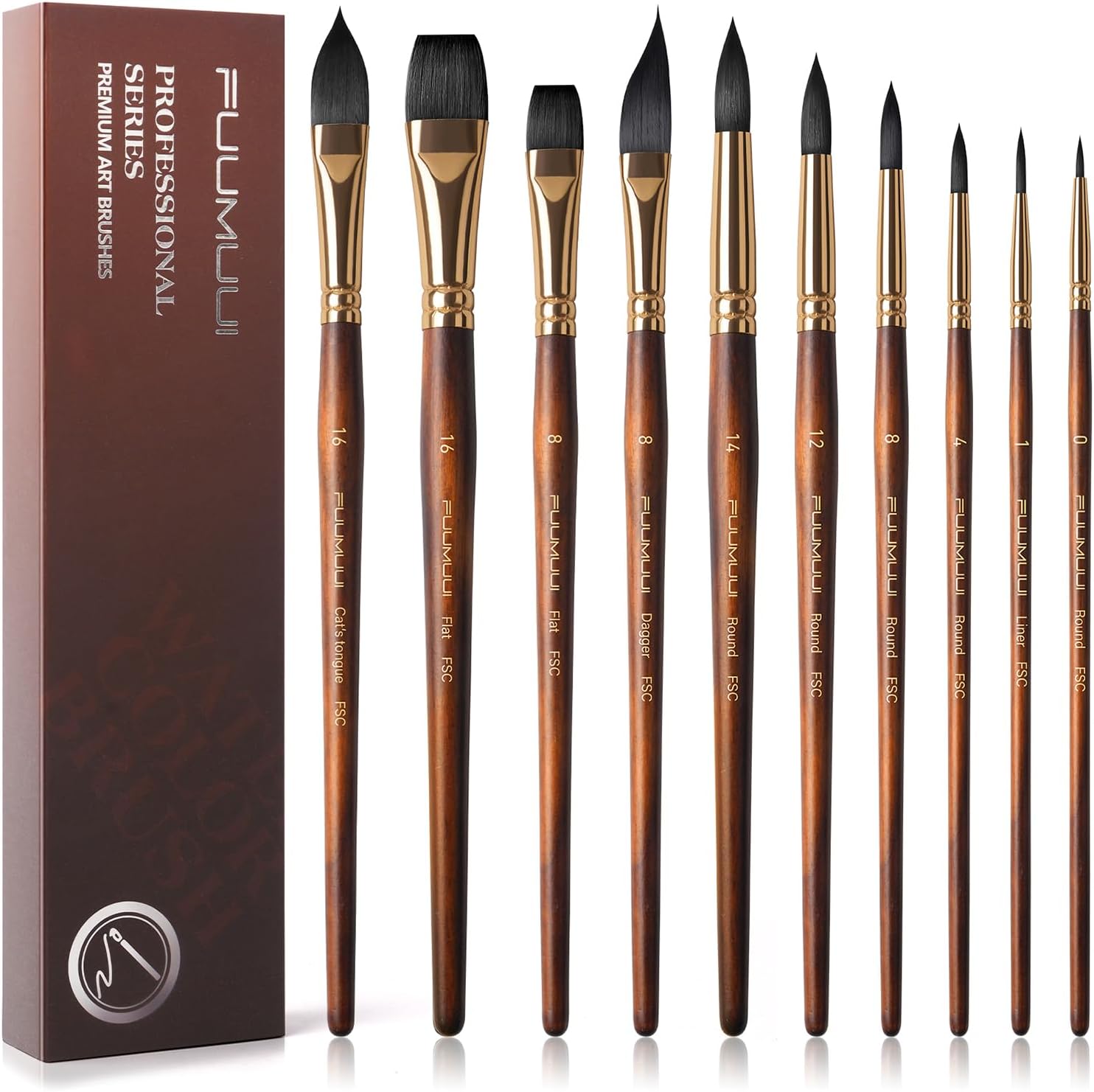
The second Fuumuui set uses the same soft synthetic squirrel hair but leans toward expressive, wash-heavy painting. Shapes include pointed rounds, flats, a dagger, a cat’s tongue and an oval wash. The listing highlights superior control, even color flow from the point and enough carrying capacity for flowing gestural strokes, with aluminum ferrules and birch handles.
The oval wash is the key difference. It behaves like a mop brush, holding a large amount of water for soft, wet-in-wet skies, water and backgrounds.
Best suited for: Loose landscape and floral painters, and anyone who works mostly wet-in-wet.
Key features:
- Pointed rounds, flats, dagger, cat’s tongue, oval wash
- Synthetic squirrel hair
- Aluminum ferrules
- Birch handles
Pros:
- Oval wash for soft skies
- Expressive shape mix
- Good for gouache and ink too
Cons and limitations:
- Fewer small detail sizes
- Size details less clear in listing
- Mop shapes take time to master
Buying consideration: If you prefer tight detail, choose the other Fuumuui set. If you paint loosely, this one is a better fit.
3. FENORKEY 12 pc Round Watercolor Brushes — Best for a budget run of rounds

Many watercolorists paint almost everything with rounds, and this set gives every size from 1 to 12. The listing describes soft, flexible nylon tips with high absorption and pigment-holding capacity, crimped aluminum ferrules treated to prevent shedding, and lacquered wooden handles.
A full run is useful for learning which sizes you prefer. Most painters settle on two or three favorites, and this set lets you find them before investing in premium brushes.
Best suited for: Round-brush painters, students and anyone building a first watercolor kit on a budget.
Key features:
- 12 rounds, sizes 1-12
- Nylon bristles
- Crimped aluminum ferrules
- Lacquered wooden handles
Pros:
- Every round size
- Low cost
- Good for experimenting
Cons and limitations:
- Nylon can be springier and hold less water than squirrel-style hair
- No flats or wash brushes
- Small sizes may lose points sooner
Buying consideration: Add a flat or mop for washes. Rounds alone make large flat washes harder.
4. Sdanart Watercolor Brushes Professional, 10 pc — Best for a mixed-shape starter

Sdanart packs a lot of variety into a very low-cost set, including a rigger #1, fine tip and rounded tips in sizes 2, 10, 12 and 16, a dagger 10 and several other shapes. The listing describes nylon bristles with good pigment holding and lacquered mahogany-color handles.
The rigger is a useful inclusion. Its long, thin hairs hold enough paint for long, continuous lines such as branches, grasses and rigging, which is hard with a standard round.
Best suited for: Beginners who want to try several watercolor shapes before buying better brushes.
Key features:
- Rigger #1
- Rounds including sizes 2, 10, 12, 16
- Dagger 10
- Nylon bristles
Pros:
- Very low cost
- Rigger and dagger included
- Large size 16 round
Cons and limitations:
- Nylon hair is less soft than squirrel-style synthetics
- Build quality is basic
- Listing describes many uses beyond watercolor
Buying consideration: Use this set to learn shapes, then replace your most-used brush with a higher-quality version.
5. Benicci 12 pc Artist Paint Brush Set — Best for watercolor plus acrylic

Benicci’s set is a multi-media set with flat, round, fan and filbert shapes in high-grade nylon. The listing says the bristles keep their shape and do not shed, and the wooden handles are ergonomic.
It is not a dedicated watercolor set, but if you switch between watercolor and acrylic, durable nylon that tolerates both is practical. Keep separate brushes for each medium if you can, since acrylic left in a brush can stiffen it.
Best suited for: Painters who use both watercolor and acrylic and want one durable set.
Key features:
- 12 brushes: flat, round, fan, filbert
- Nylon bristles
- Ergonomic wooden handles
Pros:
- Durable
- Versatile shapes
- Works across mediums
Cons and limitations:
- Less water capacity than squirrel-style hair
- No wash or mop brush
- Not watercolor-specific
Buying consideration: Wash brushes promptly when using acrylic. Dried acrylic ruins watercolor softness.
6. AROIC 10 pc Paint Brush Set — Best for kids and classroom use

This very inexpensive set includes ten nylon brushes in various shapes with anti-rust nickel ferrules and wooden handles. The listing positions it for watercolor, acrylic, oil and crafts for all ages.
For children, classes and casual practice, low cost matters more than perfect points. Brushes that are lost or damaged are easy to replace.
Best suited for: Kids, art classes and casual practice sessions.
Key features:
- 10 nylon brushes
- Nickel ferrules
- Wooden handles
Pros:
- Very affordable
- Good for groups
- Easy to replace
Cons and limitations:
- Basic points
- Not designed for watercolor washes
- Shedding possible with heavy use
Buying consideration: For classrooms, buy several sets and assign one per student to reduce wear and confusion.
Buying Guide: How to Choose Watercolor Brushes
Natural or synthetic hair
Kolinsky sable is known for holding a lot of water while keeping a fine point and good spring. Squirrel holds even more water but is very soft. Modern synthetics, especially synthetic squirrel blends, imitate these properties at much lower cost and are easier to care for.
Belly, point and snap
The belly is the thick middle that holds water. The point is the tip that makes fine lines. Snap is how quickly the brush springs back after a stroke. A good watercolor round has all three.
Essential shapes
Start with a medium round, a large round or mop for washes, and a flat for straight edges. Add a rigger for lines and a dagger or cat’s tongue for varied strokes as you progress.
Sizes
Sizes vary between brands, so compare actual dimensions where listed. A size 8 to 12 round is a common all-purpose choice.
Handle length
Short handles suit painting at a desk with paper flat or slightly tilted. Long handles suit easel work.
Ferrules and build
Corrosion-resistant ferrules that grip the hair firmly reduce shedding and loosening.
When to buy premium
Once you know which sizes you use most, replacing those with premium brushes gives the biggest improvement for the money.
Matching Brush Shapes to Watercolor Techniques
Knowing which shape does which job keeps you from buying ten brushes that all do the same thing. This is how the shapes in the sets above map to common techniques:
| Technique | Best Shape | Why It Works |
|---|---|---|
| Flat and graded washes | Wide flat, large round (12-14) | Carries enough water to cover the area before the edge dries |
| Wet-in-wet skies and water | Oval wash or mop | Huge water load and soft touch that does not disturb the wet paper |
| Glazing | Medium round or flat | Lays a thin, even layer quickly without scrubbing the dry layer below |
| Leaves and petals | Dagger, cat’s tongue, round | Press-and-lift strokes create varied shapes in a single motion |
| Branches, grasses, rigging | Rigger | Long hair holds paint for long, thin, continuous lines |
| Hard edges and architecture | Flat | Straight chisel edge gives clean lines and corners |
| Details and highlights | Small round (0-2), detail brush | Fine point for eyes, textures and final accents |
A practical first kit is therefore three to four brushes: a large round or mop, a medium round, a flat and a small round or rigger. The Fuumuui sets cover all of these; the FENORKEY rounds cover the round sizes but need a flat or mop added.
One more tip: try a new brush on scrap paper before using it on a painting. Load it fully, drag a long stroke, and watch how long it lasts before running dry and whether the point comes back when you lift. That simple test tells you more about a brush than its size number.
When to Step Up to a Premium Brush
Synthetic sets are a smart way to learn. When you know which round you reach for most, consider one high-quality brush in that size. Our hands-off reviews of established names can help you compare: see the Grumbacher watercolor brush review, the Escoda watercolor brush review and the Da Vinci watercolor brush review.
Whatever you buy, care decides how long it lasts. Our guide on how to care for watercolor brushes covers rinsing, reshaping and storage, and how to keep paint brushes from shedding explains what loosens hairs.
Common Mistakes to Avoid
- Buying only small brushes. Large washes need large brushes.
- Leaving brushes standing in water. It bends tips and loosens ferrules.
- Scrubbing with soft hair. It damages points and lifts paint underneath.
- Using watercolor brushes for acrylic. Dried acrylic stiffens hair.
- Drying brushes upright when wet. Water runs into the ferrule.
- Comparing sizes across brands blindly. A size 8 in one brand may be larger than another.
FAQs
What brushes do I need for watercolor painting?
A medium round, a large round or mop for washes, and a flat cover most techniques. A rigger and small round help with lines and details.
Are synthetic brushes good for watercolor?
Yes. Modern synthetics, including synthetic squirrel, hold water well and keep good points at a much lower cost than natural hair.
What size watercolor brush is most useful?
A size 8 to 12 round is a common all-purpose choice, but sizes vary by brand.
What is a mop brush used for in watercolor?
Mop and oval wash brushes hold a large amount of water for soft washes and wet-in-wet areas such as skies and backgrounds.
Can I use acrylic brushes for watercolor?
You can, but stiffer acrylic brushes hold less water. Soft synthetic watercolor brushes work better for washes.
How do I clean watercolor brushes?
Rinse in clean water, gently reshape the tip, and dry flat or tip-down. Avoid harsh soaps and do not leave brushes standing in water.
Final Recommendation
For most painters, the Fuumuui 10-piece set with wide flat, rounds, dagger and cat’s tongue is the best balance of shapes, water capacity and price. Choose the Fuumuui oval wash set if you paint loosely, FENORKEY for a full run of rounds, Sdanart for a very low-cost mixed set, Benicci if you split time with acrylic, and AROIC for kids and classes.