PaintingProGuide is reader-supported. When you buy through links on this page we may earn an affiliate commission at no extra cost to you.
Mabef is an Italian easel maker known for oiled beech wood studio easels, and its name comes up whenever painters talk about a first “proper” easel. Mabef makes many models, but the Mabef studio easel we could verify on Amazon.com in October 2026 is the M/11, a lyre-style floor easel with a ratchet canvas holder and a central tilting mast. This review looks closely at what that listing specifies, which painters it suits, and where an H-frame might serve you better.
We also compare two heavy H-frame studio easels from MEEDEN and U.S. Art Supply, because the most common question about the M/11 is not “is it good?” but “is a lyre easel the right type for my work?”
Quick answer: The Mabef M/11 Wooden Lyre Easel is a strong choice for painters working on small to medium-large canvases in a home studio who want a classic beech easel with a tilting mast and a modest footprint. If you paint very tall canvases, the MEEDEN Versatile Studio H-Frame Easel holds work up to 77 inches and rolls on wheels. If you want one easel that tilts from vertical to fully flat for watercolor and pouring as well as oils, the U.S. Art Supply Heavy Duty H-Frame is the more versatile option.
Our Top Picks at a Glance
- Mabef M/11 Wooden Lyre Easel — Best Mabef studio easel for home studios and medium canvases
- MEEDEN Versatile Studio H-Frame Easel — Best alternative for very tall canvases
- U.S. Art Supply Heavy Duty Extra Large H-Frame Easel — Best alternative for multi-media painters who need a flat position
| Product | Best For | Key Spec | Key Strength | Price Tier |
|---|---|---|---|---|
| Mabef M/11 Lyre Easel | Home studio, medium canvases | Beech; holds up to 22 lb (10 kg) | Ratchet holder, tilting mast | $$$ |
| MEEDEN H-Frame Studio Easel | Very tall canvases | Beech; canvas up to 77 in; 59 to 95 in tall | Front wheels, broad stance | $$$ |
| U.S. Art Supply Heavy Duty H-Frame | Oils plus watercolor and pouring | Beech; vertical to flat; tray 23 to 50 in | Full tilt range, locking casters | $$$ |
How We Chose
This review draws on the Amazon listing details and specifications checked in October 2026, on how well each easel’s design, canvas capacity, adjustability and footprint fit typical studio painting, and on how widely each listing has been reviewed by Amazon buyers. We did not assemble or paint at these easels. Where listing figures conflict, we say so rather than choosing one.
- Canvas capacity: maximum height and weight the easel is specified to hold.
- Adjustability: mast tilt, holder height and how quickly you can change them.
- Footprint and mobility: floor space used and whether there are wheels.
- Construction: wood species and finish.
- Medium fit: vertical-only easels versus those that go flat.
Mabef Studio Easel Review: The M/11 Lyre Easel
1. Mabef M/11 Wooden Lyre Easel — Best for Home Studios and Medium Canvases

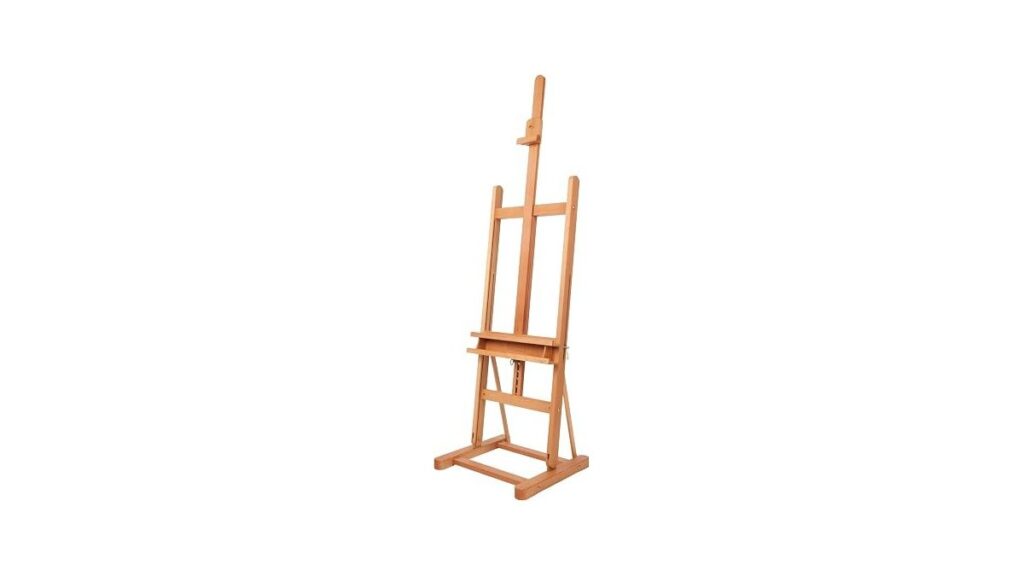
A lyre easel takes its name from its shape: a tripod-like base whose legs splay out and curve together toward a central mast, a little like the musical instrument. It is lighter in appearance and footprint than an H-frame, and it is the classic look many people picture when they think of an artist’s easel. The M/11 follows that pattern in oiled, stain-resistant beech.
The listing highlights a ratchet-adjustable canvas holder, a central mast with adjustable tilt, and support for canvases or boards up to 10 kg (22 lb). It is described as an indoor studio easel for oil, acrylic and pastel painting or display. Assembly is required and is described as simple.
Two listing details need care. Product dimensions are given as 30 inches deep, 26 inches wide and 96.5 inches high; that height likely reflects the mast at full extension. Weight appears twice with different values: the bullets say approximately 15 lb while the details field says 4 lb. A full beech floor easel weighing 4 lb seems unlikely, but we cannot confirm the true figure, so plan as though it is the heavier number if you will move it often.
Best suited for: oil, acrylic and pastel painters in home studios or spare rooms who work mostly on canvases from small up to around medium-large, and who want a well-known beech easel that also looks good as a display stand.
Key features
- Lyre design in oiled, stain-resistant beech
- Ratchet-adjustable canvas holder
- Central mast with adjustable tilt
- Holds canvases or boards up to 22 lb (10 kg)
- Listed dimensions 30 in D x 26 in W x 96.5 in H
Pros
- Classic Italian beech construction from a specialist easel maker
- Ratchet holder makes height changes quick
- Smaller visual and floor footprint than an H-frame
- Doubles as an attractive display easel
Cons and limitations
- Conflicting weight figures on the listing
- Maximum canvas height not stated in the listing data
- No wheels, so moving it means lifting
- Does not tilt to horizontal for watercolor or pouring
- Highest price tier in this comparison
Buying consideration: a lyre easel is excellent for its size, but if your canvases regularly approach or exceed four feet, or are heavy, an H-frame gives more stability and capacity.
How the M/11 compares with other Mabef designs
Mabef’s catalog covers lyre, H-frame, A-frame, French box and tabletop easels. Lyre models like the M/11 sit in the middle: sturdier than lightweight A-frames, lighter and smaller than heavy H-frames. If you like the brand but need a different format, look up the specific model’s canvas capacity and adjustments on the seller’s page; we only cover the M/11 here because it is the one we could verify on Amazon.com.
Living with a lyre easel
The legs of a lyre easel spread wider at the bottom than at the top, so the usable floor area is larger than the mast suggests. Measure your space with the legs splayed. Also note that the front leg can get in the way if you like to stand very close to the canvas; many painters set the canvas holder a little higher and step back more often, which is good practice anyway.
Tilt is useful. Leaning the canvas slightly forward at the top reduces glare from overhead lights and keeps dust from settling on wet paint. A slight backward tilt can feel more natural for drawing. The M/11’s tilting mast lets you set either.
Alternatives Worth Comparing
2. MEEDEN Versatile Studio H-Frame Easel — Best for Very Tall Canvases

MEEDEN’s H-frame is built for scale. The listing gives a total height adjustable from 59 to 95 inches, vertical tilting, and canvas capacity up to 77 inches. The mast has three sliders that adjust to canvas size, and two large front wheels let you roll it into position before locking it in place.
The listing weight is 25.5 lb and the footprint 21 inches deep by 19 inches wide, which is compact for an easel with that capacity. The broad, flat H-frame base is what gives it stability with large, heavy canvases.
Best suited for: painters who work on big vertical canvases and want to move the easel around the studio.
Key features
- Solid beech H-frame
- Height adjustable from 59 to 95 inches
- Holds canvas up to 77 inches
- Two front rolling wheels; three mast sliders
- Tools and pictorial instructions included
Pros
- Largest stated canvas capacity here
- Wheels make repositioning easy
- Compact base for its capacity
Cons and limitations
- Tilts in vertical range only; not a flat-table easel
- No supply tray mentioned in the listing
Buying consideration: choose this over the M/11 when canvas height, not tilt range, is your main constraint.
3. U.S. Art Supply Heavy Duty Extra Large H-Frame Easel — Best for Mixed Media

This H-frame earns its “heavy duty” name. The listing describes hand-sanded, oil-finished German beech, a built-in supply tray on a metal ratchet adjustable from 23 to 50 inches high, locking caster wheels and four large knobs for quick changes. Most importantly, it adjusts from vertical through to completely flat, and past vertical for pastel and portrait work.
The listed floor dimensions are 26 inches wide by 27.5 inches deep, 80 inches tall at rest with a maximum adjustable height of 139 inches. Weight is listed at 35 lb, the heaviest here. The tray height range is chosen to suit both sitting and standing.
Best suited for: painters who switch between oils on a vertical canvas and watercolor, pouring or flat work.
Key features
- Oil-finished German beech H-frame
- Adjusts from vertical to flat and past vertical
- Supply tray on a ratchet from 23 to 50 inches
- Locking caster wheels
- Maximum height 139 inches per the listing
Pros
- Widest tilt range in this guide
- Built-in tray keeps tools close
- Rolls and locks in place
Cons and limitations
- Heaviest and largest footprint here
- Maximum canvas size not stated directly
Buying consideration: the most flexible easel here if your work spans media and you have the floor space.
Lyre vs H-Frame: Which Studio Easel Type Fits You?
The choice between the Mabef M/11 and the two H-frames is really a choice between easel types. Lyre easels are graceful, relatively light and good at holding small to medium-large work in a compact visual footprint. H-frames are heavier, more rigid and better with large or heavy canvases, and the better ones add wheels, trays and wider tilt ranges.
A practical rule: if most of your canvases are under about 36 inches tall and you value a classic look, a lyre easel is a pleasure to use. If you regularly paint at four feet or more, use heavy palette knife work that pushes against the canvas, or want to roll the easel aside after each session, an H-frame makes life easier.
Setting Up a Studio Corner Around Your Easel
An easel only performs as well as the space around it. A few placement decisions make a bigger difference to daily painting than the gap between two good easels.
Light direction
Place the easel so the main light falls on the canvas from one side, ideally the side opposite your painting hand, so your arm does not cast a shadow across the work. North-facing windows are the traditional choice in the northern hemisphere because their light changes less through the day. With artificial light, use consistent, high color-rendering bulbs and keep them at the same angle each session.
Viewing distance
Leave room to step back at least two or three times the canvas height. Judging a painting only from arm’s length is one of the most common reasons compositions drift. A lyre easel’s compact base helps in small rooms, but it does not change the need for back-up space.
Palette and taboret position
Keep the palette on the same side as your painting hand and roughly at elbow height. If the easel has no tray, a small rolling cart or taboret beside it keeps paint, brushes, medium and rags within reach. Painters often find that a good taboret changes their workflow more than a new easel does.
Floor protection and ventilation
Put a washable mat or drop cloth under the easel, especially with oils. If you use solvents, open a window or use odorless mineral spirits in a closed container, and store oily rags in a sealed metal can. Easel wood soaks up spills, so wiping drips promptly keeps it looking good for years.
Canvas height
Set the canvas so the area you are working on sits near eye level. Raise or lower it as you move through the painting rather than crouching or reaching. This is where a quick ratchet holder like the M/11’s earns its keep.
Buying Guide: How to Choose a Mabef Studio Easel or Alternative
Measure your biggest canvas
Capacity is the first filter. Check the maximum canvas height the easel supports and the weight limit. Leave a margin; you will eventually paint something larger than you planned.
Check ceiling height
Studio easels extend tall. A mast that reaches 95 inches or more can hit a low ceiling when raised, so measure before buying if you work in a basement or attic.
Decide whether you need a flat position
Watercolor, pouring and some drawing need a horizontal or near-horizontal surface. Lyre easels and many H-frames only tilt within a vertical range; easels like the U.S. Art Supply model go fully flat.
Consider mobility
Wheels are a real advantage in shared rooms. Without them, plan where the easel will live permanently, because frequent lifting of a heavy beech easel gets old quickly.
Think about adjustment mechanisms
Ratchet holders and large knobs change height quickly; crank systems are smoother on very heavy easels. Quick adjustment matters when you raise and lower the canvas to work at a comfortable height on different areas.
Look at wood and finish
Beech is the standard for quality studio easels because it is hard, dense and stable. An oiled or clear finish resists paint and solvent stains and makes cleanup easier.
Plan for a supply surface
If the easel has no tray, budget for a side table or taboret. Reaching across the floor for brushes breaks your rhythm.
Set Up and Maintain Your Easel
A wooden easel lasts decades with simple care; our guide to cleaning and maintaining a wooden easel covers paint removal, oiling and knob care. If floor space is the issue, compare your options with our tips on using a tabletop easel correctly, and if you prefer to paint seated, see how to paint sitting with a lap easel.
Common Mistakes to Avoid
- Buying a lyre easel for canvases that exceed its comfortable capacity.
- Ignoring ceiling height when the mast is fully extended.
- Overtightening knobs, which can strip wooden threads over time.
- Leaving solvent-soaked rags draped over the easel; they stain the wood and are a fire risk.
- Expecting a vertical-only easel to work for watercolor washes.
- Skipping the weight question; a heavy easel that must move daily becomes a chore.
FAQs
Is the Mabef M/11 good for large canvases?
It is specified to hold canvases or boards up to 22 lb. The listing does not state maximum canvas height, so for very tall work an H-frame such as the MEEDEN, which lists capacity up to 77 inches, is the safer choice.
What is a lyre easel?
A lyre easel is a three-legged studio easel whose legs splay outward and curve toward a central mast. It is lighter and more compact than an H-frame and is often used for small to medium-large canvases and display.
Where are Mabef easels made?
Mabef is an Italian company known for beech wood easels. Check the specific product page for the country of manufacture of the model you buy.
Can I use a studio easel for watercolor?
Only if it tilts to a flat or near-flat position. The U.S. Art Supply H-frame goes fully flat; the M/11 and MEEDEN tilt within a vertical range.
How much does the Mabef M/11 weigh?
The listing gives two figures, about 15 lb in the description and 4 lb in the details field. We could not confirm which is correct, so plan around the higher figure.
Do H-frame easels need assembly?
Most do. The MEEDEN listing includes tools and pictorial instructions, and Mabef also notes simple assembly for the M/11.
Final Recommendation
Choose the Mabef M/11 if you want a classic Italian beech lyre easel for a home studio and your canvases stay in the small to medium-large range. It is a refined, space-conscious easel with quick ratchet adjustment and useful tilt, as long as you accept no wheels and a vertical-only working range.
If you paint big, the MEEDEN H-frame’s 77-inch capacity and front wheels make more sense. If you move between oils, watercolor and pouring, the U.S. Art Supply Heavy Duty H-frame’s vertical-to-flat range and tray are worth its size. Pick the easel type that matches your largest canvas and your media, then pick the brand.