PaintingProGuide is reader-supported. When you buy through links on this page we may earn an affiliate commission at no extra cost to you.
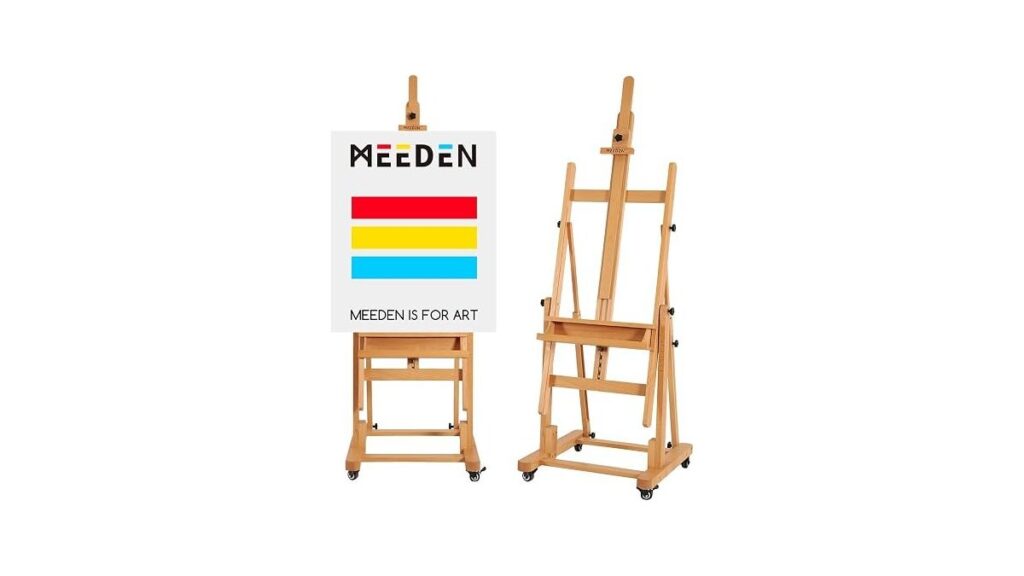
The MEEDEN studio easel most buyers land on is the MEEDEN Studio H-Frame Easel, a large beech wood floor easel that tilts from vertical to completely flat, rolls on two front wheels and holds canvases up to 77 inches. It is the kind of easel you buy once and build a painting corner around, so the details matter: how tall it gets, how much it weighs, whether it suits watercolor as well as oil, and what it cannot do.
This MEEDEN studio easel review works through the listing specifications one by one, explains who the H-frame design suits, and flags the trade-offs that are easy to miss when you are looking at product photos. There is no hype here, and no claim that we have painted at this easel; just a careful read of what MEEDEN states and how that maps to real studio use.
Quick answer: The MEEDEN Studio H-Frame Easel is a strong fit for painters who want one full-size studio easel for oil, acrylic, pastel and watercolor, since it adjusts from 59 to 95 inches tall, tilts all the way to horizontal, and holds canvases up to 77 inches. It suits a dedicated studio space best; at 29.8 pounds it is movable on its front wheels but not a travel easel. If you mostly paint small works or need portability, a French or tabletop easel is the better category.
MEEDEN Studio Easel at a Glance
- MEEDEN Studio H-Frame Easel (Classic Walnut) — Best for a permanent home studio that handles large canvases and flat watercolor work
| Product | Best For | Key Spec | Key Strength | Price Tier |
|---|---|---|---|---|
| MEEDEN Studio H-Frame Easel | Home studio, large canvases, sitting or standing | Height 59–95 in; canvas up to 77 in; 29.8 lb | Tilts from vertical to fully flat | $$$ |
How We Chose What to Cover
This review is based on the Amazon listing details and specifications checked in October 2026, how well the easel’s format, size and adjustments fit typical studio painting, and how widely the listing is reviewed by Amazon buyers. It is one of the most widely reviewed MEEDEN easel listings, which is one reason it is the focus here. We have not used this easel ourselves; where we discuss how H-frame easels behave, we rely on how the design generally works.
We judged the easel against the criteria that decide whether a studio easel gets used every day or becomes a coat rack:
- Canvas capacity — the largest canvas it holds and whether it can hold two at once.
- Height range — whether you can paint both seated and standing.
- Tilt range — whether it goes flat for watercolor and pours, or only vertical for oils.
- Stability and materials — wood type, hardware and weight.
- Mobility and storage — wheels, folding and footprint.
- Assembly and support — pre-assembly, instructions and warranty.
MEEDEN Studio Easel Reviewed
1. MEEDEN Studio H-Frame Easel — Best for a permanent home studio

The MEEDEN H-frame is built from thickened beech wood with galvanized hardware and a polished oil finish in a walnut color. The listing gives an adjustable height of 59 to 95 inches, which covers sitting and standing painting, and an angle range that runs from fully vertical to horizontal. That flat position is the feature that separates it from many studio easels, which tilt only forward and back a few degrees.
Three sliders on the mast let it hold two canvases at the same time, which MEEDEN suggests for keeping a reference artwork next to your working canvas. The maximum canvas size is listed at 77 inches. Two large front wheels and rubber feet are meant to balance mobility with stability, and the frame folds flat for storage. Main parts arrive pre-assembled and labeled, with tools, illustrated steps and an assembly video. MEEDEN states a three-year warranty.
Best suited for: Oil, acrylic, pastel and watercolor painters with a dedicated space; artists who alternate between sitting and standing; anyone working on large canvases or wanting a reference image held beside the work.
Key features:
- Beech wood H-frame with galvanized hardware and oil finish
- Height adjusts from 59 to 95 inches
- Tilts from fully vertical to horizontal (flat)
- Three sliders; holds two canvases at once
- Holds canvases up to 77 inches
- Two front rolling wheels plus rubber feet
- Folds flat; large ergonomic knobs
- Pre-assembled main parts, labeled; tools and video included
- Dimensions 21 x 19 x 95 inches; weight 29.8 lb
- Three-year warranty stated by MEEDEN
Pros:
- Flat position suits watercolor, pastel and pouring
- Wide height range for seated and standing work
- Large canvas capacity for a home-studio easel
- Two-canvas setup is handy for copying or reference work
- Wheels make it easy to roll toward a window
- Straightforward assembly support and a stated warranty
Cons and limitations:
- 29.8 lb is too heavy for plein air or frequent travel
- Needs ceiling height and floor space at full extension (95 in)
- Top price tier compared with A-frame and tabletop easels
- No built-in storage tray for supplies beyond the canvas holder area
- Wheels mean you should check it is steady on your floor before heavy palette-knife work
Buying consideration: Measure your room before ordering. At full height the mast reaches 95 inches, so in a room with a low ceiling or sloped attic roof you may never use the top of the range. Also confirm the floor is level where the wheels and rubber feet will sit.
What an H-Frame Easel Does Well
An H-frame easel gets its name from its shape: two upright posts joined by cross-bars, sitting on a rectangular base. Compared with a three-legged A-frame or tripod easel, the base is wider and the weight sits lower, which generally makes H-frames steadier under pressure from a brush or palette knife. That is why they are the standard choice for home and classroom studios where the easel stays in one place.
The trade-off is size. An H-frame takes more floor area and is heavier, and many basic H-frames are vertical-only. The MEEDEN design answers the second problem with its tilting head that reaches horizontal, which makes it a convertible studio easel rather than a pure oil-painting stand.
Sitting, Standing and Working Flat
A 59-to-95-inch height range covers most painting positions. Seated painters can bring the canvas low enough that their eye line falls near the center of the work, which reduces neck strain. Standing painters can raise it to step back and judge the whole composition. For very large canvases, the upper range lets the bottom edge clear the base while the top stays within reach.
The flat position is the hidden value. Watercolor washes, ink, pastel dust control and acrylic pouring all benefit from a horizontal or near-horizontal surface. A painter who works in more than one medium would otherwise need a separate table or tabletop easel for these tasks. On this easel you can switch angles with the knobs instead of moving to another surface.
Holding Two Canvases at Once
Three sliders let the MEEDEN hold two canvases at once. In practice this is useful for copying a master study, working from a printed reference mounted on a board, or painting a diptych where both halves need to be compared side by side. Keep the combined size within the easel’s 77-inch capacity and position heavier work lower on the mast for stability.
Planning Your Studio Corner Around the Easel
A large studio easel works best when the space around it is planned. Light is the first consideration. Many painters place the easel so a window sits to the side of the canvas rather than behind it, which avoids silhouetting the work and keeps glare off wet paint. North-facing windows in the Northern Hemisphere give the steadiest daylight, but any side light is better than light coming from directly behind the canvas.
Next, think about stepping back. Judging a large canvas means walking several feet away from it, so leave a clear path behind your painting position. A rolling easel helps here: you can pull it toward the window for color decisions and push it back against the wall when you are done.
Finally, plan for your palette and supplies. The MEEDEN listing does not describe a built-in supply tray, so most painters pair an H-frame with a small rolling cart or side table at hand height. Put it on your dominant-hand side so you are not reaching across the canvas.
Canvas sizes and how the easel handles them
| Canvas size | Typical use | How it fits a 77-inch-capacity H-frame |
|---|---|---|
| 8 x 10 to 11 x 14 in | Studies, sketches | Fits easily; a tabletop easel may be more convenient |
| 16 x 20 to 18 x 24 in | Standard finished work | Comfortable at seated or standing height |
| 24 x 36 in | Larger finished pieces | Well within capacity; raise the mast when standing |
| 36 x 48 in and up | Statement pieces | Within listed capacity; keep the canvas low on the mast for stability |
If you sometimes prefer to paint small pieces from an armchair, our guide on how to paint sitting with a lap easel shows how a lap easel can complement a big studio frame.
Who Should Buy the MEEDEN Studio Easel
- Home studio painters who want one easel to handle everything from small studies to large canvases.
- Mixed-media artists who switch between vertical oil work and flat watercolor or pastel.
- Painters with back or neck strain who benefit from adjusting height to sit or stand.
- Art teachers and serious students setting up a long-term workspace.
Who Should Skip It
- Plein air painters. A French easel or pochade box is the right tool outdoors; a 29.8 lb studio frame is not.
- Small-space renters without room for a 21 x 19 inch footprint and full-height mast.
- Painters who only work small, such as 8 x 10 or 11 x 14 inch studies; a tabletop easel is cheaper and easier to store.
- Buyers on a tight budget, since this easel sits in the top price tier.
Alternatives Worth Comparing
The product data available for this review covers only this MEEDEN H-frame listing, so we are not linking alternative products here. If you want to compare before buying, these are the categories to look at and the questions to ask of any listing:
- A-frame (lyre) studio easels — lighter and cheaper, with a smaller footprint, but usually vertical-only and less steady under heavy work.
- Other tilting H-frames — compare maximum canvas size, height range and whether the head truly reaches horizontal.
- French easels — combine a supply box with folding legs for outdoor work; capacity is much smaller.
- Tabletop easels — ideal for small work, classrooms and seated painting at a desk.
Buying Guide: How to Choose a Studio Easel
Maximum canvas size
Check the largest canvas you realistically plan to paint in the next few years, then add a margin. The MEEDEN’s 77-inch capacity covers most home-studio work, including large statement pieces. Remember that a listed capacity is the maximum height of canvas the clamps can hold, not a promise that every large canvas will feel steady at full extension.
Height range and ceiling clearance
A wide height range is only useful if your room allows it. Measure from floor to ceiling where the easel will stand. If you paint seated, check the lowest position too; a minimum of 59 inches overall height is low enough on this model for comfortable seated work.
Tilt range
Vertical-only easels suit oil and acrylic. If you also use watercolor, gouache, ink or pastel, look for a head that tilts flat, as this one does. Forward tilt also reduces glare from overhead lights and helps keep pastel dust off the painting surface.
Material and hardware
Beech is a dense hardwood commonly used for quality easels because it resists dents and holds screws well. Galvanized or rust-resistant hardware matters if you clean brushes nearby or work in a humid room. Large knobs are easier to tighten fully, which affects stability more than many buyers expect.
Weight, wheels and footprint
Weight usually equals stability, but it also means effort when you move the easel. Wheels help, but only if they lock or the rubber feet do the braking. At 29.8 lb and a 21 x 19 inch footprint, the MEEDEN is a room-to-room easel, not a car-to-field easel.
Assembly and warranty
Studio easels arrive flat-packed. Labeled parts, included tools and a video reduce the chance of a wobbly build. A stated warranty, three years in this case, is worth noting; keep your order details in case you need to use it.
Set Up and Look After Your Easel
A wooden easel lasts longer with simple care. Our guide on how to clean and maintain a wooden easel covers removing dried paint, tightening hardware and protecting the finish. If you also paint small pieces at a desk, how to use a tabletop easel correctly explains when a smaller easel is the better tool alongside a studio H-frame.
Common Mistakes to Avoid
- Ignoring ceiling height. A 95-inch mast does not fit every room at full extension.
- Overtightening during assembly. Snug the hardware, then tighten fully once the frame is square, or the frame can twist.
- Rolling with a wet canvas clamped high. Lower or remove large wet canvases before moving the easel.
- Leaving knobs half-tight. Loose knobs cause slow sagging while you paint; check them at the start of each session.
- Placing it on an uneven floor. A wheeled easel needs a level spot so the rubber feet carry the load.
- Buying for the biggest canvas you might ever paint. Buy for the work you actually do, unless you have the space to spare.
FAQs
How tall does the MEEDEN Studio H-Frame Easel adjust?
The listing gives an adjustable height range of 59 to 95 inches, which covers both seated and standing painting.
What is the largest canvas the MEEDEN studio easel holds?
MEEDEN lists a maximum canvas size of 77 inches, and the three sliders let it hold two canvases at once.
Can the MEEDEN H-frame easel be used for watercolor?
Yes. The head adjusts from fully vertical to horizontal, so it can hold a watercolor board flat or at a slight angle for washes.
How heavy is the MEEDEN Studio H-Frame Easel?
The listing states an item weight of 29.8 pounds, with dimensions of 21 x 19 x 95 inches. Two front wheels help you roll it within a room.
Is the MEEDEN studio easel hard to assemble?
MEEDEN says the main parts come pre-assembled and labeled, with tools, step-by-step illustrations and an assembly video. Allow time to square the frame before fully tightening the hardware.
Does the MEEDEN studio easel come with a warranty?
The listing states a three-year warranty from MEEDEN. Keep your order confirmation in case you need to make a claim.
Final Recommendation
The MEEDEN Studio H-Frame Easel is a well-specified choice for a permanent home studio. Its 59-to-95-inch height range, 77-inch canvas capacity and full tilt to horizontal make it unusually versatile for a single easel, and the two-canvas setup adds real value for reference and copy work.
Buy it if you have the floor and ceiling space and want one easel to serve oil, acrylic, pastel and watercolor. Skip it if you paint outdoors, work only small, or need something you can fold into a closet every evening; in those cases a French or tabletop easel will serve you better for less money.