
PaintingProGuide is reader-supported. When you buy through links on this page we may earn an affiliate commission at no extra cost to you.
MEEDEN and U.S. Art Supply are two of the names you see most often when shopping for a wooden studio easel online. Both sell beech wood H-frames, both cover beginner to advanced painters, and their flagship models look similar in photos. The MEEDEN vs US Art easel question usually comes down to a handful of specific differences: height range, tilt, tray adjustment, mobility and weight.
This comparison sets the MEEDEN Classic H-Frame Easel against U.S. Art Supply’s Heavy Duty Extra Large H-Frame, the two models that most often end up side by side in a shopping cart, and uses the listing specifications for each to show where they differ. We also point out where the rest of each brand’s lineup fills gaps.
Quick answer: Choose the MEEDEN Classic H-Frame if you want a solid beech studio easel for canvases up to 48 inches at a lower weight and price tier, and you mostly paint upright. Choose the U.S. Art Supply Heavy Duty Extra Large H-Frame if you need tilt past vertical for pastel, a flat position for watercolor or pouring, locking casters and a much taller maximum height. For the largest canvases, MEEDEN’s heavier H-frame models compete directly with the U.S. Art Supply.
MEEDEN vs US Art Easel at a Glance
| Feature | MEEDEN Classic H-Frame | U.S. Art Supply Heavy Duty H-Frame |
|---|---|---|
| Wood | European dried beech, natural oil finish | Aged German beech, natural oil finish |
| Height range | 69 to 95 inches | 80 inches at rest, up to 139 inches |
| Max canvas | Up to 48 inches | Large canvases (no single figure stated) |
| Tilt | Adjustable angle via sliding backrest | Past vertical to flat horizontal |
| Tray adjustment | Metal ratchet | Metal ratchet, 23 to 50 inches |
| Mobility | No casters listed | Locking caster wheels |
| Footprint | 22 x 22 inches | 26 x 27.5 inches |
| Listed weight | 21.3 pounds | 35 pounds |
| Price tier | $$$ | $$$ |
| Best for | Upright oil and acrylic in a home studio | Multi-media studios, pastel, pouring, large work |
How We Compared
We have not used either easel. This comparison is based on the Amazon listing details and specifications for each model checked in October 2026, how well each easel’s adjustment range, tilt, mobility and capacity fit common studio needs, and how widely each product is reviewed by Amazon buyers. Where one listing gives a specification the other does not, we say so rather than guess.
We weighed these factors:
- Construction: wood type, finish and hardware.
- Working range: mast height, maximum canvas and tray height.
- Tilt: whether the easel suits pastel, watercolor and pouring as well as oil and acrylic.
- Mobility and footprint: casters, base size and weight.
- Ease of use: adjustment mechanisms and assembly support.
Why the H-Frame Design Matters Here
Both easels in this comparison are H-frames, and that shared design explains why they are so often cross-shopped. An H-frame has a rectangular base, two vertical uprights joined by crossbars, and a central mast that carries the canvas holder. Compared with an A-frame or tripod, that base spreads weight over a wider, flatter footprint, so the easel resists rocking when you lean into a stroke or work with a palette knife.
The design also allows larger canvases and heavier hardware. Tilt mechanisms, ratchet trays and caster bases are far easier to build into an H-frame than into a three-legged easel. That is why most dedicated studio easels, from both brands, use this shape.
The trade-off is size. An H-frame does not fold into a bag, and even a classic model like the MEEDEN occupies a fixed square of floor. If you need to pack your easel away after every session, neither of these is the right category, and a field or tabletop easel will serve you better.
MEEDEN Classic H-Frame Easel

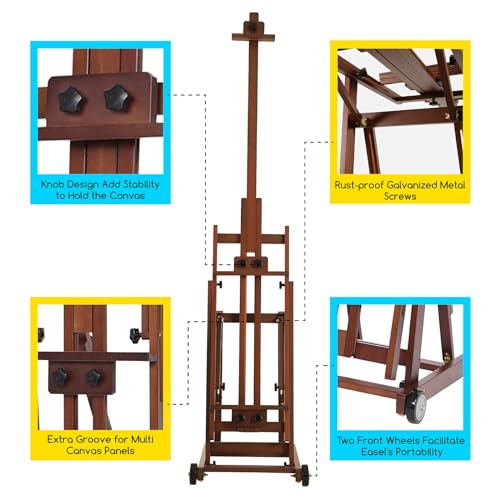
MEEDEN’s Classic H-Frame is the brand’s straightforward studio easel. The listing describes it as handmade from European dried beech, refined with natural oil. It has an adjustable-height center mast and an adjustable-angle sliding backrest, so you can set a comfortable working angle by loosening and tightening the side knobs, whether sitting or standing.
Height runs from 69 to 95 inches, and the easel accommodates canvases up to 48 inches. A metal ratchet device handles adjustment, and the listing credits the four-sided base and central column for stability with larger, heavier canvases. All wood blocks and hardware are labeled, tools are included, and an assembly video is available on the product page. Listed weight is 21.3 pounds with a 22 by 22 inch footprint.
Best suited for: oil and acrylic painters working upright on canvases up to 48 inches in a home studio.
Key features:
- Solid European beech with natural oil finish
- Height 69 to 95 inches; canvases up to 48 inches
- Adjustable-angle sliding backrest and ratchet adjustment
- 22 x 22 inch footprint; listed weight 21.3 pounds
Pros:
- Lighter and more compact than the U.S. Art Supply heavy-duty model
- Labeled parts, included tools and assembly video
- Smooth ratchet adjustment
Cons and limitations:
- No flat or past-vertical tilt stated
- No casters listed
- Lower maximum height and canvas size than heavy-duty H-frames
Buying consideration: If you work mainly upright on medium to large canvases and want a classic H-frame without the bulk of a heavy-duty model, this is the more practical choice.
U.S. Art Supply Heavy Duty Extra Large H-Frame
U.S. Art Supply’s heavy-duty H-frame is built for flexibility across media. According to its Amazon listing checked in October 2026, it uses hand-sanded, aged German beechwood with a deluxe natural oil finish, a built-in artist storage tray and locking caster wheels.
Its signature feature is tilt. The easel adjusts from 90 degrees vertical to flat horizontal and can go past vertical for pastels and portraits, so dust falls away from the surface, or flat for watercolor and paint pouring. Four large knobs make changes quick. The supply tray moves on a metal ratchet from 23 to 50 inches high for seated or standing work. Floor dimensions are 26 by 27.5 inches, 80 inches tall at rest and up to 139 inches at maximum, with a listed weight of 35 pounds.
Best suited for: studios that switch between oil, pastel, watercolor and pouring, and painters working on large canvases.
Key features:
- Aged German beechwood, natural oil finish
- Tilts past vertical and down to flat
- Ratchet tray from 23 to 50 inches; locking casters
- Up to 139 inches tall; listed weight 35 pounds
Pros:
- Covers every medium from pastel to pouring
- Locking casters for repositioning
- Much taller maximum height for large canvases
Cons and limitations:
- Heavier and larger footprint
- Higher price tier than the MEEDEN Classic
- Listing does not give a single maximum canvas figure
This model was not among the products checked for this specific comparison page, so we do not link to it here. You can find it by searching its full name on Amazon, and we cover it alongside other studio easels in our guide to the best professional wooden easel.
Head-to-Head: Where They Differ
Construction and finish
Both use beech with a natural oil finish, which is the standard for quality studio easels. MEEDEN specifies European dried beech; U.S. Art Supply specifies aged German beech and hand sanding. On paper, there is no meaningful material advantage either way. Both should look and feel like solid furniture.
Height and canvas size
The U.S. Art Supply easel extends far higher, up to 139 inches versus 95 inches. That extra height is less about painting at the ceiling and more about raising a tall canvas so you can reach its lower section comfortably. MEEDEN states a 48-inch canvas maximum, which covers most home studio work. If you regularly paint canvases larger than that, the U.S. Art Supply, or one of MEEDEN’s bigger H-frames, is the better fit.
Tilt and media flexibility
This is the clearest difference. The U.S. Art Supply listing describes tilt past vertical and all the way to flat. The MEEDEN Classic listing describes an adjustable angle via the sliding backrest but does not mention a flat position. For oil and acrylic, either works. For pastel, watercolor and pouring, the U.S. Art Supply is the safer choice.
Tray and seated painting
Both use a metal ratchet for adjustment. U.S. Art Supply lists its tray range as 23 to 50 inches. MEEDEN does not state a tray range for this model, but describes the easel as suitable for sitting or standing. If you paint seated with a low canvas, check that the tray reaches low enough for your chair.
Mobility and footprint
The U.S. Art Supply has locking casters; the MEEDEN Classic lists none. Casters make it easy to roll a heavy easel toward a window, then lock it. Without casters, the MEEDEN is lighter at 21.3 pounds and has a smaller 22 by 22 inch base, so it is still manageable to move and takes less floor space.
Assembly and support
MEEDEN labels all parts, includes tools and provides an animated assembly video. The U.S. Art Supply listing does not detail assembly support in the same way. Both require assembly.
Other Models From Each Brand
Both brands make more than one H-frame, which changes the comparison depending on your needs. Based on listings checked in October 2026, MEEDEN’s heavier options include an Extra Large H-Frame with a height range of 80 to 142 inches, flat-to-past-vertical tilt, a ratchet tray from 18 to 50 inches and four locking casters, which competes directly with the U.S. Art Supply heavy-duty model. MEEDEN also sells a Movable Large H-Frame that holds art up to 78.7 inches and two boards at once.
U.S. Art Supply also makes lightweight options such as the Cabrillo aluminum tabletop easel, which adjusts from 15 to 21 inches and holds items up to 24 by 30 inches, useful as a second easel. We cover several of these models in our professional easel guide linked above.
Value: What the Price Difference Buys
The MEEDEN Classic sits in a lower part of the top price tier than the U.S. Art Supply heavy-duty model. The extra cost of the heavier easel pays for three concrete things: a much wider tilt range, locking casters and a taller mast. If you will use all three, the U.S. Art Supply represents fair value. If you paint upright in one spot, you would be paying for features that sit idle.
It is also worth thinking about weight as part of value. The heavier easel’s 35 listed pounds add stability when you push hard against a large canvas, but they also make the easel harder to move without its wheels. The MEEDEN’s 21.3 pounds is a middle ground: enough mass for a medium-size canvas, light enough to slide across a room by hand.
Finally, consider what you would buy next. Many painters eventually own two easels, a main studio H-frame and a lighter one for studies or display. Starting with the MEEDEN Classic leaves budget for a second easel later; starting with the heavy-duty model may mean you never need another studio easel at all.
Buying Guide: Choosing Between MEEDEN and U.S. Art Supply
Start with your media
If you only paint oil and acrylic upright, both brands’ H-frames work well. If pastel, watercolor or pouring is part of your practice, prioritize an easel that explicitly lists flat and past-vertical tilt.
Size your canvas, then your easel
Note the largest canvas you plan to paint in the next few years. Under about 48 inches, the MEEDEN Classic is enough. Above that, compare the heavy-duty models from both brands.
Consider your room
Measure floor space and ceiling height. The U.S. Art Supply base is 26 by 27.5 inches; the MEEDEN Classic is 22 by 22 inches. Neither reaches full height in a standard room, but both adjust down.
Think about moving it
If the easel needs to move regularly, casters matter more than any other feature. If it stays in one place, the lighter MEEDEN Classic is easier to reposition occasionally by hand.
Setting up either easel for comfort
Whichever you choose, set the canvas so its center sits at or slightly below eye level when you stand or sit in your usual position. Tilt the top of the canvas back a few degrees for oil and acrylic to reduce glare from overhead light. Keep your palette on the painting-hand side at roughly waist height, either on the easel tray or a side table, so you are not twisting between mixing and painting.
Plan for maintenance
Both oil-finished beech easels benefit from regular cleaning and occasional re-oiling. Our guide on how to clean and maintain a wooden easel covers what to do. If you also paint small pieces seated, see how to use a tabletop easel correctly.
Who Should Buy Which
Specifications are easier to apply when you picture the painter behind them. These profiles cover the situations we see most often when people weigh these two easels:
- The weekend oil painter in a spare bedroom: MEEDEN Classic. Canvases rarely exceed 36 inches, work is upright, and a smaller, lighter easel suits a room that also holds a desk or guest bed.
- The pastel portrait artist: U.S. Art Supply. Tilting past vertical lets pastel dust fall clear of the surface instead of settling into the drawing.
- The acrylic pour artist who also paints with a brush: U.S. Art Supply. A flat position lets pours level out, and the same easel returns to upright for brushwork.
- The watercolor painter moving to a floor easel: U.S. Art Supply, or a MEEDEN model that lists a flat position, since the Classic does not.
- The art teacher equipping a small studio: MEEDEN Classic for multiple stations on a budget, with one heavy-duty easel for demonstrations if funds allow.
- The painter working on canvases over four feet: U.S. Art Supply or MEEDEN’s heavier H-frames, compared side by side on tray range and casters.
If you see yourself in more than one profile, let the medium decide. Tilt range is the one feature you cannot add later, while casters and storage can be improvised.
Common Mistakes to Avoid
- Comparing different classes of easel. A classic H-frame and a heavy-duty H-frame serve different studios.
- Assuming every H-frame tilts flat. Check the listing if you need horizontal for watercolor or pouring.
- Ignoring weight. A 35-pound easel is harder to move without casters.
- Overlooking tray height. Seated painters need a low tray range.
- Buying for brand alone. Model specifications matter more than the logo.
- Skipping ceiling checks. Tall masts may not extend fully in your room.
FAQs
Is MEEDEN or U.S. Art Supply better?
Neither is better across the board. The MEEDEN Classic H-Frame is lighter and more compact for upright oil and acrylic work, while the U.S. Art Supply Heavy Duty H-Frame adds full tilt, locking casters and a taller maximum height.
Which easel tilts flat for watercolor?
The U.S. Art Supply Heavy Duty H-Frame lists a flat horizontal position. The MEEDEN Classic H-Frame listing describes an adjustable angle but does not mention flat.
How big a canvas does the MEEDEN Classic H-Frame hold?
Its listing states canvases up to 48 inches.
Does the U.S. Art Supply H-frame have wheels?
Yes, its listing describes locking caster wheels for mobility.
Which is easier to assemble?
Both need assembly. MEEDEN highlights labeled parts, included tools and an assembly video for the Classic H-Frame.
Are both easels made of solid wood?
Yes. MEEDEN lists European dried beech and U.S. Art Supply lists aged German beechwood, both with a natural oil finish.
Final Verdict by Use Case
For upright oil and acrylic in a home studio: the MEEDEN Classic H-Frame is the more practical choice, lighter, smaller and in a lower price tier, with canvases up to 48 inches.
For multi-media studios, pastel or pouring: the U.S. Art Supply Heavy Duty H-Frame wins on tilt range and casters.
For very large canvases: compare the U.S. Art Supply heavy-duty model with MEEDEN’s Extra Large and Movable Large H-frames; at that level, the choice comes down to tray range, caster design and whether you need to hold two canvases at once.



2 Comments