
PaintingProGuide is reader-supported. When you buy through links on this page we may earn an affiliate commission at no extra cost to you.
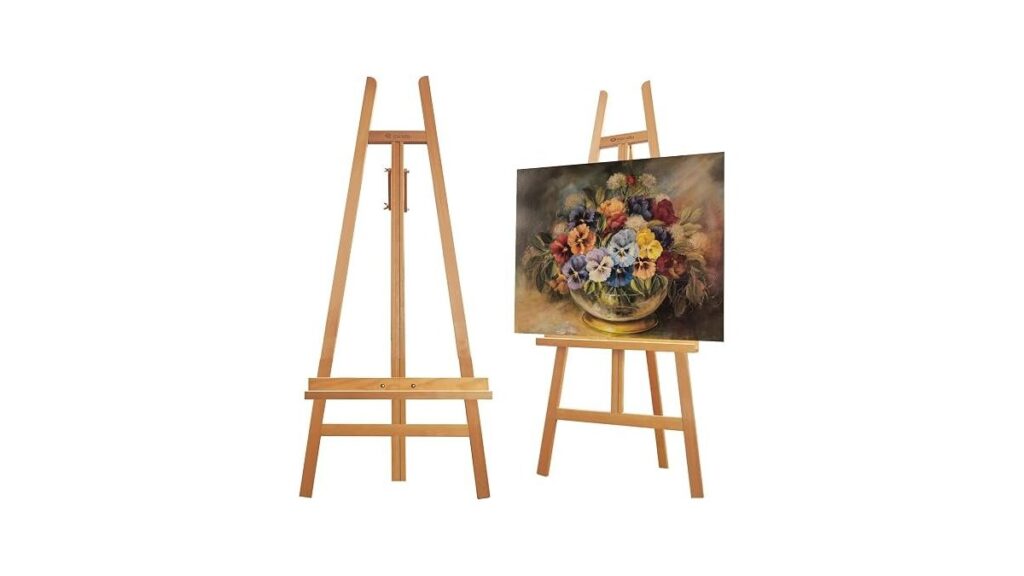
Shopping for a MEEDEN A-frame easel usually comes down to one model on Amazon: the MEEDEN Large Painting Easel Stand, a lyre-style beech wood studio easel with a ratchet height adjuster, a forward-tilting mast and a folding rear leg. It suits painters who want a real floor easel for canvases up to 48 inches without giving up a corner of the room to a heavy H-frame. Below we go through what the listing specifies, how it behaves in a typical home studio, and the trade-offs that come with the A-frame design.
Earlier versions of this page presented several MEEDEN A-frame picks. The October 2026 listing check turned up one MEEDEN lyre A-frame that matched the query, so this is a single-product review with the depth that deserves.
Quick answer: The MEEDEN Large Painting Easel Stand is a good fit for oil, acrylic and pastel painters working up to 48-inch canvases in a home studio, thanks to its 63 to 89 inch height range, 10-degree forward tilt and folding rear leg. If you regularly paint larger than 48 inches or press hard with a palette knife, a heavier H-frame studio easel will feel steadier.
Our Top Picks at a Glance
- MEEDEN Large Painting Easel Stand (lyre A-frame, beech) — Best for home studios with canvases up to 48 inches
| Product | Best For | Key Spec | Key Strength | Price Tier |
|---|---|---|---|---|
| MEEDEN Large Painting Easel Stand | Home studio, medium-large canvases | Height 63–89 in; canvas up to 48 in; 15.22 lb | Ratchet height, 10° forward tilt, folding rear leg | $$$ |
How We Chose
We have not set up or painted at this easel. This review is based on the Amazon listing details and specifications checked in October 2026, how well the easel’s height range, canvas capacity, adjustments and footprint match what studio painters need, and how widely the product is reviewed by Amazon buyers.
What we measured it against:
- Canvas capacity and height range for the sizes most home painters use.
- Adjustment mechanism: how quickly and securely the canvas height changes.
- Tilt: whether the mast angles to suit pastel or reduce glare.
- Footprint and storage: floor space when open and how it folds.
- Build: wood type, hardware and stated warranty.
MEEDEN A-Frame Easel Review: The Large Painting Easel Stand
1. MEEDEN Large Painting Easel Stand — Best for Home Studios With Canvases up to 48 Inches

MEEDEN calls this a lyre-style studio A-frame easel. Height adjusts from 63 to 89 inches and it holds canvases up to 48 inches. It is built from solid beech wood with steel fittings, finished in a deep walnut color, and has a large ledge that holds brushes and paints as well as the canvas.
The listing describes three ways to adjust it. The center mast tilts forward up to 10 degrees, which MEEDEN highlights for pastel work. A ratchet mechanism sets the height quickly. And three-point stability comes from the two front legs and a rear leg that folds in for storage. MEEDEN also points out that the mast tilts to vertical, which brings the top of a tall canvas within easier reach, and that a forward tilt lets pastel dust fall away from the surface instead of settling into the painting.
Listed dimensions are 35 inches deep, 26 inches wide and about 63 inches high at the lowest setting, with a weight of 15.22 pounds. MEEDEN offers a three-year warranty and a satisfaction guarantee, and includes an assembly video.
Best suited for: painters with a spare room or studio corner who work on canvases from about 16×20 up to 48 inches tall, including pastel artists who want a forward tilt.
Key features:
- Lyre-style A-frame in solid beech with steel fittings
- Height 63 to 89 inches; holds canvases up to 48 inches
- Ratchet height mechanism
- Center mast tilts forward up to 10 degrees
- Rear leg folds in for storage
- Large ledge for brushes and paints
- 15.22 pounds; three-year warranty
Pros:
- Ratchet adjustment is faster than wing-nut sliders
- Forward tilt helps pastel artists and reduces glare
- Lighter than most H-frame studio easels
- Folds for storage, which suits shared rooms
- Three-year warranty stated in the listing
Cons and limitations:
- 48-inch canvas limit is lower than large H-frames
- Rear leg extends the footprint to 35 inches deep
- No backward tilt or flat position mentioned for watercolor
- Three-point base is less planted than an H-frame under heavy pressure
Buying consideration: the 35-inch depth is the number to check. That rear leg needs floor space behind the easel, and in a narrow room it can become something you trip over.
Understanding the Lyre A-Frame Design
A lyre easel takes its name from the curved, harp-like shape of its front legs, which spread at the base and meet near the top. Combined with a rear leg, this creates a tripod. Tripods are naturally stable on uneven floors because three points always sit flat, which is one reason A-frames are popular in older homes and studios with imperfect floors.
The trade-off is how the easel handles force. When you press into a canvas, an A-frame transfers that load toward the back leg. With moderate pressure this is fine. With heavy palette knife work on a large canvas, some painters find an A-frame shifts slightly where an H-frame would not.
In exchange, an A-frame is usually lighter, cheaper and easier to fold away. For many home painters working at medium sizes, that is the better bargain.
Buying Guide: How to Choose an A-Frame Studio Easel
Canvas capacity versus your real sizes
MEEDEN lists a 48-inch maximum. If your largest canvases are around 36×48 or smaller, you are within range with some margin. If you plan to move into 48×60 or larger work, look at an H-frame instead.
Height range and posture
A 63 to 89 inch total height lets most adults keep the canvas center near eye level whether standing or sitting on a tall stool. Check the lowest setting if you paint seated in a regular chair, since a high minimum can put the bottom edge of a small canvas above comfortable reach.
Ratchet versus sliders
A ratchet height mechanism moves in set steps and locks quickly, which is convenient when you change canvas sizes often. Sliders with knobs allow finer positioning but take longer to adjust. MEEDEN’s ratchet favors speed.
Tilt for pastel and glare
Forward tilt matters more than many buyers realize. For pastel, tilting the top toward you lets dust fall to the ledge rather than into the painting. For oil, a slight forward tilt cuts reflections from overhead lights on wet paint. Up to 10 degrees, as MEEDEN lists, covers both uses.
Footprint and folding
Measure the space where the easel will stand. The listed 26-inch width and 35-inch depth define the open footprint. Folding the rear leg in makes the easel far shallower for storage in a closet or behind a door.
Wood and hardware
Beech is the standard hardwood for quality easels because it is dense and stable. Steel fittings, as listed here, hold up better than plastic parts. Check bolts periodically, since wood compresses slightly over the first weeks of use.
Warranty and support
A stated warranty, three years in this case, is worth weighing alongside features. It suggests confidence in the hardware and gives you recourse if a part fails.
Planning Your Studio Space Around an A-Frame
Before ordering, sketch your painting area on paper. Mark the easel’s 26 x 35 inch footprint, then add room in front for you to stand, usually another 2 to 3 feet, and space to step back several feet and view the work from a distance. Add a side table for your palette within arm’s reach of your painting hand.
Ceiling height is rarely a problem with this easel. At its 89-inch maximum it sits comfortably below a standard 8-foot ceiling, leaving room for a tall canvas to extend a little above the mast top. That is one practical advantage over taller H-frames, which can bump against ceilings at full extension.
Think about light as well. North-facing windows give the most consistent daylight in the Northern Hemisphere. If you rely on artificial light, place a daylight-balanced lamp to one side and slightly above the canvas so it falls evenly across the surface.
Is the MEEDEN A-Frame Easel Worth It?
For a painter moving up from a tabletop or a lightweight metal tripod easel, the MEEDEN A-frame is a meaningful upgrade. Solid beech, steel fittings, a ratchet adjuster and a forward tilt are features that make daily painting smoother, and the stated three-year warranty adds reassurance.
Where the value case weakens is at the extremes. Painters who only work small will pay for capacity they never use, and painters working very large will hit the 48-inch ceiling. For the broad middle, home painters working between roughly 16×20 and 36×48, the easel’s specification lines up well with what they need.
Who This Easel Suits, and Who It Does Not
Good fit: home studio painters working up to 48 inches; pastel artists; painters who share a room and need to fold the easel away; anyone wanting quick height changes between canvases.
Poor fit: painters working on very large canvases; heavy palette knife or impasto painters who lean hard on the canvas; watercolorists who need a flat surface; plein air painters who need a portable field easel.
Setting Up the MEEDEN A-Frame for Daily Painting
- Place the rear leg away from walkways. Position the easel so the back leg points toward a wall or corner, not the path you walk.
- Center the canvas on the mast. Off-center canvases put uneven load on a tripod base.
- Use the ledge sparingly. It is handy for brushes and a few tubes, but heavy jars on the ledge add weight to the front and can make the easel feel top-heavy.
- Light from the side. Set the easel so window light or a lamp falls across the canvas from one side, without your shadow crossing it.
- Use the tilt. A few degrees forward reduces glare and makes reaching the top of a tall canvas easier.
How the MEEDEN A-Frame Handles Common Canvas Sizes
The 48-inch limit is easier to judge when you map it to sizes you actually buy.
| Canvas Size | Fit on This Easel | Notes |
|---|---|---|
| 8×10 to 11×14 | Works, but oversized easel for the job | Raise the canvas high on the mast to reach eye level; a tabletop easel may be more comfortable |
| 16×20 to 18×24 | Comfortable | A natural range for this easel in a home studio |
| 24×36 to 30×40 | Comfortable, the sweet spot | Large enough to benefit from a floor easel, well within capacity |
| 36×48 | At the listed limit | Fits by height; keep pressure moderate and the canvas centered |
| Larger than 48 in tall | Not recommended | Choose an H-frame studio easel |
Using the Easel for Oil, Acrylic and Pastel
Oil painting
Oil painters benefit most from the forward tilt, which reduces glare on wet, glossy paint under overhead lights. Keep solvent jars and heavy mediums on a separate table rather than the ledge, both for stability and to avoid spills on the beech finish. The vertical position works well for long sessions where you step back frequently to judge the painting.
Acrylic painting
Acrylic dries quickly, so painters often work faster and change canvases more often. The ratchet height mechanism helps here, letting you swap from a small study to a larger canvas without fiddling with knobs. Wipe acrylic drips off the wood promptly, since dried acrylic is harder to remove than wet.
Pastel
MEEDEN specifically mentions pastel, and the design supports it. Tilting the mast forward lets loose pastel dust fall to the ledge instead of collecting in the textured surface of the paper or board. Place a damp cloth or a strip of paper on the ledge to catch dust, and clean it after each session to keep dust out of the studio air.
Easel Types at a Glance
If you are still deciding on easel type rather than model, this general comparison may help.
| Easel Type | Stability | Footprint | Portability | Best For |
|---|---|---|---|---|
| Lyre A-frame (like this MEEDEN) | Good on uneven floors | Moderate; rear leg adds depth | Folds for storage | Home studios, medium to large canvases |
| H-frame studio easel | Highest | Square base, often heavy | Low | Very large canvases, heavy work |
| Tabletop easel | Good for small work | Desk only | High | Small canvases, seated painting |
| Field or French easel | Moderate | Small | High | Plein air painting |
Assembly and First-Week Checklist
The easel ships unassembled, and MEEDEN includes an assembly video. A few steps help it stay solid over time.
- Lay out every part first and match it to the instructions before driving any bolt.
- Snug bolts, do not crush the wood. Tighten firmly, then stop. Overtightening can split beech or strip threads.
- Test the ratchet through its full range before mounting a canvas, so you know how each step feels.
- Check the tilt lock at both vertical and full forward tilt.
- Retighten after a week. Wood settles around hardware during the first sessions, so a quick check prevents wobble from developing.
Look After Your Easel
A beech easel will last years if you keep paint off the joints and hardware snug. Our guide on cleaning and maintaining a wooden easel covers removing dried paint and protecting the finish. If you also paint small pieces seated, read our tips on painting seated with a lap easel as a companion setup for low-effort sketching sessions.
Common Mistakes to Avoid
- Ignoring the depth measurement. The rear leg needs room; 35 inches deep is more than many expect.
- Exceeding the canvas limit. Forcing a canvas taller than 48 inches into the holders strains the mast.
- Leaning heavily into large canvases. Steady the canvas with your free hand during heavy knife work.
- Overloading the ledge. Keep heavy supplies on a side table.
- Skipping periodic bolt checks. Retighten after the first few sessions and occasionally after that.
- Using a studio A-frame outdoors. At over 15 pounds, it is not a field easel.
FAQs
How tall a canvas can the MEEDEN A-frame easel hold?
The listing says it holds canvases up to 48 inches, with a total height adjustable from 63 to 89 inches.
Does the MEEDEN A-frame easel tilt?
Yes. The center mast tilts forward up to 10 degrees, which MEEDEN recommends for pastel work. It also stands vertical. The listing does not mention a flat position.
How much does the MEEDEN A-frame easel weigh?
The listing gives an item weight of 15.22 pounds.
Does it fold for storage?
Yes. The rear leg folds in, making the easel much shallower for storage.
Is the MEEDEN A-frame good for pastel?
It is well suited to pastel thanks to the forward tilt, which lets dust fall away from the surface, and the ledge, which catches it.
Should I choose an A-frame or an H-frame easel?
Choose an A-frame for medium to large canvases, smaller rooms and easier storage. Choose an H-frame for very large or heavy canvases and maximum stability.
Final Recommendation
The MEEDEN Large Painting Easel Stand is a well-specified lyre A-frame for home studios. Its ratchet height adjustment, 10-degree forward tilt and folding rear leg make it practical for oil, acrylic and especially pastel painters working up to 48 inches.
If your canvases regularly exceed 48 inches, or you paint with heavy pressure, step up to an H-frame. If you mostly paint small pieces at a desk, a tabletop easel will serve you better and cost less space.



One Comment