PaintingProGuide is reader-supported. When you buy through links on this page we may earn an affiliate commission at no extra cost to you.
“Eco-friendly” is printed on a lot of children’s paint, and it can mean almost anything. Sometimes it describes the ingredients, such as plant pigments or mineral earth colors. Sometimes it means the packaging is recycled or compostable. Occasionally it just means the paint is water-based. The best eco-friendly paints for kids are clear about which of those things they actually do, and they stay safe, washable and fun for small hands.
This guide explains what to look for on the label, then compares six kids’ paints on Amazon whose listings make specific environmental or ingredient claims: mineral pigment powders, vegetable-based finger paints, recycled-plastic packaging and paraben-free tempera for classrooms. We note exactly what each seller claims so you can judge for yourself.
Quick answer: For the strongest combination of natural ingredients and low-waste packaging, the Natural Earth Paint Petite Kit uses organic cornstarch, gum arabic and mineral pigments in compostable pouches. For toddlers, Honeysticks Non Toxic Finger Paint comes in bottles made from reclaimed plastic with FSC-sourced cardboard. For classrooms, Colorations Paraben-Free Simply Washable Tempera gives big 16 oz bottles made in the USA.
Our Top Picks at a Glance
- Natural Earth Paint Petite Kit — Best overall eco-friendly kids paint
- Honeysticks Non Toxic Finger Paint — Best for toddlers, with recycled packaging
- Lattooland Natural Vegan Finger Paints — Best taste-safe option for babies
- Jar Melo Vegetable Finger Paint Powder — Best mix-as-you-go powder for young toddlers
- Colorations Paraben-Free Washable Tempera — Best for classrooms and big projects
- ABEIER Washable Finger Paint, 12 Colors — Best budget color range
| Product | Best For | Key Spec | Key Strength | Price Tier |
|---|---|---|---|---|
| Natural Earth Paint Petite Kit | Low-waste families | 6 mineral pigment packets, makes up to 35 oz | Compostable pouches | $$ |
| Honeysticks Finger Paint | Toddlers 1+ | 6 pots, 2.02 fl oz each | Reclaimed plastic bottles | $$ |
| Lattooland Vegan Finger Paints | Babies 6 months+ | 4 powders, 50 g each | Vegetable-based, taste-safe | $$ |
| Jar Melo Paint Powder | Toddlers 10 months+ | 6 colors, 60 g each | Food-grade thickeners | $$ |
| Colorations Tempera 8-Pack | Classrooms | 8 x 16 fl oz | Paraben-free, AP Seal | $$ |
| ABEIER Finger Paint | Color variety | 12 colors, 1.21 fl oz each | ASTM D-4236 conforming | $ |
How We Chose
We have not used these paints with children for this guide. Our picks are based on the Amazon listing details and specifications checked in October 2026, how specific and relevant each listing’s environmental and ingredient claims are, how well each paint suits a given age, and how widely each product is reviewed by Amazon buyers. We excluded paints whose listings made no environmental claim at all.
- Ingredient transparency: plant, vegetable or mineral pigments named in the listing.
- Packaging: recycled, recyclable or compostable materials stated.
- Safety statements: non-toxic claims, ASTM D-4236 conformance or AP certification.
- Age suitability: appropriate for the youngest intended user.
- Washability: cleans from skin and common surfaces.
What Makes a Kids’ Paint Eco-Friendly?
There is no single legal definition for eco-friendly paint, so it helps to break the label into parts and check each one.
Pigments
Conventional kids’ paints usually use synthetic pigments. Eco-focused brands may use mineral earth pigments, the same family of colors used in ochres and umbers for centuries, or vegetable and fruit-derived colorants. Mineral pigments tend to give warm, natural hues; vegetable colors are often softer and can fade faster with light exposure.
Binders and fillers
The binder holds pigment together and sticks it to paper. Natural options include cornstarch and gum arabic, the binder traditionally used in watercolor. These are simple, familiar ingredients, which is part of their appeal for parents.
Preservatives
Liquid paints need preservatives to stop mold. Some brands now advertise paraben-free formulas. Powder paints avoid the issue by staying dry until you mix them, which is why several eco brands sell powders.
Packaging
Packaging is often where the biggest environmental gains are. Recycled plastic bottles, FSC-certified cardboard and compostable pouches cut waste even when the paint inside is conventional.
Safety is separate from eco
A natural paint is not automatically safe to eat, and a synthetic one is not automatically harmful. Look for a non-toxic statement or ASTM D-4236 conformance, which addresses labeling for chronic health hazards in art materials, and follow age guidance.
Best Eco-Friendly Paints for Kids Reviewed
1. Natural Earth Paint Petite Kit — Best for low-waste families

Natural Earth Paint has built its brand around earth pigments, and this petite kit shows why it is a favorite with eco-minded parents. The kit contains six packets of paint powder in red, orange, yellow, green, blue and brown, plus a bamboo brush. Mixed with water, the listing says the set makes up to 35 ounces of washable, tempera-like paint.
The ingredient list is short: organic cornstarch, gum arabic and mineral pigments. The seller states the paint is free from nuts, dairy, gluten and synthetic dyes, is cruelty-free and is made in the USA. Packaging is a recycled paper box with compostable pouches.
Because it is a powder, you mix only what you need and the rest stays fresh. The listing also says it adheres to wood, rocks, glass, fabric and paper, which makes it useful beyond the easel, for example on painted rocks or nature crafts.
Best suited for: Families and schools who want natural ingredients and minimal waste in one kit.
Key features:
- 6 mineral pigment powders plus bamboo brush
- Makes up to 35 oz of paint
- Organic cornstarch and gum arabic binder
- Recycled box and compostable pouches
Pros:
- Most detailed eco claims in this guide
- Mix only what you need
- Works on many craft surfaces
Cons and limitations:
- Requires mixing before use
- Earth pigments give muted rather than neon colors
Buying consideration: Mix small batches and store leftovers covered in the fridge for short-term use, or mix fresh each session.
2. Honeysticks Non Toxic Finger Paint — Best for toddlers

Honeysticks finger paint comes in six 2.02 fl oz pots of thick, creamy paint. The seller describes it as water-based and made with cosmetic-grade colorings, and says it washes easily from skin.
The eco credentials sit mainly in the packaging: the honeypot bottles are made from 100% reclaimed kerbside plastic, and the cardboard comes from an FSC-certified supplier. Both are described as fully recyclable.
The thick texture is a practical bonus for toddlers. It stays where little fingers put it, which means fewer drips and spills than with thin paints.
Best suited for: Toddlers making their first finger paintings, and gift buyers.
Key features:
- 6 pots, 2.02 fl oz each
- Water-based with cosmetic-grade colorings
- Bottles from 100% reclaimed plastic
- FSC-sourced cardboard
Pros:
- Strong packaging story
- Thick, controllable texture
- Washable from skin
Cons and limitations:
- Higher price per ounce than classroom paints
- Eco claims focus on packaging more than pigments
Buying consideration: A thoughtful first-birthday gift that parents will feel good about.
3. Lattooland Natural Vegan Finger Paints — Best for babies and young toddlers

Lattooland’s kit contains four vegetable-based paint powders in pink, yellow, blue and green, 50 g each, plus art sheets and accessories. The seller describes it as made 100% from vegetables and fruits, vegan, chemical-free and taste-safe, suitable for babies from 6 months.
Taste-safe matters for this age group, because babies inevitably put fingers in their mouths. That does not make paint a snack, but it lowers worry during sensory play.
The powder format means you control thickness: mix thinner for spreading with hands or thicker for footprints and handprint keepsakes.
Best suited for: Babies and toddlers in the mouthing stage, and sensory play sessions.
Key features:
- 4 vegetable-based powders, 50 g each
- Art sheets and accessories included
- Stated vegan and taste-safe
- Suitable from 6 months per listing
Pros:
- Youngest age suitability here
- Adjustable consistency
- Simple ingredients
Cons and limitations:
- Only four colors
- Vegetable colors are softer than synthetic pigments
Buying consideration: Ideal for first sensory play; move to a wider palette as kids grow.
4. Jar Melo Vegetable Finger Paint Powder — Best for mix-as-you-go toddler play
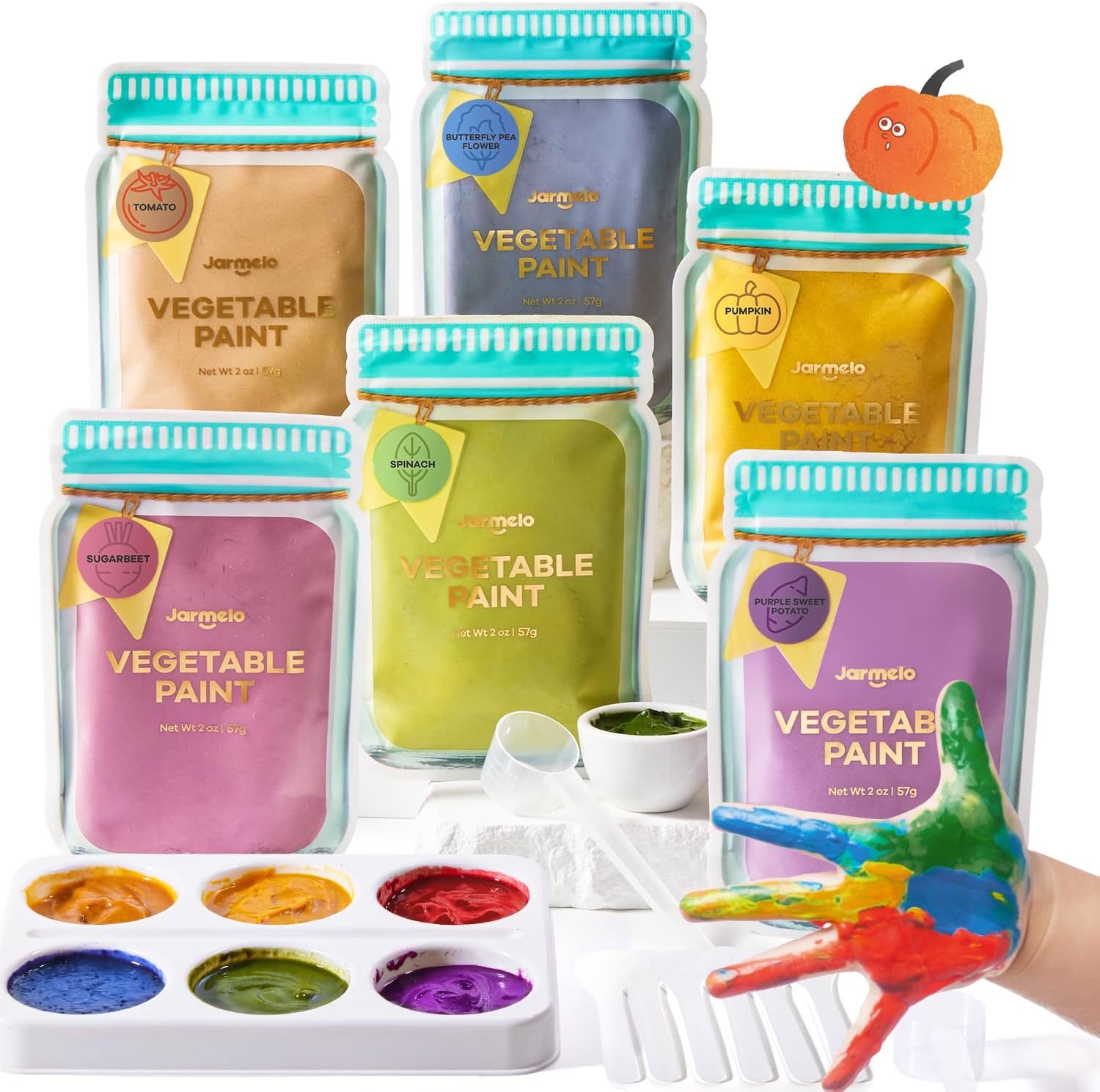
Jar Melo’s powder set includes six colors, a mixing palette, two spoons and six stirring sticks. The listing says the paint is made from pure vegetable powder and food-grade thickeners, with no additives, and is suitable from 10 months.
Mixed with warm water, it becomes a creamy, mousse-like paint that the seller says washes easily from skin and most surfaces. The listing also notes that porous fabrics and wood can absorb it, which is an honest and useful caution.
Six colors give more variety than Lattooland’s four, while keeping the same mix-fresh benefit.
Best suited for: Toddlers 10 months and up, and parents who prefer to prepare paint fresh.
Key features:
- 6 vegetable paint powders, 60 g each
- Palette, spoons and stirring sticks
- Food-grade thickeners
- Suitable from 10 months per listing
Pros:
- More colors than most powder kits
- Mixing tools included
- Clear cleanup guidance
Cons and limitations:
- Requires prep time
- May stain porous fabric and wood
Buying consideration: Dress kids in old clothes, since the listing warns about porous fabrics.
5. Colorations Paraben-Free Simply Washable Tempera — Best for classrooms and big projects

Colorations is a familiar name in schools, and this Rainbow Plus pack provides eight 16 oz bottles: red, orange, yellow, green, blue, purple, black and white. The formula is described as paraben-free, made in the USA and certified with the AP Seal for safety.
The listing also says it does not include latex, dairy, casein, egg, gluten, peanut, tree nuts or soy, which is helpful for classrooms managing allergies. It works on paper, canvas, wood, cardboard, cardstock and papier-mache, and the seller says it will not chip, flake or crack when dry.
Its eco angle is narrower than the powder kits, but large refillable-size bottles reduce packaging per ounce compared with many tiny pots.
Best suited for: Teachers, homeschoolers and families who paint often and in volume.
Key features:
- 8 colors, 16 fl oz each
- Paraben-free, AP Seal certified
- Allergen-conscious ingredient list
- Made in the USA
Pros:
- Large volume for the price
- Black and white for mixing tints and shades
- Multi-surface use
Cons and limitations:
- Liquid format needs preservatives
- Eco claims are more about formula safety than natural pigments
Buying consideration: Decant into small cups for kids and keep the big bottles capped to keep paint fresh.
6. ABEIER Washable Finger Paint, 12 Colors — Best for budget color range

ABEIER offers 12 colors in 1.21 fl oz containers, including white and black, at the lowest price tier in this guide. The seller states it conforms to ASTM D-4236 and describes it as non-toxic and environmentally friendly.
Those eco claims are general rather than specific, so treat this as a budget, non-toxic option with a wide palette rather than a deep-green choice. It suits families who want variety for color-mixing play without paying premium prices.
Best suited for: Toddlers 1 to 3 and families who want lots of colors cheaply.
Key features:
- 12 colors, 1.21 fl oz each
- ASTM D-4236 conforming
- Washable from skin, fabric and plastic per listing
Pros:
- Lowest price tier
- Widest color range here
- Creamy texture
Cons and limitations:
- General, less specific eco claims
- Small containers run out quickly
Buying consideration: Choose this for value and variety; choose powders or Honeysticks if packaging and ingredients matter most.
Buying Guide: How to Choose Eco-Friendly Paints for Kids
Read the specific claim
Look for named ingredients (mineral pigments, vegetable powders, gum arabic) or named packaging (recycled plastic, FSC cardboard, compostable pouches). Vague words like “green” or “natural” alone tell you little.
Match the format to the age
Babies and young toddlers do well with taste-safe powders mixed thick. Toddlers enjoy creamy finger paint. Preschoolers and up can handle tempera with brushes.
Consider powder versus liquid
Powders store longer, need fewer preservatives and let you mix only what you need. Liquids are ready instantly and better for busy classrooms.
Check safety certifications
ASTM D-4236 conformance and AP certification are useful signals. Natural ingredients do not replace these safety statements.
Think about color brightness
Earth and vegetable pigments give softer, natural hues. If your child loves neon, a non-toxic conventional paint with recycled packaging may be a better compromise.
Plan for cleanup
Even washable paint can stain porous fabric and raw wood. Use smocks, cover surfaces and wash promptly.
Reduce waste beyond the paint
Reuse jars for water, paint on scrap cardboard, and choose larger containers when you paint often.
Low-Waste Painting Habits at Home
The paint is only one part of a greener art routine. Use the back of old drawings, cereal boxes and delivery cardboard as painting surfaces. Rinse brushes in a jar rather than under a running tap, and let the pigment settle before pouring off clear water. Wash and reuse yogurt cups as paint pots, and pick washable brushes with wooden or bamboo handles that will last for years.
Eco-Friendly Painting Projects to Try
Natural paints shine on natural surfaces. Try our guide to making painted rock critters with kids using stones from a walk, or follow the simple easy ladybug painting tutorial for kids on scrap cardboard.
Common Mistakes to Avoid
- Assuming “natural” means safe to eat. Follow age guidance and supervise.
- Mixing too much powder paint at once, then throwing the rest away.
- Expecting vegetable colors to stay bright for years on display.
- Using eco paint on fabric you want to keep clean; some natural colors stain.
- Ignoring packaging when comparing brands.
- Buying tiny pots for heavy users, which creates more waste per ounce.
FAQs
What is the most eco-friendly paint for kids?
Among the picks here, the Natural Earth Paint Petite Kit makes the most specific claims, with mineral pigments, organic cornstarch and gum arabic, and compostable pouches in a recycled paper box.
Is natural paint safe for babies?
Some powders, such as Lattooland and Jar Melo, are described by their sellers as taste-safe and suitable from 6 or 10 months. Always supervise and follow the stated age range.
Are washable paints bad for the environment?
Not necessarily. Most kids’ washable paints are water-based. Their environmental impact depends on pigments, preservatives and packaging, so check each brand.
Do natural paints stain clothes?
They can. Vegetable and mineral colors may stain porous fabrics, and Jar Melo’s listing specifically warns about this. Use smocks and wash promptly.
How do I store powder paint?
Keep unused powder dry and sealed. Once mixed with water, use it soon; mixed natural paint has no strong preservatives and can spoil.
Is paraben-free paint more eco-friendly?
Paraben-free refers to the preservative system. It is a formula choice that some parents prefer, but it does not on its own make a paint natural or low-waste.
Final Recommendation
Decide which part of “eco” matters most to you. For natural ingredients and low-waste packaging together, the Natural Earth Paint Petite Kit leads. Honeysticks is the best toddler finger paint for packaging. Lattooland and Jar Melo are the taste-safe powder picks for the youngest painters, with Jar Melo offering more colors. Classrooms will get the most value from Colorations paraben-free tempera, and ABEIER is the budget choice when a wide palette matters more than detailed green credentials.