PaintingProGuide is reader-supported. When you buy through links on this page we may earn an affiliate commission at no extra cost to you.
STEAM adds the A for Art to science, technology, engineering and math, and painting is one of the easiest ways to bring those subjects together. Mixing primary colors is a chemistry-flavored experiment in how pigments combine. Building and decorating a birdhouse is engineering with a creative finish. Painting symmetrical patterns is geometry you can hang on the fridge. The best STEAM paint sets for kids are the ones that make those connections natural: kits that involve building, mixing, observing or designing, not just filling in a picture.
A “STEAM” label on the box does not guarantee any of that, so for each set below we explain which skills it can genuinely support and give a simple activity to make the link explicit.
Quick answer: For building plus painting, the CRAFTY HAPPITOYS 9 birdhouses and 9 wind chimes kit is the strongest STEAM pick: kids assemble wooden structures, then design and paint them. For color-mixing science with figurines, the Funto Paint Your Own Unicorn kit includes instructions for mixing colors. For older kids, the Shuttle Art 69-piece set supports deeper color theory and design projects.
Our Top Picks at a Glance
- CRAFTY HAPPITOYS 9 Birdhouses and 9 Wind Chimes — Best engineering-plus-art kit
- Funto Paint Your Own Unicorn Painting Kit — Best color-mixing kit for young kids
- Shuttle Art 69 Pack Kids Paint Set — Best for color theory and design
- Inburit Acrylic Paint Set with Canvas — Best for observation and planning
- Jar Melo Kids Tempera Painting Set — Best for color experiments with washable paint
- Shuttle Art Washable Finger Paint Set, 53 PCS — Best sensory STEAM for preschoolers
| Product | Best For | Key Spec | Key Strength | Price Tier |
|---|---|---|---|---|
| CRAFTY HAPPITOYS Kit | Engineering + art | 9 birdhouses, 9 wind chimes, paint, brushes | Build then decorate | $$ |
| Funto Unicorn Kit | Color mixing, ages 3+ | 6 figurines, 6 paint pots, brush, guide | Mixing instructions | $$ |
| Shuttle Art 69 pcs | Color theory, ages 8+ | 30 acrylics, 19 brushes, canvases, easel | Depth for projects | $ |
| Inburit Acrylic Set | Observation, ages 8+ | 18 acrylics, canvases, pad, easel | Sketch-plan-paint | $$ |
| Jar Melo Tempera | Experiments, ages 4 to 8 | 24 washable tempera, bucket palette | Washable color lab | $$ |
| Shuttle Art Finger Paint | Sensory, ages 3 to 6 | 14 washable colors, tools, smock | Hands-on exploration | $$ |
How We Chose
We have not run these kits in our own classrooms or homes. The picks are based on the Amazon listing details and specifications checked in October 2026, how naturally each kit connects painting with science, engineering, technology or math concepts, and how widely each product is reviewed by Amazon buyers.
- Genuine STEAM link: building, mixing, measuring, observing or designing, not just a label.
- Age fit: sensory and mixing for young kids, design and theory for older ones.
- Group use: individually packed kits for classrooms where possible.
- Stated safety: non-toxic and washable claims as listed.
- Open-endedness: room for children to make their own design choices.
Best STEAM Paint Sets for Kids Reviewed
1. CRAFTY HAPPITOYS 9 Birdhouses and 9 Wind Chimes — Best for engineering plus art

This kit contains 18 individually wrapped projects: 9 wooden birdhouse kits and 9 wooden wind chimes, each with a paintbrush and paints, according to the listing. Children build the structure using pictorial instructions, then paint and decorate it. The listing describes smooth wooden boards and non-toxic paint and targets ages roughly 4 to 8.
This is the clearest STEAM pairing on the list. Assembling a birdhouse involves following a sequence, fitting parts and understanding structure; a wind chime adds a little sound science. Decorating comes last, so design choices sit on top of real engineering.
Individually wrapped kits make it ideal for classrooms, scout groups and parties.
Best suited for: Kids about 5 to 9, classrooms, camps and group activities.
Key features:
- 9 wooden birdhouse kits
- 9 wooden wind chime kits
- Paint and brush with each
- Pictorial instructions
Pros:
- Build-then-paint engineering
- Individually packed
- Finished items to use outdoors
- Good group value
Cons and limitations:
- Small paint portions
- Younger kids may need help assembling
- Outdoor use needs sealing
Buying consideration: Ask kids to predict which birdhouse design will shed rain best before painting, then test with a spray bottle.
2. Funto Paint Your Own Unicorn Painting Kit — Best for color mixing for young kids

Funto’s kit includes 6 figurines, 6 paint pots, 1 brush and instructions on how to mix colors, per the listing. It is described as non-toxic and suited to kids around 3 and up, and the figurines can be used for storytelling play after painting.
The mixing instructions are what make it STEAM-friendly. Children can predict what happens when they combine two colors, test it on the palette, and record results before painting their figures.
Painting a three-dimensional object also builds spatial awareness.
Best suited for: Kids about 3 to 7 learning colors and fine motor control.
Key features:
- 6 figurines
- 6 paint pots
- 1 brush
- Color-mixing instructions
Pros:
- Built-in color science
- Painting in 3D
- Play after painting
- Low-to-mid price tier
Cons and limitations:
- Only one brush
- Small paint pots
- Unicorn theme is specific
Buying consideration: Make a simple chart: draw two circles plus an equals sign and let kids paint the result of each mix.
3. Shuttle Art 69 Pack Kids Paint Set — Best for color theory and design

Shuttle Art’s 69-piece set includes a wood table easel, 30 acrylic colors in 12 ml tubes, 7 blank and 7 themed 8×10 canvases, a smock, a 16-sheet acrylic pad, 19 brushes, a palette, water bucket and storage bag, per the listing. It states ASTM D-4236 and EN71 conformance.
For older kids, STEAM painting can mean color theory (complementary colors, tints and shades), perspective and proportion, or design challenges. Thirty colors and a pad provide space for experiments, while canvases are for applying what they learned.
It suits children around 8 to 14.
Best suited for: Kids 8 and up exploring color science, design and art together.
Key features:
- 30 acrylics, 12 ml
- 19 brushes, palette
- 14 canvases, 16-sheet pad
- Easel, smock, water bucket
Pros:
- Room for experiments
- Easel for design work
- Lots of brushes
- Stated safety standards
Cons and limitations:
- Small tubes
- Acrylic is permanent on fabric
- Mid price tier
Buying consideration: Challenge kids to paint the same landscape in warm colors and then in cool colors, and compare the mood.
4. Inburit Acrylic Paint Set with Canvas — Best for observation and planning

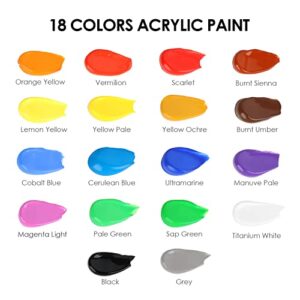
Inburit includes 18 acrylic colors, 8 brushes, five 8×10 canvases, a 15-sheet pad, a palette and a tabletop easel, per the listing.
Scientific observation and art share a core skill: looking carefully. Kids can sketch a leaf, shell or insect on the pad, note its shapes and colors, then paint a careful study on canvas. That is the same process naturalists used before photography.
Fewer colors encourage mixing to match what they see.
Best suited for: Kids 8 and up interested in nature study and observational drawing.
Key features:
- 18 acrylic colors
- 8 brushes
- 5 canvases, 15-sheet pad
- Tabletop easel, palette
Pros:
- Pad for sketches and notes
- Encourages color matching
- Complete kit
- Gift-ready
Cons and limitations:
- Fewer colors and brushes
- No smock
- Not for toddlers
Buying consideration: Create a “field journal” page: sketch, label parts, then paint the specimen.
5. Jar Melo Kids Tempera Painting Set — Best for color experiments with washable paint

Jar Melo offers 24 washable tempera colors (15 ml each) with 3 brushes, a palette, a storage bucket and a wash bucket, per the listing. The bucket lid becomes a palette and the base doubles as a rinse cup.
Washable tempera is ideal for messy color experiments with younger kids: mixing, layering and testing how much white makes a tint. The all-in-one bucket keeps a “color lab” organized.
The listing targets ages 4 to 8.
Best suited for: Kids about 4 to 8 doing color experiments at home or in class.
Key features:
- 24 washable tempera colors
- 3 brushes, palette
- Storage and wash bucket
- Portable
Pros:
- Washable
- Organized lab-style kit
- Vivid colors per listing
- Good color range
Cons and limitations:
- Tempera cracks if applied thick
- Few brushes
- Small bottles for groups
Buying consideration: Have kids make a tint ladder: one drop of color, then add white step by step and paint each result.
6. Shuttle Art Washable Finger Paint Set, 53 PCS — Best for sensory STEAM for preschoolers

Shuttle Art’s 53-piece finger paint set includes 14 washable colors in 2 oz bottles, classic, neon and glitter, plus over 30 tools such as brushes and a pad, and a waterproof smock, per the listing.
For preschoolers, STEAM starts with the senses: how paint feels, how it spreads, what happens when colors meet. Finger paint, sponges and stamps make cause and effect visible.
It also introduces patterns and shapes through stamping.
Best suited for: Preschoolers about 3 to 6.
Key features:
- 14 washable finger paints, 2 oz
- Brushes, sponges, stamps, pad
- Waterproof smock
- Classic, neon, glitter colors
Pros:
- Washable
- Sensory learning
- Pattern tools
- Smock included
Cons and limitations:
- Not for detail
- Pad is consumable
- Glitter can spread
Buying consideration: Ask, “What happens if we mix blue and yellow with our fingers?” and let them discover green.
STEAM Lessons You Can Teach With Paint
Science: color mixing and pigments
Start with primaries and let kids predict and test mixtures. Older children can explore complementary colors, which neutralize each other when mixed, and why adding white makes a tint while black makes a shade.
Technology: tools and processes
Compare how different brushes, sponges and rollers apply paint. Kids can document results with photos and make a “tool guide” for classmates.
Engineering: build, then decorate
Birdhouses, cardboard sculptures and paper models give painting a structural base. Discuss how paint protects wood from weather.
Art: design choices
Give a brief: design a birdhouse that attracts attention, or a rock that tells a story. Children explain their choices.
Math: symmetry, pattern and measurement
Fold paper for symmetrical blot paintings, paint repeating patterns, or measure and mark a grid before painting. Older kids can enlarge a small drawing using a grid, a technique artists have used for centuries, which quietly teaches ratio and scale.
Bringing it together
The strongest STEAM moments happen when children explain their thinking. After any project, ask three questions: What did you expect? What actually happened? What would you change next time? Writing or drawing the answers in a simple notebook builds the habits of a scientist and an artist at the same time, and gives you a record of how their thinking grows over a term.
A Five-Day STEAM Painting Plan
If you want a structure for a school break or a homeschool week, this plan uses any of the sets above with a few household extras.
Day 1: Predict and mix. Give children red, yellow, blue and white. Before mixing, they draw a chart and guess each result. Then they test and paint swatches beside their guesses. Discuss which predictions were right and why.
Day 2: Tools investigation. Paint the same shape five times using a flat brush, a round brush, a sponge, a cotton swab and a fingertip. Kids describe the texture and edge each tool makes and decide which is best for grass, clouds or dots.
Day 3: Symmetry. Fold paper in half, paint on one side only, press and open. Talk about lines of symmetry, then paint a symmetrical butterfly or ladybug on purpose.
Day 4: Build. Assemble a birdhouse, cardboard box house or paper sculpture. Paint it, thinking about which colors stand out and which blend in, the way animals use camouflage.
Day 5: Design challenge. Give a brief such as “paint a rock that would help someone find their way home”. Children plan on paper, paint, then present their design and explain the choices.
Each day takes 30 to 60 minutes and builds a vocabulary of color, pattern and structure that carries into later art and science lessons.
Buying Guide: How to Choose STEAM Paint Sets for Kids
Look for a real activity
Building, mixing instructions or experiments are signs of a genuine STEAM kit.
Match to age
Sensory and color mixing for ages 3 to 6; building and observation for 5 to 9; color theory and design for 8 and up.
Check group suitability
Individually wrapped kits save time in classrooms and make sure every child has the same materials to work with.
Consider outdoor use
Birdhouses and wind chimes need a clear sealer if they will be outside. Sealing is a good lesson in itself: why does water damage wood and paint?
Add a notebook
A simple journal for predictions and results turns any paint set into a STEAM activity. Even a few stapled sheets work; what matters is that children record what they guessed, what happened and what they learned, in words or pictures.
Easy Projects to Start
Painted rocks combine observation (shape, texture) with design; try our painted rock critters guide. A ladybug painting introduces symmetry, and a dinosaur painting can lead into a science conversation about fossils and color guesses.
Common Mistakes to Avoid
- Trusting the label alone. Check for an actual STEAM activity.
- Doing the building for them. Struggle is part of engineering.
- Skipping predictions. Ask kids to guess before mixing or testing.
- Using acrylic with toddlers. Washable paint is better for experiments.
- Not sealing outdoor projects. Paint fades and peels without protection.
- Ending at “pretty”. Ask kids to explain what they discovered.
FAQs
What makes a paint set STEAM?
A real link to science, technology, engineering or math, such as color-mixing experiments, building a structure to paint, or design challenges with measurement and symmetry.
What is the best STEAM activity with paint?
Color mixing is the simplest. Build-and-paint projects like birdhouses add engineering, and observational painting adds science.
Are STEAM kits good for classrooms?
Yes, especially individually wrapped kits that give each child their own materials and project.
What age are STEAM paint kits for?
Many target 3 to 8, but older kids can do deeper STEAM work with acrylic sets and design briefs.
How do I make painting more educational?
Ask kids to predict, test and record. Talk about why colors change, how tools affect marks and how structures are built.
Do painted birdhouses need sealing?
If they go outside, yes. A clear outdoor sealer protects paint and wood from rain and sun.
Final Recommendation
For a true STEAM project, the CRAFTY HAPPITOYS birdhouse and wind chime kit combines building and painting. Young children will learn color science with Funto’s figurine kit, and older kids can explore color theory and design with the Shuttle Art 69-piece set or observational painting with Inburit.
Jar Melo’s washable tempera bucket is a tidy color lab for ages 4 to 8, and Shuttle Art’s finger paint set is the sensory starting point for preschoolers.