
PaintingProGuide is reader-supported. When you buy through links on this page we may earn an affiliate commission at no extra cost to you.
Nobody paints a whole ceiling with a brush. The field is rolled, and the brush does the part that decides whether the job looks professional: cutting a clean line where the ceiling meets the wall, working around light fixtures, vents and beams, and getting into corners a roller cannot reach. That work happens overhead, often from a ladder, with paint trying to run down the handle. The best paint brushes for ceilings are 2 to 2.5 inch angled sash brushes with synthetic filaments for water-based ceiling paint, short or adjustable handles for control at awkward angles, and, for high ceilings, a brush that threads onto an extension pole so you can cut in from the floor.
Quick answer: For most ceiling cut-in work, the Wooster Shortcut 2 inch angle sash brush is our top pick: a 2 inch nylon-polyester angled head on a flexible handle only about 2 inches long, which keeps your hand close to the work for precise lines overhead. For high or vaulted ceilings, the ROLLINGDOG 2.5 inch adjustable angle brush locks at six angles and threads onto an extension pole. To roll the field as well, the Rhibak 27-piece roller kit includes 9 inch and 4 inch rollers, brushes and a 2 to 4 foot pole.
A brief note on scope: ceiling painting is home-improvement work rather than fine art, but many painters on this site paint their own studios, and some paint decorative ceiling murals. The brush advice here applies to both.
How Ceiling Painting Works
Cutting in first
Painters brush a band of paint 2 to 3 inches wide around the edges of the ceiling and around fixtures before rolling. The roller then blends into this band. Cutting in is where an angled brush earns its keep.
Rolling the field
The main area is rolled in sections while the cut-in band is still wet, which prevents visible lines where brush and roller meet. A 9 inch roller on an extension pole is the standard tool.
Working overhead
Painting above your head is tiring and messy. Short or angled handles keep the brush stable, and loading the brush lightly reduces drips running down the handle and your arm.
Ceiling paint
Most ceiling paints are flat, water-based acrylic designed to hide imperfections and reduce spatter. Synthetic nylon and polyester brushes are the right match.
Textured ceilings
Popcorn and knockdown textures are fragile and absorbent. Use a thick-nap roller and a soft, well-loaded brush with light pressure, and test a small area first; some old textures loosen when wet.
Our Top Picks at a Glance
- Wooster Shortcut 2 Inch Angle Sash Brush — Best overall brush for ceiling cut-in
- ROLLINGDOG 2.5 Inch Adjustable Angle Brush — Best for high and vaulted ceilings
- PinStone 3-Pack 2 Inch Short-Handle Angled Brushes — Best value short-handle brushes
- Rhibak 27-Piece Paint Roller Kit with Pole — Best complete ceiling kit
- Coltree 5-Piece Flat and Angle Brush Set — Best mixed-size set for beams and trim
- Pro Grade 5-Piece Brush Set — Best budget set with angle stubby
- Bates 6-Pack Flat and Angled Brushes — Best spares for primer and touch-ups
| Product | Best For | Key Spec | Key Strength | Price Tier |
|---|---|---|---|---|
| Wooster Shortcut 2″ | Precise cut-in overhead | 2″ angle, nylon-polyester, ~2″ flexible handle | Hand close to the work | $ |
| ROLLINGDOG 2.5″ Adjustable | High ceilings | 2.5″ SRT synthetic, 6 locking angles, pole thread | Cut in from the floor | $ |
| PinStone 3-Pack 2″ | Value cut-in | 3 x 2″ angled, synthetic, rubber short handle | Three brushes | $ |
| Rhibak 27-Piece Kit | Rolling and brushing | 9″ and 4″ rollers, covers, brushes, 2–4 ft pole | Everything in one | $$ |
| Coltree 5-Piece | Beams, trim, edges | 1″ and 2″ flat, 1.5″, 2″, 2.5″ angle | Mixed shapes | $ |
| Pro Grade 5-Piece | Budget set | Flats, angles, 2″ angle stubby; SRT filaments | Stubby for tight spots | $ |
| Bates 6-Pack | Primer, spares | 3 flat, 3 angled, natural/synthetic | Lowest cost | $ |
How We Chose
We picked these brushes and tools from the Amazon listing details and specifications checked in October 2026, judging how well each one’s shape, size, filament and handle design suit cutting in and painting ceilings, and how widely each product is reviewed by Amazon buyers. We did not paint ceilings with them. Specifications come from the listings.
- Angled heads around 2 to 2.5 inches for cut-in.
- Synthetic filaments for water-based ceiling paint.
- Handle design: short, flexible or adjustable for overhead control.
- Pole compatibility for high ceilings.
- Complete kits for people who also need rollers.
Best Paint Brushes for Ceilings Reviewed
1. Wooster Shortcut 2 Inch Angle Sash Brush — Best for precise cut-in overhead

The Wooster Shortcut has a 2 inch angled head of white nylon and gold polyester filament, suitable for all paints, set in a brass-plated steel ferrule. Its flexible purple Shergrip handle is only about 2 inches long, which Wooster says adds maneuverability in tight spaces. The packaging even shows the proper holding position.
A short handle changes how you hold the brush: more like a pencil than a stick. Overhead, that puts your fingers right behind the bristles, which gives more control along the ceiling line and around fixtures. Many painters find it less tiring than a full-length sash brush when working above their heads.
Wooster is one of the long-established US brush brands among professional painters, and the Shortcut is a widely used cut-in brush.
Best suited for: Anyone cutting in ceilings from a ladder or step stool.
Key features:
- 2″ angled head
- Nylon and polyester blend for all paints
- Brass-plated steel ferrule
- Flexible ~2″ Shergrip handle
Pros:
- Excellent control
- Comfortable overhead
- Established professional brand
Cons and limitations:
- Short handle means you need to be close to the ceiling
- Single brush
Buying consideration: Load only the bottom third of the bristles to reduce paint running toward your hand.
2. ROLLINGDOG 2.5 Inch Adjustable Angle Brush — Best for high and vaulted ceilings

ROLLINGDOG’s brush has a 2.5 inch angled head of solid round tapered synthetic filament and a rubber handle with a push-button joint that locks at six positions. The handle threads onto standard extension poles, so you can paint high or low out of reach and adjust the angle to work around obstacles.
For tall rooms, stairwells and vaulted ceilings, this is the practical answer. You can set the head at an angle, screw the brush onto a pole and cut in the ceiling line from the floor. It also helps with the tops of walls above cabinets.
Best suited for: Painters with high ceilings, stairwells and awkward overhead areas.
Key features:
- 2.5″ angled head
- SRT synthetic filament
- 6 locking angle positions
- Threads onto extension poles
- Rubber handle
Pros:
- Cut in from the floor
- Adjustable angle
- Fewer ladder moves
Cons and limitations:
- Less precise than a hand-held brush
- Pole sold separately
Buying consideration: Practice the angle on a wall first; cutting in from a pole takes a few minutes to get used to.
3. PinStone 3-Pack 2 Inch Short-Handle Angled Brushes — Best for value cut-in

PinStone’s three-pack includes 2 inch angled brushes with synthetic bristles, stainless steel ferrules and short rubber handles with hanging holes. The listing describes shed-free filaments for smooth finishes and crisp edge lines, and says the short grip gives precise control in confined spaces.
Three short-handle brushes let you keep one for ceiling white, one for wall color and one spare, or let helpers cut in alongside you.
Best suited for: DIY painters who want short-handle angled brushes at a low price.
Key features:
- 3 x 2″ angled brushes
- Synthetic bristles
- Stainless steel ferrule
- Short rubber handle
Pros:
- Three brushes
- Non-slip grip
- Low price tier
Cons and limitations:
- Less established brand
Buying consideration: Use the hanging hole to dry brushes tip-down.
4. Rhibak 27-Piece Paint Roller Kit with Pole — Best for a complete ceiling kit

Rhibak’s kit includes six 4 inch roller covers, six 9 inch roller covers, 4 and 9 inch roller frames, a handle extension pole of about 2 to 4 feet in aluminum alloy, and paint brushes. The listing says it suits all latex and oil paints and stains.
For someone painting a ceiling from scratch, a kit like this removes the guesswork. The 9 inch roller handles the field, the 4 inch roller covers narrow areas and the pole reaches standard ceilings from the floor.
Best suited for: First-time ceiling painters who need rollers, a pole and brushes.
Key features:
- 27 pieces
- 6 x 9″ and 6 x 4″ roller covers
- Roller frames
- 2–4 ft aluminum extension pole
- Brushes included
Pros:
- Complete kit
- Extension pole
- Spare roller covers
Cons and limitations:
- Kit brushes are basic
- Pole is short for very high ceilings
Buying consideration: Pair the kit with a quality angled brush for cutting in.
5. Coltree 5-Piece Flat and Angle Brush Set — Best for beams, trim and edges
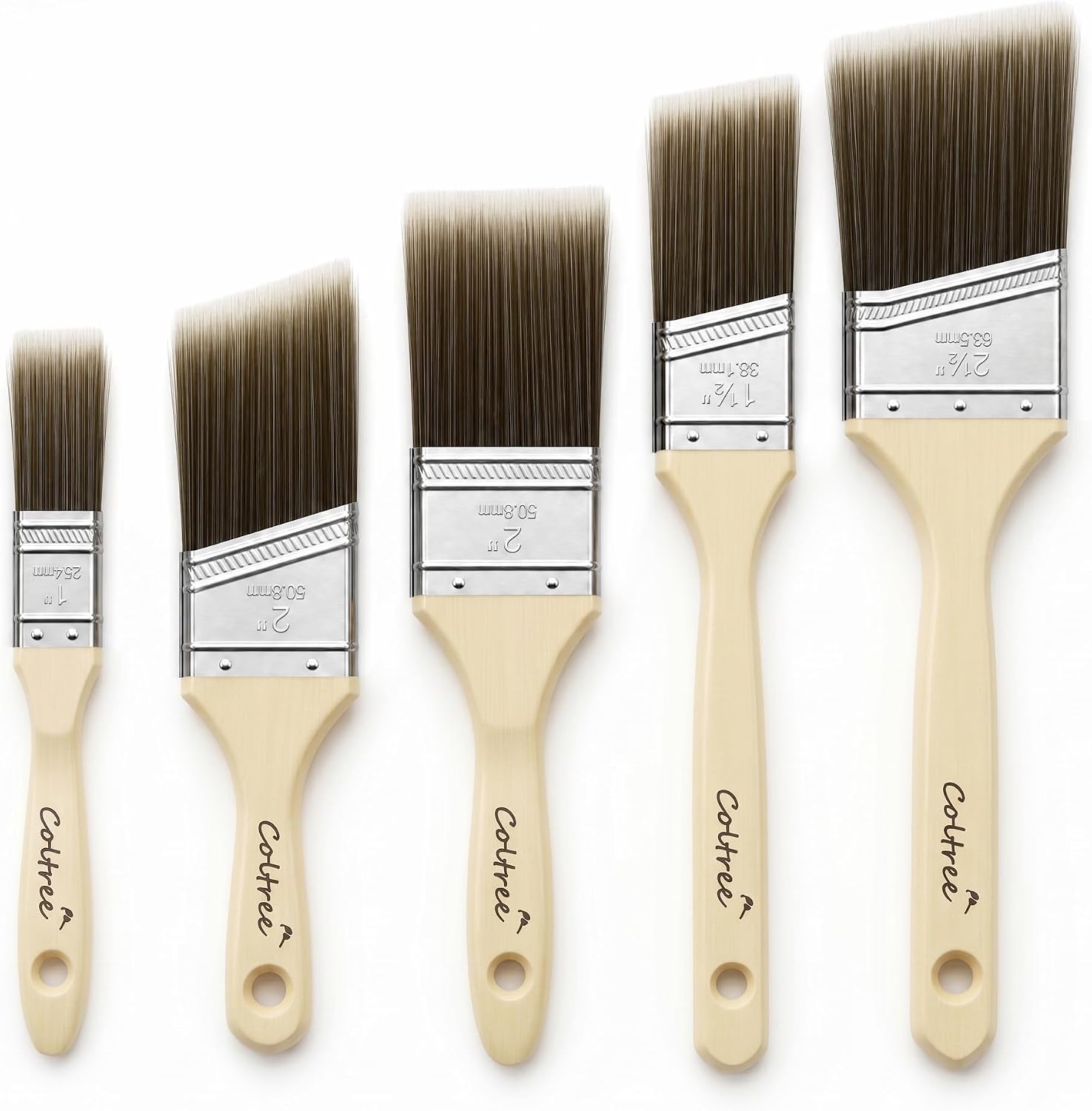
Coltree’s set includes 1 and 2 inch flats and 1.5, 2 and 2.5 inch angled brushes with thick bristles, lightweight solid wood handles and stainless steel ferrules. The listing says they suit oil and water-based paints and stains.
Ceilings with exposed beams, crown molding or tray details need more than one brush size. The flats handle beam faces and the angles cut in along edges.
Best suited for: Ceilings with beams, coffers or molding.
Key features:
- 5 brushes
- 1″ and 2″ flat
- 1.5″, 2″ and 2.5″ angle
- Stainless steel ferrule
Pros:
- Mixed sizes and shapes
- Low price tier
Cons and limitations:
- Long handles less comfortable overhead
Buying consideration: Use the 1.5 inch angle around fixtures and vents.
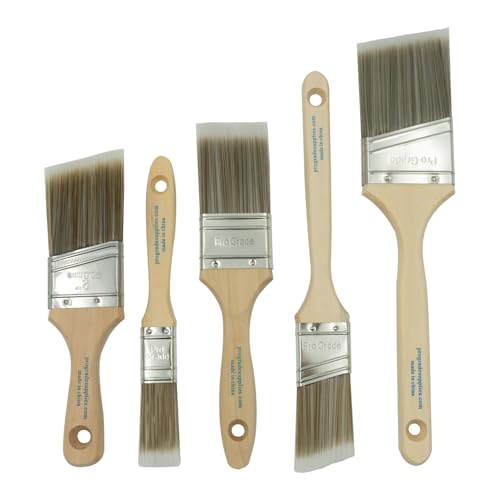
6. Pro Grade 5-Piece Brush Set — Best for a budget set with angle stubby

Pro Grade’s five-piece set includes a 1 inch flat, 1.5 inch angle, 2 inch flat, 2 inch angle stubby and 2.5 inch angle, with SRT filaments and adhesive-bonded bristles.
The 2 inch angle stubby is the most useful piece for ceilings, giving short-handle control at a budget price.
Best suited for: Budget DIY projects.
Key features:
- 5 brushes
- Angle stubby included
- SRT filaments
Pros:
- Stubby for control
- Very low cost
Cons and limitations:
- Budget quality
Buying consideration: Keep the stubby for ceiling lines and the others for walls and trim.
7. Bates 6-Pack Flat and Angled Brushes — Best for primer and touch-ups

Bates’ six-pack has three flats and three angled brushes from 1 to 2.5 inches, with natural bristles mixed with synthetic filaments.
They are useful as spares for primer, stain-blocking sealer on water-stained ceilings, and touch-ups.
Best suited for: Spares and primer work.
Key features:
- 6 brushes
- 3 flat, 3 angled
- Natural and synthetic blend
Pros:
- Lowest cost
- Two shapes
Cons and limitations:
- Natural blend less ideal for water-based paint
Buying consideration: Use with oil-based stain-blocking primers on ceiling water marks.
How to Cut In a Ceiling Line
- Protect floors and furniture and remove or cover light fixtures.
- Dip the brush about a third of the way and tap off excess.
- Start a little away from the corner, then guide the angled tip toward the line in a smooth stroke.
- Paint a band 2 to 3 inches wide along the edge.
- Cut in one wall’s length, then roll that section while the band is wet.
- Repeat around the room, keeping a wet edge.
Avoiding Drips and Spatter
- Load brushes lightly and wipe the ferrule regularly.
- Use ceiling paint, which is formulated to reduce spatter.
- Wear safety glasses; paint drips overhead.
- Work in sections small enough to keep a wet edge.
- Keep a damp rag handy for wall drips.
Ladder and Comfort Tips
Comfort affects line quality more than people expect. Position the ladder so the section you are cutting is slightly in front of you rather than directly overhead, which reduces neck strain. Move the ladder often instead of reaching. A small paint cup or handheld pail on a strap lets you keep one hand free for the ladder. Take breaks every 20 to 30 minutes; tired arms make shaky lines.
Ceiling Murals and Decorative Ceilings
Painters who create sky ceilings, star fields or decorative borders face the same overhead challenges. Base coats and gradients are rolled or brushed with wide brushes, and details are added with artist brushes on short handles or with a stable platform rather than a ladder. Breaks are important; working overhead fatigues arms quickly.
Buying Guide: How to Choose Brushes for Ceilings
Angled heads
Angled sash brushes around 2 to 2.5 inches give the cleanest ceiling lines.
Handle length
Short handles give control overhead; adjustable, pole-ready brushes reach high ceilings.
Filament
Synthetic nylon and polyester for water-based ceiling paint; they hold their shape and release paint evenly.
Rollers and poles
You will need a roller and extension pole for the field; kits simplify this for first-timers.
Quality versus quantity
One good cut-in brush plus inexpensive spares is a sensible mix. The cut-in line is what people notice, so that is where to spend; primer and touch-ups can use cheaper brushes.
Comfort
Rubber grips and light weight reduce fatigue, which matters when your arm is raised for long stretches.
Related Brush Care Guides
Keep your cut-in brush in top shape with tips to prevent shedding and how to dry brushes properly, and see our large brush techniques for broad coverage.
Common Mistakes to Avoid
- Cutting in the whole room first, then rolling after the band has dried.
- Overloading the brush and getting drips down your arm.
- Using a long-handled brush on a ladder where you cannot control it.
- Painting a textured ceiling with heavy pressure.
- Skipping eye protection.
- Painting with poor lighting, which hides thin spots and missed edges until the paint dries.
FAQs
What brush is best for cutting in a ceiling?
A 2 to 2.5 inch angled sash brush with synthetic filament; short handles add control.
Can I cut in a ceiling with an extension pole?
Yes, with a pole-compatible adjustable brush such as the ROLLINGDOG.
Should I cut in or roll first?
Cut in a section, then roll it while the cut-in band is still wet.
How do I avoid lines where brush and roller meet?
Keep a wet edge by rolling soon after cutting in each section.
What paint is best for ceilings?
Flat ceiling paint, which hides imperfections and reduces spatter.
How do I paint a popcorn ceiling?
Use a thick-nap roller and a soft brush with light pressure; test a small area first.
Final Recommendation
For cutting in ceilings, the Wooster Shortcut is the best brush for control overhead. Choose the ROLLINGDOG adjustable brush for high and vaulted ceilings, and PinStone’s three-pack for value short-handle brushes. If you also need rollers, the Rhibak kit covers everything. Coltree suits beams and molding, Pro Grade is a budget set with a useful stubby, and Bates brushes are spares for primer and touch-ups.




