

PaintingProGuide is reader-supported. When you buy through links on this page we may earn an affiliate commission at no extra cost to you.
Small children grip a brush with their whole fist, press hard and scrub, so the brushes adults use are almost guaranteed to frustrate them. Good paint brushes for kids have short, chunky handles that are easy to hold, sturdy bristles that survive pressing and scrubbing, and ferrules that do not shed hairs into the paint. As children grow, they need thinner handles and a wider variety of shapes, including fine rounds for detail and flats for filling. The best brushes for kids match that stage.
This guide compares six brush sets on Amazon, from chunky toddler brushes to mixed-shape value packs, foam and nylon classroom assortments and a bulk pack for groups. It also explains which brush shapes to give at which age and how to keep kids’ brushes usable longer.
Quick answer: For toddlers and preschoolers, the Anezus 10-piece chunky brush set is the best pick: five round and five flat brushes with thick, colorful handles and rust-proof ferrules, designed for washable, tempera and acrylic paint. For early elementary kids who want to try different strokes, the Horizon Group USA 35-piece value pack mixes chubby, foam, nylon, angled, liner and shader brushes. For classrooms, the ONEXIZ 162-piece bulk pack gives every child a flat and a round brush.
Brushes by Age
| Age | Handle | Shapes | Good fits |
|---|---|---|---|
| 2–4 | Short and chunky | Large round and flat, foam | Anezus, YGAOHF chubby sets |
| 4–7 | Short, medium thickness | Round, flat, foam, a liner | Horizon Group 35, KEVIN&SASA 15 |
| 7–12 | Standard craft handles | Round, flat, angle, fan, detail | KEVIN&SASA 15, Cra-Z-Art 7 |
| Classrooms | Mixed | Flat + round per child | ONEXIZ 162 |
Our Top Picks at a Glance
- Anezus 10-Piece Chunky Kids Paint Brushes — Best for toddlers and preschoolers
- YGAOHF 10-Piece Chubby Toddler Brushes — Best short-handled alternative
- Horizon Group USA 35-Piece Value Pack — Best variety for young kids
- KEVIN&SASA CRAFTS 15-Piece Value Pack — Best shape mix for school-age kids
- ONEXIZ 162-Piece Bulk Brushes — Best for classrooms
- Cra-Z-Art 7-Count Artist Brushes — Best low-cost starter pack
| Product | Best For | Key Spec | Key Strength | Price Tier |
|---|---|---|---|---|
| Anezus 10 Chunky | Toddlers | 5 round + 5 flat; chunky handles | Rust-proof ferrules | $ |
| YGAOHF 10 Chubby | Toddlers | 10 round and flat; 6.5 in long | Easy-grip plastic handles | $ |
| Horizon Group 35 | Ages 4–7 | 35 brushes incl. chubby, foam, nylon, liner | Many brush types | $ |
| KEVIN&SASA 15 | Ages 5–12 | 15 brushes: fan, bright, detail, round, mop, angle | Silicone handles | $ |
| ONEXIZ 162 | Groups | 81 flat + 81 round | Bulk quantity | $ |
| Cra-Z-Art 7 | Budget starter | 7 assorted sizes | Lowest tier | $ |
How We Chose
These brush sets were selected from Amazon listing details and specifications checked in October 2026, judging handle size and grip, bristle durability, shape variety and quantity for different ages, and how widely each set is reviewed by Amazon buyers. We have not used these brushes with children. Age guidance reflects common practice.
- Grip — chunky handles for little hands.
- Durability — bristles that survive scrubbing.
- Shedding — firmly fixed bristles.
- Shape variety — round, flat and specialty shapes as kids grow.
- Quantity — single sets versus classroom packs.
Best Paint Brushes for Kids Reviewed
1. Anezus 10-Piece Chunky Kids Paint Brushes — Best for toddlers and preschoolers
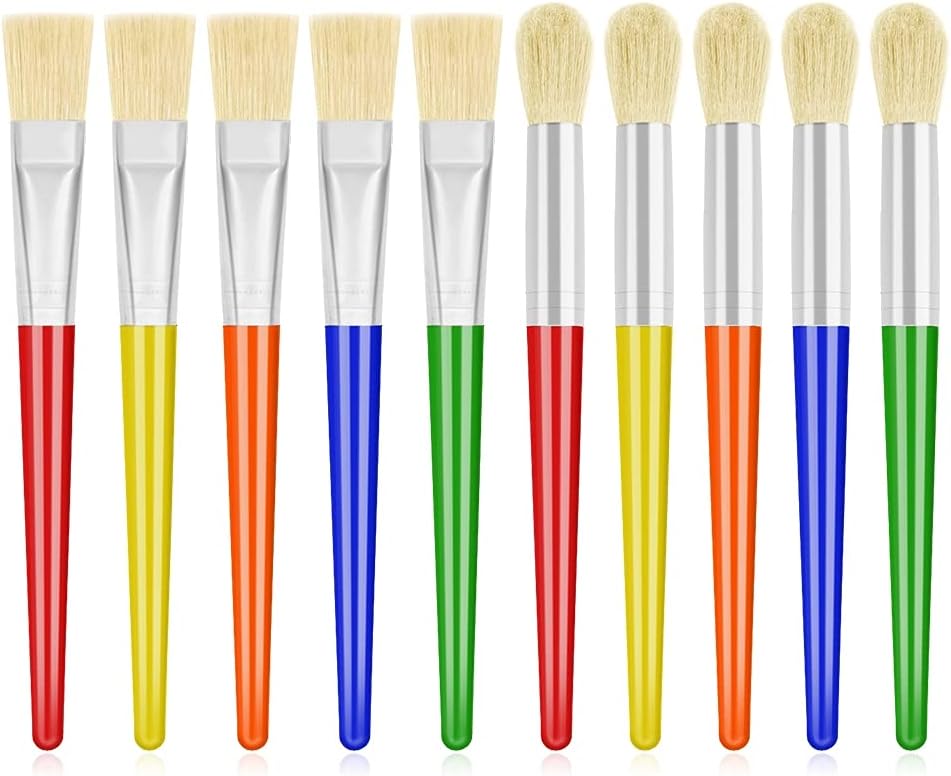
Anezus makes this set specifically for young children: five round and five flat brushes with large, chubby, brightly colored handles. The listing describes soft hog bristle, rust-proof ferrules and bristles firmly fixed to resist falling out.
Chunky handles let toddlers use a natural fist grip, and the round-plus-flat mix lets them make both dots and broad strokes.
It works with washable paint, tempera and acrylic, and cleans with warm soapy water.
Best suited for: Children around 2 to 5.
Key features:
- 10 brushes: 5 round, 5 flat
- Large chubby handles
- Hog bristle
- Rust-proof ferrules
Pros:
- Easy for small hands
- Sturdy bristles
- Low tier
Cons and limitations:
- Not for fine detail
- Natural bristle holds water longer
- Larger brushes need more paint
Buying consideration: Give toddlers one brush per color so paints stay clean and they do not need to rinse constantly.
2. YGAOHF 10-Piece Chubby Toddler Brushes — Best for a short-handled alternative

YGAOHF’s chubby brushes have bright plastic handles and ferrules and measure 6.5 inches (16 cm) overall, a short length that is easy for small children to control. The set mixes round and flat heads.
The listing notes the bristles are treated with glue for shipping, so they feel stiff at first; wash them before the first use.
They work with washable paint and acrylic.
Best suited for: Toddlers and preschoolers.
Key features:
- 10 round and flat brushes
- 6.5 in overall length
- Plastic handles and ferrules
- Bristles stiffened for shipping
Pros:
- Short and easy to hold
- Plastic resists water damage
- Low tier
Cons and limitations:
- Needs washing before first use
- Natural bristles per details
- Not for detail work
Buying consideration: Soak the bristles briefly in warm water and work out the shipping glue before kids use them.
3. Horizon Group USA 35-Piece Value Pack — Best for variety for young kids

Horizon Group USA’s pack includes 35 brushes across many types: chubby rounds, foam brushes in several sizes, nylon flats, angled, spotter, liner and shader brushes. The listing says it is great for groups, classrooms and preschool art.
Foam brushes are excellent for young kids: they hold lots of paint, make smooth strokes and cannot shed bristles.
The variety lets children discover how different tools make different marks.
Best suited for: Kids around 4 to 8, families and small groups.
Key features:
- 35 brushes
- Chubby, foam, nylon, angled, liner, shader
- Works with watercolor, acrylic and washable paint
- Good for groups
Pros:
- Great variety
- Foam brushes for easy coverage
- Low tier
Cons and limitations:
- Quality varies by brush type
- Small detail brushes are easy to lose
- No storage case
Buying consideration: Sort brushes into a cup by type so kids learn which tool does which job.
4. KEVIN&SASA CRAFTS 15-Piece Value Pack — Best for school-age kids

KEVIN&SASA’s 15-piece set includes 1 fan, 2 detail, 2 mop, 3 bright, 3 round and 4 angle brushes with nylon bristles and colorful silicone handles. Each shape has its own head color, which helps kids identify them.
This is a good next step for children who have outgrown chunky brushes and want to try techniques like fan-brush grass or angled strokes.
It works with all paint types according to the listing.
Best suited for: Kids around 5 to 12 exploring different brush shapes.
Key features:
- 15 brushes in 6 shapes
- Nylon bristles
- Silicone handles
- Color-coded heads
Pros:
- Real shape variety
- Comfortable handles
- Low tier
Cons and limitations:
- Mop brushes better for watercolor than thick paint
- Small set for groups
- Budget quality
Buying consideration: Show kids one new shape each session, such as the fan brush for grass, so they learn deliberately.
5. ONEXIZ 162-Piece Bulk Brushes — Best for classrooms and groups

ONEXIZ’s bulk pack contains 81 flat brushes (about 0.59 inch) and 81 round brushes (about 0.39 inch) with nylon bristles and lightweight plastic handles.
One flat and one round per child covers most classroom painting, and bulk quantities mean lost or damaged brushes are easy to replace.
Clean with warm soapy water.
Best suited for: Teachers, camps and parties.
Key features:
- 162 brushes: 81 flat, 81 round
- Nylon bristles
- Plastic handles
- Soap-and-water cleanup
Pros:
- Huge quantity
- Low cost per brush
- Simple pairing
Cons and limitations:
- Only two shapes
- Basic quality
- Standard handles, not chunky
Buying consideration: Collect brushes in a bucket of water at the end of class so paint never dries in them.
6. Cra-Z-Art 7-Count Artist Brushes — Best for a low-cost starter pack

Cra-Z-Art’s pack includes seven all-purpose brushes in assorted sizes with translucent handles. The listing describes them as shed-proof and artist quality.
It is the lowest-cost option here, suitable for older kids starting out or as spares.
Standard handles suit kids with a pencil-style grip.
Best suited for: Kids around 7 and up and budget top-ups.
Key features:
- 7 brushes, assorted sizes
- Translucent handles
- Shed-proof per listing
- All-purpose
Pros:
- Lowest tier
- Good spares
- Assorted sizes
Cons and limitations:
- Limited detail in listing
- Not chunky for toddlers
- Small set
Buying consideration: Keep a pack as backups for when favorite brushes get ruined.
Brush Shapes Explained for Parents
- Round: a pointed or domed tip for lines, dots and small shapes. The most versatile shape.
- Flat: a square tip for broad strokes, filling areas and straight edges.
- Foam: a sponge wedge or dome that spreads paint smoothly. Great for toddlers and backgrounds.
- Fan: spread bristles for grass, fur, trees and texture.
- Angle: a slanted flat for curved strokes, leaves and corners.
- Liner or detail: long, thin bristles for whiskers, outlines and writing.
- Mop: a soft, full brush for washes, mostly with watercolor.
Bristle Types
| Bristle | Feel | Best with |
|---|---|---|
| Nylon / synthetic | Springy, smooth, easy to clean | Acrylic, tempera, watercolor |
| Hog bristle | Stiff, holds thick paint | Tempera and thick paint; scrubbing |
| Soft natural hair | Soft, holds water | Watercolor for older kids |
| Foam | No bristles; smooth strokes | Toddlers, backgrounds, stencils |
For most kids, synthetic and foam brushes are the practical choice: they tolerate pressing, survive washing and do not mind acrylic. Stiff hog bristles are useful for thick tempera and for kids who scrub.
Beyond Brushes: Other Tools Kids Love
Painting is not only about brushes, and young children often learn more from other tools at first:
- Sponges cut into shapes for stamping clouds, leaves and patterns.
- Small foam rollers for quick backgrounds.
- Cotton swabs for dot painting and pointillism.
- Old toothbrushes for splatter stars (with adult help).
- Dot daubers and bottle caps for perfect circles.
- Fingers and hands for washable finger painting and handprint art.
Mixing these with a few good brushes gives children a broad sense of how paint can be applied, and many of the tools are already in the kitchen drawer.
Teaching Kids to Care for Brushes
- Rinse between colors in a water cup, then blot on a paper towel.
- Do not stand brushes on their tips in water.
- Wash with soap and lukewarm water at the end of painting.
- Reshape the bristles with fingers.
- Dry flat or bristles up.
- Never let acrylic dry in brushes; it hardens permanently.
For more detail, see our guide on how to remove paint from brushes. Older kids who move on to fine natural-hair brushes should learn how to care for sable brushes and how to fix sable brushes that lose their shape.
Helping Kids Hold a Brush
Grip develops gradually, and the right brush makes each stage easier. Toddlers naturally use a whole-hand fist grip, which works fine with chunky handles and foam brushes. Around preschool age, many children shift toward holding the brush with their fingers further down the handle; short, medium-thickness handles help here. By early elementary school, most kids can use a pencil-style grip, which gives the control needed for rounds and detail brushes. Rather than correcting grip constantly, offer the handle size that suits the stage and let control develop through practice.
A few simple exercises help: painting big circles and zigzags on large paper, tracing over thick pencil lines with a brush, and making rows of dots with a round brush. These build control without the pressure of making a “picture,” and they are fun warm-ups before any project.
Setting Up Brushes for a Session
- Put out only the brushes needed for today’s project.
- Place one brush beside each paint color for young kids to avoid muddy mixing.
- Use a heavy, wide-based water cup that is hard to tip over.
- Keep a folded paper towel next to each child for blotting.
- Set a “brush bath” bucket of soapy water where finished brushes go.
Brush Projects for Kids
Try a fan brush for grass in our easy dinosaur painting, a round brush for spots in the ladybug painting, and small detail brushes for faces on painted rock critters.
Buying Guide: How to Choose Paint Brushes for Kids
Match handle to hand
Chunky handles for toddlers, medium for preschoolers, standard for school-age kids.
Choose durable bristles
Kids press hard; stiff, firmly fixed bristles last longer.
Include foam brushes for little ones
They cannot shed and hold lots of paint.
Add shapes gradually
Round and flat first; fan, angle and liner later, once children can control where the brush goes and want new effects to try.
Buy enough for groups
Bulk packs prevent waiting and sharing.
Know when to replace brushes
Kids’ brushes are inexpensive, and a worn brush makes painting harder. Replace brushes when bristles splay permanently, shed into the paint, or have hardened with dried acrylic near the ferrule. Keeping a few spares means a ruined brush never ends a painting session early.
Match brushes to paint
Thick tempera and acrylic need sturdier bristles; watercolor works best with softer brushes that hold water. A mixed set like Horizon Group’s or KEVIN&SASA’s covers both, while chunky toddler sets are aimed at thick washable paints.
Consider cleanup
Plastic and silicone handles tolerate water better than unsealed wood, which can swell and crack if brushes are left soaking. If you choose wooden handles, dry them promptly after washing.
Common Mistakes to Avoid
- Giving toddlers thin artist brushes.
- Leaving brushes in water.
- Letting acrylic dry on brushes.
- Using one brush for every color.
- Skipping the first wash on brushes stiffened for shipping.
- Buying only tiny brushes. Kids need big brushes for big areas.
FAQs
What paint brushes are best for toddlers?
Short, chunky brushes with large round and flat heads, plus foam brushes. Sets like Anezus and YGAOHF are designed for small hands.
Are foam brushes good for kids?
Yes. They hold lots of paint, make smooth strokes and do not shed bristles, which is ideal for young children.
How do I stop kids’ brushes from shedding?
Choose brushes with firmly fixed bristles and crimped ferrules, avoid soaking the ferrule, and do not let kids pull at bristles.
Can kids use the same brushes for acrylic and watercolor?
They can, but wash thoroughly between uses. Many families keep separate brushes for acrylic.
How many brushes does a child need?
Two to four is enough to start: a large flat, a medium round and a foam brush, plus a small round for older kids.
How do I clean dried paint from kids’ brushes?
Washable paint usually softens in warm soapy water. Dried acrylic is much harder to remove and may need a brush cleaner.
Final Recommendation
For toddlers, choose the chunky Anezus or YGAOHF brushes. Young kids benefit from the variety in the Horizon Group USA 35-piece pack, and school-age children can explore shapes with the KEVIN&SASA 15-piece set. Teachers should stock the ONEXIZ 162-piece bulk pack, and the Cra-Z-Art 7-count makes a cheap set of spares.





3 Comments