PaintingProGuide is reader-supported. When you buy through links on this page we may earn an affiliate commission at no extra cost to you.
Painting wooden toys is a lovely project with one serious difference from most crafts: the finished piece goes into a child’s hands, and often into a child’s mouth. That puts safety ahead of color range or price. For decorative painting on blocks, peg dolls, cars and puzzles, the best paint for wooden toys is a water-based acrylic with clear safety information on the listing, applied in thin coats and finished with a sealer that is suitable for children’s products, then allowed to cure completely.
Quick answer: For most wooden toy projects, the Shuttle Art 18-color bulk acrylic set is the strongest choice here: it lists conformity with both ASTM D-4236 and the EN71-3 toy safety standard, and its 250 ml bottles cover a lot of blocks. For a wider palette with metallics, Caliart’s 36-color set is a good alternative. For crisp faces and patterns on peg dolls, ARTISTRO dual-tip acrylic markers are easier than a tiny brush.
We compare six options below, then explain what the safety labels mean, how to prepare and seal toys, and which projects suit painted finishes.
Our Top Picks at a Glance
- Shuttle Art 18 Colors Acrylic Paint, 250 ml Bottles — Best overall for wooden toys
- Caliart Acrylic Paint Set, 36 Colors — Best wide palette with metallics
- Apple Barrel Essentials Acrylic Paint Set, 12 Colors — Best satin-finish basics on a budget
- ARTISTRO 24 Dual-Tip Acrylic Paint Markers — Best for faces, lines and patterns
- GOTIDEAL Acrylic Paint Set, 18 Colors — Best matte set with brushes
- Shuttle Art Acrylic Paint Set, 16 x 12 ml Tubes — Best small set for a few toys
| Product | Best For | Key Spec | Key Strength | Price Tier |
|---|---|---|---|---|
| Shuttle Art 18 bulk | Many toys, blocks | 18 x 250 ml, matte | ASTM D-4236 and EN71-3 listed | $ |
| Caliart 36 | Colorful designs | 36 x 2 oz, matte and metallic | Big palette, 12 brushes | $$ |
| Apple Barrel Essentials | Budget basics | 12 x 2 oz, satin | Multi-surface, soap cleanup | $ |
| ARTISTRO markers | Faces and details | 24 dual-tip markers, 1 mm and 1 to 5 mm | No brush needed | $ |
| GOTIDEAL 18 | Beginners | 18 x 2 oz, matte, 10 brushes | Brushes included | $$ |
| Shuttle Art 16 tubes | Small projects | 16 x 12 ml, gloss, 3 brushes | Lowest cost | $ |
How We Chose
We based these picks on the Amazon listing details and specifications checked in October 2026, how well each paint fits decorative painting on wooden toys, including the safety information each listing provides, and how widely each product is reviewed by Amazon buyers. We have not painted toys with these products and cannot verify safety claims beyond what the listings state, so read the labels yourself and follow the guidance below.
- Safety information: stated non-toxic formulas and any toy-safety standards named.
- Water-based: low odor and easy cleanup for home and classroom use.
- Coverage on wood: creamy paint that covers in thin coats.
- Colors: bright primaries and secondaries children love.
- Volume: enough for sets of blocks or many small toys.
We left out a washable kids’ paint from our research. Washable paint is meant to come off skin and clothes, which also means it rubs off toys.
Best Paint for Wooden Toys Reviewed
1. Shuttle Art 18 Colors Acrylic Paint, 250 ml Bottles — Best for wooden toys overall
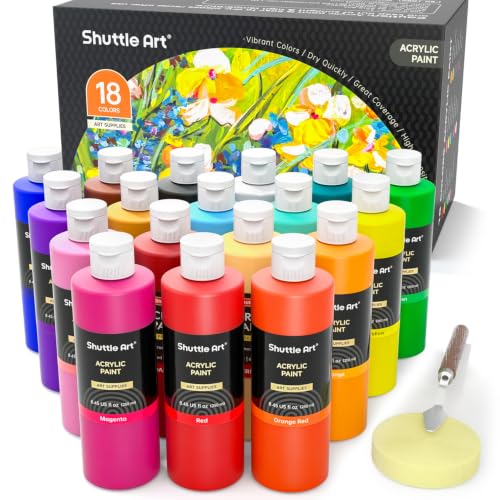
Two things set this Shuttle Art set apart for toy makers. First, the listing states conformity with U.S. ASTM D-4236 and EN71-3, and describes the paint as non-toxic and acid-free. EN71-3 is the European toy safety standard covering the migration of certain elements, which is more directly relevant to toys than art-material labeling alone. Second, each of the 18 colors comes in a 250 ml (8.45 oz) bottle, enough to paint whole sets of blocks.
The paint is described as thick and creamy, mixing and blending well, and drying permanent, waterproof and fade-proof. The matte finish looks natural on wood, and wood is among the listed surfaces.
Best suited for: Painting sets of blocks, stacking toys, puzzles and peg dolls.
Key features:
- 18 colors, 250 ml each
- Matte finish
- ASTM D-4236 and EN71-3 listed
- Non-toxic, acid-free per listing
Pros:
- Toy-safety standard named
- Large volume
- Good color range
Cons and limitations:
- Large bottles take space
- You still need a child-safe sealer for durability
Buying consideration: Even with safety-labeled paint, seal toys and let them cure fully before giving them to children.
2. Caliart Acrylic Paint Set, 36 Colors — Best for a wide palette with metallics

Caliart’s 36 colors include metallic gold and silver, with 12 brushes in the box. The listing says the paint conforms to ASTM D-4236, is non-toxic, and is water-proof and fade-resistant once dry, with a matte and metallic finish.
A big palette is handy for toy cars, animals and dolls where you want many distinct colors. Note that ASTM D-4236 is an art-material labeling standard rather than a toy-specific one.
Best suited for: Colorful painted animals, vehicles and decorative toys.
Key features:
- 36 colors, 2 oz each
- Includes metallic gold and silver
- Matte and metallic finish
- 12 brushes
Pros:
- Large color range
- Brushes included
- Good bottle size
Cons and limitations:
- No toy-specific standard listed
- Metallics are better for display toys
Buying consideration: Use metallics on decorative or display pieces rather than baby toys.
3. Apple Barrel Essentials Acrylic Paint Set, 12 Colors — Best for satin basics on a budget

Apple Barrel’s Essentials set includes 12 basic colors in 2 oz bottles with a satin finish. The listing names terra cotta, papier mache, canvas, wood, plaster, rigid plastic, fabric and concrete among surfaces, with soap-and-water cleanup while wet.
Satin has a gentle sheen that looks finished on toys and wipes clean more easily than matte.
Best suited for: Simple toy projects with basic colors.
Key features:
- 12 colors, 2 oz each
- Satin finish
- Multi-surface including wood
- Non-toxic
Pros:
- Low cost
- Satin finish
- Easy cleanup
Cons and limitations:
- Limited colors
- No toy-specific standard listed
Buying consideration: Mix the basics to create custom shades.
4. ARTISTRO 24 Dual-Tip Acrylic Paint Markers — Best for faces, lines and patterns

Painting a tiny smile on a peg doll with a brush takes a steady hand. Paint markers make it easy. Each ARTISTRO marker has a 1 mm fine tip for lines and outlines and a 1 to 5 mm dot tip for bold dots. The listing describes pre-activated tips ready to use, water-based odorless acrylic paint conforming to ASTM D-4236, and use on wood among many surfaces.
They are ideal for faces, stripes, numbers and letters on blocks.
Best suited for: Peg dolls, alphabet blocks and patterns.
Key features:
- 24 colors
- Dual tip: 1 mm fine and 1 to 5 mm dot
- Water-based acrylic
- ASTM D-4236 per listing
Pros:
- Precise lines without brushes
- No pumping needed
- Great for kids to use themselves
Cons and limitations:
- Not for large areas
- Results vary by surface per listing
Buying consideration: Paint base colors with a brush, then add details with markers once dry.
5. GOTIDEAL Acrylic Paint Set, 18 Colors — Best for a matte set with brushes

GOTIDEAL provides 18 colors in 2 oz bottles plus 10 brushes, with a matte finish and wood listed as a surface. The listing describes creamy, pigmented paint and a non-toxic formula.
It is a simple starter kit for families painting toys together.
Best suited for: First-time toy painters who need brushes.
Key features:
- 18 colors, 2 oz each
- Matte finish
- 10 brushes
- Non-toxic per listing
Pros:
- Brushes included
- Natural matte look
- Good value
Cons and limitations:
- No toy-specific standard listed
- Fewer colors than larger sets
Buying consideration: Use the flat brushes for block faces and rounds for details.
6. Shuttle Art Acrylic Paint Set, 16 x 12 ml Tubes — Best for a few small toys

For a handful of peg dolls or a single toy car, small tubes are enough. Shuttle Art’s 16 tubes of 12 ml come with three brushes. The listing describes creamy, rich pigment that is permanent, waterproof and fade-proof, with wood among the surfaces and a gloss finish.
It is the lowest-cost option here.
Best suited for: Small projects and trying toy painting before buying more.
Key features:
- 16 colors, 12 ml tubes
- Gloss finish
- 3 brushes
- Non-toxic per listing
Pros:
- Very low cost
- Compact
- Bright gloss
Cons and limitations:
- Small volume
- No toy-specific standard listed
Buying consideration: Squeeze out only what you need; tubes stay fresh longer than open bottles.
Understanding Safety Labels on Paint
ASTM D-4236 is a U.S. standard for labeling art materials for chronic health hazards. A paint labeled as conforming has been evaluated and labeled accordingly; it does not by itself mean a product is certified for toys.
EN71-3 is part of the European toy safety standard and limits the migration of certain elements from toy materials. A paint listing that names EN71-3 is giving more toy-relevant information.
In the United States, children’s toys are covered by toy safety requirements such as ASTM F963. If you are making toys to sell, research the rules that apply to you and use finishes documented for children’s products. For toys for your own family, choose paints and sealers with the clearest safety information, and avoid painting toys for babies who mouth everything; natural, unfinished wood or a food-safe oil finish is often preferred for teethers.
How to Paint Wooden Toys
- Sand smooth. Sand edges and surfaces with fine sandpaper so there are no splinters. Wipe off dust.
- Seal the grain if needed. A thin base coat or sealer keeps colors from soaking unevenly into raw wood.
- Paint in thin coats. Two thin coats cover better and dry faster than one thick coat.
- Add details. Use fine brushes or paint markers for faces, stripes and letters.
- Let it dry thoroughly. Acrylic dries quickly to the touch but takes longer to harden.
- Seal. Apply a clear sealer appropriate for children’s items, following the label.
- Cure fully. Leave the toy for the full cure time before play.
Choosing Wood for Painted Toys
The wood matters almost as much as the paint. Hardwoods such as maple, beech and birch are dense and smooth, take paint evenly and resist dents from rough play, which is why many classic wooden toys use them. Softwoods like pine are cheaper and easier to cut, but they dent more easily and their resinous knots can bleed through light colors over time. Unfinished craft shapes, such as peg dolls, blocks and wheels sold for crafting, are usually birch or similar hardwoods and come ready to paint after a light sanding.
Avoid pressure-treated lumber and reclaimed wood with an unknown history, since you cannot be sure what it has been treated with. Plywood is fine for puzzles if the edges are sanded smooth and sealed.
Painting Toys With Children
Kids love painting their own toys, and it is a great way to build attachment to them. Set up a covered table, give each child a small cup of a few colors rather than whole bottles, and offer chunky brushes and paint markers. Older children can mask stripes with tape; younger ones do best with dots and simple shapes. Let the adults handle sanding and sealing, and keep the finished toys on a shelf to cure before they go into the toy box. Expect a few smudges; they are part of the charm.
Toy Painting Ideas
Painted wooden blocks with letters and numbers, rainbow stacking rings, peg-doll families, toy cars with racing stripes, and simple animal shapes are all easy projects. Leave some wood natural for a modern look: painting only the ends of blocks or half of a peg doll looks striking and uses less paint.
Many techniques from sign painting carry over to toys; see our guide to painting DIY wooden signs for lettering tips. For a fun reveal effect on display pieces, try the method in our scratch art painting guide.
Buying Guide: How to Choose Paint for Wooden Toys
Put safety information first
Look for non-toxic, water-based paints with clear safety statements. Toy-specific standards are a plus.
Choose matte or satin
Matte looks natural on wood; satin is easier to wipe clean.
Use a suitable sealer
Sealing protects paint from wear and saliva. Choose a sealer appropriate for children’s products and let it cure fully.
Think about volume
Block sets use more paint than you expect. Larger bottles save money.
Consider markers for detail
Paint markers make faces and letters much easier, especially for kids helping out.
Keep a record
If you make toys as gifts, write down the paint and sealer you used and keep the labels. It makes touch-ups easy later and lets you answer questions from parents about what is on the toy.
Avoid washable paints
They are designed to come off and will not last on toys.
Common Mistakes to Avoid
- Skipping sanding. Splinters and rough edges are unsafe.
- Thick paint layers. They chip more easily during play.
- Using craft sealers without checking. Read the label for suitability on children’s items.
- Giving toys to children too soon. Let paint and sealer cure completely.
- Painting baby teethers. Consider leaving them unfinished or using a food-safe oil.
- Using metallic or glitter paints on toddler toys. Save them for display pieces.
FAQs
What paint is safe for wooden toys?
Choose water-based, non-toxic acrylic paints with clear safety information, ideally naming a toy safety standard, and seal with a finish suitable for children’s products. Let everything cure fully.
Is acrylic paint safe for kids’ toys?
Non-toxic acrylics are widely used for decorative painting on toys. Check labels for safety information and seal the paint for durability.
Do I need to seal painted wooden toys?
Yes. Sealing protects the paint from chipping and moisture. Use a sealer suitable for children’s items and allow full cure time.
What does EN71-3 mean on a paint label?
It refers to part of the European toy safety standard that limits the migration of certain elements from toy materials.
Can I paint wooden toys for babies?
Many parents prefer unfinished wood or a food-safe oil finish for teethers and toys that babies mouth constantly.
How long should painted toys cure before use?
Follow the sealer’s cure time, which can be several days. Acrylic paint itself dries to the touch quickly but hardens over a longer period.
Final Recommendation
For most wooden toys, the Shuttle Art 18-color bulk set is the best match, because its listing names both ASTM D-4236 and the EN71-3 toy safety standard and its large bottles suit block sets. Caliart’s 36 colors suit colorful display toys, and Apple Barrel Essentials covers the basics with a satin finish.
Add ARTISTRO markers for faces and letters. GOTIDEAL and the small Shuttle Art tube set are easy starters. Whatever you choose, sand well, seal appropriately and let toys cure fully before play.