PaintingProGuide is reader-supported. When you buy through links on this page we may earn an affiliate commission at no extra cost to you.
Calligraphy with a brush depends on one thing more than any other: a tip that springs back to a sharp point after every stroke. That spring is what lets a single brush make a hairline upstroke and a full, swelling downstroke without changing tools. The best paint brushes for calligraphy are therefore pointed round brushes with a long, resilient belly, either traditional Chinese and Japanese ink brushes made from wolf, goat, weasel or blended hair, or Western synthetic rounds for smaller modern brush lettering.
Quick answer: If you want to explore East Asian calligraphy properly, the Marspark 12-piece Chinese calligraphy brush set is the best starting point because it includes several hair types, so you learn how soft goat and springy wolf hair behave. For a focused, affordable trio, the Corciosy wolf hair brushes in three sizes give the snap that beginners find easiest to control. For small Western brush lettering, the fine rounds in the Grabie 11-piece detail set work well with watercolor and gouache.
A quick note on terms. In East Asia the brush is called a maobi (Chinese) or fude (Japanese), and the style of practice called shufa or shodo uses ink ground from an ink stick or bottled sumi ink on absorbent paper. Western brush lettering uses the same pressure principle with watercolor, gouache or ink on smoother paper. The brushes overlap, but not completely, and the guide below explains where each fits.
Our Top Picks at a Glance
- Marspark 12-Piece Chinese Calligraphy Brush Set — Best overall set for learning hair types
- SEAMEW Chinese and Japanese Calligraphy Brush Set — Best set with a bamboo roll holder
- Corciosy Wolf Hair Sumi Brushes, 3 Sizes — Best springy brushes for beginners
- Eldraqth 3-Size Chinese Brush Set — Best budget trio with stated nib sizes
- Qulkws 3-Piece Nylon Calligraphy Brushes — Best synthetic option for easy care
- Corciosy Flower Bird Line-Drawing Brushes — Best for fine line work alongside calligraphy
- Grabie 11-Piece Fine Detail Brushes — Best for small Western brush lettering
| Product | Best For | Key Spec | Key Strength | Price Tier |
|---|---|---|---|---|
| Marspark 12-Piece Set | Learning hair types | 12 brushes: bear, wool, weasel, goat/wolf, rabbit | Wide range of hairs | $$ |
| SEAMEW Calligraphy Set | Organized practice kit | Mixed-hair brushes plus roll-up bamboo holder | Storage included | $ |
| Corciosy Wolf Hair Trio | Controlled strokes | 3 wolf hair brushes, L/M/S | Springy, sharp tip | $ |
| Eldraqth 3-Size Set | Budget practice | 3 brushes, 23 cm long, stated nib sizes | Clear sizing | $ |
| Qulkws Nylon Trio | Low-maintenance practice | 3 nylon brushes, bamboo handles | Durable synthetic tip | $ |
| Corciosy Line-Drawing Brushes | Fine lines and outlines | Line-drawing brush set, steel shafts | Thin, controlled lines | $ |
| Grabie 11-Piece Detail Set | Small brush lettering | Sizes 5/0 to 7, nylon | Fine points for small text | $ |
How We Chose
We selected these brushes from the Amazon listing details and specifications checked in October 2026, how well each brush’s hair type, sizing and shape suit calligraphy, and how widely each product is reviewed by Amazon buyers. We have not written with these brushes. Where a listing is inconsistent (for example, a set titled as 10 pieces that describes 12 brushes in its bullets), we say so.
- Tip shape: calligraphy needs a pointed round that returns to a sharp tip.
- Hair type: wolf (weasel) hair is springy; goat hair is soft and absorbent; blends sit between.
- Size spread: a large, medium and small brush cover most practice formats.
- Shedding and build: we favored listings that describe reinforced heads and note care requirements honestly.
- Fit for the style: East Asian brush calligraphy and Western brush lettering need different sizes.
Best Paint Brushes for Calligraphy Reviewed
1. Marspark 12-Piece Chinese Calligraphy Brush Set — Best for learning different hair types

Marspark’s set includes 12 brushes with a wide spread of hair types: artificial bear hair, three wool hair brushes, two weasel hair, two goat and wolf blends, and two rabbit hair brushes, according to the listing. Handles are described as ebony with tightly reinforced heads, and Marspark notes that slight shedding can happen.
That variety is the point. Wolf and weasel hair have spring, which makes it easier to finish a stroke cleanly. Wool (goat) hair is softer and holds more ink, which rewards controlled pressure and gives fuller, rounder strokes. Trying each type early teaches you which one suits your hand and your script.
Best suited for: Learners starting Chinese or Japanese calligraphy who want to try several hair types before committing to one.
Key features:
- 12 brushes
- Bear, wool, weasel, goat/wolf and rabbit hairs
- Ebony handles
- Reinforced brush heads
Pros:
- Broad introduction to hair types
- Covers several sizes
- Suitable for sumi and watercolor too
Cons and limitations:
- Listing notes slight shedding is possible
- Brushes need breaking in and careful washing
Buying consideration: New natural-hair brushes often come stiffened with glue. Soak only the tip portion you plan to use and rinse it out gently before the first session.
2. SEAMEW Chinese and Japanese Calligraphy Brush Set — Best for an organized practice kit

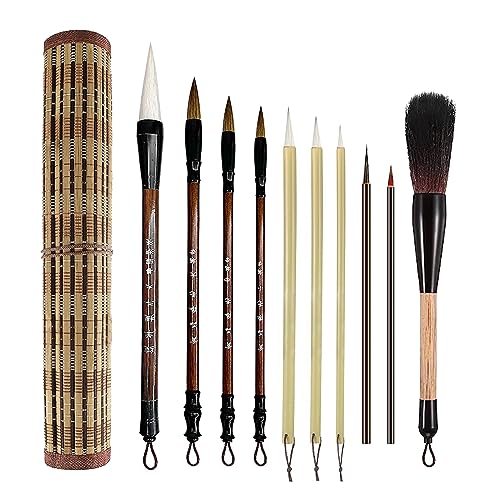
SEAMEW’s set covers a similar range of hairs, including artificial bear hair, wool, weasel and Jian Hao brushes made from goat and wolf hair. The title says 10 pieces while a bullet mentions 12 brushes, so check the listing photos for the exact count. A roll-up bamboo brush holder is included.
The bamboo roll is more useful than it looks. Calligraphy brushes should dry hanging or flat, and rolling them up protects the tips in a bag. If you take classes, this is a tidy kit to carry.
Best suited for: Students attending classes or practicing away from home.
Key features:
- Mixed hair types including Jian Hao goat and wolf
- Roll-up bamboo holder
- Sold for Chinese and Japanese calligraphy
Pros:
- Storage included
- Variety similar to larger sets
- Gift-friendly presentation
Cons and limitations:
- Piece count is inconsistent across the listing
- Natural hair requires careful care
Buying consideration: Use the roll for carrying only after brushes are fully dry, or mold can form.
3. Corciosy Wolf Hair Sumi Brushes, 3 Sizes — Best for springy, controlled strokes

Corciosy offers three handmade wolf hair brushes in large, medium and small with wooden shafts and a lanyard for hanging. The listing describes strong elasticity and absorbency.
Wolf hair (in Chinese brush terms, this is often weasel hair) is the classic choice for regular and running scripts because it springs back quickly and forms a crisp point. Beginners usually find it more forgiving than soft goat hair, which can splay if pressure is uneven.
Best suited for: Beginners and intermediate learners practicing regular script, kana or line-based styles.
Key features:
- 3 brushes: large, medium, small
- Wolf hair tips
- Wooden shafts
- Lanyard for hanging to dry
Pros:
- Springy tips are easier to control
- Three practical sizes
- Hang-dry design
Cons and limitations:
- Less ink capacity than goat hair
- Only three brushes
Buying consideration: Hang brushes tip down to dry. Standing them upright lets water run into the base and loosen the hair.
4. Eldraqth 3-Size Chinese Brush Set — Best for budget practice with clear sizing

Eldraqth is one of the few listings here that gives exact nib sizes: large 4.5 x 1 cm, medium 3.8 x 0.9 cm and small 3.2 x 0.8 cm, all on 23 cm handles. The brushes are described as handmade with solid wood shafts and high-quality fiber, and a bamboo pen holder is included.
Knowing the nib length helps you choose paper size. A 4.5 cm head suits characters on larger practice sheets, while the 3.2 cm head handles smaller grids and signatures.
Best suited for: Budget-minded beginners who want three sizes and a stand.
Key features:
- 3 brushes with stated nib sizes
- 23 cm handles
- Fiber tips
- Bamboo pen holder included
Pros:
- Low price tier
- Clear size information
- Holder keeps brushes off the table
Cons and limitations:
- Fiber type is not specified
- Less suited to long-term serious study
Buying consideration: Fiber brushes are easier to care for than natural hair, which suits casual practice.
5. Qulkws 3-Piece Nylon Calligraphy Brushes — Best for low-maintenance practice

Qulkws makes this trio with nylon tips and sturdy bamboo handles in large, medium and small. The listing says the large brush is for bigger areas, the medium for general writing and contour lines, and the small for detail.
Nylon tips do not have the absorbency of natural hair, so each load of ink runs out sooner. In exchange they shed less, dry faster and survive careless washing. That makes them a sensible practice brush and a good choice for watercolor brush lettering, which uses less liquid.
Best suited for: Hobbyists who want brush calligraphy without the upkeep of natural hair.
Key features:
- 3 nylon brushes
- Bamboo handles
- Hanging cord
- Large, medium, small
Pros:
- Low maintenance
- Durable tips
- Works for ink and watercolor
Cons and limitations:
- Holds less ink than natural hair
- Less expressive dry-brush texture
Buying consideration: Reload more often with nylon and keep strokes shorter to avoid running dry mid-character.
6. Corciosy Flower Bird Line-Drawing Brushes — Best for fine lines alongside calligraphy

This Corciosy set is aimed at gongbi-style line work: outlining flowers, birds, branches and stems. The listing describes sharp, uniform strokes and steel shafts that do not bend.
Line-drawing brushes are not the main tool for calligraphy, but they are useful for small signature characters, seal outlines and the fine painted elements that often accompany calligraphy on cards and scrolls.
Best suited for: Calligraphers who add painted details or very small characters to their work.
Key features:
- Line-drawing brush set
- Steel shafts
- Designed for outlines and fine detail
Pros:
- Thin, controlled lines
- Rigid shafts
- Good companion to a main calligraphy set
Cons and limitations:
- Not a primary calligraphy brush
- Listing focuses on line work rather than lettering
Buying consideration: Buy this as a second set after you have a main writing brush.
7. Grabie 11-Piece Fine Detail Brushes — Best for small Western brush lettering

Grabie’s set runs from 5/0 to size 7 in synthetic nylon with triangular handles and protective tubes. It is sold as a detail and miniature set, but the larger rounds in the set are also usable for small pointed-brush lettering with watercolor or gouache.
For modern brush lettering on smooth paper, a synthetic round with a fine point is easier to manage than a large Chinese brush. The triangular handle helps keep the brush at a consistent angle.
Best suited for: Western brush lettering in small sizes, card making and journal headers.
Key features:
- 11 brushes, 5/0 to 7
- Synthetic nylon
- Triangular handles
- Protective tubes
Pros:
- Fine points
- Easy-grip handles
- Works with watercolor, gouache and acrylic
Cons and limitations:
- Too small for East Asian calligraphy
- Not designed specifically for lettering
Buying consideration: Use the sizes 4 to 7 for lettering; the smallest sizes are for detail painting.
What Else a Brush Calligraphy Setup Needs
The brush is only one of the traditional “four treasures of the study”: brush, ink, paper and inkstone. Even if you skip the inkstone and use bottled ink, the other pieces change how any brush performs, so plan for them when you set a budget.
Ink
Bottled sumi or Chinese ink is the easiest start. Grinding an ink stick on an inkstone gives more control over density and is part of the practice for many calligraphers. Watercolor and gouache are the usual media for Western brush lettering.
Paper
Absorbent practice paper and rice paper let the ink spread slightly and record the speed of each stroke. Smooth paper suits Western lettering but can make East Asian brushes feel slippery. Grid practice sheets help you keep characters a consistent size.
Felt mat and paperweights
A felt underlay stops ink from bleeding onto the table and gives the paper a little cushion, which makes pressure changes easier to control. Paperweights hold thin sheets flat.
Brush rest and drying
A brush rest keeps a loaded brush from rolling, and a hanging rack or hook lets brushes dry tip down. Several sets above include hanging loops, which is a sign the maker expects them to be dried properly.
Buying Guide: How to Choose Calligraphy Brushes
Decide which tradition you are practicing
Chinese and Japanese calligraphy use large, absorbent brushes with ink on rice paper or practice paper. Western brush lettering uses smaller pointed rounds with watercolor, gouache or ink. Choose the brush family first.
Understand hair types
Wolf or weasel hair is springy and snaps back to a point. Goat (wool) hair is soft and holds more ink, producing fuller strokes but demanding more control. Blended brushes combine the two. Synthetic nylon is durable and low maintenance but holds less ink.
Size by character size
Match the brush head to the size of characters or letters you write. Large heads suit big characters; medium heads suit standard practice grids; small heads suit signatures and annotations.
Check the point
A good calligraphy brush comes to a single sharp tip when wet. Split or fuzzy tips make hairline strokes impossible.
Look for care features
Hanging loops and roll-up holders help brushes dry properly, which extends their life.
Expect a break-in period
Many natural-hair brushes arrive stiffened with starch or glue. Softening only the working part of the tip gives you more control while learning.
Related Brush Care Guides
Natural-hair brushes reward good care. Read how to keep paint brushes from shedding before using a new set, and follow our steps for drying paint brushes correctly so the tips keep their shape.
Common Mistakes to Avoid
- Softening the entire head of a new brush when you only need the tip working.
- Drying brushes upright, which pulls water into the base and loosens hairs.
- Using a tiny detail brush for large characters and pressing too hard to compensate.
- Washing with hot water or harsh soap, which damages natural hair.
- Expecting nylon brushes to hold as much ink as goat hair.
FAQs
What is the best brush hair for beginner calligraphy?
Wolf or weasel hair is usually easiest for beginners because it springs back to a point. Goat hair is softer and more expressive but harder to control at first.
Can I use watercolor brushes for calligraphy?
Yes for Western brush lettering. A pointed round watercolor brush is a common lettering tool. For Chinese or Japanese calligraphy, a dedicated ink brush works better.
Why does my new calligraphy brush feel stiff?
Many brushes are shipped with the hair stiffened by starch or glue to protect the shape. Soak and gently work the tip to loosen it before use.
How do I clean a Chinese calligraphy brush?
Rinse in cool water until the water runs clear, gently reshape the tip with your fingers, and hang it tip down to dry.
How many calligraphy brushes do I need?
Start with three sizes: large, medium and small. Add specialist brushes later as your style develops.
Do synthetic calligraphy brushes work?
They work well for practice and lettering. They hold less ink than natural hair, so you reload more often.
Final Recommendation
For anyone serious about learning East Asian calligraphy, the Marspark 12-piece set is the best way to discover which hair suits you. Choose the SEAMEW kit if you want a bamboo roll for classes, and the Corciosy wolf hair trio if you prefer a smaller set with springy, forgiving tips. Budget learners can start with the Eldraqth or Qulkws trios. If your interest is Western brush lettering, the Grabie set is the better fit, and the Corciosy line-drawing brushes make a good second set for fine painted details.