PaintingProGuide is reader-supported. When you buy through links on this page we may earn an affiliate commission at no extra cost to you.
Calligraphers have argued about writing angles for centuries, and the answer depends on the tool. Broad-edge and pointed-pen calligraphers traditionally write on a sloped board, often somewhere between 30 and 45 degrees, because a slope lets you sit upright, see the letters without distortion and control ink flow from a dip pen. East Asian brush calligraphers, by contrast, usually write on a flat surface with the brush held vertically. So the best easel for calligraphy is really an adjustable writing slope: a tabletop board or easel that locks at several angles, from nearly flat to fairly steep, with a ledge that holds paper and a guard sheet steadily. For large-scale lettering on chalkboards, signs and pads, a presentation easel takes over.
Quick answer: For most Western calligraphers, the Falling in Art 5-position beech drafting board easel is the best choice: a 16.5 x 12.1 inch board that sets from flat to about 68 degrees and weighs only 1.9 lbs. If you want a steeper easel that holds finished pieces upright, the MEEDEN tabletop H-frame adjusts from 41 to 78 degrees. For chalkboard and signage lettering at standing height, the Falling in Art flip chart easel 2-pack holds pads and boards up to 20 lbs.
Writing Angles and Why They Matter
Broad-edge (italic, foundational, blackletter)
Many teachers recommend a board sloped somewhere around 30 to 45 degrees. A slope slows ink flow from a dip pen or nib, so you get fewer blobs, and keeps your eyes perpendicular to the writing.
Pointed pen (copperplate, Spencerian)
Pointed-pen writers often work at a gentler slope. The flexible nib responds to pressure, and a modest angle gives comfortable control while keeping posture upright.
Brush lettering
Western brush lettering with brush pens or watercolor is often done flat or on a gentle slope, depending on how wet the medium is.
East Asian brush calligraphy
Traditional shufa and shodo are written on paper laid flat on a felt mat, with the brush held vertical. A sloped easel is not the norm here, though one can be useful for displaying finished pieces.
Large-scale and chalk lettering
Chalkboard signs, menu boards and presentation lettering are written standing at a near-vertical surface, which is where a presentation easel helps.
Our Top Picks at a Glance
- Falling in Art 5-Position Beech Drafting Board Easel — Best overall writing slope for calligraphy
- MEEDEN Tabletop H-Frame Easel, Beech — Best for steep angles and displaying work
- Miratuso Wooden Sketchbox Tabletop Easel — Best with storage for nibs and inks
- ARTIFY Adjustable Beechwood Sketchbox Easel — Best alternative sketchbox
- AOTEMOON Beechwood Tabletop Easel with Shoulder Strap — Best for carrying to classes
- Falling in Art 63.5 Inch Flip Chart Easel, 2 Pack — Best for chalkboard and large-scale lettering
| Product | Best For | Key Spec | Key Strength | Price Tier |
|---|---|---|---|---|
| Falling in Art Drafting Board | Daily practice | 16.5 x 12.1″ beech board, 5 positions flat to 68°, 1.9 lb | Wide angle range, light | $$ |
| MEEDEN Tabletop H-Frame | Steep slopes and display | Beech, 7 settings 41°–78°, holds up to 23″ | Fully assembled | $$$ |
| Miratuso Sketchbox | Writing with storage | Beech, removable partitions, max 21″ canvas, folds to 14.5 x 10.5 x 3.5″ | Supplies stored inside | $$ |
| ARTIFY Sketchbox | Alternative sketchbox | Beech, adjustable angle, carry handle, storage | Storage and portability | $$ |
| AOTEMOON Easel | Classes and travel | Beech sketchbox, adjustable bracket, shoulder strap | Strap for carrying | $$ |
| Falling in Art Flip Chart 2-Pack | Chalk and sign lettering | Aluminum, 33.5–63.5″, 20 lbs, removable clip | Standing height | $$ |
How We Chose
We chose these easels from the Amazon listing details and specifications checked in October 2026, by how well each one’s angle range, board size, stability and portability suit calligraphy practice, and by how widely each product is reviewed by Amazon buyers. We have not written on these boards. Angle ranges and dimensions are as listed.
- Angle range covering gentle to steep writing slopes.
- Board or ledge that holds paper and guard sheets steady.
- Stability under steady hand pressure.
- Storage for nibs, holders and inks.
- Portability for classes and workshops.
Best Easel for Calligraphy Reviewed
1. Falling in Art 5-Position Beech Drafting Board Easel — Best for daily calligraphy practice

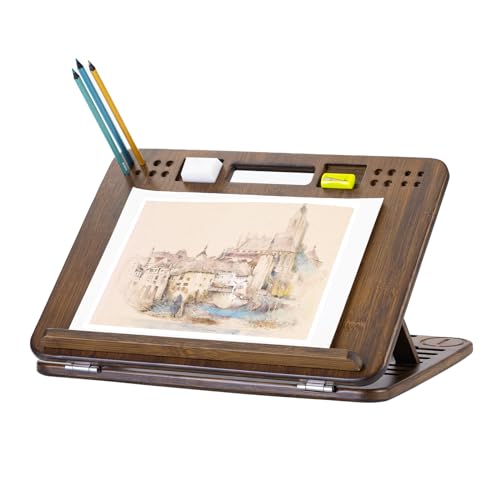
Falling in Art’s drafting board is European beech with a 16.5 x 12.1 inch smooth surface and five settings from flat to about 68 degrees. It weighs 1.9 lbs and has non-slip rubber feet. The listing says the board can hold paper of the same size as well as larger panels.
This is essentially a writing slope, which is the classic calligraphy tool. You can set it near 30 to 45 degrees for broad-edge work, lower it for pointed pen, and lay it flat for brush lettering with wetter media. The smooth board takes tape or clips for paper, and a sheet of padding paper under your work gives a softer writing surface.
At under 2 lbs, it moves easily between a desk and a kitchen table.
Best suited for: Western calligraphers practicing broad-edge, pointed pen and brush lettering.
Key features:
- European beech
- 16.5 x 12.1″ board
- 5 positions, flat to ~68°
- 1.9 lb
- Non-slip rubber feet
Pros:
- Wide angle range
- Smooth board for paper
- Very light
- Low price tier
Cons and limitations:
- No ledge storage for tools
- Board size limits larger sheets
Buying consideration: Tape a few sheets of paper to the board as padding; nibs behave better on a slightly soft surface.
2. MEEDEN Tabletop H-Frame Easel, Solid Beech — Best for steep angles and displaying work

MEEDEN’s tabletop H-frame arrives fully assembled, in sanded solid beech, with seven settings from 41 to 78 degrees. It holds canvases or boards up to 23 inches high and weighs about 3.4 lbs.
The angle range starts steeper than a drafting board, which suits calligraphers who prefer a more upright writing surface and is ideal for displaying finished pieces at shows. An H-frame mast also lets you clip a drawing board in place.
Best suited for: Calligraphers who prefer steep angles, and anyone who wants to display finished work.
Key features:
- Solid beech H-frame
- 7 settings, 41°–78°
- Holds up to 23″ high
- Fully assembled
Pros:
- Sturdy H-frame
- Steep angles
- Doubles as display
Cons and limitations:
- No near-flat setting
- Needs a drawing board for loose paper
Buying consideration: Mount a lightweight drawing board on the easel and tape your paper to it.
3. Miratuso Wooden Sketchbox Tabletop Easel — Best for writing with storage

Miratuso’s sketchbox is hand-sanded beechwood with electroplated hardware and a removable internal partition for storing paints and brushes. Folded, it measures 14.5 x 10.5 x 3.5 inches; the maximum canvas height is 21 inches. Rubber feet protect the table.
For calligraphers, the storage compartment is a tidy home for nib holders, nibs, ink bottles and guide sheets. The lid works as a sloped support when opened.
Best suited for: Calligraphers who want one box for supplies and a writing slope.
Key features:
- Beechwood sketchbox
- Removable partition
- Max canvas 21″
- Folded 14.5 x 10.5 x 3.5″
- Rubber feet
Pros:
- Storage for nibs and inks
- Compact
- Protects table surfaces
Cons and limitations:
- Angle range not specified
- Heavier than a drafting board
Buying consideration: Store ink bottles upright in the compartment and close the lid only when they are sealed tight.
4. ARTIFY Adjustable Beechwood Sketchbox Easel — Best for an alternative sketchbox

ARTIFY’s easel is sturdy beechwood with adjustable angles and canvas width, a carrying handle and a built-in storage box. The listing positions it for studio, classes and outdoor use.
It fills the same role as the Miratuso: a writing slope that carries your tools. Choose between them based on availability and finish.
Best suited for: Calligraphers who want a sketchbox easel with storage.
Key features:
- Beechwood
- Adjustable angles
- Built-in storage
- Carrying handle
Pros:
- Storage and portability
- Mid price tier
- Adjustable
Cons and limitations:
- Few dimensional details in listing
Buying consideration: Check the board width against your paper size before buying.
5. AOTEMOON Beechwood Tabletop Easel with Shoulder Strap — Best for carrying to classes
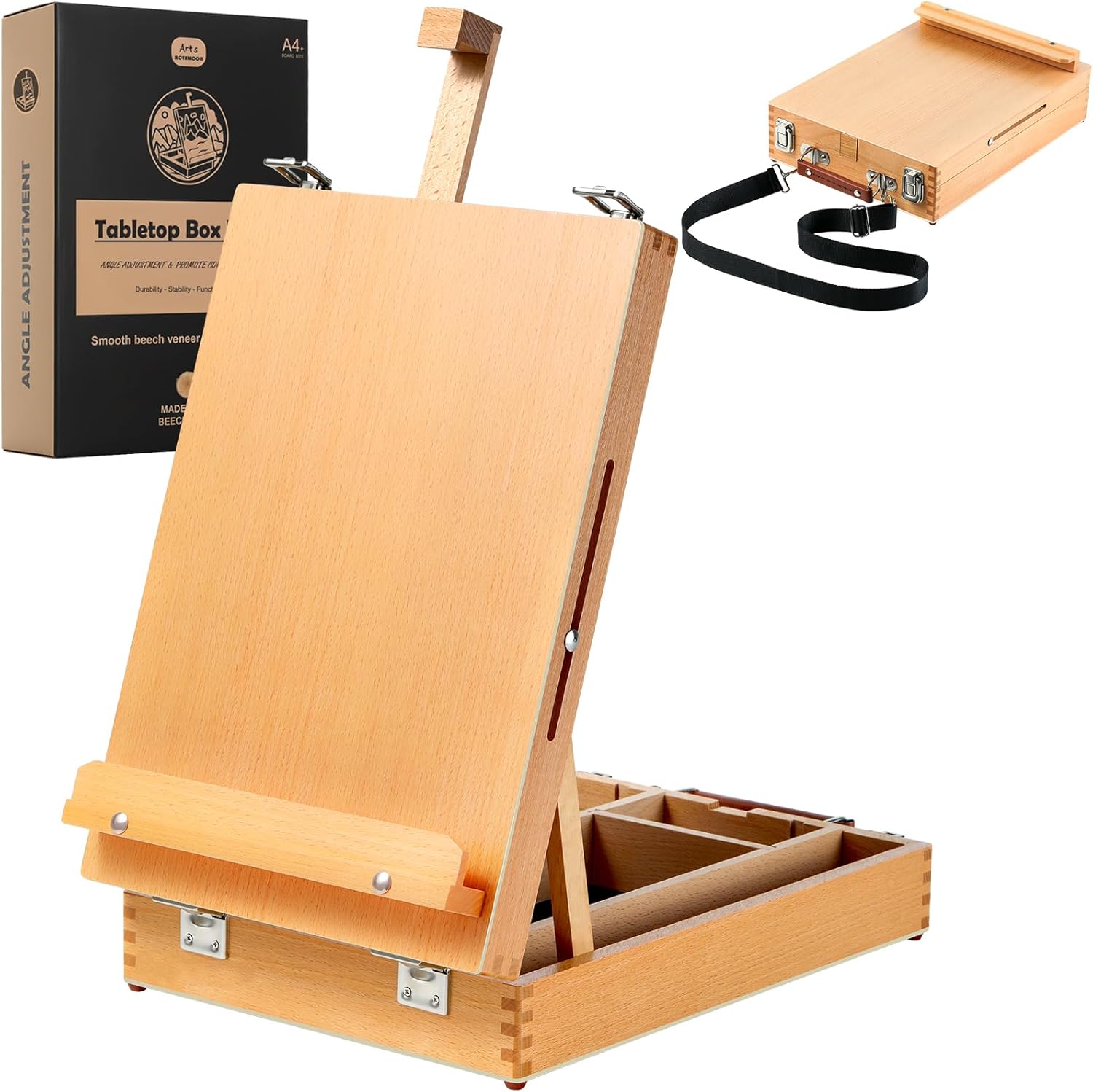
AOTEMOON’s sketchbox easel is solid beechwood that folds into a compact box with a carrying handle and an adjustable shoulder strap. The storage box has adjustable partitions, and an adjustable bracket supports boards at various angles.
The shoulder strap makes it the most portable of the sketchbox options, which helps if you attend calligraphy workshops or guild meetings.
Best suited for: Calligraphers who travel to classes and workshops.
Key features:
- Solid beechwood
- Folds into sketchbox
- Adjustable partitions
- Shoulder strap and handle
- Adjustable angle bracket
Pros:
- Most portable sketchbox
- Organized storage
- Sturdy
Cons and limitations:
- About 4 lbs
- Bracket designed for boards rather than loose paper
Buying consideration: Clip paper to a thin board and set the board on the bracket.
6. Falling in Art 63.5 Inch Flip Chart Easel, 2 Pack — Best for chalkboard and large-scale lettering

Falling in Art’s presentation easels have telescoping legs from 33.5 to 63.5 inches, a removable top clip for paper pads, canvases and whiteboards, adjustable brackets and a 20 lb capacity. They are aluminum with non-slip rubber feet and fold to 35 inches.
Chalkboard artists and sign letterers work standing at a near-vertical surface. These easels hold a chalkboard, a large practice pad or a sign board at a comfortable height, and the two-pack lets you keep a reference layout next to the board.
Best suited for: Chalkboard artists, sign letterers and calligraphy teachers demonstrating to a group.
Key features:
- 2 aluminum easels
- 33.5–63.5″ height
- 20 lb capacity
- Removable top clip, adjustable brackets
- Non-slip feet
Pros:
- Standing height
- Holds pads and boards
- Two easels
Cons and limitations:
- Not a writing slope for small work
Buying consideration: Use a large pad on one easel for demonstrations and the other for your layout.
Setting Up a Calligraphy Writing Slope
- Set the board angle to suit your tool: steeper for broad-edge, gentler for pointed pen, flat for wet brush work.
- Tape a pad of a few sheets of paper to the board for a slightly soft writing surface.
- Fix a guard sheet across the lower part of the page to keep skin oils off the paper.
- Place a guideline sheet under translucent paper, or rule lines lightly in pencil.
- Keep ink on the side of your writing hand, on a stable surface that will not tip.
- Sit with feet flat and the board close enough that your arm moves freely.
Posture and Comfort at the Writing Slope
A writing slope is as much about your body as about the letters. When the paper lies flat, most people lean forward and bend the neck to see the writing line, and after an hour the shoulders and lower back complain. Raising the board brings the writing line closer to your natural line of sight, so you can sit upright with the spine relaxed.
Keep the writing line at roughly the same height throughout a page by moving the paper up as you go, rather than reaching down to the bottom of the sheet. Many calligraphers tape a strip of card across the board as a movable rest and slide the paper upward beneath it. The forearm should rest lightly on the board or the guard sheet, and the writing hand should move from the elbow and shoulder for larger letters rather than from the fingers alone.
Lighting matters too. A lamp placed on the side opposite your writing hand prevents the hand from casting a shadow on the nib. A daylight-balanced bulb helps you judge ink density and color, particularly with gouache or colored inks.
A Low-Cost Alternative
If you are just starting, a drawing board propped on a few books makes a serviceable temporary writing slope. It will not lock at a precise angle and may slide, but it lets you discover which angle suits you before buying an adjustable easel. Once you know your preferred slope, a board like the Falling in Art model gives the same angle reliably every session.
Buying Guide: How to Choose an Easel for Calligraphy
Angle range
Look for settings from nearly flat to around 45 degrees or steeper. Several fixed positions are easier to repeat than a free-tilting hinge, which matters when you want every practice session to feel the same.
Board surface
A smooth, rigid board takes tape and padding sheets easily. Avoid textured or slatted surfaces that a sharp nib can catch on through thin paper.
Stability
The board should not shift as you write. Rubber feet help, and so does a little weight; very light boards can creep forward under steady pressure from the forearm.
Size
Match the board to your usual paper size, from practice pads to larger sheets.
Storage
Sketchbox designs keep nibs, holders and ink together, which saves setup time and keeps sharp nibs from rolling loose in a drawer.
Large-format needs
For chalkboards and signs, choose a standing presentation easel.
Related Easel Guides
Learn how to use a tabletop easel correctly to set height and angle, see how to work seated with a lap easel for a portable writing slope, and keep beech boards in shape with our wooden easel care guide.
Common Mistakes to Avoid
- Writing flat with a dip pen and getting ink blobs from fast flow.
- Using an angle so steep that ink runs back out of the nib.
- Skipping a guard sheet and leaving oily marks on the paper.
- Using a board that slides as you write.
- Expecting East Asian brush calligraphy to work on a steep slope.
- Writing at the very bottom of the page instead of moving the paper up to keep the writing line at a comfortable height.
FAQs
What angle should a calligraphy board be?
Many broad-edge calligraphers work at roughly 30 to 45 degrees; pointed-pen writers often prefer a gentler slope.
Do I need an easel for calligraphy?
Not strictly, but a sloped board improves posture, visibility and ink control for pen calligraphy.
Can I use a drafting board for calligraphy?
Yes. An adjustable drafting board is essentially a writing slope.
Is Chinese brush calligraphy done on an easel?
Traditionally no; it is written on paper laid flat with the brush held upright.
What easel is best for chalkboard lettering?
A standing presentation easel that holds a chalkboard at a comfortable height.
How do I stop paper slipping on a writing board?
Use low-tack tape at the corners or a clip, and add padding sheets underneath.
Final Recommendation
For Western pen and brush lettering, the Falling in Art drafting board is the best all-round writing slope. Choose the MEEDEN H-frame if you prefer steep angles or want to display finished pieces. Miratuso, ARTIFY and AOTEMOON sketchboxes add storage for nibs and inks, with AOTEMOON being the easiest to carry. For chalkboard and large-scale lettering, the Falling in Art flip chart easels hold boards at standing height.