

PaintingProGuide is reader-supported. When you buy through links on this page we may earn an affiliate commission at no extra cost to you.
Round canvases change how a painting is composed. There are no corners to anchor a horizon or a figure, so the eye travels around the edge and settles in the middle. That makes circles ideal for mandalas, dot art, florals, planets, moons, wreath designs and acrylic pours. The best canvas for acrylic paint in a round format depends on one decision more than any other: do you want a flat canvas panel that frames and stacks easily, or a stretched round canvas with a frame depth that hangs on the wall as-is?
Quick answer: For most acrylic painters, the TRANSON 4-size round stretched canvas pack is the best place to start: 6, 8, 10 and 12 inch circles, four-layer primed and about 15 mm deep, so you can try every size and hang the results. For a classroom or paint party, the Simetufy 12-pack of 10 inch round canvas boards gives you identical flat panels at a low cost per piece. For gallery-style pieces at one size, the LOPYXBR 10-pack of 8 inch stretched rounds uses pine strips for a firm, clean edge.
Below we explain the difference between round panels and stretched rounds, which formats suit acrylic pouring and heavy texture, and how to choose sizes for the kind of design you plan to paint.
Round Canvas Panels vs Stretched Round Canvas
Both formats show up under “round canvas” on Amazon, and the listings do not always make the difference obvious.
Round canvas panels (boards)
A canvas panel is cotton canvas glued over a flat board. It is thin, light and rigid, and it will not dent if pressed. Panels are cheap, easy to store and slip into a round frame or onto a small tabletop easel. Their weakness is moisture: heavy pours and thick wet layers can soak into a paper-board core and cause warping. PHOENIX says this directly in its listing and warns that its panels are not designed for acrylic pouring or heavy texture.
Stretched round canvas
Stretched rounds wrap canvas around a circular frame, usually wood, fiberboard or a paper-board ring, with staples on the back. They have depth, typically around 15 mm in these listings, so they look finished on a wall without a frame. Because the canvas sits away from the support, a pour can run off the edges cleanly. The trade-off is that a stretched surface has some give and can be dented.
Which to choose for acrylic
Choose panels for practice, classes, kids, framing and small detailed work. Choose stretched rounds for pours, wall pieces, gifts and heavier paint application.
Our Top Picks at a Glance
- TRANSON 4 Sizes Round Stretched Canvas (12″, 10″, 8″, 6″) — Best overall round canvas for acrylic
- LOPYXBR 10-Pack 8 Inch Round Stretched Canvas — Best for consistent wall-ready pieces
- Frcctre 6-Pack 12 Inch Round Stretched Canvas — Best for larger statement circles
- Simetufy 12-Pack 10 Inch Round Canvas Boards — Best for classes and mandala practice
- PHOENIX Round Canvas Panels, 8/10/12 Inch, 9 Pack — Best panel variety for framing
- JMIATRY 10-Pack 8 Inch Round Canvases — Best alternative 8 inch bulk pack
- Aodaer 12-Piece Shaped Canvas Set — Best for mixing circles with other shapes
| Product | Best For | Key Spec | Key Strength | Price Tier |
|---|---|---|---|---|
| TRANSON 4-Size Stretched | Trying several sizes | 6″, 8″, 10″, 12″ rounds, ~15 mm deep, 4-layer primed | Size variety, wall-ready | $$ |
| LOPYXBR 8″ Stretched 10-Pack | Series and gifts | 10 x 8″ rounds, pine strip frame, 1.6 cm thick | Firm wooden frame | $$ |
| Frcctre 12″ Stretched 6-Pack | Larger pieces | 6 x ~11.75″ rounds, 15 mm deep, cotton | Big painting area | $$ |
| Simetufy 10″ Boards 12-Pack | Classes, mandalas | 12 x 10″ flat panels, cotton, gesso-primed | Low cost per piece | $$ |
| PHOENIX Round Panels 9-Pack | Framing, practice | 3 each of 8″, 10″, 12″ panels, cotton | Three sizes of flat panel | $$ |
| JMIATRY 8″ 10-Pack | Bulk 8″ projects | 10 x 8″ round canvases, cotton and wood | Alternative bulk option | $$ |
| Aodaer Shaped Set | Mixed-shape displays | 12 x 6″ pieces: rounds, squares, triangles, hexagons | Shape variety | $$ |
How We Chose
We based these picks on the Amazon listing details and specifications checked in October 2026, on how well each canvas’s format, size, frame and priming fit acrylic painting on a round surface, and on how widely each product is reviewed by Amazon buyers. We have not painted on these canvases. We quote what each listing states about construction and use, including the limitations makers mention.
- Format: flat panel or stretched, and how that suits pours, texture and framing.
- Size and count: diameter, number of pieces and whether sizes are mixed.
- Frame material and depth: pine, fiberboard or paper board, and how deep the profile is.
- Priming: acid-free gesso and the number of coats where stated.
- Stated limitations: notes about pouring, watercolor or heavy texture.
Best Canvas for Acrylic Paint (Round) Reviewed
1. TRANSON 4 Sizes Round Stretched Canvas — Best for trying several sizes

TRANSON packs four round stretched canvases at roughly 12, 10, 8 and 6 inches in diameter, each about 15 mm thick. The canvas is a linen and cotton blend primed with four layers of acid-free acrylic gesso and stretched over a recycled high-density fiber frame, stapled on the back. The listing says the frame does not bend and suits hanging on a wall.
Four sizes in one pack is the most useful thing about it. A 6 inch circle is a quick study or ornament, an 8 inch suits a single flower or a moon, and the 10 and 12 inch rounds have room for full mandalas and pours. Painting the same design at different sizes teaches you how scale changes detail and brush choice.
TRANSON states clearly that these canvases are ready for acrylic and oil but not suitable for watercolor or gouache. That is honest and helpful; acrylic is exactly what they are for.
Best suited for: Acrylic painters exploring round compositions, and anyone who wants a set of graduated circles for a wall grouping.
Key features:
- 4 rounds: 12″, 10″, 8″, 6″
- About 15 mm deep
- Linen and cotton blend
- Four-layer acid-free gesso
- High-density fiber frame, back-stapled
Pros:
- Four sizes for experimenting
- Wall-ready profile
- Generously primed
- Clear stated use
Cons and limitations:
- Only one of each size
- Not for watercolor or gouache
- Fiber frame is not wood
Buying consideration: If you plan to pour, put each circle on cups so paint can run off the edges freely.
2. LOPYXBR 10-Pack 8 Inch Round Stretched Canvas — Best for consistent wall-ready pieces

LOPYXBR’s pack contains ten 8 inch round canvases with a thickness of about 1.6 cm. The cotton canvas is stretched and nailed to pine wood strips, which the listing says creates sturdy edges and a tight surface.
Ten identical rounds are ideal for series work: a set of moon phases, a zodiac collection, seasonal florals or a batch of handmade gifts. The pine frame and depth mean each finished piece can hang without framing.
Eight inches is a friendly size for acrylic dot mandalas. It is big enough for several rings of dots but small enough to finish in one sitting.
Best suited for: Painters making a matching set of wall pieces, holiday gifts or market items.
Key features:
- 10 x 8″ rounds
- About 1.6 cm thick
- Pine wood strip frame
- Pure cotton canvas
Pros:
- Wooden frame
- Uniform size for series
- Wall-ready depth
Cons and limitations:
- Single size only
- Priming details are not specified
Buying consideration: Add a coat of gesso if you want a smoother surface for fine dot work.
3. Frcctre 6-Pack 12 Inch Round Stretched Canvas — Best for larger statement circles

Frcctre offers six round canvases about 11.75 inches across and 15 mm thick. The canvas is 100 percent cotton, acid-free, and stretched and stapled onto paper board bars.
Twelve inches is where round compositions start to feel substantial on a wall. It gives room for layered pours, large botanical designs or a detailed planet with rings. The listing names acrylic, oil, gouache, spray paint and tempera.
Paper board bars are lighter than wood, which is useful for hanging, but they are less rigid. Avoid soaking the frame during pours and let pieces dry flat.
Best suited for: Painters who want bigger round pieces for display, at a lower cost than wooden-framed rounds.
Key features:
- 6 x ~11.75″ rounds
- 15 mm deep
- 100% cotton, acid-free
- Paper board bar frame
Pros:
- Large painting area
- Light for hanging
- Multiple pieces for a series
Cons and limitations:
- Paper board frame is less rigid than wood
- Higher price tier for the count
Buying consideration: Dry poured pieces flat and level; a soft frame can twist if stood on edge while wet.
4. Simetufy 12-Pack 10 Inch Round Canvas Boards — Best for classes and mandala practice
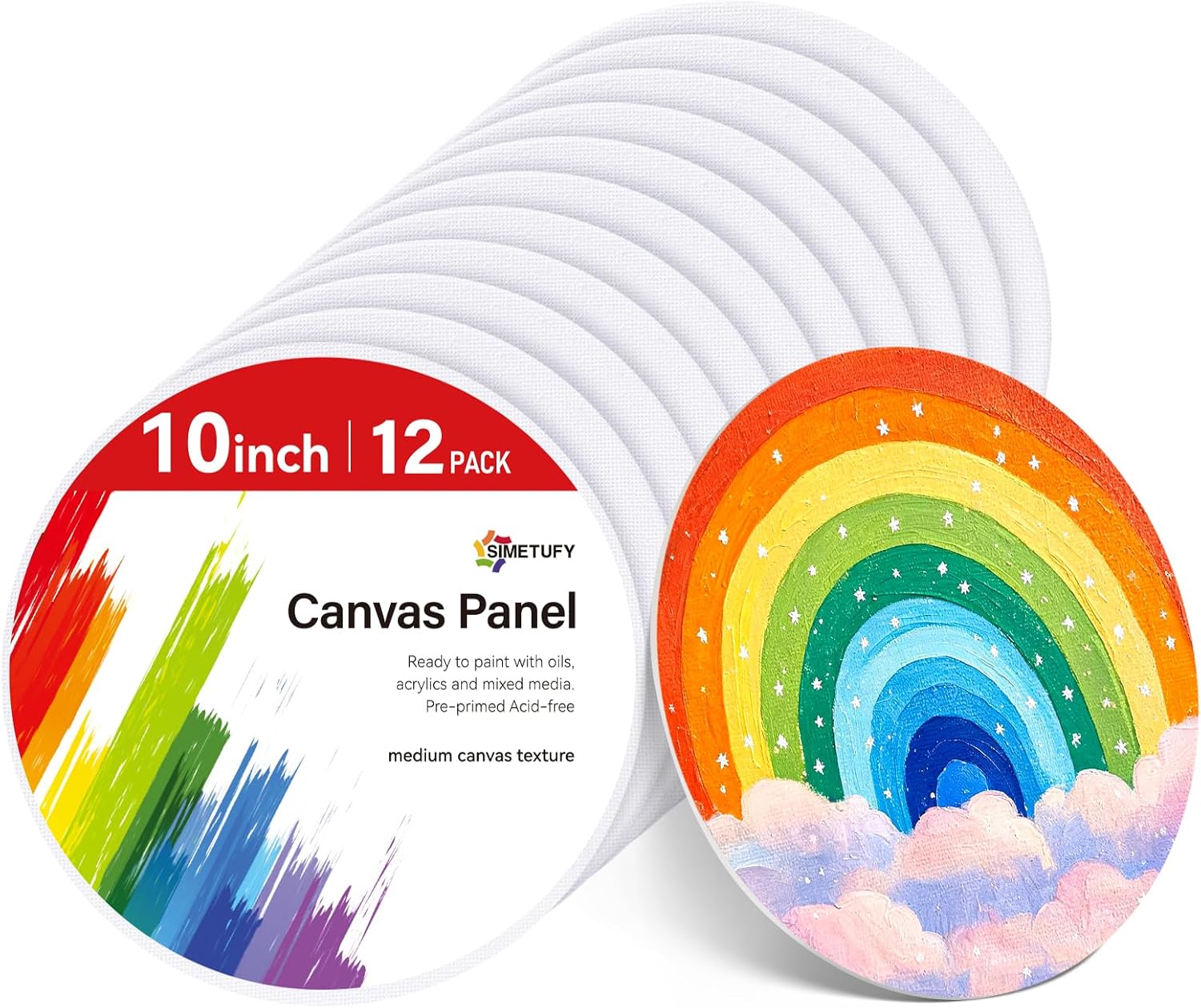
Simetufy’s 10 inch round panels are 100 percent cotton with a smooth medium texture, pre-coated with acid-free gesso over a sturdy board core that the listing says resists warping. They are sold for oil, acrylic, watercolor, tempera, pouring and gouache.
Flat boards are the right format for classes and paint nights. They stack, they travel without damage and every student gets an identical surface. The 10 inch diameter is generous for mandalas, dreamcatcher designs and decorative wall hangings, which the listing specifically mentions.
Simetufy lists pouring as a use, but panels are generally less forgiving with very wet pours than stretched rounds. For heavy pours, test one board first.
Best suited for: Teachers, paint party hosts and painters practicing mandala designs.
Key features:
- 12 x 10″ flat round panels
- 100% cotton
- Acid-free gesso primer
- Sturdy board core
Pros:
- Low cost per piece
- Easy to store and carry
- Fits round frames and mini easels
Cons and limitations:
- Panels need a frame or easel to display
- Heavy pours may stress the board
Buying consideration: Seal the back with a coat of acrylic if you plan very wet techniques, which helps prevent warping.
5. PHOENIX Round Canvas Panels, 9 Pack — Best for framing and graduated practice

PHOENIX includes three each of 8, 10 and 12 inch round panels. The canvas is 100 percent cotton glued over paper board and pre-primed with acid-free gesso. PHOENIX notes these panels are not designed for acrylic pouring or heavy texture painting because of the amount of paint those techniques use.
That warning makes the use case clear. These are for brush painting: florals, lettering, calligraphy on round panels, collage and kids’ projects. Three sizes give you room to practice a design small before committing to the 12 inch panel.
Panels this light are easy to mount in a round frame or embroidery-style hoop frame for display.
Best suited for: Brush painters who want three sizes of flat round panel for practice and framing.
Key features:
- 9 panels: 3 each of 8″, 10″, 12″
- 100% cotton canvas
- Acid-free gesso
- Paper board core
Pros:
- Three sizes
- Clear guidance on limits
- Light and easy to frame
Cons and limitations:
- Not for pours or heavy texture
- Paper board core is less rigid than MDF
Buying consideration: Keep paint layers moderate and let each dry before adding the next.
6. JMIATRY 10-Pack 8 Inch Round Canvases — Best for bulk 8 inch projects

JMIATRY sells ten 8 inch round canvases with cotton and wood listed as materials. The listing describes a smooth white surface and sturdy construction but gives fewer specifics than LOPYXBR on frame depth and priming.
If the LOPYXBR pack is unavailable or you want a second source for a large project, this is a comparable 8 inch bulk option.
Best suited for: Painters making many matching 8 inch pieces.
Key features:
- 10 x 8″ rounds
- Cotton and wood construction
- White primed surface
Pros:
- Bulk count
- Wood listed in materials
- Good for series work
Cons and limitations:
- Fewer construction details in the listing
- Single size
Buying consideration: Check the photos for profile depth before planning to hang without frames.
7. Aodaer 12-Piece Shaped Stretched Canvas Set — Best for mixing circles with other shapes

Aodaer’s set includes 12 stretched canvases at 6 inches: three each of round, square, triangle and hexagon. The frames are pine wood and the canvas is white cotton fabric. The title names acrylic pouring and oil painting.
Only three pieces are round, so this is not a round-canvas bulk pack. It is useful when you want circles as part of a geometric wall display, or when you want to test how a design reads in different shapes.
Best suited for: Small decorative displays and painters experimenting with shaped canvas.
Key features:
- 12 pieces at 6″
- 3 each: round, square, triangle, hexagon
- Pine wood frames
- Cotton canvas
Pros:
- Shape variety
- Wooden frames
- Sized for small pours
Cons and limitations:
- Only 3 rounds
- Small size limits detail
Buying consideration: Plan a color theme across shapes so the group reads as one piece.
Buying Guide: How to Choose Round Canvas for Acrylics
Panel or stretched
Use panels for brush work, classes and framing. Use stretched rounds for pours, wall pieces and heavy layers.
Diameter
Six to 8 inches suits ornaments, studies and small gifts. Ten to 12 inches suits mandalas, pours and wall art. Mixed-size packs help you find your preferred scale.
Frame material and depth
Pine frames are the most rigid. Fiberboard and paper board frames are lighter. A depth around 15 mm looks finished on the wall without framing.
Priming and surface
Acid-free gesso is standard. More coats give a smoother surface for dot art and fine lines. Add your own gesso if you want even smoother.
Pouring compatibility
Stretched rounds handle pours best because excess paint runs off the edges. Check panel listings for pour warnings.
Count and cost per piece
Bulk packs make sense for classes and series. Mixed packs make sense for experimenting.
Composing on a circle
Sketch from the center outward with a compass or a string pinned at the center. Radial designs, centered subjects and borders that follow the curve all work well on rounds.
Related Canvas Guides
Round surfaces still follow standard acrylic rules. Learn how to do underpainting on canvas with acrylic to set up your colors, see whether acrylic paint works on canvas board if you choose panels, and finish with our guide to sealing acrylic paint on canvas.
Common Mistakes to Avoid
- Pouring on a paper-board panel that the maker says is not designed for pours.
- Starting a mandala off-center; mark the true center first.
- Placing a strong horizontal line across a circle, which can make the piece look tilted.
- Drying stretched rounds on edge after a pour, which causes drips and sags.
- Forgetting to paint the sides of a stretched round you plan to hang unframed.
FAQs
Is canvas board or stretched canvas better for round acrylic paintings?
Stretched rounds suit pours and wall display; boards suit brush work, classes and framing.
Can I do acrylic pouring on round canvas?
Yes, on stretched rounds especially. Some round panels, such as the PHOENIX panels, are not designed for pours.
How do I find the center of a round canvas?
Draw two chords across the circle and their perpendicular bisectors; where they cross is the center. A circle center finder ruler is faster.
What size round canvas is best for mandalas?
Eight to 12 inches gives room for several rings of dots without taking days to finish.
Do round canvases need special frames?
Panels usually need a round frame or an easel. Stretched rounds with a 15 mm profile can hang as they are.
Should I gesso a pre-primed round canvas?
It is optional. An extra coat gives a smoother surface for dot art and fine detail.
Final Recommendation
Choose the TRANSON 4-size pack if you want to explore round compositions and hang the results. Pick LOPYXBR or JMIATRY for a matching series of 8 inch rounds, and Frcctre for larger 12 inch pieces. For classes, mandala practice and framing, Simetufy’s 10 inch boards and the PHOENIX 9-pack are the economical choices, keeping in mind that PHOENIX is for brush painting rather than pours. The Aodaer set suits geometric displays that mix circles with other shapes.




