PaintingProGuide is reader-supported. When you buy through links on this page we may earn an affiliate commission at no extra cost to you.
Plastic palettes stain, warp and crack; ceramic ones chip and weigh a lot. Metal palettes for painters sit between the two. Aluminum and steel well palettes are light, hard to break and smooth enough that paint rinses away, which is why they are popular with watercolor and gouache painters and in classrooms.
The options on Amazon right now are mostly simple aluminum well trays, round or rectangular, sold in packs. That is a narrow category, so we kept the list to the four that clearly fit and spend more of this guide on choosing a layout, preventing problems such as dents and corrosion, and getting the most from a metal palette.
Quick answer: The ELFULLY 10-Pack Aluminum Round Palettes are the best value for classrooms and anyone who wants several palettes. For a watercolor box-style layout, choose the Honbay Rectangular 12-Well Palettes, and for a simple pair of round palettes, the Trinkrittey set.
Our Top Picks at a Glance
- ELFULLY 10-Pack Aluminum Round Palettes — Best for classrooms, groups and color studies
- Honbay Rectangular Metal 12-Well Palettes (2 pc) — Best for watercolor and gouache with a row layout
- Trinkrittey Round Metal Palettes (2 pc) — Best for a pair of deep-well round palettes
- JKJF Round Metal 10-Well Palettes (2 pc) — Best for basic metal palettes for students
| Product | Best For | Key Spec | Key Strength | Price Tier |
|---|---|---|---|---|
| ELFULLY 10-Pack Aluminum Round Palettes | Classrooms, groups and color studies | 6.7 in diameter; 10 wells of 1.5 in + 3.3 in center | Ten stackable trays | $ |
| Honbay Rectangular Metal 12-Well Palettes (2 pc) | Watercolor and gouache with a row layout | 23 x 11 cm; 12 wells; aluminum | Row of wells plus mixing space | $ |
| Trinkrittey Round Metal Palettes (2 pc) | A pair of deep-well round palettes | 10 wells + center; aluminum; 2.4 oz | Deep recesses keep colors apart | $ |
| JKJF Round Metal 10-Well Palettes (2 pc) | Basic metal palettes for students | 10 wells; aluminum; 2.46 oz | Simple and durable | $ |
How We Chose
We based these picks on Amazon listing details and specifications checked in October 2026, how well each palette’s material, well layout and size suit painting, and how widely each product is reviewed by Amazon buyers. We left out tiny stainless steel cups marketed mainly for makeup and nail art, and palette knives that appeared in the same search.
We compared each palette on:
- Material and finish (aluminum, stainless steel)
- Number, size and depth of wells
- Mixing area
- Layout: round or rectangular
- Pack size and price per palette
- Ease of cleaning
Metal vs Plastic vs Ceramic Palettes
Each material handles paint differently:
- Metal (aluminum, steel): light, shatterproof, non-absorbent and less prone to staining than plastic. Can dent; bare steel can rust if left wet.
- Plastic: cheapest and lightest, but watercolor beads on new plastic and staining builds up over time.
- Ceramic or porcelain: the smoothest mixing surface and stain-resistant, but heavy and breakable.
- Enamel-coated metal: used in traditional watercolor boxes; the white enamel shows true color and resists staining.
For watercolor and gouache, metal and ceramic both give a pleasant, even surface. For classrooms and travel, metal wins because it survives drops.
Best Metal Palettes for Painters Reviewed
1. ELFULLY 10-Pack Aluminum Round Palettes — Best for classrooms, groups and color studies

ELFULLY’s pack gives you ten identical aluminum palettes, each 6.7 inches across with ten 1.5-inch wells around a 3.3-inch central reservoir. The listing describes them as rust- and corrosion-resistant and less prone to staining than plastic, and they stack for storage.
Ten palettes is more than most solo painters need, which is exactly why this pack suits workshops, classrooms and painting parties. It also works for an individual who likes to keep a separate palette for each painting or each color family, letting watercolor or gouache dry in the wells and re-wetting later.
The round layout puts every color within easy reach of the central mixing area. The wells are relatively shallow, so they suit watercolor, gouache and small amounts of acrylic better than big puddles of wash.
Best suited for: Teachers, workshop hosts and painters who like dedicated palettes per project.
Key features:
- Ten aluminum palettes
- 6.7 inch diameter
- Ten 1.5 inch wells plus 3.3 inch central reservoir
- Stackable
- Rust- and stain-resistant per listing
Pros:
- Lowest cost per palette
- Stacks neatly
- Metal resists staining better than plastic
Cons and limitations:
- Small mixing area per palette
- Shallow wells for big washes
- Thin aluminum can dent
Buying consideration: If you only need one or two palettes, a two-pack costs less overall. Buy the ten-pack when you will actually use the quantity.
2. Honbay Rectangular Metal 12-Well Palettes (2 pc) — Best for watercolor and gouache with a row layout

A rectangular well palette mirrors the layout of a watercolor box: colors in a row, mixing space alongside. Honbay’s pair are aluminum, about 23 by 11 cm, each with 12 wells, and the listing names watercolor, gouache, acrylic, oil and tempera.
Painters who arrange colors in a consistent order, warm to cool or by pigment, often prefer a row to a circle, because the eye learns where each color lives. Two palettes let you keep one for watercolor and one for gouache, or one at home and one in a travel bag.
Best suited for: Watercolor and gouache painters who like a fixed color order and a compact tabletop palette.
Key features:
- Two aluminum palettes
- Twelve wells each
- About 23 x 11 cm
- Listed for watercolor, gouache, acrylic, oil and tempera
Pros:
- Logical row layout
- Compact for desk or travel
- Low price tier for a pair
Cons and limitations:
- Mixing areas are modest
- Listing dimensions are inconsistent
- No lid
Buying consideration: Squeeze tube watercolor into the wells and let it dry; it re-wets easily and turns the palette into a compact pan set.
3. Trinkrittey Round Metal Palettes (2 pc) — Best for a pair of deep-well round palettes

Trinkrittey’s round aluminum palettes have ten recesses and a central mixing zone. The listing highlights deep recesses that keep pigments separate, and lists watercolor, oils and gouache among the uses.
The non-absorbent metal surface is the main reason to choose metal over plastic: watercolor and gouache stains wipe out more easily, and paint behaves consistently on the surface. A pair at this price tier covers a home palette and a spare.
Best suited for: Hobby painters who want a durable round palette with separate color wells.
Key features:
- Two aluminum palettes
- Ten recessed wells plus central mixing area
- Smooth, non-absorbent surface
- Light at about 2.4 oz each
Pros:
- Deep wells reduce color contamination
- Rinses clean under water
- Very low price tier
Cons and limitations:
- Diameter not specified in the listing
- Central area is small for big mixes
- Can dent if dropped
Buying consideration: Compare the photos with the ELFULLY palettes; if they look similar in size, choose the pack size you need rather than the brand.
4. JKJF Round Metal 10-Well Palettes (2 pc) — Best for basic metal palettes for students
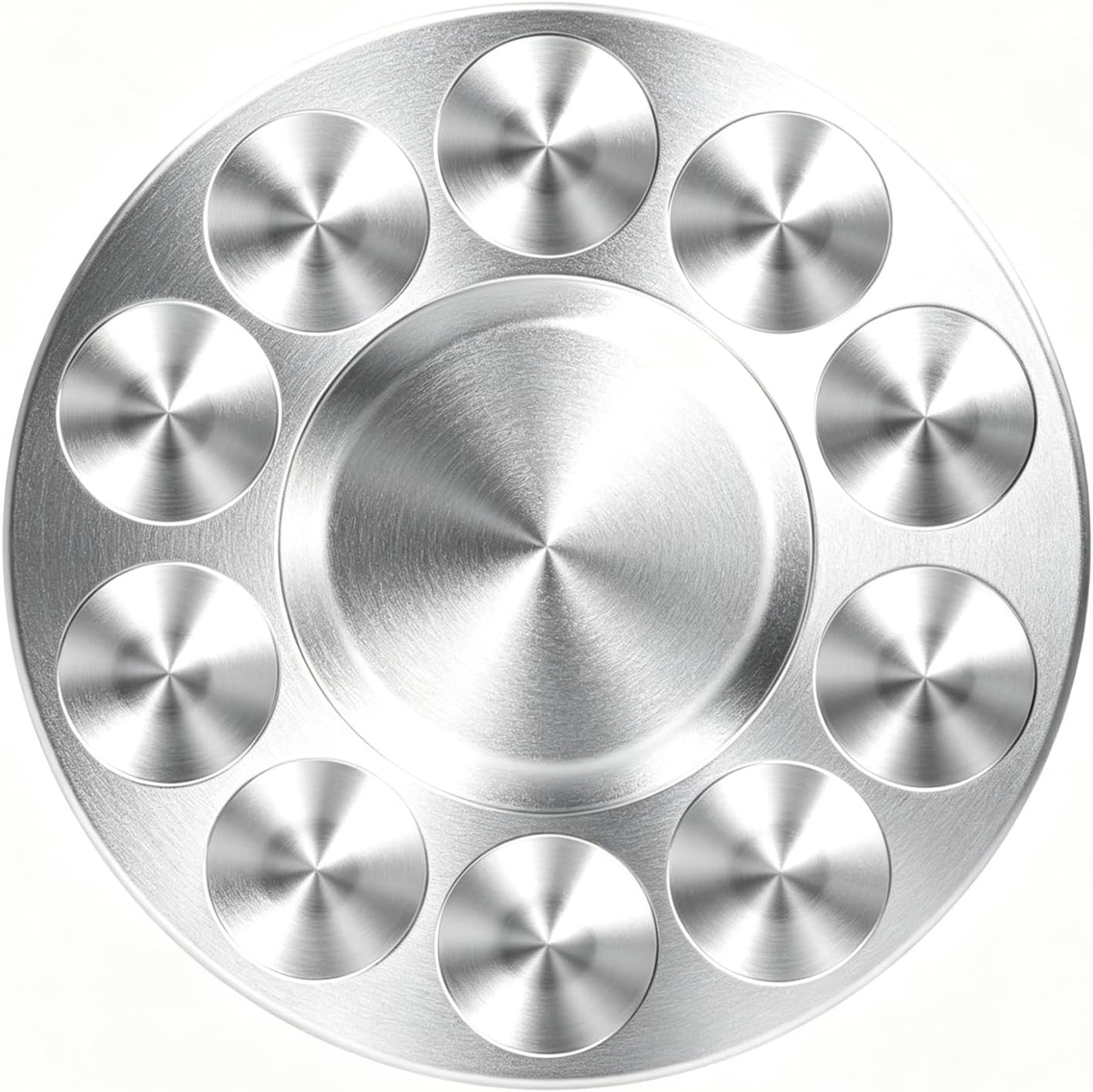
JKJF’s listing is brief: two aluminum palettes for holding and mixing pigments, aimed at artists, students and children. The design is the familiar round tray with ten wells around a center.
For a student or beginner, that simplicity is enough. Aluminum does not crack the way plastic can when dropped, and dried paint lifts off more easily. If you need specific dimensions, check the product photos before buying, since the listing does not state them.
Best suited for: Students, beginners and families who want a sturdy, inexpensive palette.
Key features:
- Two aluminum palettes
- Ten wells with central mixing area
- About 2.46 oz each
Pros:
- Sturdy, uncrackable metal
- Low price tier
- Easy to clean
Cons and limitations:
- Few details in the listing
- No stated diameter
- Basic finish
Buying consideration: These are a practical spare or student palette; experienced painters may prefer a larger mixing area.
Using a Metal Palette for Different Media
Watercolor. Squeeze tube paint into the wells and let it dry overnight. It re-wets with a damp brush, turning the palette into a refillable pan set. Mix in the central area or larger wells and wipe clean between sessions.
Gouache. Gouache can also be left to dry and re-wetted, though some brands crack when dry. Many gouache painters prefer fresh paint each session and use the wells to keep colors separate while mixing.
Acrylic. Acrylic dries quickly on any open palette, and a metal well palette is no exception. Use small amounts and mist with water. Dried acrylic usually peels off smooth metal with a fingernail or soaks off in warm water.
Oil. Oil painters typically prefer a flat palette with plenty of mixing room, such as glass or wood. A small metal well palette can still hold medium or a few colors for small studies.
Caring for a Metal Palette
Rinse the palette after each session or let watercolor dry in the wells deliberately. Avoid abrasive scouring pads, which scratch aluminum and make future staining more likely. A soft sponge and mild soap are enough for most cleanups.
Dry the palette before stacking or storing, particularly if it is steel. Aluminum does not rust like iron, but it can still discolor if left wet against other metals. Stack palettes with a paper towel between them if paint is still drying in the wells.
If a palette dents, gently press it back from the underside. Deep creases are hard to remove, so store metal palettes flat rather than wedged into a crowded bag.
How to Arrange Colors in a Well Palette
A consistent layout saves time and reduces muddy mixes, because your hand learns where each color lives. Here is a simple approach that works on round and rectangular metal palettes alike.
- Start with a limited palette of six to eight colors: a warm and cool version of each primary plus one or two earth colors.
- Place colors in the order of the color wheel, so neighbors mix cleanly: yellows, oranges, reds, violets, blues, greens.
- Put earth colors such as burnt sienna and raw umber together at one end or between the reds and blues.
- Leave one or two wells empty for convenience colors or a test mix you want to keep.
- Label the underside or the edge with a fine marker or a strip of tape so you can refill wells correctly.
On a round palette, treat the central reservoir as your main mixing area and the outer wells as storage. On a rectangular palette, keep the row of wells for pure color and use any open area or a second palette for mixing.
If you paint in watercolor, try swatching each well on a strip of paper and keeping it with the palette. Dried paint in a metal well can look darker than it paints, and a swatch card avoids surprises.
Refill wells before they run completely dry and crack. Adding fresh tube paint on top of a partly used well keeps the color consistent and the pan solid.
Buying Guide: How to Choose a Metal Palette
Round or rectangular layout
Round palettes put every color an equal distance from the center, which is efficient for mixing. Rectangular palettes give a fixed color order, similar to a watercolor box. Choose based on how you like to organize your colors.
If you are not sure, start with a round palette; it is the most common and the most forgiving.
Number and size of wells
Ten to twelve wells cover most limited palettes with room for a few extra colors. Larger wells hold more paint and suit washes; smaller wells conserve paint.
Deep wells keep colors from running into each other when you carry the palette, which matters for travel and classrooms.
Mixing area
A small central reservoir is fine for detail work, but larger paintings need more space. If you mix large washes, plan on a second palette or a flat mixing plate alongside.
Some painters keep two identical palettes: one for pure colors and one purely for mixing, which they wipe clean as often as needed.
Material thickness
Thin aluminum is light but dents. Heavier gauge metal feels sturdier but costs more. Listings rarely give thickness, so check weight and photos.
A very light palette is easier to carry but can slide on a table; a damp paper towel underneath stops it moving.
Pack size
Ten-packs make sense for classrooms and workshops. Two-packs cover a main palette and a spare. Do not pay for quantity you will not use.
Portability
Metal palettes travel well because they will not crack. Pair one with a zip bag or slim case to keep wet paint off the rest of your kit.
Palette Care and Technique Guides
Keep any palette in good shape with our step-by-step guide on how to clean a painting palette. If acrylic dries too fast on an open metal tray, try our tips on keeping a paint palette from drying out, or learn what a wet palette is and when it is the better choice.
Common Mistakes to Avoid
- Scrubbing aluminum with abrasive pads
- Leaving a steel palette wet overnight
- Using a tiny well palette for large washes
- Mixing too many colors in one central reservoir
- Stacking palettes while paint is still wet
- Expecting acrylic to stay workable on an open metal tray
FAQs
Are metal palettes good for watercolor?
Yes. Their smooth, non-absorbent surface lets watercolor mix evenly and rinse away. Many painters let tube watercolor dry in the wells and re-wet it later.
Do aluminum palettes stain?
They resist staining better than plastic. Strong pigments such as phthalo blue can still tint the surface slightly, but most color wipes away with water and a soft sponge.
Can I use acrylic paint on a metal palette?
Yes. Dried acrylic usually peels or soaks off smooth metal. Use small amounts, since acrylic dries quickly on any open palette.
Will an aluminum palette rust?
Aluminum does not rust the way steel does, but it can discolor or corrode if left wet for long periods. Rinse and dry it after use.
What is the best palette for gouache?
A well palette made of metal or ceramic suits gouache because it keeps colors separate and rinses easily. Some painters let gouache dry in the wells and re-wet it.
How many wells does a palette need?
Ten to twelve wells are enough for most painters using a limited palette. More wells help if you keep many convenience colors.
Final Recommendation
For classrooms, workshops or anyone who likes a fresh palette for each project, the ELFULLY ten-pack offers the best value per palette. Watercolor and gouache painters who like a fixed color order should choose the Honbay rectangular palettes.
If you just want a pair of sturdy round palettes, the Trinkrittey and JKJF sets serve the same purpose; pick by price and photos. For large mixes or oil painting, add a flat glass or wooden palette alongside your metal well tray.