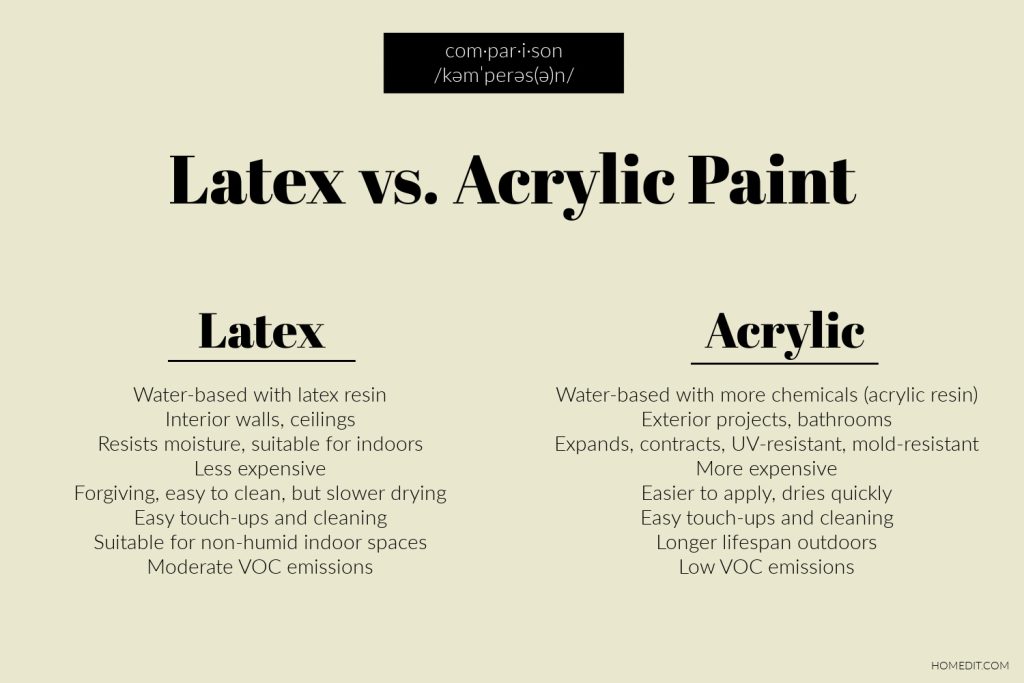
Quick answer: Is acrylic paint the same as latex? Not exactly, but they are close relatives. Both are water-based paints that dry as a polymer film, and most modern “latex” house paints actually use acrylic or vinyl-acrylic binders, not rubber. The differences are in purpose and recipe: artist acrylics contain more and finer pigment, fewer fillers and often more lightfast colors, while latex house paint is made to cover large walls cheaply and durably. They are not interchangeable for every job.
The confusion is understandable. Walk into a hardware store and you will see “latex paint” on cans that list acrylic resin as the binder. Walk into an art store and you will see “acrylic paint” in small tubes that clean up with water just like that wall paint. Under the labels, the chemistry overlaps a great deal. What separates them is what each is designed to do.
This guide explains how acrylic and latex paint are related, the key differences that matter for artists and crafters, when one can substitute for the other and when it cannot.
Where the Word “Latex” Comes From
In paint, “latex” refers to a polymer emulsion: tiny particles of plastic resin suspended in water. The term dates back to early water-based paints that used synthetic rubber-like polymers. The name stuck even as formulas moved on.
Today, the binder in most “latex” house paints is acrylic, vinyl acrylic (PVA blended with acrylic) or styrene acrylic. Modern latex paint generally does not contain natural rubber latex from rubber trees, which is why the paint industry typically states that it does not pose the same concerns as natural latex products for people with latex allergies. Anyone with a severe allergy should still check the product’s safety data sheet or ask the manufacturer.
How Acrylic and Latex Paint Are Similar
- Water-based. Both thin and clean up with water while wet.
- Emulsion chemistry. Both contain polymer particles suspended in water that fuse into a film as the water evaporates.
- Water-resistant when dry. Once cured, neither rewets with water.
- Flexible film. Both remain somewhat flexible, which helps them resist cracking compared with older oil-based paints.
- Low odor. Compared with solvent-based paints, both have relatively mild odors, though formulations vary.
Because the chemistry overlaps, the real question for most readers is which paint suits the project. For canvas and paper, the paint’s pigment load and grade usually matter more than the label on the can. Our guide to the best acrylic paint brands and their grades shows how student, craft and artist ranges differ.
Student, Craft and Artist Acrylic: Where Latex Fits
It helps to think of water-based paints as a spectrum rather than two separate categories.
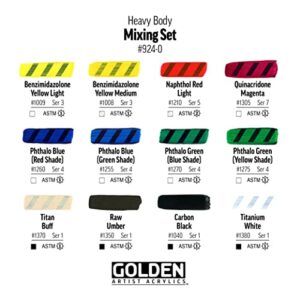
- Artist acrylic: The highest pigment concentration, individually named pigments and published lightfastness ratings in many ranges.
- Student acrylic: Similar binder, but more fillers and sometimes substitute (“hue”) pigments to keep the price down.
- Craft acrylic: Designed for decor and crafts, often thinner, with less pigment and fewer details on the label.
- Latex house paint: Built for opacity, washability and coverage across large areas, using store-mixed colorants and substantial fillers.
Moving down the list, cost per ounce drops and the paint is tuned less for color mixing and more for convenience or coverage.
Key Differences Between Artist Acrylic and Latex House Paint
| Factor | Artist acrylic paint | Latex house paint |
|---|---|---|
| Main purpose | Fine art and crafts on canvas, paper, wood | Covering walls, trim and exterior surfaces |
| Binder | Usually 100% acrylic polymer | Acrylic, vinyl acrylic or styrene acrylic, varies by grade |
| Pigment load | High, especially in artist grade | Lower, balanced with fillers for coverage and cost |
| Fillers and extenders | Few in artist grade, more in student and craft | Significant, such as clays, calcium carbonate and silica |
| Pigment quality | Single, often lightfast pigments, labeled by code | Tinted from colorants at the store; lightfastness not designed for art |
| Color mixing | Clean, intense mixes | Mixes can turn dull or chalky |
| Consistency | Heavy, soft or fluid body options | Uniform, designed for rollers and brushes on walls |
| Additives | Minimal, art-focused | Mildewcides, leveling agents and others for walls |
| Packaging and cost | Small tubes and jars, higher cost per ounce | Quarts and gallons, low cost per ounce |
The biggest practical difference for painters is pigment. Artist acrylics are built around concentrated, individually named pigments that mix cleanly and resist fading. If you want to see how pigment load varies across art paint ranges, our comparison of the best acrylic paint brands for artists explains what to look for on the label.
Is 100% Acrylic House Paint the Same as Artist Acrylic?
Not quite. Higher-grade house paints often advertise “100% acrylic” binders, which makes them chemically closer to artist acrylics than vinyl-acrylic blends. However, the pigment system is still designed for walls: store-tinted colorants, fillers for hiding power and additives for scrubbing and mildew resistance. The binder may be similar; the recipe and goals are different.
Durability and Aging Over Time
Both paints form tough films, but they are tested against different kinds of wear. House paint is engineered to survive scrubbing, scuffs from furniture, humidity in kitchens and bathrooms, and, for exterior grades, rain and sun on siding. Artist acrylic is engineered to keep its color and flexibility on a canvas that hangs indoors for decades.
That difference shows up in a few ways:
- Color stability: Many artist colors carry lightfastness ratings. Wall paint colorants are chosen for a typical repaint cycle of years, not generations, and some tints may shift over time.
- Flexibility: Artist acrylic films are designed to flex with stretched canvas. Some flat house paints with high filler content are more brittle and can crack if the support moves.
- Surface hardness: Wall paint, especially higher-sheen grades, is often formulated to resist scrubbing and blocking better than unvarnished artist paint.
For a mural or a piece of furniture, house paint’s toughness is an advantage. For a painting meant to last, the artist formula’s color stability and flexibility matter more.
Can You Use Latex Paint for Art?
Yes, with realistic expectations. Many artists use house paint for specific purposes:
- Large murals and backgrounds, where cost per gallon matters and fine color mixing does not.
- Underpainting and toning large canvases.
- Acrylic pouring practice, where some pourers use inexpensive latex paint mixed with pouring medium.
- Craft and decor projects such as furniture, signs and set pieces.
Limitations include duller color mixing, possible color shifts over time, a chalkier finish in some flat paints and less predictable behavior with art mediums. For fine art you plan to keep or sell, artist acrylics are the more reliable choice.
Can You Use Acrylic Artist Paint on Walls?
You can, especially for murals, accents and small decorative details. Artist acrylic adheres well to properly prepared, primed walls. The challenge is cost and scale: small tubes are expensive for large areas. Many muralists block in large areas with wall paint and use artist acrylics for detailed, saturated passages. For murals in high-traffic or exterior areas, a clear protective topcoat suited to the location helps with durability.
Can You Mix Acrylic and Latex Paint?
Because both are water-based emulsions, they can often be mixed physically. Results vary depending on the binders and additives involved. Possible issues include changes in consistency, uneven sheen, slower drying or reduced durability. If you want to mix them, test on a sample board first, mix thoroughly and let the test dry fully before relying on it.
Sheen Names: Wall Paint vs. Art Paint
| House paint sheen | Closest art paint equivalent | Notes |
|---|---|---|
| Flat or matte | Matte acrylic or matte medium | Hides surface flaws; can look chalky and mark easily |
| Eggshell | Satin-leaning matte | Slight glow; common for living spaces |
| Satin | Satin varnish or medium | Balanced sheen and washability |
| Semi-gloss | Gloss medium mixed with matte | Durable; shows brushstrokes |
| Gloss | Gloss medium or gloss varnish | Deepens color; reflects light strongly |
Artist acrylics usually dry with a natural sheen that varies by color and pigment. Artists often unify it at the end with a varnish, while house paint sheen is built into the can.
Using Leftover House Paint in the Studio
Half-used cans of wall paint can still be useful to a painter. White and neutral latex paint makes an inexpensive ground for practice boards and cardboard studies. Darker colors can tone large practice canvases. It also works for painting frames, display boards and studio furniture.
Keep a few limits in mind. Old paint that has frozen, separated permanently or developed a sour smell should be discarded according to local rules. Do not rely on house paint for work you intend to sell as archival, and test it with any art mediums before mixing large batches.
Gesso vs. Latex Primer
Acrylic gesso is the standard primer for canvas and panels in art. It is formulated to stay flexible, provide “tooth” for paint to grip, and accept acrylic and oil painting. Latex wall primer is formulated for drywall and plaster. Some artists use latex primer on large or experimental supports to save money, but it may be less flexible on stretched canvas and has not been formulated with long-term artwork in mind. For pieces you want to last, use artist gesso.
Latex vs. Acrylic for Different Projects
| Project | Better choice | Why |
|---|---|---|
| Fine art painting on canvas | Artist acrylic | Pigment quality, mixing, lightfastness |
| Large interior mural background | Latex wall paint | Cost and coverage |
| Mural details and highlights | Artist acrylic | Saturated, precise color |
| Furniture makeover | Latex or furniture-specific paint | Durability on large surfaces |
| Acrylic pouring on a budget | Either, with pouring medium | Latex is cheaper; artist acrylic gives richer color |
| Rocks, crafts and small decor | Craft or artist acrylic | Small sizes and color variety |
| Exterior siding and trim | Exterior latex house paint | Weather and UV resistance designed for buildings |
Safety and Cleanup
Both paints clean up with soap and water while wet and become difficult to remove once dry. Keep brushes wet during use and wash them promptly. Do not pour large amounts of either paint down drains; let paint water settle, dispose of solids in the trash and follow local rules for leftover cans. Read labels for any warnings, particularly for pigments in artist paints and additives in house paints, and ventilate when painting large areas.
Related Question: Is Acrylic Ink the Same as Alcohol Ink?
No. This is another common mix-up. Acrylic ink is pigment suspended in an acrylic polymer emulsion, thinned to an ink-like consistency. It is water-based while wet and permanent once dry, and it works with brushes, dip pens and airbrushes on paper and canvas. Alcohol ink uses dyes dissolved in alcohol. It flows and spreads dramatically on non-porous surfaces like yupo paper, ceramic tile and glass, and it can be reactivated with alcohol after drying. Dye-based alcohol inks are also generally considered less lightfast than pigment-based acrylic inks.
For a closer look at how a pigment-based acrylic ink behaves, see our Daler-Rowney acrylic ink review.
FAQs
Is latex paint just acrylic paint?
Not exactly. Most modern latex paints use acrylic or vinyl-acrylic binders, so they are related to acrylic paint. However, house paint uses different pigments, more fillers and wall-specific additives, so it behaves differently from artist acrylics.
Does latex paint contain rubber?
Modern latex paints generally use synthetic polymers rather than natural rubber latex. The name is historical. People with severe latex allergies should still check the product’s safety data sheet.
Can I use acrylic paint instead of latex on walls?
Yes for small areas, murals and accents on primed walls. For whole rooms, artist acrylic is expensive compared to wall paint, which is designed for large-area coverage and scrubbing.
Can you paint acrylic over latex?
Generally yes. Both are water-based, and acrylic adheres well to clean, dry, cured latex paint. Lightly scuffing glossy surfaces improves grip.
Is acrylic ink the same as alcohol ink?
No. Acrylic ink is a water-based, pigment-based ink that dries permanent. Alcohol ink is dye-based, dissolved in alcohol, and can be reactivated with alcohol after drying.
Which is better for art, acrylic or latex?
Artist acrylic is better for most fine art because of its pigment quality, clean color mixing and lightfastness. Latex is useful for budget-friendly backgrounds, murals and practice.
Final Thoughts
Acrylic and latex paint are related, water-based polymer emulsions, but they are built for different jobs. Latex covers walls economically; artist acrylic delivers concentrated, mixable, lasting color. Use house paint where scale and cost matter and artist acrylics where color quality and longevity matter.
When color quality is the priority, choosing the right tubes makes a visible difference. Explore our guide to artist-grade acrylic paints and how they compare to find the right fit for your work.