PaintingProGuide is reader-supported. When you buy through links on this page we may earn an affiliate commission at no extra cost to you.
Quick answer: All artist and craft acrylic paint is water based: pigment carried in an acrylic polymer emulsion that thins and cleans up with water while wet, then dries water-resistant. For a well-balanced first set, the Caliart 24-color set lists classic mixing colors like Phthalo Blue, Yellow Ochre and Burnt Sienna. For buttery, non-leaking bottles, the Artkey 24-color set is a strong alternative, and for big projects the Nicpro 14-color 16.9 oz bulk set gives the most paint per color.
“Water based acrylic paint” can sound like a contradiction: if it is water based, why does it become waterproof? The answer is the binder. Acrylic paint is an emulsion of tiny acrylic polymer particles suspended in water. While the paint is wet, water is the carrier, so you can thin it with water and wash brushes in the sink. As the water evaporates, the polymer particles fuse into a flexible plastic film that water can no longer dissolve.
That combination of easy cleanup and durable results is why water-based acrylic is the most popular paint for beginners, classrooms, crafters and many professional painters. This guide explains how it works, how it compares with other “water-based” paints, how much water you can safely add and which sets suit different needs.
How Water-Based Acrylic Paint Works
- Wet stage: polymer particles and pigment float in water. The paint is workable and water-soluble.
- Drying stage: water evaporates, usually within minutes for thin layers. Particles move closer together.
- Film formation: particles coalesce into a continuous, flexible film that locks pigment in place.
- Curing: the film continues to harden for a day or more, especially in thick layers.
Once the film has formed, water no longer re-dissolves it, which is why you must rinse brushes before acrylic dries. It is also why you can glaze a new layer over a dry one without disturbing it, something watercolor and gouache cannot do as easily.
Water-Based Acrylic vs Other Water-Based Paints
| Paint | Binder | Rewettable When Dry? | Finish |
|---|---|---|---|
| Acrylic | Acrylic polymer emulsion | No | Satin to gloss, or matte |
| Watercolor | Gum arabic | Yes | Transparent, matte |
| Gouache | Gum arabic, more pigment | Yes | Opaque, matte |
| Tempera (school paint) | Various, often starch or casein | Often yes | Matte, chalky |
| Water-mixable oil | Modified oil | No, dries by oxidation | Oil-like |
For direct comparisons, see our guides on acrylic paint vs water-based paint, water-based oil paint vs acrylic and acrylic paint markers vs water-based markers.
How Much Water Can You Add?
A little water improves flow and is perfectly fine. Many manufacturers suggest keeping water additions modest, often up to about a quarter to a third of the paint volume for surfaces like canvas. Beyond that, the binder can spread too thin, leaving a weak, chalky layer that may lift. For washes and thin glazes, use an acrylic medium instead of lots of water. On absorbent paper, thinned acrylic behaves more like watercolor, and our guide on misting acrylic paint with water explains how to keep paint workable without over-diluting it.
Our Top Picks at a Glance
- Caliart 24-Color Set with 12 Brushes — Best balanced mixing palette
- Artkey 24-Color Set (2 oz) — Best buttery consistency and leak-proof bottles
- Nicpro 24-Color Set with Palette and Color Wheel — Best for learning color
- Shuttle Art 36-Color Set with Brushes and Palette — Best large color range
- TMOL 24-Color Set with 12 Brushes — Best compact gift set
- Apple Barrel Vibrant Spectrum, 16 Colors — Best water-based craft acrylic
- Nicpro 14-Color Bulk Set, 16.9 oz — Best bulk water-based acrylic
| Product | Best For | Key Spec | Key Strength | Price Tier |
|---|---|---|---|---|
| Caliart 24 | Mixing palette | 24 x 2 oz, classic named colors, 12 brushes | Creamy, high coverage | $$ |
| Artkey 24 | Smooth handling | 24 x 2 oz, semi-gloss | Tightly sealed bottles, labeled colors | $$ |
| Nicpro 24 | Learning color | 24 x 2 oz, 12 brushes, palette, guide | Color wheel included | $$ |
| Shuttle Art 36 | Variety | 36 x 2 oz, gloss, 12 brushes, palette | Metallic gold and silver | $$ |
| TMOL 24 | Gift or starter | 24 x 2 oz, 12 brushes | Fade resistant | $$ |
| Apple Barrel 16 | Crafts | 16 x 2 oz, matte | Made in USA | $$ |
| Nicpro Bulk 14 | Classrooms, murals | 14 x 16.9 oz | Large squeeze bottles | $$ |
How We Chose
We selected these sets from the Amazon listing details checked in October 2026, comparing color selection, bottle size, finish, included accessories and stated safety standards, plus how widely each has been reviewed by Amazon buyers. We have not painted with these specific sets ourselves.
Best Water-Based Acrylic Paints Reviewed
1. Caliart Acrylic Paint Set of 24 Colors with 12 Brushes — Best for a balanced mixing palette

Caliart’s 24-color set stands out because its listing names classic artist colors: Lemon Yellow, Medium Yellow, Yellow Ochre, Burnt Sienna, Orange, Vermilion, Crimson, Scarlet, Magenta, Purple, Phthalo Blue and Cobalt Blue, among others. That mix of warm and cool primaries plus earths is exactly what you need to learn color mixing.
Bottles are 2 oz (59 ml), the paint is described as creamy with high pigment and good coverage and the set includes 12 brushes. It is water based and non-toxic.
Best suited for: beginners who want to learn mixing with sensible colors.
Key features:
- 24 colors x 2 oz
- Classic named colors including Phthalo Blue and Yellow Ochre
- 12 brushes
- Water based, non-toxic
Pros:
- Thoughtful color selection
- Good value
- Brushes included
Cons and limitations:
- No palette
- Fewer colors than 36-color sets
Buying consideration: Mix a color chart pairing each color with white and with its neighbors; it teaches you the set fast.
2. Artkey Acrylic Paint Set, 24 Colors (2 oz) — Best for smooth handling and leak-proof bottles
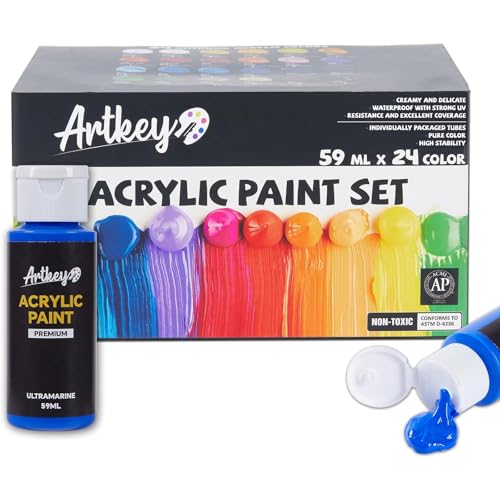
Artkey describes a butter-like consistency that glides on and covers both large areas and fine detail, with semi-gloss finish. Bottle caps are tightly screwed to prevent leaks and drying before opening, and each bottle is labeled with its color name.
The listing says the water-based formula is certified safe and non-toxic for people and pets, and lists canvas, fabric, wood, ceramic, rock, metal, plastic and plaster as surfaces.
Best suited for: painters who want smooth paint and tidy storage.
Key features:
- 24 colors x 2 oz
- Semi-gloss
- Leak-resistant sealed bottles
- Color names on bottles
Pros:
- Smooth consistency
- Easy color identification
- Gift box
Cons and limitations:
- No brushes included
Buying consideration: Store bottles upside down for a few minutes before use so paint flows to the nozzle.
3. Nicpro Acrylic Paint Set, 24 Colors with Brushes and Palette — Best for learning color

Nicpro’s set includes 24 colors in 2 oz bottles, 12 brushes, a palette and a beginner’s guide with a color wheel. It is quick-drying, waterproof when dry and fade-resistant per the listing, and conforms to ASTM D-4236.
The color wheel makes it easier to understand complementary colors and mixing, especially for self-taught painters.
Best suited for: self-taught beginners and students.
Key features:
- 24 colors x 2 oz
- 12 brushes and palette
- Guide and color wheel
- Semi-gloss, ASTM D-4236
Pros:
- Learning aids included
- Complete kit
- Mid price tier
Cons and limitations:
- Basic brushes
Buying consideration: Use the color wheel to plan a three-color painting before opening every bottle.
4. Shuttle Art 36-Color Set with Brushes and Palette — Best for a large color range

With 36 colors including metallic gold and silver, 12 brushes and a palette, Shuttle Art covers a lot of ground. It is water based, ASTM D4236 conforming and dries waterproof and fade resistant, according to the listing.
More premixed colors mean less mixing time for crafts and illustrative work.
Best suited for: crafters and painters who prefer ready-made colors.
Key features:
- 36 colors x 2 oz
- Gloss
- 12 brushes and palette
- Metallic gold and silver
Pros:
- Big range
- All-in-one
- Wide surface list
Cons and limitations:
- Gloss finish only
Buying consideration: Keep a small notebook of which bottle mixes make your favorite colors.
5. TMOL 24-Color Acrylic Paint Set with 12 Brushes — Best for a compact gift set

TMOL packs 24 colors in 60 ml bottles with 12 brushes. The listing describes smooth, quick-drying paint, ASTM D4236 conformance and easy water cleanup.
It is a tidy, giftable box for beginners and teens.
Best suited for: gifts and casual painters.
Key features:
- 24 colors x 2 oz
- 12 brushes
- Fade resistant
- ASTM D4236
Pros:
- Ready to paint
- Gift-friendly
- Mid price tier
Cons and limitations:
- No palette
Buying consideration: Add a pad of acrylic paper for practice.
6. Apple Barrel Vibrant Spectrum Craft Acrylic, 16 Colors — Best for water-based craft acrylic

Apple Barrel is a water-based craft acrylic made in the USA. The 16 bright 2 oz colors dry matte and can be brushed, stamped, stenciled or sponged on wood, Styrofoam, plaster and terra cotta. Clean up with soap and water while wet.
Craft acrylic is thinner and less pigmented than artist paint, but it is ideal for decorative projects and easy for children to use.
Best suited for: home decor crafts and stenciling.
Key features:
- 16 colors x 2 oz
- Matte
- Made in USA
- Soap and water cleanup
Pros:
- Easy to apply
- Matte decorative look
- Trusted craft brand
Cons and limitations:
- Less coverage on dark surfaces
Buying consideration: Base-coat with white on dark wood for brighter colors.
7. Nicpro 14-Color Bulk Acrylic Paint Set (16.9 oz) — Best for bulk water-based acrylic

Fourteen essential colors, including white, Mars black, red, yellow, blue, green and burnt umber, each in a 16.9 oz squeeze bottle. The listing describes creamy, fade-resistant paint that works on canvas, rocks, wood, glass, ceramic, fabric, leather and more.
Large bottles suit murals, classrooms and painters who go through white quickly.
Best suited for: classrooms, murals and heavy users.
Key features:
- 14 colors x 16.9 oz
- Essential mixing colors
- Non-toxic
Pros:
- Huge volume
- Cost-effective per ounce
Cons and limitations:
- Higher upfront cost
- Fewer colors
Buying consideration: Decant into small lidded cups for daily use to keep the big bottles clean.
Buying Guide: How to Choose Water-Based Acrylic Paint
Artist, student or craft grade
Craft acrylics are thinner and matte; student acrylics balance cost and coverage; artist acrylics carry the most pigment.
Color selection
Look for warm and cool primaries, white, black and a couple of earth colors.
Consistency
Heavy-body paint holds brush marks; fluid paint levels smoothly. Most sets sit in between.
Finish
Matte, satin and gloss affect color depth; varnish can change it later.
Bottle size
2 oz bottles for variety; large bottles for volume.
Safety
Look for ASTM D4236 and, for children, EN71 conformance.
Why Painters Choose Water-Based Acrylic
No solvents
Water cleanup means no mineral spirits or turpentine, which suits small apartments, classrooms and anyone sensitive to odors.
Fast drying
Thin layers dry in minutes, so you can build a painting in one session and glaze or correct without waiting days, as you would with oil.
Versatility
The same paint can be used thinned like watercolor, straight from the bottle like gouache or thickened with gel for impasto. It sticks to canvas, paper, wood, primed metal, ceramics and fabric with the right medium.
Durability
Once cured, acrylic is flexible and resists yellowing, so paintings stay bright.
The trade-offs
Fast drying makes soft blending harder, and colors can shift slightly darker as they dry. Retarders, stay-wet palettes and working in sections help.
Surfaces That Work With Water-Based Acrylic
- Canvas and canvas boards: the classic choice, usually pre-primed with acrylic gesso.
- Acrylic and mixed-media paper: for practice and studies.
- Wood: sand and prime first for even color.
- Rocks, terra cotta and ceramics: decorative only unless sealed; not food safe.
- Fabric: mix with fabric medium for flexibility.
- Glass and plastic: clean well and use a primer or specialty acrylic for better adhesion.
Tips for Painting With Water-Based Acrylic
- Squeeze out small amounts; acrylic dries quickly on the palette.
- Mist your palette or use a stay-wet palette.
- Paint thin layers and build up; thick layers can crack as they cure.
- Rinse brushes often and never let paint dry in them.
- Seal finished pieces with a varnish for protection.
Try a project that plays with water itself, such as our guide to painting water with acrylic paint, or turn your paint into home decor with DIY wall art with acrylic.
Storing Water-Based Acrylic Paint
Because acrylic is water based, it dries out when exposed to air and can be damaged by freezing. Close caps tightly and wipe nozzles before closing so they do not crust over. Store bottles upright at room temperature, away from heaters and direct sun. If a bottle thickens slightly, stir in a few drops of water or flow medium. If paint has separated, shake or stir it well; if it smells sour or has turned rubbery, it is time to replace it.
Common Mistakes to Avoid
- Adding too much water and weakening the paint film.
- Letting paint dry on brushes or palettes.
- Assuming dried acrylic will wash off; it is water-resistant once cured.
- Using craft acrylic for fine art and expecting artist-grade coverage.
- Pouring large amounts of paint water down drains.
- Storing bottles where they freeze; water-based paint can be damaged by freezing.
- Judging a color while wet; many acrylics dry slightly darker, so test on a scrap and let it dry first.
- Painting thick layers in one go and getting cracks as the surface skins over before the inside dries.
FAQs
Is all acrylic paint water based?
Artist and craft acrylic paints are water-based emulsions. Some industrial acrylic coatings use solvents, but those are not artist paints.
Is water-based acrylic paint waterproof?
Once dry and cured, it is water-resistant. While wet, it dissolves in water.
Can I thin acrylic paint with water?
Yes, in moderation. For heavy thinning, use an acrylic medium so the paint film stays strong.
What is the difference between acrylic and tempera?
Acrylic dries to a flexible, water-resistant film; tempera typically remains rewettable and dries matte and chalky.
Is water-based acrylic paint safe for kids?
Many sets conform to ASTM D4236 and EN71. Supervise young children and wash hands after painting.
Does water-based acrylic paint smell?
It has a mild odor while wet and very little once dry, far less than solvent-based paints. Some brands add ammonia as a preservative, which you may notice when opening a bottle.
How do I clean up water-based acrylic?
Use soap and water while wet. Dried paint may need a brush restorer or rubbing alcohol.
Final Recommendation
For learning to paint with water-based acrylic, the Caliart 24-color set offers the most useful mixing palette, while Artkey delivers smooth paint in leak-resistant bottles. Choose Nicpro’s 24-color set if you want a palette and color wheel included, Shuttle Art for 36 ready-made colors, TMOL as a gift, Apple Barrel for crafts and the Nicpro bulk set for classrooms and murals.