
PaintingProGuide is reader-supported. When you buy through links on this page we may earn an affiliate commission at no extra cost to you.
Quick answer: A “wood frame for canvas painting” can mean two things: a display frame that surrounds a finished canvas, or the wooden stretcher frame the canvas is stretched over. For display, the MCS 16 x 20 walnut float frame is the easiest way to give a stretched canvas a clean gallery look, and the FOLKOR vintage gold 16 x 20 solid wood frame suits traditional oil paintings. To build the canvas itself, the Texas Art 16 x 20 stretcher bar kit or the Nanweiyas pine stretcher kit lets you stretch your own canvas or remount a rolled painting.
A finished canvas painting looks very different once it is framed. A frame protects the edges, defines the image, adds a sense of value and helps the painting sit comfortably in a room. Wood remains the most popular frame material because it is warm, easy to finish in different colors and suits both modern and traditional work, from small studies to large statement pieces.
This guide explains the two kinds of wood frames for canvas paintings, how float frames, traditional frames and stretcher bars differ, how to measure correctly and which current options suit different paintings and budgets.
Display Frames vs Stretcher Frames
| Type | What It Does | Who Needs It |
|---|---|---|
| Floater (float) frame | Surrounds a stretched canvas with a small gap so the painting appears to float | Painters with gallery-wrapped or standard stretched canvases |
| Traditional rabbet frame | Canvas sits in a recess behind the frame lip, edges covered | Classic oil paintings, canvas boards, ornate looks |
| Stretcher bars | The wooden frame behind the canvas that holds it taut | Painters stretching their own canvas or remounting rolled paintings |
| Canvas + frame sets | Pre-stretched canvas already fitted into a floater frame | Painters who want to paint and hang immediately |
Floater Frames Explained
Floater frames are L-shaped in profile. The canvas sits inside, attached from the back or base, with a narrow gap between the canvas edge and the frame. The gap creates a shadow line that makes the painting look suspended. Float frames show the whole image, including painted edges, and suit modern and contemporary work, abstracts and gallery-wrapped canvases.
Traditional Frames Explained
Traditional frames have a lip that overlaps the front edge of the canvas by a small amount, hiding staples and unpainted sides. Ornate gold, carved and wide wooden moldings belong here and suit landscapes, portraits and classical oil painting. They also work for canvas boards and panels.
Stretcher Bars Explained
Stretcher bars are the wooden frame inside a stretched canvas. They are sold as interlocking pieces you assemble into a rectangle, then you staple canvas around them. Many kits are sold in sizes based on the outer dimension of the frame, and you need extra canvas on all sides to wrap around the bars and staple to the back.
Our Top Picks at a Glance
- MCS Canvas Float Frame, 16 x 20, Walnut Woodgrain — Best overall float frame
- Abtgt Canvas Floating Frame, 12 x 16, 0.9 in Deep — Best compact float frame
- FROM ONE 4-Pack 11 x 14 Canvas with Floater Frames — Best paint-and-hang set
- FOLKOR Vintage Gold Solid Wood Frame, 16 x 20 — Best traditional ornate frame
- Texas Art DIY Stretcher Bar Kit, 16 x 20 — Best stretcher bars for quality canvases
- Nanweiyas DIY Pine Canvas Frame Kit, 16 x 20 — Best budget stretcher kit
- Akfado Floating Frame for 24 x 36, 1.5 in Deep — Best large float frame (wood-look metal)
| Product | Best For | Key Spec | Key Strength | Price Tier |
|---|---|---|---|---|
| MCS Float Frame 16×20 | Standard stretched canvas | Holds canvas up to 3/4 in deep, 17.75 x 21.75 in outside | Tool-free hook-and-loop mounting | $$ |
| Abtgt Float 12×16 | Smaller paintings | 0.9 in deep, engineered wood | 4 Velcro strips, two sawtooth hooks | $$ |
| FROM ONE 4-Pack 11×14 | Paint then hang | 10 oz cotton canvas in solid wood floater | Hanging hardware and screwdriver included | $$ |
| FOLKOR Gold 16×20 | Traditional oils | Solid wood, embossed gold finish | Self-assembly bars | $$$ |
| Texas Art 16×20 Bars | Stretching your own canvas | Brazilian white wood, no-nail design | Pre-attached adhesive | $$ |
| Nanweiyas 16×20 Kit | Budget stretching | Pine wood bars | Hammer-only assembly | $ |
| Akfado Float 24×36 | Large canvases | 1.5 in deep, aluminum with wood-grain look | Includes hardware and manual | $$$ |
How We Chose
We selected these frames and kits from the Amazon listing details and specifications checked in October 2026, judging frame style, wood or wood-look construction, size and depth compatibility, ease of mounting and how widely each product has been reviewed by Amazon buyers. We have not framed paintings with these specific products.
- Fit: clear inner dimensions and maximum canvas depth.
- Construction: solid wood, engineered wood or stated alternatives.
- Mounting: tool-free fasteners, hooks and hardware included.
- Style range: float, traditional ornate and DIY stretcher options.
Best Wood Frames for Canvas Paintings Reviewed
1. MCS Canvas Float Frame, 16 x 20, Walnut Woodgrain — Best for an all-round float frame

MCS makes this float frame for 16 x 20 inch stretched canvases up to 3/4 inch deep. It measures 17.75 x 21.75 inches overall and has a walnut woodgrain paper-wrap finish over engineered wood.
Mounting is tool-free: adhesive-backed hook-and-loop fasteners hold the canvas inside, so you can swap paintings easily. Pre-attached sawtooth hangers allow vertical or horizontal hanging.
Note the 3/4 inch maximum depth: it suits standard-profile canvases, not 1.5 inch gallery canvases.
Best suited for: painters framing standard 16 x 20 stretched canvases for home display or gifts.
Key features:
- Fits 16 x 20 canvas up to 3/4 in deep
- 17.75 x 21.75 in overall
- Walnut woodgrain on engineered wood
- Hook-and-loop mounting
- Sawtooth hangers
Pros:
- No tools needed
- Easy to change artwork
- Warm, neutral finish
Cons and limitations:
- Paper-wrap finish, not solid wood
- Not deep enough for gallery canvases
Buying consideration: Measure your canvas depth before ordering; most budget pre-stretched canvases are 5/8 to 3/4 inch.
2. Abtgt Canvas Floating Frame, 12 x 16, 0.9 in Deep — Best for a compact float frame
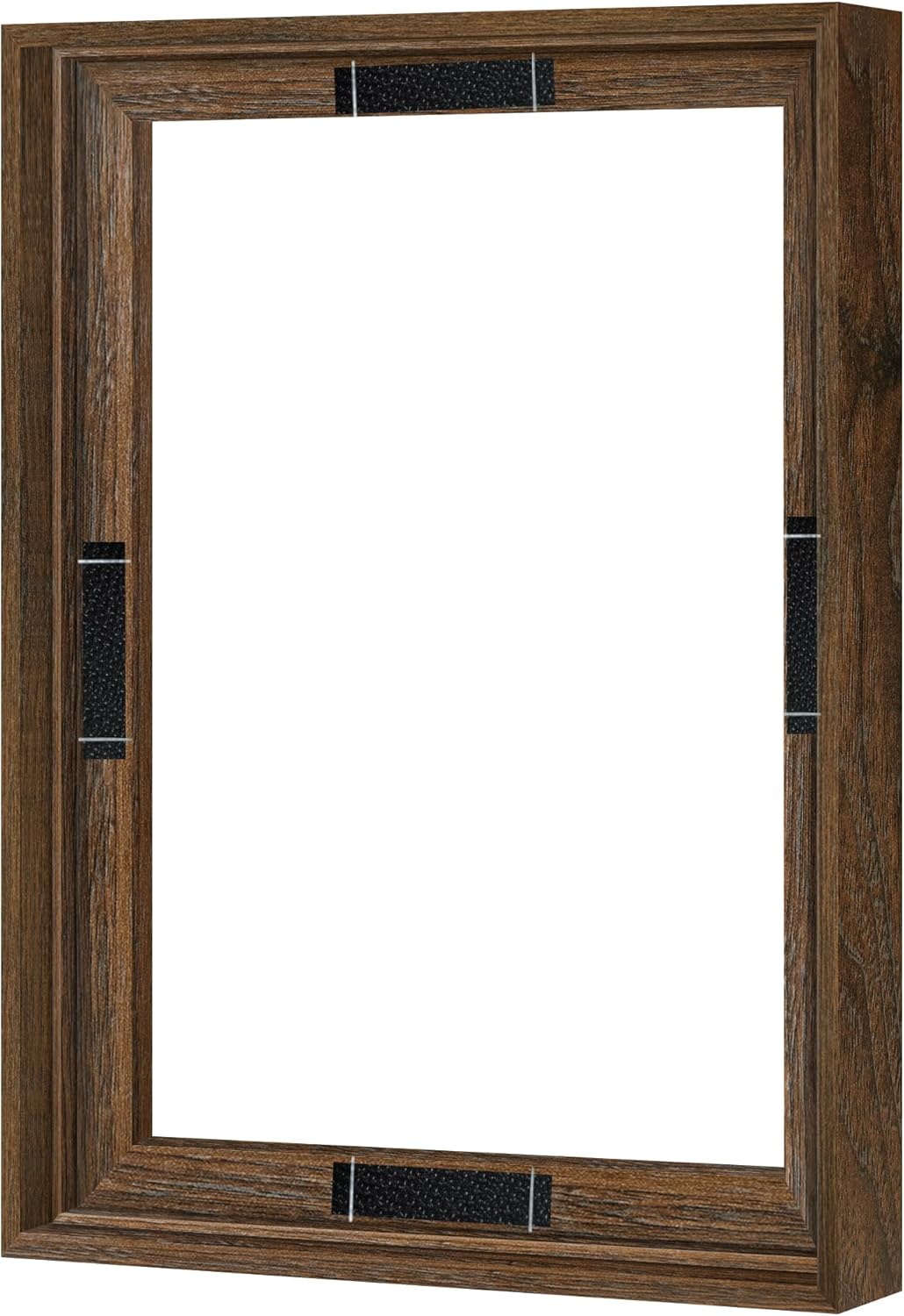
Abtgt’s 12 x 16 float frame is 0.9 inch deep, with four Velcro strips for tool-free mounting and two black sawtooth hooks for vertical or horizontal hanging. Each frame is individually boxed.
Smaller float frames are ideal for studies and small works, and a group of matching frames makes a cohesive gallery wall.
Best suited for: small paintings, studies and gallery walls.
Key features:
- Fits 12 x 16 canvas
- 0.9 in deep
- Engineered wood
- 4 Velcro strips, 2 sawtooth hooks
Pros:
- Tool-free mounting
- Slightly deeper than 3/4 in
- Individually boxed
Cons and limitations:
- Engineered rather than solid wood
- Single size
Buying consideration: Buy several at once if you plan a grid; matching frames make small paintings look intentional.
3. FROM ONE 4-Pack 11 x 14 Canvas with Floater Frames — Best for painting and hanging immediately
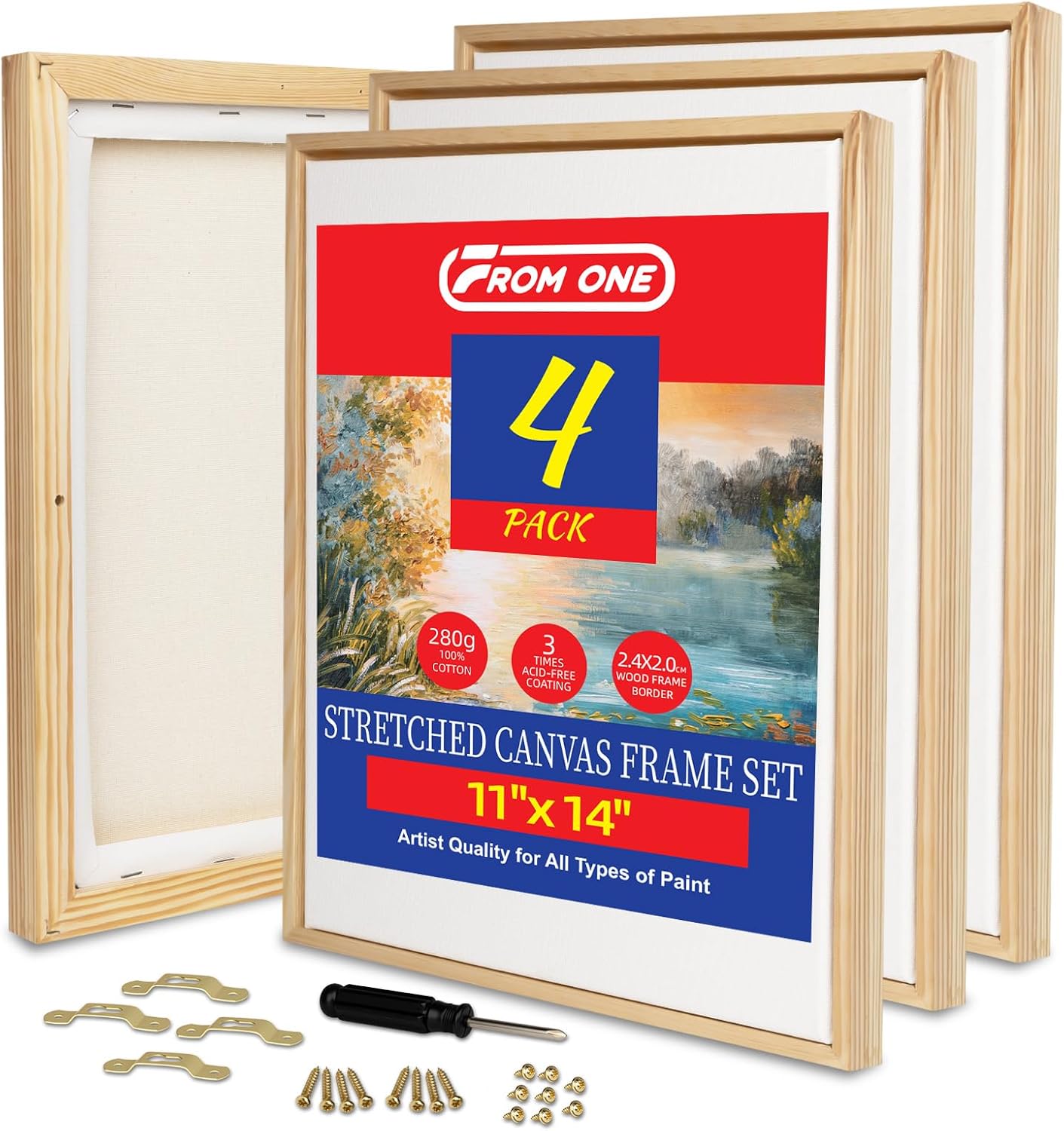
FROM ONE sells canvas and frame together: four 11 x 14 inch 10 oz 100% cotton canvases, triple-primed and pre-stretched, each pre-fitted into a matching solid wood floater frame. Hooks, screws and a screwdriver are included.
You paint directly on the canvas while it sits in the frame, then hang it. That saves measuring and framing later and gives a finished, gallery-ready result.
Best suited for: painters who want finished, framed pieces with minimal effort.
Key features:
- 4 canvas and frame sets, 11 x 14 in
- 10 oz 100% cotton, triple-primed
- Solid wood floater frames
- Hanging hardware and screwdriver
Pros:
- Canvas and frame in one
- Solid wood
- Ready to hang
Cons and limitations:
- Painting near frame edges takes care
- Fixed size
Buying consideration: Mask the inner frame edge with low-tack tape while painting to keep it clean.
4. FOLKOR Vintage Gold 16 x 20 Solid Wood Frame — Best for a traditional ornate frame

FOLKOR’s frame is solid wood with a rich gold tone and embossed patterns, designed for canvas paintings, prints and photographs. It ships as frame bars that you assemble yourself.
An ornate gold frame instantly gives a landscape or portrait a classic, gallery look and is a traditional pairing with oil paintings.
Best suited for: traditional oil paintings, portraits and gifts.
Key features:
- 16 x 20 in
- Solid wood
- Vintage gold finish with embossed pattern
- Self-assembly bars
Pros:
- Classic, high-end look
- Sturdy solid wood
- Reusable
Cons and limitations:
- Requires assembly
- Higher price tier
- Ornate style does not suit modern work
Buying consideration: Pair with a canvas that has unpainted edges; a traditional frame hides them.
5. Texas Art DIY Wood Stretcher Bars, 16 x 20 — Best for stretcher bars for quality canvases

Texas Art makes its stretcher bars from Brazilian white wood, which the listing says offers better strength and a smoother surface than imitation pine or spruce bars. A no-nail design uses pre-attached adhesive to bond the canvas, and instructions and video tutorials are provided.
Use it to stretch your own raw or primed canvas, or to remount a painting that arrived rolled.
Best suited for: painters stretching their own canvas or remounting rolled work.
Key features:
- 16 x 20 in
- Brazilian white wood
- No-nail adhesive design
- Instructions and video guides
Pros:
- Strong, smooth bars
- Beginner-friendly
- Gallery-wrap ready
Cons and limitations:
- Adhesive method differs from traditional stapling
- Higher price than basic pine kits
Buying consideration: Leave at least 2 inches of extra canvas on each side to wrap around the bars.
6. Nanweiyas DIY Pine Canvas Frame Kit, 16 x 20 — Best for a budget stretcher kit

Nanweiyas’s pine kit assembles with only a small hammer. The listing stresses that the stated size is the display area and that your canvas needs a reserved blank margin to wrap around the frame.
It is the least expensive way to mount a rolled painting or stretch a piece of canvas for a one-off project.
Best suited for: occasional stretching and remounting on a budget.
Key features:
- 16 x 20 in display area
- Pine wood
- Hammer-only assembly
Pros:
- Very low price tier
- Simple assembly
- Natural wood
Cons and limitations:
- Pine can be less stable than hardwoods
- Requires canvas margin
Buying consideration: Check that the assembled frame is square by measuring both diagonals before stapling.
7. Akfado Floating Frame for 24 x 36 Canvas, 1.5 in Deep — Best for large float framing

This frame is aluminum alloy with a walnut wood-grain look rather than real wood, included here because it is one of the few float frames sized for 24 x 36 inch canvases up to 1.5 inches deep. The listed size is the inner dimension, so a 24 x 36 canvas needs the 24 x 36 frame.
It arrives as bars with hardware and a manual for assembly.
Best suited for: large and gallery-depth canvases.
Key features:
- Fits 24 x 36 in canvas
- 1.5 in deep
- Aluminum with wood-grain finish
- Hardware and manual included
Pros:
- Fits gallery-depth canvases
- Large size
- Durable
Cons and limitations:
- Metal, not wood
- Assembly required
- Highest price tier
Buying consideration: Use two hooks and wall anchors for a frame and canvas this size.
How to Measure a Canvas for a Frame
- Measure width and height of the canvas edge to edge. Most stretched canvases are sold by these outer dimensions.
- Measure depth from the front of the canvas to the back of the stretcher bars. Check this against the frame’s maximum depth.
- Order by inner dimension for float frames (the size of canvas they hold), as Akfado and MCS describe.
- For stretcher bars, remember the kit size is the frame, and your canvas must be larger to wrap around.
Buying Guide: How to Choose a Wood Frame for Canvas Painting
Match frame style to the painting
Float frames suit modern, abstract and gallery-wrapped work. Traditional frames suit classical landscapes and portraits.
Check depth compatibility
Standard canvases are 5/8 to 3/4 inch; gallery canvases are around 1.5 inch. The frame must accommodate the depth.
Solid vs engineered wood
Solid wood is sturdier and more expensive. Engineered wood with a wood-grain wrap is lighter and cheaper.
Mounting method
Hook-and-loop fasteners and clips make swapping art easy. Screws and offset clips are more permanent.
Finish and color
Natural wood and walnut tones are versatile; black looks modern; gold looks traditional.
Hanging hardware
Check for sawtooth hangers, D-rings or wire, and use anchors for heavy frames.
Related Framing Guides
For step-by-step instructions, read how to frame a canvas painting. If you would rather build your own, see how to make a frame for a canvas painting, and if you decide not to frame at all, here is how to hang a canvas without a frame.
Common Mistakes to Avoid
- Ordering a float frame by outer size when the listing uses inner size.
- Ignoring canvas depth and buying a frame too shallow for a gallery canvas.
- Using an ornate gold frame on a minimalist abstract.
- Forgetting to leave enough canvas margin when using stretcher bars.
- Hanging a large framed canvas from a single nail.
- Framing an oil painting before it is fully dry.
- Pressing glass directly against an oil or acrylic surface; canvas paintings are normally framed without glass.
FAQs
What kind of frame is best for a canvas painting?
Float frames are best for showing the whole painting with a modern look; traditional frames suit classic oil paintings. Both are commonly made of wood.
Do canvas paintings need frames?
Not always. Gallery-wrapped canvases with painted edges can hang unframed. A frame adds protection and a finished look.
What is a floater frame?
A frame with an L-shaped profile that holds the canvas inside with a small gap, making the painting appear to float.
How do I know what size frame to buy for my canvas?
Measure the canvas width, height and depth. Buy a float frame whose inner dimensions match the canvas and whose depth capacity fits.
What are stretcher bars?
Wooden bars that interlock into the frame behind a stretched canvas. You staple or bond canvas around them.
Should the frame color match the painting or the room?
Usually the painting. Pick a frame that supports the artwork’s colors and style, then make sure it does not clash with the room. Neutral woods and black are the safest choices for most work.
Can I frame a canvas board?
Yes. Canvas boards fit standard traditional picture frames in common sizes.
Final Recommendation
For framing finished stretched canvases, the MCS 16 x 20 walnut float frame is the most practical all-round choice, with the Abtgt 12 x 16 float frame for smaller works and the Akfado 24 x 36 for large gallery-depth canvases. If you want to paint and hang in one step, the FROM ONE canvas and floater sets are ready to go. Choose the FOLKOR gold frame for traditional oils. To build the canvas itself, Texas Art stretcher bars are the stronger option and Nanweiyas the budget pick.





One Comment