PaintingProGuide is reader-supported. When you buy through links on this page we may earn an affiliate commission at no extra cost to you.
Quick answer: The most common painting canvas sizes are 8×10, 11×14, 16×20, 18×24, 24×36 and 30×40 inches, plus squares like 12×12 and 24×24. For a first painting, 11×14 or 12×16 is comfortable. To try several sizes at once, the KEFF 24-pack includes six each of 5×7, 8×10, 9×12 and 11×14, and the ESRICH 12×16 three-pack is an affordable step up in scale.
Painting canvas sizes follow a set of standard dimensions that have grown up around frame sizes, photo proportions and the practicalities of shipping. Knowing them helps in three ways: you can buy canvases that fit ready-made frames, you can choose a format that suits your subject, and you can plan how much paint and time a painting will take. This guide covers every common size in inches and centimetres, the proportions behind them, which sizes suit which subjects and rooms, and six canvas packs that let you try several sizes without overbuying.
Standard Painting Canvas Sizes Chart
| Size (inches) | Size (cm, approx.) | Category | Typical Use |
|---|---|---|---|
| 4×4, 5×5, 6×6 | 10×10 to 15×15 | Mini | Studies, ornaments, gifts, daily painting |
| 5×7 | 13×18 | Small | Cards, color tests, quick sketches |
| 8×10 | 20×25 | Small | Practice, plein air, small finished pieces |
| 9×12 | 23×30 | Small | Landscapes, sketchbook-proportion studies |
| 11×14 | 28×36 | Medium | First finished paintings, portraits |
| 12×12 | 30×30 | Medium square | Abstracts, pours, florals, grids |
| 12×16 | 30×41 | Medium | Still life, landscapes, classes |
| 16×20 | 41×51 | Medium | Portraits, landscapes, wall art |
| 18×24 | 46×61 | Large | Statement pieces, detailed scenes |
| 24×24 | 61×61 | Large square | Modern abstracts, feature walls |
| 24×36 | 61×91 | Large | Living room art, abstracts, pours |
| 30×40 | 76×102 | Extra large | Above sofas and beds |
| 36×48 and up | 91×122+ | Extra large | Gallery and commission work |
Canvas Proportions: Why the Sizes Exist
Standard canvas sizes share a handful of ratios, which is why some subjects and photos fit better than others.
- 4:5 — 8×10, 16×20. A slightly squarish rectangle, popular for portraits.
- 3:4 — 9×12, 12×16, 18×24. Matches many phone camera photos, so reference images crop neatly.
- 2:3 — 24×36. Matches standard 35mm photo proportions; good for landscapes and tall figures.
- 11:14 — 11×14 is close to 4:5 and is a classic frame size.
- 1:1 — squares, which suit abstracts, pours and grid displays.
Before you start, crop your reference photo to the same ratio as your canvas. It avoids stretched or squashed compositions, and our guide on how to grid a canvas for painting shows how to transfer it accurately.
Metric and International Canvas Sizes
Outside the US, canvases are usually sold in metric sizes, and they do not always match inch sizes exactly. European suppliers commonly stock sizes such as 20×20 cm, 30×40 cm, 40×50 cm, 50×70 cm, 60×80 cm and 70×100 cm. A 30×40 cm canvas is close to, but slightly smaller than, a 12×16 inch canvas (about 30.5×40.6 cm), and 40×50 cm is a little smaller than 16×20 inches. If you buy frames and canvases in different systems, measure both before you commit. Traditional French numbered sizes, grouped into Figure, Paysage and Marine formats, are also still used by some makers and suit portraits, landscapes and seascapes respectively.
Planning a Painting for a Specific Wall
If the painting is destined for a particular spot, plan the size from the wall back. Measure the furniture or space the art will sit above, multiply the width by about two-thirds, and look for the standard canvas size closest to that number. Then cut paper or use painter’s tape to mark the outline on the wall and live with it for a day. It is much easier to change your mind about a paper rectangle than a finished 30×40 painting. For very large spaces, two or three canvases hung with equal gaps can be easier to paint, carry and hang than one oversized piece.
How to Choose a Canvas Size
By skill and time
Small canvases (5×7 to 9×12) finish in an hour or two and are ideal for practice. Medium canvases (11×14 to 16×20) suit a finished piece over one or several sessions. Large canvases (18×24 and up) take more paint, bigger brushes and more time.
By subject
Portraits suit 11×14 and 16×20 in portrait orientation. Landscapes suit 9×12, 12×16 and 24×36 in landscape orientation. Abstracts and pours often use squares or large rectangles.
By wall
Above a sofa or bed, aim for art about two-thirds of the furniture width; that usually means 30×40 or larger, or a group of smaller canvases. Hallways and small walls suit 11×14 to 16×20.
By frame
Standard sizes fit off-the-shelf frames. Odd sizes require custom framing, which can cost more than the canvas.
By depth
Standard profile canvases are about 5/8 to 3/4 inch deep, made for framing. Gallery profile canvases are about 1.5 inches deep and look finished without a frame.
Our Top Picks at a Glance
- KEFF 24-Pack, 5×7 to 11×14 — Best for trying four common sizes
- ESRICH 32 Pack, 4×4 to 8×10 — Best for small and mini sizes
- GOTIDEAL 14 Pcs Stretched Canvas — Best stretched multi-size starter
- ESRICH 12×16 Canvas Boards, 3 Pack — Best affordable medium size
- YONEVALON 48 Pack 8×10 Canvas Boards — Best bulk standard size
- ESRICH 8×10 Canvas Boards, 5 Pack — Best small pack of the most common size
| Product | Best For | Key Spec | Key Strength | Price Tier |
|---|---|---|---|---|
| KEFF 24-Pack | Four common sizes | 6 each of 5×7, 8×10, 9×12, 11×14; triple primed | Covers small to medium | $$ |
| ESRICH 32 Pack | Small and mini | 8 each of 4×4, 5×5, 5×7, 8×10 | Squares included | $$ |
| GOTIDEAL 14 Stretched | Stretched sizes | 4×4, 5×7, 8×10, 11×14 stretched | Ready to hang | $$ |
| ESRICH 12×16, 3 Pack | Medium size | 3 boards, 12×16, cotton | Step up in scale | $ |
| YONEVALON 48 Pack 8×10 | Bulk 8×10 | 48 boards, 3 mm, 10 oz triple primed | Thick MDF board | $$ |
| ESRICH 8×10, 5 Pack | Small pack | 5 boards, 8×10, cotton | Low cost | $ |
How We Chose
These picks are based on the Amazon listing details and specifications checked in October 2026: the sizes in each pack, construction (board or stretched), priming and core, and quantity. We selected packs that help you explore common sizes or stock up on the most useful one, and considered how widely each is reviewed by Amazon buyers. We have not painted on these canvases ourselves; construction details are from the listings.
- Size coverage: packs with several standard sizes, or a bulk supply of one.
- Standard dimensions: sizes that fit off-the-shelf frames.
- Construction: boards for practice, stretched for display.
- Priming: acid-free primer, ideally triple coated.
- Value: cost per canvas at each size.
Best Canvas Packs for Exploring Sizes Reviewed
1. KEFF 24-Pack Canvas Boards, 5×7, 8×10, 9×12, 11×14 — Best for Trying Four Common Sizes

The quickest way to discover the size you enjoy is to paint on several. KEFF’s pack includes six boards in each of four of the most popular sizes: 5×7, 8×10, 9×12 and 11×14. All are 100% cotton with a smooth, triple-primed surface for acrylic, oil and mixed media.
The four sizes fit standard canvas frames, so anything you like can be framed without custom work. Notice how differently you paint at 5×7 and 11×14: small canvases push you to simplify, larger ones invite detail.
Best suited for: beginners finding their scale, classes and gift sets.
Key features:
- 24 boards: 6 each of 5×7, 8×10, 9×12, 11×14
- 100% cotton
- Triple-primed surface
- Fits standard frames
Pros:
- Four useful sizes
- Triple priming
- Good value
Cons and limitations:
- No medium-large sizes
- Core material not detailed
Buying consideration: Paint the same simple subject on each size; it shows quickly which scale feels natural.
2. ESRICH 32 Pack Multi-Size Canvas Boards, 4×4 to 8×10 — Best for Small and Mini Sizes

Small formats are where many painters practice most, and squares are a nice change from rectangles. This ESRICH pack includes eight boards each of 4×4, 5×5, 5×7 and 8×10, all pure cotton with an acid-free primer over a sturdy board core.
The minis are perfect for color studies, ornaments, and multi-panel displays where several small canvases hang together as one piece.
Best suited for: daily painting, kids, classrooms and multi-panel displays.
Key features:
- 32 boards: 8 each of 4×4, 5×5, 5×7, 8×10
- Pure cotton
- Acid-free primer, board core
Pros:
- Square minis included
- Lots of practice surfaces
- Low cost per board
Cons and limitations:
- Small sizes only
Buying consideration: Arrange 4×4 or 5×5 squares in a grid for a striking wall display; see our guide to multi-canvas sets.
3. GOTIDEAL 14 Pcs Multi Pack Stretched Canvas — Best for Stretched Multi-Size Starter
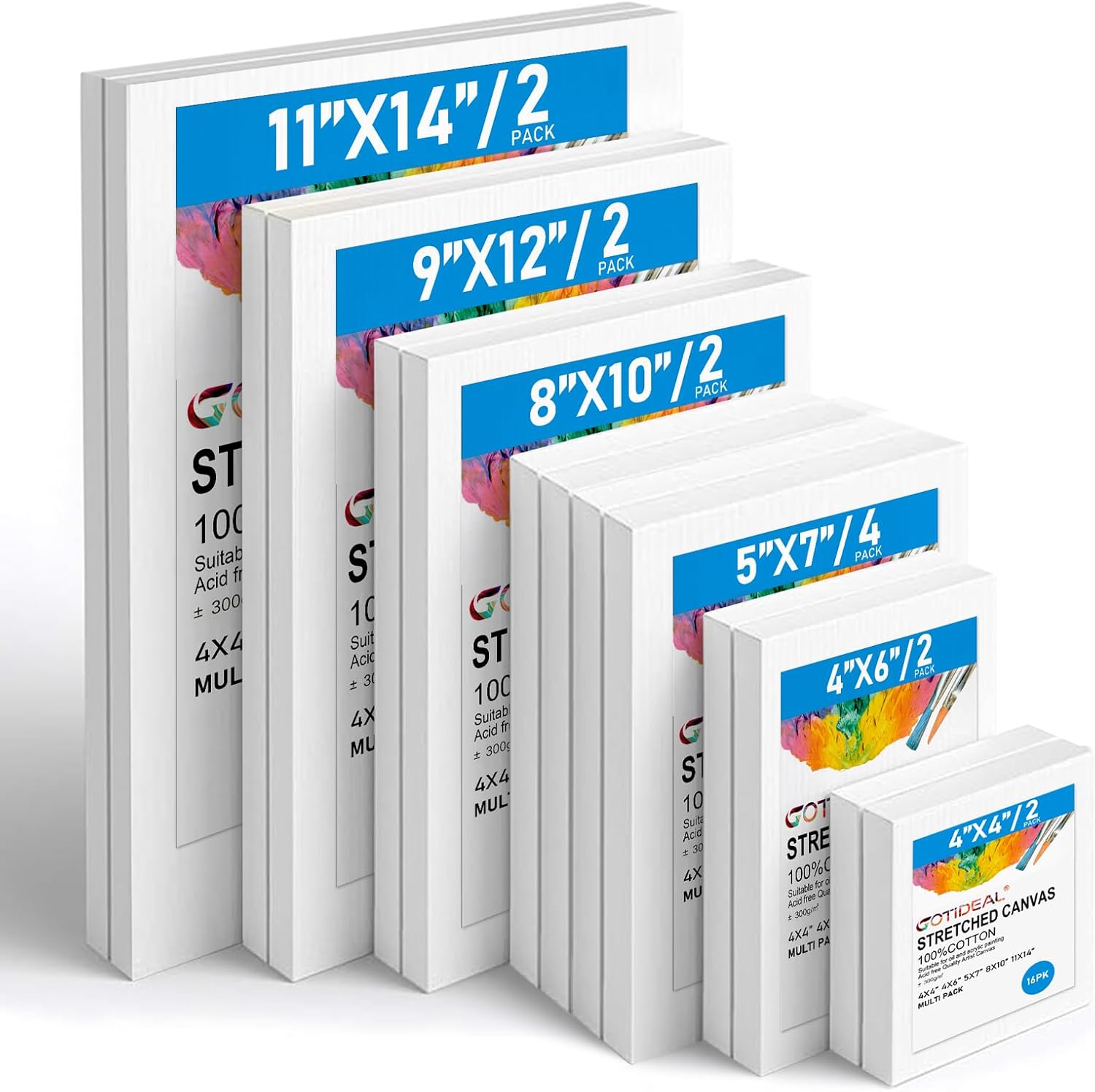
If you want to feel the difference between sizes on stretched canvas rather than boards, GOTIDEAL’s 14-piece set covers 4×4, 5×7, 8×10 and 11×14, with extra 5x7s. The 100% cotton has a medium grain and acid-free gesso, nailed to wooden frames.
Stretched canvases hang without frames, so finished pieces in different sizes can be grouped on a wall right away.
Best suited for: beginners who want ready-to-hang canvases in several sizes.
Key features:
- 14 stretched canvases
- 4×4, 5×7, 8×10, 11×14
- 100% cotton, medium grain
- Acid-free gesso
Pros:
- Ready to hang
- Range of sizes
- Inexpensive
Cons and limitations:
- No larger sizes
- Nailed sides
Buying consideration: Group finished pieces of different sizes along a shared center line for a tidy display.
4. ESRICH Canvas Boards 12×16, 3 Pack — Best for Affordable Medium Size

12×16 is an underrated size: it is noticeably bigger than 11×14, shares the 3:4 ratio of most phone photos, and still fits on a tabletop easel. This ESRICH pack offers three 12×16 boards in pure cotton with a safe, non-toxic, acid-free primer over a sturdy core.
It is an inexpensive way to step up from small studies to a finished-size painting.
Best suited for: painters moving up from small canvases and anyone working from phone photos.
Key features:
- 3 boards, 12×16
- Pure cotton
- Acid-free primer, sturdy board core
Pros:
- 3:4 ratio matches phone photos
- Very affordable
- Good step up in size
Cons and limitations:
- Only three boards
- Boards need framing to display
Buying consideration: Crop your reference photo to 3:4 before transferring the composition.
5. YONEVALON 48 Pack 8×10 Canvas Boards — Best for Bulk Standard Size

If you have settled on 8×10 for practice, buying in bulk makes sense. YONEVALON’s 48-pack has 3 mm thick boards with 10 oz cotton triple pre-primed with acid-free acrylic gesso, according to the listing.
8×10 is the most common frame size, so the best studies can be framed cheaply, and a 48-pack supports a daily painting habit for weeks.
Best suited for: daily painters, art teachers and plein air practice.
Key features:
- 48 boards, 8×10
- 3 mm thick MDF board
- 10 oz cotton, triple primed
- Acid-free gesso
Pros:
- Thick board stated
- Triple primed
- Low cost per board
Cons and limitations:
- Single size
- Large box
Buying consideration: Number and date the back of each study to track your progress over a month.
6. ESRICH Canvas Boards 8×10, 5 Pack — Best for Small Pack of the Most Common Size

For a handful of practice surfaces in the most common size, this ESRICH five-pack is the lowest-commitment option. Each 8×10 board is pure cotton with an acid-free primer and a sturdy board core.
It is a good way to test whether you enjoy 8×10 before buying a bulk pack.
Best suited for: occasional painters and quick projects.
Key features:
- 5 boards, 8×10
- Pure cotton
- Acid-free primer
Pros:
- Very low cost
- Standard frame size
Cons and limitations:
- Only five boards
Buying consideration: Move to a bulk pack once you know 8×10 suits you.
Buying Guide: Choosing Canvas Packs by Size
Buy a mixed pack first
If you are unsure, a multi-size pack shows you which scale you enjoy. Then buy that size in bulk.
Match the size to the brush
Larger canvases need larger brushes. A 24×36 canvas painted only with small brushes takes forever and looks fussy.
Budget paint by size
Paint use roughly scales with area. A 16×20 has four times the area of an 8×10, so expect to use about four times as much paint.
Think about storage
Boards stack flat; stretched canvases need upright storage. Large canvases need space.
Orientation is your choice
Any rectangular canvas can be used in portrait (vertical) or landscape (horizontal) orientation. Decide before you start and mark the top on the back, especially if you plan to add hanging hardware.
Consider transport
Canvases larger than about 24×36 can be hard to carry and may not fit in a car. Multi-panel sets are an alternative for big walls.
Using Multiple Canvas Sizes Together
You do not need one huge canvas to fill a wall. Two or three medium canvases, or a grid of small squares, can work as one piece. Our guide on how to paint a multi-canvas wall art set explains how to split a design across canvases and hang them evenly. And if a canvas gets damaged in storage, see how to fix a ripped canvas painting.
Common Mistakes to Avoid
- Ignoring proportions. A reference photo in the wrong ratio distorts the composition.
- Buying odd sizes you plan to frame. Stick to standard sizes.
- Starting too big. Large canvases are harder to finish; build up gradually.
- Going too small for detail. Detailed subjects need room.
- Forgetting depth. Check profile depth if you plan to frame or hang unframed.
- Not measuring the wall. Use painter’s tape to mark the size before buying large canvases.
FAQs
What are the standard canvas sizes?
Common sizes include 5×7, 8×10, 9×12, 11×14, 12×16, 16×20, 18×24, 24×36 and 30×40 inches, plus squares such as 12×12 and 24×24.
What size canvas is best for beginners?
An 11×14 or 12×16 is comfortable for a first finished painting. 8×10 is ideal for practice and quick studies.
What canvas size is best above a couch?
Usually around two-thirds of the couch width, which often means 30×40 or larger, or a set of two or three medium canvases.
What canvas size matches a phone photo?
Most phone photos are 3:4, matching 9×12, 12×16 and 18×24 canvases.
What is the difference between standard and gallery canvas?
Standard canvases are about 5/8 to 3/4 inch deep and designed for framing. Gallery canvases are about 1.5 inches deep and designed to hang unframed.
Do canvas sizes fit standard frames?
Standard sizes such as 8×10, 11×14, 16×20 and 24×36 fit off-the-shelf frames; choose a floater frame for stretched canvas.
Final Recommendation
To discover your preferred size, start with the KEFF 24-pack across four common sizes, or the ESRICH 32-pack if you like small and square formats. The GOTIDEAL stretched set lets you try sizes on ready-to-hang canvas. When you are ready for a finished-size painting, the ESRICH 12×16 three-pack is an inexpensive step up, while the YONEVALON 48-pack of 8×10 boards keeps a daily practice stocked. If you just need a few, the ESRICH 8×10 five-pack is the low-cost start.