PaintingProGuide is reader-supported. When you buy through links on this page we may earn an affiliate commission at no extra cost to you.
Quick answer: Gamblin and Winsor & Newton both make professional oil paint you can trust for permanent work. Gamblin is the pick if you value American-made paint, a safer studio (Gamsol, Solvent-Free Gel, Gamvar) and a student line that behaves like artist paint; the Gamblin Artist Oil Colors Introductory Set is the flagship starting point and the Gamblin 1980 set is the best value. Winsor & Newton is the pick for the widest color range and traditional handling; the Artists’ Oil Colour Introductory Set gives you ten professional tubes for less, and Winton is the cheaper student line.
Gamblin vs Winsor & Newton is one of the most common decisions a painter faces when stepping up from craft-store oils. Both companies sell a professional range and a student range, both publish lightfastness information, and both are widely stocked. The differences are in philosophy and chemistry: Gamblin, founded in Portland, Oregon in 1980, built its brand around safer materials and modern pigments, while Winsor & Newton, founded in London in 1832, carries almost two centuries of traditional formulation. This comparison walks through the paint, the sets available on Amazon, the mediums and varnishes that go with them, and which brand suits which painter.
Gamblin vs Winsor & Newton at a Glance
| Factor | Gamblin | Winsor & Newton |
|---|---|---|
| Founded | 1980, Portland, Oregon, USA | 1832, London, UK |
| Professional line | Artist’s Oil Colors (37 ml and 150 ml tubes) | Artists’ Oil Colour (21 ml, 37 ml and 200 ml tubes) |
| Student line | 1980 Oil Colors, 37 ml | Winton Oil Colour, 37 ml and 200 ml |
| Binder | Alkali-refined linseed oil; safflower in some whites | Linseed oil, with safflower in some whites and pale colors |
| Studio safety ecosystem | Gamsol, Solvent-Free Gel and Fluid, Gamvar varnish | Sansodor, Liquin, Artisan water-mixable range |
| Color range | Focused, with many single-pigment colors | Very large, including historical and “hue” colors |
| Manufacturing | Made in the USA | Made in France and other locations within the ColArt group |
Our Top Picks at a Glance
- Gamblin Artist Oil Colors Introductory Set — Best professional starter set from Gamblin
- Winsor & Newton Artists’ Oil Colour Introductory Set, 10 x 21 ml — Best professional starter set from Winsor & Newton
- Gamblin 1980 Oil Color Exclusive Set — Best value student-grade set
- Winsor & Newton Winton Emerald Green Hue, 37 ml — Best way to sample Winton
- Gamblin Artist’s Oil Colors Cerulean Blue, 37 ml — Best single professional tube to test Gamblin
- Gamblin Gamvar Picture Varnish, 8.5 oz — Best companion varnish for either brand
| Product | Best For | Key Spec | Key Strength | Price Tier |
|---|---|---|---|---|
| Gamblin Artist Oil Colors Introductory Set | Professional Gamblin starter | Nine 37 ml tubes plus birch wood panel | Pigment-rich, American-made, generous tube size | $$$ |
| W&N Artists’ Oil Colour Introductory Set | Professional W&N starter | Ten 21 ml tubes | Finest-pigment professional paint at a lower entry price | $$$ |
| Gamblin 1980 Oil Color Exclusive Set | Value student set | Eight 37 ml tubes, cradled panel, Solvent-Free Gel | High-end student paint with bonus panel and medium | $$$ |
| W&N Winton Emerald Green Hue, 37 ml | Sampling Winton | Single 37 ml tube | High tinting strength and coverage at student price | $ |
| Gamblin Artist’s Oil Colors Cerulean Blue, 37 ml | Sampling Gamblin professional | Single 37 ml tube, genuine cerulean | True single-pigment mineral color | $$ |
| Gamblin Gamvar Picture Varnish, 8.5 oz | Final varnish | Synthetic resin, gloss, 8.5 oz | Can be applied sooner than traditional varnishes | $$ |
How We Chose
The products below were evaluated from their Amazon listing details and specifications checked in October 2026, how well each represents its brand’s professional or student tier, and how widely each is reviewed by Amazon buyers. Brand-level statements about binders, history and product lines reflect long-published manufacturer information rather than independent lab testing. We have not painted with these specific sets.
- Tube size and count relative to price tier.
- Whether the set is professional or student grade, and how honestly it is labeled.
- Extras included (panels, mediums) and whether they are useful.
- Fit with a low-solvent studio practice.
- Availability of the same colors in open stock for refills.
The Paint: How Gamblin and Winsor & Newton Differ
Professional ranges
Gamblin Artist’s Oil Colors are ground in alkali-refined linseed oil with a focus on single-pigment colors and modern organic pigments alongside the traditional minerals. The paint is generally described as having a slightly looser, more buttery consistency than some European brands. Winsor & Newton Artists’ Oil Colour uses what the company calls the finest pigments at high concentration, with a stiffer, more traditional body, and offers one of the largest color charts in the industry, including many historical colors.
Student ranges
Gamblin 1980 was designed to be a student paint that still uses real pigments at lower concentration, with the same linseed binder as the artist line and no fillers that change handling. Winsor & Newton Winton is the long-standing student oil, formulated with a more uniform consistency and higher stiffness than Artists’ Oil Colour, using hue substitutes for expensive pigments. Both are legitimate choices for underpainting, studies and large canvases where professional paint would be wasteful.
Mediums and solvents
This is where Gamblin pulls ahead for health-conscious painters. Gamsol is an odorless mineral spirit with a high flash point and low aromatic content, Solvent-Free Gel and Fluid let you paint without any solvent, and Galkyd mediums speed drying. Winsor & Newton answers with Sansodor (low odor solvent), Liquin (alkyd medium) and the water-mixable Artisan range, which eliminates solvent entirely but is a separate paint system.
Varnish
Gamblin Gamvar, developed with the National Gallery of Art, is a synthetic resin varnish that can be applied once the paint is firm to the touch rather than after the traditional six to twelve months. Winsor & Newton sells both traditional dammar and modern synthetic varnishes. Either brand’s varnish can be used over either brand’s paint.
Gamblin vs Winsor & Newton Products Reviewed
1. Gamblin Artist Oil Colors Introductory Set — Best for A Professional Gamblin Starter

This is Gamblin’s professional introductory set: nine 37 ml tubes of Artist’s Oil Colors with a handcrafted birch wood panel from sustainably forested North American wood. The listing describes the colors as luscious, intense and pigment-rich, which is consistent with the Artist’s line as a whole. The 37 ml tube is the standard Gamblin size, so every color is refillable from open stock.
Nine tubes at 37 ml is a lot of paint compared with the 21 ml tubes in the Winsor & Newton set, which partly explains the higher price tier. The included panel means you can start a painting the day it arrives.
Best suited for: Painters stepping up to professional oil paint who want a complete palette and prefer American-made, lower-toxicity materials.
Key features:
- Nine 37 ml tubes of Gamblin Artist’s Oil Colors
- Birch wood panel handcrafted in North America
- Pigment-rich professional paint
- Made in the USA, sustainably produced
- Colors refillable in 37 ml and 150 ml tubes
Pros:
- Large tubes mean the set lasts
- Professional pigment load from the first stroke
- Bonus panel is a genuine surface, not a toy
Cons and limitations:
- Highest price tier on this page
- Nine colors; no greens or secondary colors beyond mixing
- Panel size is small for large work
Buying consideration: This is the set to buy if you have decided on Gamblin and intend to stay professional-grade. If budget is tight, start with the 1980 set below and add Artist’s tubes individually.
2. Winsor & Newton Artists’ Oil Colour Introductory Set, Ten 21 ml Tubes — Best for A Professional Winsor & Newton Starter

Winsor & Newton’s professional introductory set gives you ten 21 ml tubes of Artists’ Oil Colour, described as the highest professional quality traditional oil made from the finest pigments. The listed palette is Winsor Yellow, Crimson Alizarine, Green Ultramarine Hue, Winsor Blue (Red Shade), Winsor Green, Yellow Ochre, Indian Red, Burnt Umber, Ivory Black and Titanium White, though the listing notes contents may vary.
That is a well-designed split-primary palette with two greens and two earth reds, more complete in hue coverage than the Gamblin set. The smaller tubes are the trade-off: you get more colors and less paint per color at a lower price tier.
Best suited for: Painters who want a professional palette with a wider hue range and a lower entry cost, and anyone drawn to traditional European handling.
Key features:
- Ten 21 ml tubes of Artists’ Oil Colour
- Palette includes Winsor Blue, Winsor Green, Winsor Yellow and Crimson Alizarine
- Finest-pigment professional paint
- Earth colors and black included
Pros:
- Broader palette than the Gamblin intro set
- Lower price tier for professional paint
- Every color available in 37 ml and 200 ml open stock
Cons and limitations:
- 21 ml tubes run out fast, especially white
- Contents may vary according to the listing
- Stiffer body may need medium for fluid work
Buying consideration: Buy a separate large tube of Titanium White immediately; the 21 ml tube will not last. Otherwise this is the most economical route into professional oil paint on the page.
3. Gamblin 1980 Oil Color Exclusive Set — Best for Value Student-Grade Paint

The 1980 set bundles eight 37 ml tubes of Gamblin’s student-grade line with a free cradled wood panel and a tube of Solvent-Free Gel medium. Gamblin describes 1980 as a high-end student oil at a real value, and it is made in America like the rest of the range.
The bonus medium is more than a gimmick. Solvent-Free Gel lets a beginner thin and extend paint without any mineral spirits, which is the single biggest safety upgrade a new oil painter can make. Combined with a ready-to-use cradled panel, this is a complete low-solvent starter kit.
Best suited for: Beginners and students who want real pigment paint, a safe medium and a surface in one box, and painters who use large volumes for studies.
Key features:
- Eight 37 ml tubes of Gamblin 1980 Oil Colors
- Free cradled wood panel
- Free Solvent-Free Gel medium
- Student grade with the same linseed binder as the artist line
- Made in America
Pros:
- Best value on the page for volume plus extras
- Solvent-free medium included
- Same tube size as professional Gamblin for easy upgrading
Cons and limitations:
- Student pigment load; mixtures go gray faster than Artist’s colors
- Eight colors only
- Listing calls it an exclusive set, so availability can vary
Buying consideration: For a first oil set, this beats both professional sets on practicality. Upgrade individual colors to Artist’s grade as you learn which ones you use most.
4. Winsor & Newton Winton Oil Colour, Emerald Green Hue, 37 ml — Best for Sampling Winton
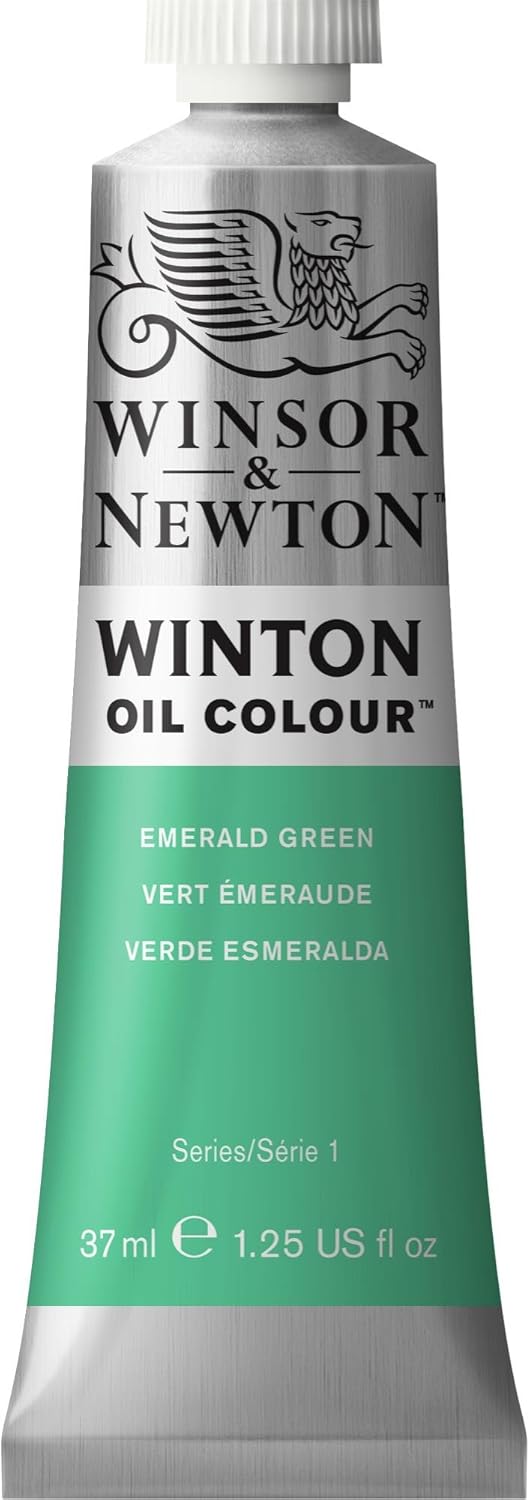
A single 37 ml Winton tube is the cheapest way to feel how Winsor & Newton’s student line handles. Emerald Green Hue is a mixture color (hence “hue”) made to imitate the historical emerald green without its toxic pigment. The listing describes high tinting strength, good coverage and a smooth consistency.
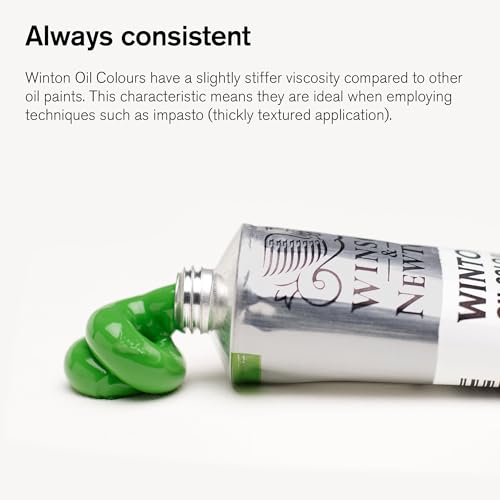
Winton is stiffer than Artists’ Oil Colour and more uniform across colors, which many painters like for palette-knife work and large underpaintings. A hue green like this one is useful for landscape mixing even on a professional palette.
Best suited for: Painters comparing student lines before committing to a set, and anyone who needs an inexpensive, strong green.
Key features:
- Single 37 ml tube
- Emerald Green Hue, a modern substitute for the historical pigment
- High tinting strength and coverage per the listing
- Winton student-grade formulation
Pros:
- Lowest price tier on the page
- Strong, usable green
- Available in 200 ml for large work
Cons and limitations:
- Hue colors are mixtures, not single pigments
- Stiffer consistency than professional paint
- One tube tells you about one color only
Buying consideration: Buy this alongside a Gamblin 1980 tube in a similar color if you want a direct student-line comparison on your own palette.
5. Gamblin Artist’s Oil Colors Cerulean Blue, 37 ml — Best for Sampling Gamblin Professional Paint

Genuine cerulean blue is a mixed metal oxide pigment that dates to the early nineteenth century, and Gamblin’s version is a true single-pigment color rather than a hue. The listing describes it as a cool, green-side blue that is very muted in tints and therefore most valuable used close to pure. That is an honest description of real cerulean.
As a test tube for the Artist’s line it is a good choice because cerulean is one of the colors where cheap substitutes fall furthest from the real thing. If you paint skies or want a reliable cool blue for atmospheric distance, you will use it.
Best suited for: Landscape and sky painters, and anyone who wants to test Gamblin’s professional line with one meaningful color.
Key features:
- 37 ml tube of Gamblin Artist’s Oil Colors
- Genuine cerulean blue, mixed metal oxide pigment
- Cool, green-leaning blue
- Muted in tint, strongest used pure
- Labeled non-toxic
Pros:
- True pigment rather than a hue mixture
- Characteristic Gamblin buttery handling
- Essential sky color for landscape work
Cons and limitations:
- Expensive per tube because the pigment is costly
- Low tinting strength is a limitation for mixing
- Not a color most beginners need first
Buying consideration: If you are testing Gamblin, this tube shows what professional pigment looks like. If you are building a first palette, buy ultramarine first and add cerulean later.
6. Gamblin Gamvar Picture Varnish, 8.5 oz Bottle — Best for A Final Varnish for Either Brand

Gamvar is a synthetic resin picture varnish that behaves like traditional dammar in appearance but can be applied much sooner, once the painting is dry to the touch and firm, instead of after months of curing. It dries to a gloss surface and is removable for future conservation. The 8.5 oz bottle will varnish many paintings.
Varnish is brand-agnostic. Gamvar works over Winsor & Newton Artists’ Oil Colour exactly as it does over Gamblin, and its early-application property makes it the most practical final varnish for painters who sell or exhibit on a schedule.
Best suited for: Any oil painter who finishes work and wants a removable, early-application varnish.
Key features:
- Synthetic resin varnish, gloss finish
- Similar appearance to dammar
- Can be applied sooner than traditional varnishes
- 8.5 oz bottle
Pros:
- Removes the long wait before varnishing
- Removable for conservation
- Works with any brand of oil paint
Cons and limitations:
- Gloss only in this listing; satin and matte versions exist separately
- Needs careful thin application to avoid streaks
- Not for use over acrylic without checking compatibility
Buying consideration: Whichever paint brand you choose, a bottle of Gamvar is a sensible addition. Apply thin and even in a dust-free room.
Verdict by Use Case
Beginner building a first oil kit
Gamblin 1980 Exclusive Set. Real pigment paint, a solvent-free medium and a panel in one box is hard to beat.
Painter stepping up to professional grade on a budget
Winsor & Newton Artists’ Oil Colour Introductory Set, plus a large tube of white. More colors for less money, with smaller tubes as the compromise.
Painter who wants professional paint and generous tubes
Gamblin Artist Oil Colors Introductory Set. Nine 37 ml tubes and a panel.
Health-conscious or shared-space studio
Gamblin, for the integrated Gamsol, Solvent-Free and Gamvar system. Winsor & Newton’s Artisan range is an alternative if you are willing to switch to water-mixable oils.
Painter who needs a very wide color chart
Winsor & Newton. The Artists’ Oil Colour range is larger and includes more historical and specialty colors.
Buying Guide: How to Choose Between Gamblin and Winsor & Newton
Decide professional or student first
The grade matters more than the brand. Both Gamblin 1980 and Winton are honest student paints; both Artist’s ranges are professional. Compare like with like.
Check tube size against your painting size
Small panels and studies suit 21 ml and 37 ml tubes. Large canvases burn through white quickly, so look at 150 ml and 200 ml options in open stock before committing to a brand.
Read the pigment index codes
Single-pigment colors mix more predictably than multi-pigment hues. Gamblin’s chart leans toward single pigments; Winsor & Newton offers both plus many hues at student level.
Think about your solvent plan
If you want to paint without mineral spirits, Gamblin’s Solvent-Free Gel and Fluid are designed for exactly that. If you are comfortable with low-odor solvent, Gamsol and Sansodor are comparable.
Consider the drying time you need
Both brands offer alkyd mediums (Galkyd, Liquin) to speed drying. Neither brand’s paint is unusually fast or slow on its own; drying varies by pigment.
Plan for varnish
Gamvar’s early application is a practical advantage for painters on deadlines. It works over either brand.
Look at open-stock availability
A set is only as useful as your ability to refill its colors. Both brands are widely stocked, but check that the specific tube size you prefer is available in each color.
Put Either Brand to Work
Paint only matters once it is on canvas. Our oil painting walkthroughs on painting a seashell in oils, painting fog in oil and painting grass in oil all work with either Gamblin or Winsor & Newton palettes, and the fog guide in particular shows where a muted cerulean earns its place.
Common Mistakes to Avoid
- Comparing Winton to Gamblin Artist’s Oil Colors. Match student to student and professional to professional.
- Buying an introductory set and never replacing the white, which runs out first in every set.
- Judging a brand by one tube. Handling varies by pigment within every range.
- Varnishing with Gamvar before the paint is firm to the touch, or applying it thickly.
- Assuming “hue” colors are inferior. They are mixtures, which is fine for many purposes, but they mix differently.
- Ignoring solvent ventilation because the label says “odorless.”
FAQs
Is Gamblin better than Winsor & Newton?
Neither is better across the board. Gamblin leads on American manufacture, low-toxicity mediums and a student line close to artist quality. Winsor & Newton leads on color range and traditional handling. Both professional lines are suitable for permanent, exhibition-quality work.
Is Gamblin 1980 the same as Winton?
They are competing student lines. Gamblin 1980 uses real pigments at lower concentration with the same linseed binder as the artist range. Winton uses hue substitutes for expensive pigments and has a stiffer, more uniform body. Both are good for studies and underpainting.
Can I mix Gamblin and Winsor & Newton oil paints?
Yes. Both are linseed-based artist oil paints and intermix without problems. Many painters build a palette from both brands based on which colors they prefer from each.
Which brand is safer for a home studio?
Gamblin has the more complete low-toxicity system: Gamsol solvent, Solvent-Free Gel and Fluid mediums, and Gamvar varnish. Winsor & Newton’s Artisan water-mixable oils remove solvent entirely but are a different paint system from traditional oils.
What is the difference between Gamblin Artist’s Oil and Gamblin 1980?
Artist’s Oil Colors have maximum pigment load and many single-pigment colors. 1980 Oil Colors are ground with the same binder but less pigment, making them more affordable for students and large-volume work.
Do I need Gamvar if I use Winsor & Newton paint?
You do not need it specifically, but it works over any oil paint and can be applied sooner than traditional varnishes. Winsor & Newton also sells its own varnishes if you prefer to stay within one brand.
Final Recommendation
Choose Gamblin if you want a safer studio, generous 37 ml tubes and American-made paint. The Artist Oil Colors Introductory Set is the professional route and the 1980 Exclusive Set is the best-value starting point for anyone. Choose Winsor & Newton if you want the broadest color chart and a lower entry price for professional paint; the Artists’ Oil Colour Introductory Set delivers that, with Winton tubes like the Emerald Green Hue for economical bulk colors.
Whichever paint you pick, finish with Gamvar when the painting is firm. The two brands intermix freely, so the most common long-term outcome is a palette drawn from both.