

PaintingProGuide is reader-supported. When you buy through links on this page we may earn an affiliate commission at no extra cost to you.
Acrylic is arguably the best medium for learning landscapes. It dries fast enough to layer a sky, mountains, trees and a foreground in one afternoon, it handles both soft atmospheric blends and crisp detail, and mistakes can simply be painted over. The difference between flat acrylic landscape paintings and ones with real depth comes down to a few principles: painting back to front, controlling value and temperature with distance, and simplifying nature into shapes.
This guide walks through composition, a landscape palette, the order of painting, how to handle skies, trees, water and grass, and a dozen subject ideas. We then review five landscape-specific acrylic books on Amazon from Jerry Yarnell, Lee Hammond, Sarah Johnston and Hugh Greer.
Quick answer: Paint landscapes from back to front: sky, then distant hills, then middle ground, then foreground, making each distant layer lighter, cooler and less detailed. For a beginner book, Acrylic Landscapes for Beginners is the easiest entry point; for classic start-to-finish demonstrations, Secrets of Acrylic: Landscapes Start to Finish by Jerry Yarnell is the best value.
Composition: Planning a Landscape Before You Paint
Place the horizon off-center
A horizon across the middle splits the picture in two. Put it in the lower third for a dramatic sky, or the upper third to emphasize land or water.
Choose one focal point
A cabin, a tree, a bend in a river or a bright patch of sky. Place it roughly a third of the way in from an edge, and give it the strongest contrast and sharpest detail in the painting.
Lead the eye
Paths, rivers, fences and shorelines carry the viewer into the scene. Curving lines feel natural; lines that run straight out of a corner pull the eye out of the painting.
Simplify into big shapes
Before painting, sketch three to five big shapes: sky, distant land, middle ground, foreground. If those shapes have clearly different values, the painting will read even before details.
A Practical Acrylic Landscape Palette
Many landscape painters work from a limited palette like this one, which mixes almost every natural color:
- Titanium white for tints, skies and highlights.
- Ultramarine blue for warm-leaning blues and shadow mixes.
- Phthalo blue (a little goes a long way) for clear skies and vivid water.
- Yellow ochre for earthy greens, fields and sunlit grass.
- Cadmium yellow light or a lemon yellow for bright greens and sunlight.
- Burnt sienna for trunks, earth and warming greens.
- A crimson or alizarin hue for sunsets and mixing purples and grays.
Mixing your own greens from blues and yellows, then dulling them with a touch of burnt sienna or red, looks far more natural than tube green straight from the bottle.
The Painting Order: Back to Front
- Tone or sketch. Lightly sketch the major shapes, or tone the canvas with a thin wash.
- Sky. Paint the whole sky first, extending slightly below the horizon so later layers overlap it.
- Distant elements. Mountains or tree lines in light, blue-gray, low-contrast values.
- Middle ground. Slightly darker, warmer and more detailed.
- Foreground. Darkest darks, warmest colors, most texture and detail.
- Highlights and accents. Sunlit edges, a few bright flowers, sparkle on water.
This order works because acrylic layers cover well, and it naturally creates atmospheric perspective: the effect where distant objects look lighter, bluer and softer because of the air between you and them. Our detailed tutorial on painting realistic landscapes with acrylics goes deeper into each stage.
How to Paint Common Landscape Elements
Skies and clouds
Paint skies darker at the top and lighter near the horizon. Blend while wet. For clouds, scumble white and light gray over a dry blue sky, keeping cloud bottoms flatter and slightly darker than their tops. See our guide to blending colors smoothly in acrylic for gradient technique.
Trees
Paint trees as masses of light and shadow, not individual leaves. Dab the dark interior first, then lighter greens on the sunlit side, then a few sky holes so the tree breathes. Distant trees are simple shapes; foreground trees get texture and trunk detail.
Water and reflections
Reflections sit directly below the objects that cast them and are usually slightly darker (for light objects) or lighter (for dark ones) than the objects themselves. Pull reflections down with vertical strokes, then cut across them with a few horizontal light lines to suggest the water surface.
Mountains
Decide the light direction and paint one side lighter, the other darker. Distant ranges stay pale and cool; near ranges get warmer, darker and textured with dry brushing.
Grass and fields
Block in fields with a flat mid-value green, then add darker greens at the base and lighter yellow-greens on top using upward flicks or a fan brush. Reduce detail as fields recede.
Rocks
Paint the dark side first, then lay the light side with a palette knife or flat brush, leaving hard edges. A few reflected warm tones in the shadows make rocks feel solid.
A First Landscape Walkthrough: Mountain Lake at Dusk
This simple scene uses every principle above on a 9×12 panel in about two hours.
- Sky: blend from a soft peach near the horizon (white, a touch of crimson and yellow ochre) to a muted blue-violet at the top (ultramarine, crimson and white). Carry the sky colors down past the horizon line.
- Far mountains: mix ultramarine, a little crimson and plenty of white. Paint a jagged ridge across the upper third with a flat brush. Keep the edges soft.
- Nearer ridge: darken the same mix with less white and a touch of burnt sienna. Overlap the first range so it sits in front.
- Tree line: with a dark green made from phthalo blue, burnt sienna and a little yellow ochre, dab a row of pine shapes along the shore using the corner of a flat brush.
- Lake: paint the water with the sky colors in reverse: lighter near the shore, darker toward the bottom edge. Pull the mountain and tree colors down in vertical strokes for reflections.
- Surface lines: with a liner and a pale peach, add a few thin horizontal lines across the reflections. They instantly read as water.
- Foreground: add dark rocks or grasses at the bottom corner, the darkest values in the painting, to frame the scene.
Photos, Plein Air and Imagination
Working from your own photographs is the most convenient way to paint landscapes at home, but cameras flatten values and exaggerate dark shadows. Simplify what you see and lighten shadows slightly. Painting outdoors, even a 20-minute study on a small panel, trains your eye to see real color temperature and atmosphere in a way photos cannot. And once you understand the principles, painting from imagination becomes possible: you can invent a scene by combining a sky you liked, a mountain shape you sketched and a foreground from your neighborhood.
12 Acrylic Landscape Painting Ideas
- A misty forest at dawn with layered tree silhouettes.
- A snowy mountain range under a pale blue sky.
- A country road leading into rolling hills.
- A lake reflection with a single dock.
- A desert mesa at sunset.
- A birch grove in autumn color.
- A seascape with breaking waves and rocks.
- A lavender or wheat field with a lone tree.
- A red barn in a winter field.
- A waterfall in a shaded canyon.
- A moonlit meadow with a few stars.
- A small cottage at the edge of a woodland.
Want to turn one of these into decor? Our guide to making DIY wall art with acrylic covers sizing and finishing for display.
Our Top Picks at a Glance
- Acrylic Landscapes for Beginners — Best for first landscapes
- Secrets of Acrylic: Landscapes Start to Finish — Best value start-to-finish demonstrations
- Paint Landscapes in Acrylic with Lee Hammond — Best for clear, approachable instruction
- Country Scenes in Acrylic (Paint This with Jerry Yarnell) — Best for rural and country subjects
- Acrylic Landscape Painting Techniques — Best technique-focused hardcover
| Product | Best For | Key Spec | Key Strength | Price Tier |
|---|---|---|---|---|
| Acrylic Landscapes for Beginners | First landscapes | Step-by-step scenic projects | Beginner-friendly subjects | $ |
| Secrets of Acrylic: Landscapes | Full demonstrations | Essential Artist Techniques series | Low price tier | $ |
| Paint Landscapes in Acrylic with Lee Hammond | Approachable lessons | Paperback | Well-known teacher | $$ |
| Country Scenes in Acrylic | Rural scenes | Paint This with Jerry Yarnell series | Themed projects | $$ |
| Acrylic Landscape Painting Techniques | Technique depth | Hardcover by Hugh Greer | Technique focus | $$ |
How We Chose
We selected these landscape books from Amazon listings checked in October 2026, based on their landscape focus, skill level suggested by title and series, format, and how widely each title is reviewed by Amazon buyers. We left out a wall-art print that appeared in our search because it is a printed acrylic-glass decor piece, not acrylic painting instruction or supplies.
- Landscape-specific instruction in acrylic.
- Beginner or intermediate positioning.
- Step-by-step vs technique format.
- Price tier.
Best Acrylic Landscape Painting Books Reviewed
1. Acrylic Landscapes for Beginners — Best for first landscapes

Sarah Johnston’s guide offers step-by-step instruction for painting scenic drives, misty forests, snowy mountains and more. Those subjects match several ideas on our list, and each one teaches a core landscape skill such as atmospheric depth or snow shadows.
It is written for beginners, so it is the gentlest place to start.
Best suited for: Beginners painting their first landscapes.
Key features:
- Step-by-step projects
- Forests, mountains, scenic drives
- Paperback
Pros:
- Beginner pacing
- Popular subjects
- Low-mid price tier
Cons and limitations:
- Less depth for experienced painters
- Project-based rather than theory
Buying consideration: Paint each project twice: once following the steps, once from your own reference.
2. Secrets of Acrylic: Landscapes Start to Finish — Best for value start-to-finish demonstrations

Jerry Yarnell, a long-time television painting instructor, presents landscapes from start to finish in this Essential Artist Techniques title. Start-to-finish demonstrations show how a painting evolves, which is often what beginners need most.
It sat in the lowest price tier among these books in our listing check.
Best suited for: Beginners and intermediates who like following a full painting process.
Key features:
- Start-to-finish landscapes
- Essential Artist Techniques series
- Paperback
Pros:
- Low price tier
- Clear process
- Experienced instructor
Cons and limitations:
- Specific painting style
- Fewer theory sections
Buying consideration: Watch for how Yarnell handles each layer, then apply that order to your own scenes.
3. Paint Landscapes in Acrylic with Lee Hammond — Best for clear, approachable instruction

Lee Hammond is known for accessible art instruction, and this book focuses specifically on landscapes in acrylic. A teacher-led approach suits painters who want explanations alongside demonstrations.
It pairs naturally with Hammond’s broader acrylic books if you already own one.
Best suited for: Beginners who like a teacher’s voice and clear explanations.
Key features:
- Landscape focus
- Acrylic-specific
- Paperback
Pros:
- Approachable instruction
- Focused topic
- Mid price tier
Cons and limitations:
- Overlaps with other Hammond titles
- Limited listing detail
Buying consideration: Use the preview to check which landscape types are covered.
4. Country Scenes in Acrylic — Best for rural and country subjects

Part of the Paint This with Jerry Yarnell series, Country Scenes focuses on rural landscapes: the barns, fields, fences and country roads many landscape painters love.
Themed books are useful once you know the basics and want projects in a specific style.
Best suited for: Painters drawn to farmland, barns and countryside.
Key features:
- Country and rural themes
- Paint This with Jerry Yarnell series
- Paperback
Pros:
- Strong theme
- Project-based
- Experienced instructor
Cons and limitations:
- Narrow subject range
- Upper-mid price tier
Buying consideration: Combine with the composition tips above to adapt projects to your own local scenery.
5. Acrylic Landscape Painting Techniques — Best for a technique-focused hardcover
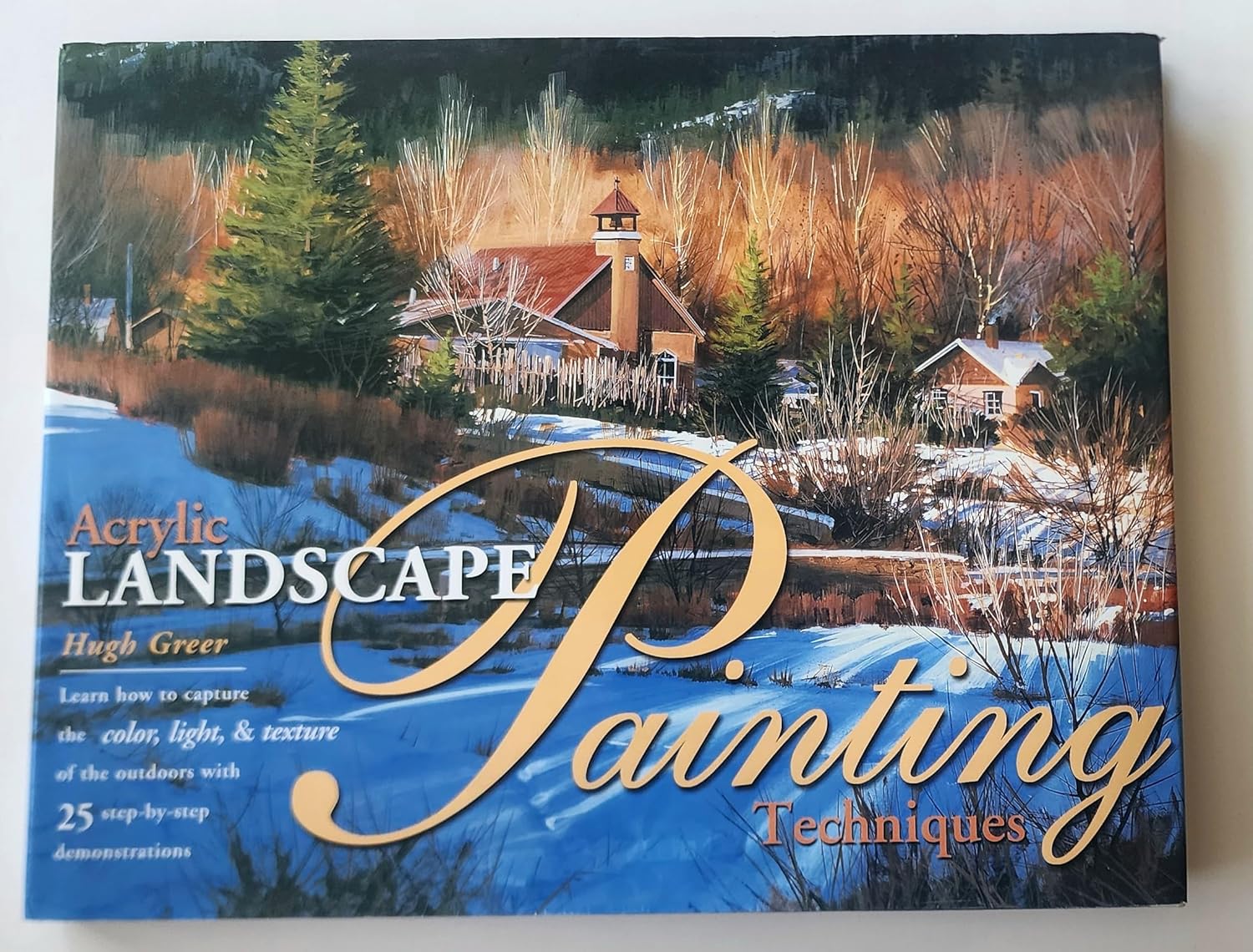
Hugh Greer’s hardcover focuses on techniques for acrylic landscapes. Technique books help you understand the “why” behind demonstrations, such as how to handle edges, values and texture.
The hardcover format holds up well as a long-term studio reference.
Best suited for: Intermediate painters who want to deepen technique.
Key features:
- Technique focus
- Hardcover
- Landscape-specific
Pros:
- Long-term reference
- Durable format
- Technique depth
Cons and limitations:
- Highest price tier in this list
- Less step-by-step hand-holding
Buying consideration: Best as a second book after a project-based beginner guide.
Buying Guide: Choosing Supplies and Books for Acrylic Landscapes
Skill level of the book
Beginner project books give exact steps; technique books assume basics and explain principles.
Subjects covered
Pick a book whose landscapes you would actually like to paint, such as mountains, seascapes or country scenes.
A limited palette
Buy the seven-color landscape palette above in larger tubes rather than a giant set.
Brushes for landscapes
A large flat for skies, a filbert for clouds and foliage, a fan brush for grass and trees, and a liner for branches.
Surface size
Start with 9×12 or 11×14. Landscapes need room for depth but should still be finishable.
Finishing
Varnish protects finished landscapes from dust and UV and evens out sheen.
Protecting Finished Landscapes
Once a painting is fully dry, a removable acrylic varnish protects it and evens out glossy and matte areas, which is especially noticeable in dark foregrounds. Our guide to preserving and protecting acrylic paintings explains when and how to varnish.
Common Mistakes to Avoid
- Horizon in the middle. Shift it up or down.
- Too much detail in the distance. Distant things should be soft and simple.
- Tube greens straight from the bottle. Mix and dull your greens.
- Same value everywhere. Make the foreground darker and the background lighter.
- Painting every leaf. Paint masses, then suggest a few leaves.
- Reflections that do not line up. Reflections fall straight down beneath objects.
FAQs
How do you paint a landscape in acrylic step by step?
Sketch big shapes, paint the sky, then distant elements, then the middle ground and finally the foreground, adding highlights last. Each closer layer gets darker, warmer and more detailed.
What colors do I need for acrylic landscapes?
Titanium white, ultramarine blue, phthalo blue, yellow ochre, a bright yellow, burnt sienna and a crimson will mix nearly every landscape color.
How do I make greens look natural in acrylic?
Mix greens from blue and yellow, then tone them down with a little burnt sienna or red. Vary them across the painting rather than using one green.
How do I create depth in a landscape painting?
Use atmospheric perspective: lighter, cooler, softer and less detailed colors in the distance, with stronger contrast and warmer colors in the foreground.
What size canvas is good for acrylic landscapes?
9×12 to 16×20 inches works well. Smaller canvases are ideal for practice studies.
Should I paint landscapes from photos or outdoors?
Both. Photos are convenient, but painting outdoors teaches you to see real color and light. Many painters do small outdoor studies and larger paintings from photos at home.
Final Recommendation
If you are painting your first acrylic landscapes, begin with Sarah Johnston’s Acrylic Landscapes for Beginners and the back-to-front method described above. For the best value demonstrations, add Jerry Yarnell’s Secrets of Acrylic, and choose Country Scenes in Acrylic if barns and fields are your favorite subjects. Lee Hammond’s landscape book suits painters who want approachable explanations, and Hugh Greer’s Acrylic Landscape Painting Techniques is the right second book when you are ready to understand technique in more depth.




