Quick answer: Good autumn fall painting ideas for canvas include a birch grove against a gold background, a single maple leaf study, a pumpkin still life, a misty lake with reflected trees, a winding leaf-covered path, an abstract color field in rust and ochre, and silhouettes against a burnt-orange sunset. Most of these work with a limited palette of yellow ochre, cadmium or azo orange, burnt sienna, alizarin or a crimson, ultramarine blue and white, on an 11×14-inch or 16×20-inch canvas.
Fall gives painters a ready-made palette. Warm golds, deep reds and soft purple shadows already sit in harmony, which is why autumn subjects tend to look good even in simple compositions.
The challenge is choosing a subject that fits your time and skill without ending up with the same generic orange tree everyone else paints. Below are autumn fall painting ideas for canvas grouped by difficulty, each with a short method, a suggested canvas size and the main skill it teaches. You will also find a core fall palette, mixing tips that keep autumn colors from turning muddy, and ideas for displaying the finished pieces.
A Core Autumn Palette
You do not need dozens of tubes. These colors cover almost every idea on this page:
| Color | Role in fall paintings |
|---|---|
| Yellow ochre | Muted golds, dry grass, warm light |
| Cadmium or azo yellow | Bright leaf highlights |
| Cadmium or pyrrole orange | Pumpkins, maples, sunsets |
| Burnt sienna | Rust, bark, earthy warmth |
| Alizarin crimson or quinacridone red | Deep reds, wine tones, cranberry |
| Ultramarine blue | Shadows, skies, mixing darks with burnt sienna |
| Titanium white | Tints, mist, highlights |
Mixing tip: Fall colors turn muddy when you mix too many pigments. Keep mixes to two or three colors. To darken orange, add burnt sienna or a touch of ultramarine instead of black. Ultramarine plus burnt sienna makes a rich, warm dark that suits autumn better than black from the tube.
Choosing a Surface and Medium for Fall Paintings
Most fall canvas projects are painted in acrylic because it dries quickly and allows easy layering. Oil gives softer blends for misty scenes. Gouache, with its matte, velvety finish, is excellent for flat, poster-like autumn designs, though it needs a suitable surface.
- Stretched canvas: The classic choice for display. 11×14 or 16×20 inches suits most ideas.
- Canvas panels: Flat, inexpensive and good for studies and practice. Easy to frame.
- Canvas prepared for gouache: Gouache can crack or lift on very flexible or slick surfaces. Rigid panels or canvases with an absorbent ground tend to work better. Our guide to the best canvas for gouache painting explains which surfaces suit gouache’s matte finish.
Easy Canvas Painting Ideas for Fall (Beginner)
1. Single maple leaf on a textured background
Canvas: 8×10 inches. Skill: Color blending within a shape.
Paint a warm, slightly textured background in yellow ochre and white. Draw one large maple leaf, fill it with yellow at the center blending to orange and red at the tips, then add veins with a liner brush in burnt sienna.
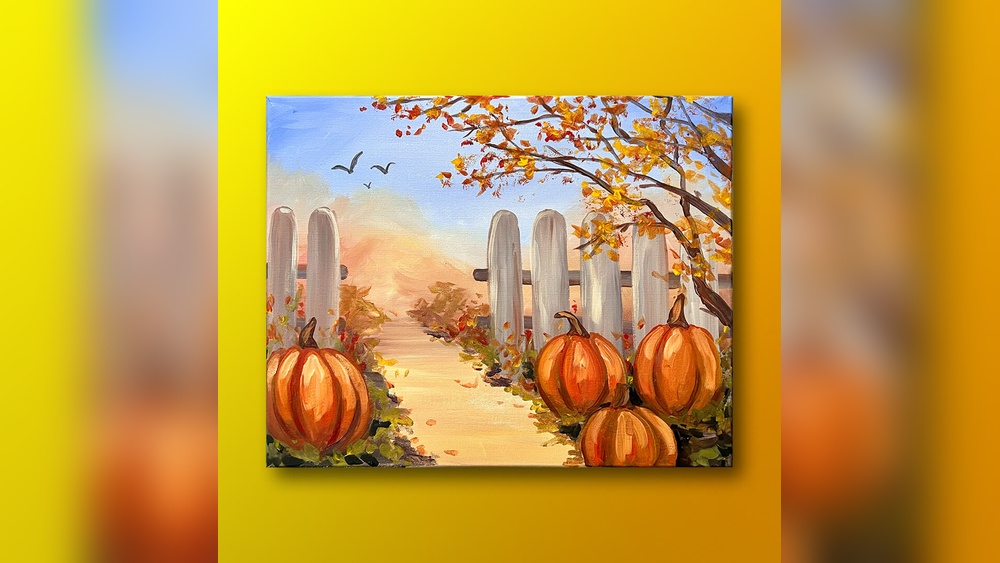
2. Pumpkin trio
Canvas: 11×14 inches. Skill: Simple form and shading.
Paint three pumpkins of different sizes on a table surface. Use curved vertical strokes to show the ribs, with a darker orange in the creases and a lighter orange-white on the ridges facing the light.
3. Fall tree silhouette against a sunset
Canvas: 11×14 inches. Skill: Smooth gradients.
Blend a sky from yellow near the horizon through orange to deep red-violet at the top. Once dry, paint a bare or partly leafed tree silhouette in a dark mix of ultramarine and burnt sienna.
4. Abstract fall color field
Canvas: 12×12 inches. Skill: Color harmony and composition.
Divide the canvas into loose horizontal bands of rust, ochre, olive and cream. Use a palette knife or wide brush and leave some edges rough. Add one thin line of metallic gold for contrast.
5. Fall leaves with masking tape
Canvas: 8×10 inches. Skill: Crisp shapes and negative space.
Cut leaf shapes from low-tack tape and stick them on the canvas. Paint over the whole surface in warm, mottled colors, then peel off the tape to reveal pale leaves.
Canvas Painting Ideas for Beginners Ready for More
6. Birch grove with golden leaves
Canvas: 16×20 inches. Skill: Layering and texture.
Paint a warm background of yellow and orange dabs to suggest foliage. Add white birch trunks with a flat brush or palette knife, then scrape dark marks across them with the edge of a card for the bark pattern.
7. Leaf-covered path
Canvas: 16×20 inches. Skill: Perspective.
Draw a path that narrows as it recedes. Paint trees on both sides, getting smaller and lighter toward the distance. Dab fallen leaves along the path, larger in the foreground and smaller farther back.
8. Misty autumn lake
Canvas: 16×20 inches. Skill: Atmospheric perspective and reflections.
Paint a pale, foggy sky. Add a line of soft fall trees on the far shore, slightly grayed and lighter for distance. Mirror the trees in the water with downward strokes, then drag a few horizontal lines of light across the reflections.
9. Apple or pear still life
Canvas: 11×14 inches. Skill: Light and shadow.
Set up real fruit with a single light source. Paint dark shadows first, then mid-tones and finally highlights. Include a cast shadow on the table to anchor the fruit.
10. Cozy window scene
Canvas: 11×14 inches. Skill: Interior-exterior contrast.
Paint a window frame with a view of fall trees outside. Inside, add a mug or candle on the sill. Keep the outside view lighter and cooler, the interior warm.
Large Canvas Ideas for Beginners and Intermediate Painters
11. Bold maple branch close-up
Canvas: 24×30 inches or larger. Skill: Scale and simplification.
Paint a single branch with five to seven large leaves filling most of the canvas. Large shapes are easier to paint well than lots of tiny details and create impact on a big wall.
12. Autumn forest abstract
Canvas: 24×36 inches. Skill: Loose mark-making.
Use vertical strokes for trunks and loose, overlapping dabs for foliage. Let drips and texture show. A large flat brush and a palette knife cover big areas quickly.
13. Rolling hills at harvest
Canvas: 24×30 inches. Skill: Landscape planes.
Paint layers of hills with different fall colors: gold fields, rust tree lines, purple-gray distant hills. Use a grid to place horizon and hill lines accurately on a large canvas; our guide on how to grid a canvas for painting explains the method.
Intermediate and Advanced Fall Ideas
14. Backlit leaves
Canvas: 11×14 inches. Skill: Value contrast.
Paint leaves lit from behind, with glowing warm centers and dark edges. Start with a dark background so the light has something to push against, then build each leaf from a deep red edge to a yellow-white center. The glow comes from contrast, not from brightness alone, so keep the surrounding values low.
15. Rainy autumn street
Canvas: 16×20 inches. Skill: Reflections and soft edges.
Paint a city or village street with wet reflections of red and gold trees and streetlights. Block in the street as one wet-looking dark plane, then pull vertical strokes of color down from each light source. Soften the bottom of every reflection so the pavement reads as wet rather than mirrored.
16. Fall portrait or figure
Canvas: 16×20 inches. Skill: Figure in a landscape.
Place a figure in a scarf walking through leaves, with warm reflected light on the face. Keep the figure small at first, about a third of the canvas height, so you can focus on gesture and color rather than likeness.
17. Gouache-style poster design
Canvas: 9×12-inch panel. Skill: Shape design and flat color.
Create a flat, graphic fall scene with simplified shapes and bold, matte colors: layered hills, a few lollipop trees, a sun disk. Limit yourself to five or six mixed colors and paint each shape in one flat coat. This works especially well in gouache on a suitable rigid surface.
Step by Step: The Birch Grove in One Afternoon
The birch grove (idea 6) is one of the most rewarding simple painting ideas on canvas, so here is a fuller method.
- Background (20 minutes): Cover the canvas with dabs of yellow ochre, orange and burnt sienna using a large round or a crumpled paper towel. Keep it lighter near the top and warmer near the bottom. Let it dry.
- Trunks (15 minutes): Mask vertical strips with tape, or paint them freehand with a flat brush in titanium white with a touch of ochre. Vary widths, with wider trunks in front and thinner ones behind.
- Shadows (10 minutes): On one side of each trunk, add a soft blue-gray made from ultramarine, burnt sienna and white to make the trunks look round.
- Bark marks (15 minutes): Dip the edge of an old card in the dark mix and press-drag horizontal marks across the trunks. Fewer marks look more natural than many.
- Foreground leaves (20 minutes): Dab bright orange and yellow leaves over the lower trunks and ground, finishing with a few red accents.
Quick Comparison of Fall Ideas
| Idea | Difficulty | Time | Main skill |
|---|---|---|---|
| Single maple leaf | Easy | 1 hour | Blending |
| Pumpkin trio | Easy | 1 to 2 hours | Simple form |
| Tree silhouette sunset | Easy | 1 hour | Gradients |
| Birch grove | Easy to medium | 2 hours | Texture |
| Leaf-covered path | Medium | 2 to 3 hours | Perspective |
| Misty lake | Medium | 2 to 3 hours | Atmosphere |
| Backlit leaves | Advanced | 3+ hours | Value contrast |
Techniques That Make Fall Paintings Look Better
- Use temperature contrast: Cool blue-violet shadows make warm oranges glow.
- Vary greens: Fall scenes look more real when some green remains, often olive or yellow-green.
- Dab, do not stroke, foliage: Short dabs with a filbert, round or sponge suggest leaves better than smooth strokes.
- Add texture: A textured background adds depth; see our guide on painting a textured background canvas for methods.
- Limit bright colors: Save the brightest orange and yellow for focal points.
- Paint from dark to light: In acrylic, laying darker values first and finishing with highlights keeps colors clean.
Common Fall Painting Mistakes
- Muddy oranges: Over-mixing or adding black. Use burnt sienna or ultramarine to darken.
- Every leaf the same color: Vary yellows, oranges, reds and browns.
- Too much detail: Suggest leaves in masses rather than painting each one.
- No focal point: Decide what the painting is about and give it the most contrast.
- Flat skies: Add gradients or soft clouds for interest.
Fall Canvas Painting Kit Essentials
If you are putting together a fall painting kit, include:
- Canvas or canvas panels in two or three sizes
- The core autumn palette above
- A large flat, medium round, filbert and liner brush
- A palette knife
- A palette, water jar and paper towels
- Masking tape for clean edges and leaf masks
Frame a Canvas Painting: Display Ideas
- Floater frames: Give stretched canvases a polished, gallery look with a small gap around the edges.
- Painted edges: Continue the painting around the sides of a gallery-wrapped canvas so it can hang without a frame.
- Seasonal grouping: Hang a trio of small fall canvas panels together for a themed display.
- Easel display: Place small paintings on tabletop easels for seasonal decor.
Before framing, let acrylic paintings dry for at least a few days, and oils for much longer, so the surface does not stick to glazing or packaging. Varnishing protects fall colors from dust and gives them an even sheen.
FAQs
What are easy canvas painting ideas for fall?
A single maple leaf, a pumpkin trio, a tree silhouette against a sunset and an abstract fall color field are all simple, quick and suitable for beginners.
What colors do I need for autumn paintings?
Yellow ochre, a bright yellow, orange, burnt sienna, a deep red, ultramarine blue and white cover most fall subjects. Mix darks from ultramarine and burnt sienna rather than using black.
What size canvas is best for beginners?
An 8×10, 11×14 or 12×12-inch canvas is manageable for most beginners. Larger canvases work well for simple, bold designs.
Can I use gouache on canvas for fall paintings?
Yes, with the right surface. Gouache works best on rigid or absorbent surfaces and can crack on very flexible canvas. Thin layers and a suitable ground help.
How do I paint fall leaves without them looking messy?
Paint leaves in masses with short dabs rather than individual shapes, vary the color, and add a few detailed leaves only at the focal point.
What are good canvas panel ideas for fall?
Canvas panels are great for small studies: single leaves, pumpkins, mushrooms, acorns or simple landscapes. They are inexpensive and easy to frame in sets.
Next Step
Pick one idea that matches the time you have this week, set out the core autumn palette and paint it on a small canvas first. A quick study tells you what works before you commit to a larger piece.
If you want to try the matte, poster-like look of gouache for your fall designs, the surface matters. Our roundup of canvases and panels that suit gouache compares options that hold gouache without cracking or lifting.