PaintingProGuide is reader-supported. When you buy through links on this page we may earn an affiliate commission at no extra cost to you.
Acrylic is the medium most painters recommend for a first attempt, and with good reason. It thins with water, dries fast enough to paint over a mistake within minutes, works on almost any surface and needs no solvents. Beginning painting acrylics is less about talent than about understanding a handful of quirks: how fast it dries, why colors shift slightly darker, and how to blend before the paint sets.
This guide covers how acrylic behaves, the supplies you actually need, the seven techniques every beginner should practice, a first-week lesson plan and the mistakes that frustrate most new painters. At the end, we review seven books and paint sets on Amazon that support the learning process.
Quick answer: Start with a 12 to 36-color student acrylic set, a few synthetic brushes and canvas panels, and practice blocking in, layering and wet blending on small surfaces. For paint, the Caliart 36-color set in 2 oz bottles gives generous volume, and the Shuttle Art 30-tube set is a compact low-cost alternative. For learning, Acrylics: Techniques and Tutorials for the Complete Beginner is an affordable technique primer, and Learn to Paint in Acrylics with 50 Small Paintings gives you a project for every practice session.
How Acrylic Paint Behaves
It dries fast
Thin layers of acrylic can dry in minutes, thicker layers in an hour or more. That speed is a gift for layering and a challenge for blending. Work in sections, keep paint on a damp palette and do your blending while the paint is wet.
It is water-soluble wet, permanent dry
While wet, acrylic cleans up with water. Once dry, it becomes a flexible, water-resistant plastic film. That is why brushes must be rinsed before paint dries in them, and why you can glaze over a dry layer without lifting it.
Colors often dry slightly darker
Many acrylics look a little lighter when wet because the binder is milky until it cures clear. Mix colors a touch lighter than your target, or test a swatch and let it dry.
It works on almost anything
Canvas, paper, wood, cardboard, stone, fabric and more, as long as the surface is clean and, for porous materials, primed.
Student vs artist grade
Student and craft acrylics use less pigment and more filler; artist-grade paints are more concentrated and lightfast. For learning, student grade is perfectly fine. Upgrade individual colors later.
What You Need to Begin
- Paint: a starter set plus a larger white. Titanium white is the opaque standard.
- Brushes: synthetic flats in two sizes, a small round, a filbert and a liner.
- Surfaces: canvas panels or heavy paper in 8×10 or 9×12.
- Palette: a stay-wet palette, or a damp towel under parchment.
- Two water jars, a rag and a palette knife.
- Optional: a spray bottle, painter’s tape and a retarder or slow-drying medium if fast drying frustrates you.
Seven Acrylic Techniques Every Beginner Should Practice
1. Blocking in
Cover the canvas with large, flat shapes of approximate color using a big brush. It establishes composition and kills the intimidating white canvas.
2. Layering
Because acrylic dries quickly, you build paintings in layers: background first, then midground, then details. Each layer can partly cover the last.
3. Wet-into-wet blending
Lay two colors side by side and brush across the join while both are wet. This is how skies and soft transitions are made. Our tutorial on painting smooth gradients with acrylics shows the motion step by step.
4. Dry brushing
Wipe most paint off a brush and drag it lightly over a dry surface. The broken texture is perfect for wood grain, grass, rock and foam.
5. Glazing
Thin paint with a glazing medium (or a little water for small areas) and brush a transparent layer over dry paint to shift its color or deepen shadows.
6. Impasto
Apply paint thickly with a brush or palette knife so strokes stand up from the surface. Heavy-body acrylic or a gel medium helps.
7. Scumbling
Scrub a thin, lighter layer of opaque paint loosely over a darker dry layer to create haze, light and atmosphere. It is ideal for clouds and mist.
Color Mixing Basics
- Primaries: red, yellow and blue mix into secondaries: orange, green and purple.
- Tints and shades: add white to lighten, a touch of black or the complement to darken.
- Complements: red-green, blue-orange and yellow-purple neutralize each other into browns and grays.
- Mix light to dark: add dark paint to light in small amounts. It takes very little blue to change a white, but a lot of white to lighten a blue.
- Clean water: dirty rinse water muddies every mix.
Your First Week of Acrylic Painting
| Day | Exercise | Goal |
|---|---|---|
| 1 | Color mixing chart from three primaries plus white | Learn mixing and the darker-when-dry shift |
| 2 | Value scale: one color, five steps | Control lightness |
| 3 | Sky gradient | Wet blending under time pressure |
| 4 | Simple fruit still life | Light, shadow and form |
| 5 | Tree line with dry brushing | Texture |
| 6 | Small landscape with layers | Back-to-front layering |
| 7 | Repeat your favorite from the week | See improvement |
Once you are comfortable, a full scene is a great next step. Our tutorials on painting a dreamy sky with acrylics and painting a cabin in the woods combine several of these techniques in one picture.
Our Top Picks at a Glance
- Acrylics: Techniques and Tutorials for the Complete Beginner — Best affordable technique primer
- Learn to Paint in Acrylics with 50 Small Paintings — Best project-a-day practice book
- How to Paint: A Complete Beginner’s Guide to Watercolors, Acrylics, and Oils — Best if you may try other media
- The Complete Acrylic Painting Guide for Beginners — Best comprehensive single-volume guide
- Caliart Acrylic Paint Set, 36 Colors with 12 Brushes — Best beginner paint set
- Shuttle Art Acrylic Paint Set, 30 x 12 ml — Best compact low-cost paint set
- Apple Barrel Acrylic Paint, White, 2 oz — Best cheap extra white for practice
| Product | Best For | Key Spec | Key Strength | Price Tier |
|---|---|---|---|---|
| Acrylics: Techniques and Tutorials | Technique primer | Complete beginner tutorials | Low price tier | $ |
| Learn to Paint in Acrylics with 50 Small Paintings | Daily practice | 50 small projects | Finishable sessions | $$ |
| How to Paint: A Complete Beginner’s Guide | Multi-media beginners | 38 step-by-step projects | Watercolor, acrylic, oil | $$ |
| The Complete Acrylic Painting Guide | One-volume reference | Techniques, supplies, mistakes | Comprehensive scope | $$$ |
| Caliart 36 Colors | Paint set | 36 x 2 oz bottles, 12 brushes | Generous volume | $$ |
| Shuttle Art 30 Tubes | Compact paint set | 30 x 12 ml tubes, 3 brushes | Wide color range | $ |
| Apple Barrel White | Extra white | 2 oz matte craft acrylic | Very low cost | $ |
How We Chose
We looked at Amazon listings checked in October 2026 and picked a mix of learning resources and paints. Books were chosen for beginner focus, scope and format as described in their titles; paints for color range, volume per color and safety statements. We also considered how widely each listing is reviewed by Amazon buyers.
- Clear beginner positioning.
- Technique coverage vs project count.
- Paint quantity per color and color range.
- Price tier relative to how long it will last.
Best Books and Paints for Beginning Acrylic Painters Reviewed
1. Acrylics: Techniques and Tutorials for the Complete Beginner — Best for an affordable technique primer

Adrian Burrows’s book in the Art Techniques series pairs techniques with tutorials for complete beginners. That combination mirrors how acrylic is best learned: understand a technique, then use it in a small painting.
It sat in the low price tier in our listing check, making it an easy first book.
Best suited for: Beginners who want to understand techniques like glazing and dry brushing, not just copy steps.
Key features:
- Techniques and tutorials
- Complete beginner level
- Paperback
Pros:
- Affordable
- Balanced theory and practice
- Acrylic-specific
Cons and limitations:
- Fewer projects than a 50-painting book
- Supplies sold separately
Buying consideration: Practice each technique on a scrap panel before using it in a full painting.
2. Learn to Paint in Acrylics with 50 Small Paintings — Best for project-a-day practice

Mark Daniel Nelson’s book is organized around 50 small paintings, with the subtitle promising to help you pick up the skills, put on the paint and hang up your art.
Small, finishable projects are ideal for a medium that dries fast: you can complete a piece before frustration sets in.
Best suited for: Beginners who want structure and frequent small wins.
Key features:
- 50 small paintings
- Skill-building sequence
- Paperback
Pros:
- High practice volume
- Low supply cost per project
- Mid price tier
Cons and limitations:
- Small scale
- Less theory
Buying consideration: Date each painting so you can see progress over the 50 projects.
3. How to Paint: A Complete Beginner’s Guide to Watercolors, Acrylics, and Oils — Best for beginners who may try other media

Ian Sidaway and Angela Gair cover watercolor, acrylic and oil, with 38 step-by-step projects according to the title. If you are not sure acrylic will be your long-term medium, this book lets you compare.
Seeing the same principles across media also deepens your understanding of acrylic’s strengths.
Best suited for: Curious beginners who want a broad foundation.
Key features:
- 38 step-by-step projects
- Watercolor, acrylic and oil
- CompanionHouse Books
Pros:
- Broad scope
- Good comparison of media
- Mid price tier
Cons and limitations:
- Less acrylic depth than a dedicated book
- Oil sections require extra supplies
Buying consideration: Start with the acrylic projects and return to the others once you are comfortable.
4. The Complete Acrylic Painting Guide for Beginners — Best for a comprehensive single-volume guide
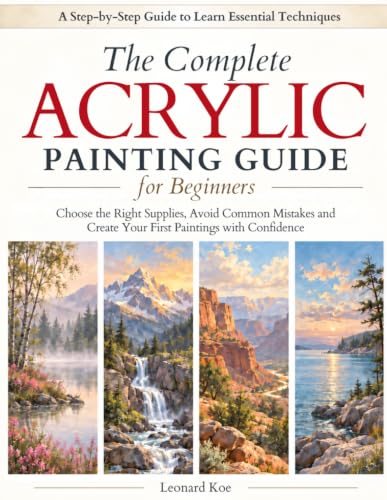
Leonard Koe’s guide promises step-by-step instruction in essential techniques, choosing the right supplies, avoiding common mistakes and creating your first paintings. That scope covers the full beginner journey in one book.
It was the highest-priced book in our listing check, so preview it to confirm the format suits you.
Best suited for: Beginners who prefer one thorough reference over several smaller books.
Key features:
- Techniques, supplies and mistakes
- Step-by-step format
- Paperback
Pros:
- Broad beginner coverage
- Supply guidance included
- Mistake-avoidance focus
Cons and limitations:
- Highest price tier among these books
- Limited listing detail
Buying consideration: Check the preview pages to confirm image quality and layout before buying.
5. Caliart Acrylic Paint Set, 36 Colors with 12 Brushes — Best for a beginner paint set

Caliart includes 36 colors in 2 oz bottles, with metallic gold and silver, plus 12 brushes. The listing describes creamy, highly pigmented paint that is water-resistant and fade-resistant when dry, ASTM D4236 conforming and acid-free.
Two-ounce bottles give enough paint for weeks of daily practice, which small-tube sets cannot match.
Best suited for: Beginners who will paint regularly.
Key features:
- 36 x 2 oz bottles
- 12 brushes
- Matte and metallic colors
- ASTM D4236
Pros:
- Generous volume
- Wide palette
- Mid price tier
Cons and limitations:
- Bottles take more storage space
- Brushes are basic
Buying consideration: Use mostly primaries and white at first; the extra colors are a bonus, not a requirement.
6. Shuttle Art Acrylic Paint Set, 30 x 12 ml Tubes — Best for a compact low-cost paint set

Shuttle Art provides 30 colors in 12 ml tubes with three bonus brushes. The listing describes creamy, thick pigments that dry permanent, waterproof and fade-proof, for surfaces including canvas, wood and fabric.
Tubes are compact and easy to carry, and 30 colors make it easy to see what each hue looks like before deciding which to buy in larger sizes.
Best suited for: Budget beginners and painters with little storage space.
Key features:
- 30 x 12 ml tubes
- 3 bonus brushes
- Gloss finish listed
Pros:
- Low price tier
- Wide color range
- Compact
Cons and limitations:
- Small tubes run out quickly, especially white
- Gloss finish may not suit all work
Buying consideration: Add a larger white; the 12 ml white tube will go first.
7. Apple Barrel Acrylic Paint, White, 2 oz — Best for a cheap extra white for practice

Apple Barrel’s 2 oz white is a matte craft acrylic that cleans up with soap and water while wet and works on wood, paper, canvas and more, according to the listing. It was the least expensive product in our listing check.
White disappears fastest in any palette. A cheap bottle for underpainting, mixing practice and priming cardboard saves your better paint.
Best suited for: Beginners who want inexpensive white for practice and base coats.
Key features:
- 2 oz bottle
- Matte finish
- Non-toxic, soap-and-water cleanup
Pros:
- Very low cost
- Good for base coats and practice
- Widely available
Cons and limitations:
- Craft-grade coverage
- Not as opaque as artist titanium white
Buying consideration: Use it for practice mixes and backgrounds; switch to a heavier white for highlights.
Buying Guide: Choosing Acrylic Supplies as a Beginner
Paint consistency
Heavy-body acrylic holds brush marks and suits impasto; fluid or craft acrylic flows and suits smooth blending and detail.
Paint volume
Two-ounce bottles or larger tubes are better value for regular practice than tiny tubes.
Color range
You need fewer colors than you think. A set with good primaries, white and black matters more than 48 shades.
Book type
Technique books explain methods; project books give practice. Beginners benefit from one of each.
Brushes
Synthetic brushes are the standard for acrylic. Rinse frequently to prevent paint drying in the ferrule.
Surfaces
Canvas panels and heavy paper keep practice cheap.
Common Mistakes to Avoid
- Fighting the drying time. Plan to layer rather than blend everything at once.
- Too much water. Over-thinned acrylic loses adhesion and looks streaky. Use a medium for big glazes.
- Forgetting the color shift. Test swatches dry darker.
- Using tiny brushes early. Big brushes for big shapes; details last.
- Letting paint dry on brushes. Rinse every few minutes.
- Skipping value. Squint at your painting; if it reads in light and dark, the color will work.
FAQs
Is acrylic paint good for beginners?
Yes. It is water-based, dries quickly, can be painted over easily and works on many surfaces without solvents.
Why does my acrylic paint dry darker?
Many acrylics contain a binder that looks milky when wet and turns clear as it dries, so colors look slightly darker once dry.
How do I blend acrylic paint before it dries?
Work in small sections, keep paint on a damp palette, mist lightly with water, or add a slow-drying medium.
Do I need to prime canvas for acrylic?
Most store-bought canvases and panels are already primed. Raw wood, paper and cardboard benefit from gesso.
Can I mix acrylic paint with water?
Yes, in moderation. A little water improves flow; too much weakens the paint film. Use mediums for heavy thinning.
What should I paint first with acrylics?
A color chart, a value scale and a simple sky gradient. They teach mixing, value and blending before you tackle full scenes.
Final Recommendation
Begin with a generous paint set, a few synthetic brushes and small surfaces, and spend your first week on the exercises above. For paint, the Caliart 36-color set gives you the volume to practice daily, while Shuttle Art is the compact budget pick; a cheap Apple Barrel white keeps practice costs down. For learning, choose Acrylics: Techniques and Tutorials if you want to understand methods, Learn to Paint in Acrylics with 50 Small Paintings if you learn by doing, How to Paint if you might branch into other media, and The Complete Acrylic Painting Guide if you prefer one comprehensive reference.