

PaintingProGuide is reader-supported. When you buy through links on this page we may earn an affiliate commission at no extra cost to you.
An acrylic paint color chart does two jobs. The first is a swatch chart: a sheet showing exactly how every paint you own looks once it dries, which is often darker than it looks wet. The second is a mixing chart: a grid where each color is mixed with each other color, and often with white, so you can see every hue your palette can make before you need it. The best acrylic paint color chart is the one you make yourself from your own paints, supported by a good reference tool or book.
This guide explains how to make both kinds of chart, then reviews the color wheels, mixing guides, recipe books and a swatch diary that make the process faster and more accurate.
Quick answer: For making your own chart, the HG Art Concepts Painter’s Color Diary is the best tool: 9 x 12 inch spiral-bound 290gsm canvas-textured paper with 40 labeled swatch boxes per page, each with a black line for judging opacity. For ready-made mixing reference, 1,500 Color Mixing Recipes for Oil, Acrylic & Watercolor by William F. Powell is the most comprehensive recipe book here. For quick color-theory answers at the easel, the Color Wheel Magic Palette Mixing Guide is a classic.
Our Top Picks at a Glance
- HG Art Concepts Painter’s Color Diary, 9 x 12 in — Best for making your own acrylic color chart
- 1,500 Color Mixing Recipes (William F. Powell) — Best comprehensive mixing recipe book
- Color Wheel Magic Palette Mixing Guide, 11.5 in — Best quick mixing reference
- JimKing Creative Color Wheel and Mixing Board — Best color-theory teaching tool
- JimKing Creative Color Wheel, 2-Pack — Best budget color wheel pair
- Color Mixing Recipes for Oil & Acrylic (450 combinations) — Best compact recipe book
- Fantastory 36-Color Acrylic Set with Color Chart — Best paint set that includes a color chart
| Product | Best For | Key Spec | Key Strength | Price Tier |
|---|---|---|---|---|
| HG Art Concepts Color Diary | Your own swatch library | 10 pages, 40 swatches each, 290gsm | Opacity line in every box | $$ |
| 1,500 Color Mixing Recipes | Mixing reference | Spiral-bound, oil/acrylic/watercolor | Largest recipe count | $$ |
| Magic Palette Mixing Guide | Quick answers | 11.5 in rotating guide | Long-established design | $ |
| JimKing Wheel + Mixing Board | Learning theory | Wheel plus mixing board, 9.25 in | Grayscale, tints and tones | $ |
| JimKing Color Wheel 2-Pack | Budget, classroom | 2 wheels, 230 mm, UV coated | Two-sided rotating wheels | $ |
| Color Mixing Recipes (450) | Compact recipes | Hardcover, oil and acrylic | Focused on oil and acrylic | $ |
| Fantastory 36-Color Set | Starting a palette | 36 x 60 ml, brushes, chart, knife | Color chart included | $$ |
How to Make an Acrylic Paint Color Chart
Printed charts from paint makers are a starting point, but they cannot show how your specific paints, on your specific paper, look when dry. Acrylic usually darkens as it dries because the binder turns from milky to clear, and student and craft paints vary between batches. Making your own chart takes an afternoon and saves months of guesswork.
Step 1: Make a swatch chart
- Use heavy paper or canvas paper, ideally 250gsm or more, so swatches do not buckle.
- Draw a grid of boxes about 1 x 1.5 inches. Draw a thick black marker line through the middle of each box before painting.
- Label each box with the brand, color name and pigment code if the tube lists one.
- Paint a thick stroke over the black line and fade it to a thin layer at one end. Add a small dab of the color mixed with white beside it.
- Let it dry completely. The black line shows how opaque or transparent each color is.
Step 2: Make a mixing grid
- Choose 6 to 12 colors you use most. Write them across the top and down the side of a grid.
- In each square, mix equal parts of the row color and the column color.
- For a more useful version, add a second row per color with white mixed in, so you see the tints too.
- Label anything surprising: a green and red that make a perfect neutral, or a blue and yellow that make a dull green.
Step 3: Keep it with your paints
Store the chart where you paint, update it when you buy a new color, and note the date. Over time it becomes the most useful reference you own, far more accurate than a printed card.
How We Chose
We chose these tools from the Amazon listing details and specifications checked in October 2026, how well each one supports making or using an acrylic color chart, and how widely each is reviewed by Amazon buyers. The two books are listed with minimal detail on Amazon, so we describe them only from their titles and formats; we have not read or used any of the products here.
- Accuracy for acrylic: tools that let you record your own dried colors score highest.
- Breadth of reference: recipe books and wheels that cover many combinations.
- Ease of use: rotating wheels and labeled swatch boxes make reference quick.
- Durability: coated or heavyweight materials survive studio use.
- Value: inexpensive tools that genuinely improve mixing.
Best Acrylic Paint Color Chart Tools Reviewed
1. HG Art Concepts Painter’s Color Diary for Acrylic and Oil, 9 x 12 in — Best for making your own color chart

This diary is a ready-made version of the swatch chart described above. Each of its ten removable pages has 40 organized swatch boxes measuring 1 x 1.5 inches, each with a bold black reference line for judging transparency and opacity, and labeled space for brand, pigment, date, formula and project notes.
The paper is 136 lb (290gsm) canvas-textured with sizing suited to oil and acrylic, which means swatches behave like they do on canvas rather than on thin paper. Glassine interleaving sheets protect finished pages, and the spiral binding lets you remove pages and pin them up beside your easel.
Best suited for: Acrylic and oil painters who want a tidy, durable swatch library of their own paints and mixes.
Key features:
- 9 x 12 in, spiral-bound
- 10 removable pages
- 40 swatch boxes per page (1 x 1.5 in)
- Black opacity line in every box
- 290gsm canvas-textured paper, glassine interleaves
Pros:
- Shows how your own paints dry
- Opacity line built in
- Paper suited to acrylic and oil
Cons and limitations:
- Only 400 swatches in total
- Higher price than a DIY grid
- Not for watercolor despite listing finish
Buying consideration: Fill the first page with single colors and white tints, then use later pages for two-color mixes of your favorites.
2. 1,500 Color Mixing Recipes for Oil, Acrylic & Watercolor — Best for a comprehensive mixing reference
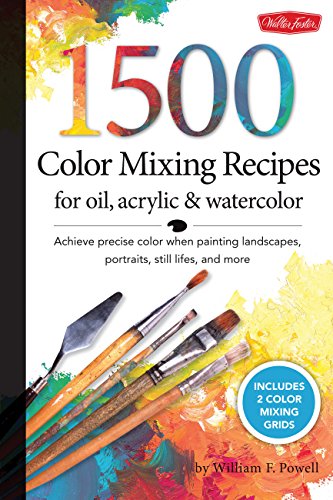
William F. Powell’s 1,500 Color Mixing Recipes is a spiral-bound reference covering oil, acrylic and watercolor. As the title says, it is aimed at achieving precise color when painting landscapes, portraits, still lifes and other subjects.
A recipe book complements your own chart: it gives you starting points for colors you have never mixed, which you can then test and record. Spiral binding lets the book lie open on your table while you work.
Best suited for: Painters who want a large printed reference of mixes to try, across several media.
Key features:
- Spiral-bound format
- Covers oil, acrylic and watercolor
- 1,500 recipes per title
- Subject-oriented: landscapes, portraits, still lifes
- By William F. Powell
Pros:
- Huge range of starting mixes
- Lies flat while painting
- Useful across media
Cons and limitations:
- Printed color may differ from your paints
- Amazon listing gives little detail
- Recipes depend on specific pigments
Buying consideration: Treat each recipe as a starting point and test it in your own swatch chart; brand differences matter.
3. Color Wheel Magic Palette Mixing Guide, 11.5 in — Best for quick mixing answers

The Magic Palette from The Color Wheel company is a long-established rotating mixing guide, listed at 11.5 x 11.5 inches and weighing under an ounce. The Amazon listing itself has very little descriptive detail, so check the product images for current features.
Tools like this let you dial in two colors and see the approximate result, along with tints and shades, which is a quick way to plan mixes before committing paint.
Best suited for: Painters who want a fast reference for planning mixes at the easel.
Key features:
- 11.5 x 11.5 in
- Rotating mixing guide
- Lightweight
- From The Color Wheel company
- Model 5324CW per listing
Pros:
- Fast reference
- Lightweight and portable
- Familiar design
Cons and limitations:
- Sparse listing detail
- Printed color approximates paint
- Not specific to acrylic
Buying consideration: Use it to choose which two paints to try, then confirm by mixing a small swatch.
4. JimKing Creative Color Wheel and Mixing Board, 9.25 in — Best for learning color theory

This JimKing package pairs a Creative Color Mixing Board with a regular 9.25 inch color wheel. The listing describes a grayscale, tints and tones, definitions of color terms and illustrations, plus a two-sided wheel with indicators for complementary, split-complementary and triad schemes, how to tint and shade, and primary, secondary and tertiary references.
For beginners, that combination teaches the reasoning behind a color chart: why complementary colors make neutrals, and how adding white or black changes a hue.
Best suited for: Beginners, students and teachers learning or teaching the basics of color theory.
Key features:
- Mixing board plus color wheel
- 9.25 in
- Grayscale, tints and tones
- Complementary, split-complementary, triad indicators
- Definitions of color terms
Pros:
- Two tools in one package
- Teaches harmony schemes
- Affordable
Cons and limitations:
- Printed colors are approximations
- Not a recipe reference
- Paper construction
Buying consideration: Pair it with a simple 6 x 6 mixing grid in your own paints; the wheel explains what the grid shows.
5. JimKing Creative Color Wheel, 2-Pack — Best for a budget color wheel pair
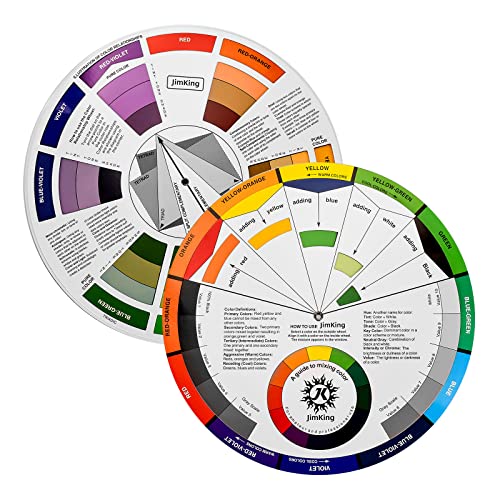
The cheaper JimKing listing offers two-sided rotating color wheels at 230 mm (about 9 inches) diameter, sold as a two-pack. The wheels are UV coated to minimize fading and protect against moisture, and come with paper envelope covers for safe transport.
The listing says the wheel helps organize colors and defines common terms, and pitches it to painters, crafters and designers alike. A pair is handy for keeping one at the easel and one in a travel kit, or for sharing in a class.
Best suited for: Students, classrooms and anyone wanting a spare wheel for a second workspace.
Key features:
- 2 color wheels
- 230 mm diameter
- Two-sided rotating design
- UV coated
- Paper envelope covers
Pros:
- Very low cost for two
- UV coating resists fading
- Portable
Cons and limitations:
- No mixing board
- Paper material
- General color theory only
Buying consideration: Keep one wheel by your palette and refer to it whenever a mix turns muddy; the complementary is usually the culprit.
6. Color Mixing Recipes for Oil & Acrylic (450+ combinations) — Best for a compact recipe book

The smaller Powell title focuses on oil and acrylic, with mixing recipes for more than 450 color combinations according to its subtitle, in a hardcover format.
If you only paint in acrylic and oil, a focused book can be quicker to navigate than the 1,500-recipe edition that also covers watercolor.
Best suited for: Acrylic and oil painters who want a smaller, focused recipe reference.
Key features:
- Hardcover
- Oil and acrylic focus
- 450+ color combinations per subtitle
- By William F. Powell
- Compact reference
Pros:
- Focused on two media
- Lower price tier
- Durable hardcover
Cons and limitations:
- Fewer recipes than the 1,500 edition
- Listing detail is sparse
- Hardcover may not lie flat
Buying consideration: If you also paint watercolor, the 1,500-recipe edition is better value; otherwise this is enough.
7. Fantastory 36-Color Acrylic Paint Set with Color Chart — Best for a paint set that includes a chart

If you are building a palette from scratch, Fantastory’s set includes 36 acrylics in 60 ml bottles with metallics, plus a 16-piece toolkit: 12 brushes, a color chart, a palette knife, a mixing palette and a sponge. The paint is listed as ASTM D-4236 certified, non-toxic and odorless, with a matte finish in the bullets.
The included chart gives you a reference for the set, but you will still get the best results by painting your own swatches from these bottles, especially since the details list a gloss finish while the bullets say matte.
Best suited for: Beginners who want paint, brushes and a starter chart in one box.
Key features:
- 36 acrylics, 60 ml each, including metallics
- 12 brushes
- Color chart, palette knife, palette, sponge
- ASTM D-4236, non-toxic
- Listed for wood, rock, clay, ceramics, fabric
Pros:
- Complete starter set
- Includes a color chart
- Generous bottle size
Cons and limitations:
- Finish description inconsistent
- Printed chart is approximate
- Craft-oriented grade
Buying consideration: Swatch every bottle on day one and keep the sheet in the box; it doubles as a color chart for this exact set.
Buying Guide: How to Choose an Acrylic Paint Color Chart Tool
Decide between recording and reference
Swatch diaries record what your paints actually do. Wheels and books give you general guidance. Most painters benefit from one of each.
Paper matters for swatches
Thin paper buckles and makes acrylic look streaky. Choose 250gsm or heavier, or canvas-textured paper like the HG diary’s 290gsm sheets.
Look for an opacity test
A black line through each swatch is the simplest way to see which colors cover and which glaze, which is crucial for layering acrylic.
Match books to your media
Recipe books that cover several media are versatile; focused books are quicker to use. Remember that printed color is always an approximation.
Durability and placement
Coated wheels and removable pages last longer in a working studio. Keep your chart where you can see it while mixing.
Put Your Color Chart to Work
Once your chart is done, try planning a limited palette for one of our simple acrylic painting ideas for beginners, or use it to choose a coordinated scheme for DIY wall art with acrylic paint.
Common Mistakes to Avoid
- Judging color while wet. Acrylic shifts as it dries; only record dry swatches.
- Relying on screen colors. Monitors and printed cards rarely match real paint.
- Skipping labels. An unlabeled swatch is useless in six months.
- Using too many colors in a mixing grid. Start with six; a 12 x 12 grid takes 144 mixes.
- Forgetting tints. Many colors only reveal their character when mixed with white.
- Never updating the chart. Add new paints as you buy them.
FAQs
What is an acrylic paint color chart?
It is a sheet of dried swatches of your paints, often with mixes and tints, used as a reference for choosing and mixing colors. Some charts are printed by paint makers; the most accurate are the ones you paint yourself.
How do I make an acrylic color chart?
Grid heavy paper into boxes, draw a black line through each, label them, and paint each color thick to thin over the line, adding a tint with white. For a mixing chart, mix each color with every other in a grid.
Why does my acrylic look different when dry?
Acrylic binder is milky when wet and clear when dry, so most colors darken slightly as they dry. That is why swatch charts must be made with dry paint.
Are color wheels useful for acrylic painting?
Yes, for understanding relationships such as complements, which neutralize each other, and harmonies. They are general guides, so confirm mixes with your own paints.
Which color mixing book is best for acrylic?
William F. Powell’s 1,500 Color Mixing Recipes covers oil, acrylic and watercolor, while his 450-combination title focuses on oil and acrylic.
How many colors should my mixing chart include?
Start with six to eight core colors, such as a warm and cool of each primary plus white and a dark. Expand once you know which mixes you rely on.
Final Recommendation
The best acrylic paint color chart is the one you paint from your own colors, and the HG Art Concepts Color Diary makes that easy with labeled boxes, opacity lines and paper suited to acrylic. Add 1,500 Color Mixing Recipes for a broad reference, or the smaller 450-combination title if you only paint oil and acrylic.
For quick theory at the easel, the Magic Palette and the JimKing wheel and mixing board are both helpful, with the JimKing 2-pack the budget option for classrooms. If you are starting from zero, the Fantastory 36-color set gives you paint and a chart to begin with.



One Comment