PaintingProGuide is reader-supported. When you buy through links on this page we may earn an affiliate commission at no extra cost to you.
Mixing is where most acrylic paintings succeed or fail, and the palette you mix on has more influence than people expect. The best acrylic paint palettes for mixing give you a large, flat, smooth area to blend with a knife, a neutral or white surface that does not distort color, and an easy way to remove dried acrylic. Many experienced painters mix on tempered glass over a neutral gray backing; others prefer clear acrylic sheets or large well palettes that keep pure colors separate around a central mixing field.
This guide compares palettes from our October 2026 Amazon check specifically for mixing performance, and then covers technique: how to lay out a mixing palette, how to mix clean color with a knife, how to judge value on the palette, and how to keep acrylic workable long enough to mix carefully.
Quick answer: For serious color mixing, the ELFULLY 2-Pack Neutral Gray Tempered Glass Palettes are the strongest choice: two 12 x 16-inch scratch-resistant glass sheets in neutral gray, which helps you judge color and value, and dried paint scrapes off with a razor. For a lighter, cheaper option, the Tamaki 2-Pack Clear Acrylic Palette works well over gray or white paper. If you like separate wells around your mixing area, the DUGATO 20-Well 2-Pack gives you two 10 x 13-inch trays.
Our Top Picks at a Glance
- ELFULLY 2 Pack Neutral Grey Tempered Glass Palettes, 12 x 16 in — Best overall palette for mixing
- Tamaki 2 Pack Clear Acrylic Palette with Thumb Hole — Best lightweight mixing palette
- DUGATO 20-Well Plastic Paint Palette, 2-Pack — Best well palette with large mixing areas
- Sweaty Pony 20 Well Square Palette, 13 x 10 in — Best single large well palette
- Mr. Pen Round Paint Tray Palettes, 4 Pack — Best small palettes for color families
| Palette | Best For | Size and Layout | Key Strength | Price Tier |
|---|---|---|---|---|
| ELFULLY Glass 2-Pack | Serious color mixing | 12 x 16 in tempered glass, neutral gray | Razor-scrape cleanup, accurate color | $$ |
| Tamaki Clear 2-Pack | Light, portable mixing | 11.8 x 7.9 in clear acrylic, thumb holes | Place gray or white paper beneath | $ |
| DUGATO 20-Well 2-Pack | Organized palettes | 10 x 13 in, 20 wells each | Two palettes, smooth non-stick | $ |
| Sweaty Pony 20-Well | Many colors at once | 13 x 10 in, 8 squares, 4 large + 8 small circles | Light, 0.35 lb | $ |
| Mr. Pen Round 4-Pack | Color families, glazes | 6.7 in, 10 wells + center, 0.4 in deep | Inexpensive spares | $ |
How We Chose
We compared palettes using the Amazon listing details and specifications checked in October 2026, judging them on mixing area, surface material and color, cleanup method, well layout and size, and on how widely each is reviewed by Amazon buyers. We did not mix paint on these palettes ourselves. Because the goal here is mixing quality rather than convenience for kids or parties, we weighted flat mixing space and color neutrality heavily.
- Mixing area: large, flat space for knife mixing.
- Surface color: neutral gray or white, or clear over a chosen backing.
- Cleanup: scrape-clean glass or peel-clean smooth plastic.
- Durability: scratch resistance that keeps the surface smooth.
- Layout: wells where useful, without eating into mixing space.
Why Palette Color Matters When Mixing
A mixture always looks different depending on what surrounds it. Mix a mid-value skin tone on bright white and it looks darker than it will on a toned canvas; mix it on a dark wood palette and it looks lighter. A neutral mid-gray palette lets you judge value and saturation more accurately, especially if you paint on a toned ground. A white palette is better if you paint on a white canvas or work in light, high-key colors. Clear palettes give you the choice: slip gray or white paper underneath depending on the painting.
Best Acrylic Paint Palettes for Mixing Reviewed
1. ELFULLY Neutral Gray Tempered Glass Palettes — Best Overall Palette for Mixing

ELFULLY’s pack includes two 12 x 16-inch tempered glass palettes, 0.12 inches thick, in a neutral gray tone, with ten non-slip adhesive pads and rounded edges for safe handling. The listing describes them as scratch-resistant and heavy duty, with a smooth surface that lets a razor blade scrape off dried paint without leaving scratches, and suitable for acrylic, watercolor, gouache, ink and oil.
For mixing, this is close to ideal. The 12 x 16-inch surface gives room to mix several large puddles of color side by side. Neutral gray helps you judge value and chroma, and glass stays perfectly smooth, so a palette knife glides and mixes completely without paint catching in scratches. With two, you can keep one for warm and one for cool mixtures, or one in use while the other is cleaned.
Best suited for: Intermediate and serious painters who mix a lot of color with a knife.
Key features:
- 2 tempered glass palettes, 12 x 16 x 0.12 inches
- Neutral gray tone for color judgment
- Scrape clean with a razor blade
- Rounded edges, 10 non-slip pads
- Acrylic, oil, watercolor, gouache and ink
Pros:
- Largest flat mixing area here
- Neutral gray for accurate mixing
- Easy to restore to a perfect surface
Cons:
- Heavy and stays on the table
- Glass can break if dropped
- Higher price tier
Buying consideration: Place it on a stable table near your easel; glass palettes are for table use, not holding.
2. Tamaki Clear Acrylic Palette 2-Pack — Best Lightweight Mixing Palette

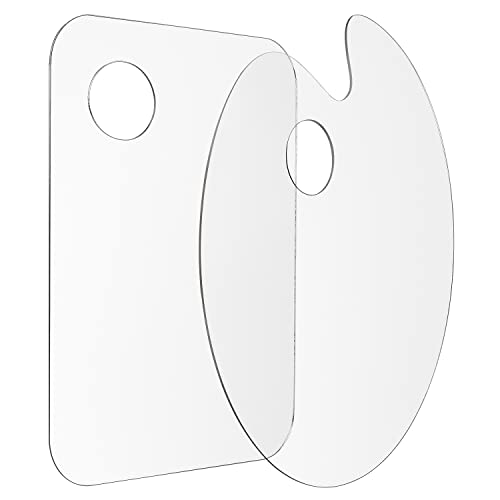
Tamaki’s two 11.8 x 7.9-inch clear acrylic palettes, one rectangular and one oval, each have a thumb hole. After removing the protective film, they are crystal clear with a smooth surface that is easy to clean and reusable.
The clear surface is the mixing advantage: put a sheet of mid-gray card underneath for value judgment, or white paper if you paint on a white ground. They are light enough to hold at the easel, which suits painters who like to stand back and mix close to the canvas.
Best suited for: Painters who want a portable, holdable palette with customizable backing color.
Key features:
- 2 clear acrylic palettes, 11.8 x 7.9 inches
- Rectangular and oval shapes
- Thumb holes
- Smooth, reusable surface
Pros:
- Choose your backing color
- Light enough to hold
- Inexpensive
Cons:
- Smaller mixing area than glass
- Can scratch with metal knives
- Flexes slightly when held
Buying consideration: Use a plastic or nylon palette knife on acrylic palettes to keep the surface smooth.
3. DUGATO 20-Well Plastic Palette 2-Pack — Best Well Palette with Large Mixing Areas

DUGATO’s two 10 x 13-inch white palettes each have 20 wells for holding and separating colors, with a smooth non-stick surface that rinses clean. The plastic is described as non-toxic, lightweight enough to hold and resistant to scratching and breaking, suitable for acrylic, oil, watercolor, gouache and tempera.
Well palettes suit painters who want pure colors kept clean around the edge while mixing in larger wells. Having two means one can be a dedicated limited palette and the other a full palette for complex paintings.
Best suited for: Painters who like organized palettes with separate wells and white mixing areas.
Key features:
- 2 palettes, 10 x 13 inches
- 20 wells each
- Smooth non-stick white plastic
- Lightweight and durable
Pros:
- Organized color layout
- White for high-key mixing
- Two palettes
Cons:
- Mixing areas are divided into wells
- White can make mid values look dark
- Plastic stains with some pigments
Buying consideration: Use the largest wells for mixing and smaller ones for pure tube colors.
4. Sweaty Pony 20-Well Square Palette — Best Single Large Well Palette

This 13 x 10-inch white plastic palette is slightly larger than A4 and has 20 wells: eight squares, four large circles and eight small circles. It weighs about 0.35 pounds, so it can be held in one hand or laid flat, and is described as sturdy, reusable and quick to wash.
The mix of square and round wells is useful: square wells for pure colors, large circles for bigger mixtures, and small circles for glazes and accents.
Best suited for: Painters who want one large, varied well palette at a low price.
Key features:
- 13 x 10 inches
- 20 wells: 8 squares, 4 large and 8 small circles
- About 0.35 lb
- Sturdy white plastic
Pros:
- Varied well sizes
- Light
- Very low price tier
Cons:
- Single palette
- Limited flat mixing space
- White surface
Buying consideration: Pair it with a flat glass or clear palette if you mix large batches with a knife.
5. Mr. Pen Round Palettes 4-Pack — Best Small Palettes for Color Families

Mr. Pen’s four round palettes are 6.7 inches across with 10 wells and a central reservoir, and wells 0.4 inches deep. They are light, smooth and easy to clean.
Small round palettes are handy as satellites to a main mixing palette: keep one for glazing mixtures, one for metallics or one per color family on a complex painting, so main mixtures stay clean.
Best suited for: Glaze mixtures, metallics and separating color families alongside a main palette.
Key features:
- 4 round palettes, 6.7 inches
- 10 wells and a central reservoir
- 0.4-inch well depth
- Smooth plastic
Pros:
- Deep wells for fluid mixtures
- Inexpensive
- Good as satellite palettes
Cons:
- Small mixing area
- Not a main mixing palette
- Light and can slide
Buying consideration: Use deep wells for fluid acrylic glazes, which run on flat palettes.
How to Mix Acrylic Paint Cleanly
- Lay out pure colors around the edge in a consistent order, leaving the center free.
- Mix with a palette knife, not a brush; the knife mixes thoroughly and wastes less paint.
- Start with the lighter color and add darker or stronger colors in small amounts; a little blue changes a lot of yellow.
- Mix enough. Running out and remixing a background color is the most common cause of patchy areas.
- Wipe the knife between mixtures to avoid contaminating the next color.
- Test on a scrap or the edge of the canvas; acrylic dries slightly darker than it looks wet.
- Keep mixtures separate on the palette, in rows from light to dark, so you can find values quickly.
A Practical Mixing Palette Layout
Arranging colors the same way every session makes mixing faster, because your hand learns where each color lives. A common layout runs along the top edge of a flat palette from light to dark and warm to cool, leaving the lower two-thirds open for mixing:
| Position (left to right) | Color | Mixing role |
|---|---|---|
| 1 | Titanium white (large amount) | Lightens and adds opacity to almost every mix |
| 2 | Lemon or cool yellow | Fresh greens, cool lights |
| 3 | Cadmium-type or warm yellow | Warm lights, oranges |
| 4 | Warm red | Oranges, warm darks, skin |
| 5 | Cool red or magenta | Violets, pinks, cool shadows |
| 6 | Ultramarine or warm blue | Shadows, violets, granular grays |
| 7 | Phthalo or cool blue | Intense greens and deep darks |
| 8 | Burnt umber or burnt sienna | Neutralizing, earth tones, warm darks |
Mix value strings beneath your main colors: three to five steps from dark to light of the same hue, laid out in a row. Value strings make it easy to model form, because you simply pick the next step rather than remixing each time. On a gray glass palette, you will see immediately whether each step reads lighter or darker than the background, which is exactly the judgment you need on a toned canvas.
Dealing with Acrylic Drying on the Palette
Acrylic’s fast drying is the main frustration with mixing. Mist the palette lightly with water, mix only what you need for the next section, and cover the palette with plastic wrap during breaks. A slow-drying medium or retarder extends open time for careful mixing. For long sessions, a wet palette keeps mixtures workable for hours; you can use it alongside a glass palette, mixing on glass and storing mixtures on the wet palette.
Buying Guide: How to Choose a Palette for Mixing Acrylic
Prioritize flat mixing space
A knife needs room. Look for at least 11 x 8 inches of flat surface, and more if you mix big batches.
Pick the surface color for your work
Neutral gray for value accuracy, white for high-key work on white canvas, clear for flexibility.
Glass vs plastic vs acrylic
Glass scrapes clean and stays smooth forever but is heavy; plastic and acrylic are light and cheap but scratch over time.
Holding or table use
Thumb-hole palettes suit easel painters who stand; glass palettes stay on the table.
Add satellite palettes
Small well palettes keep glazes, metallics and special mixtures separate.
Plan your cleanup
Razor blades for glass, soaking and peeling for plastic and acrylic.
Palette Care and Related Guides
If paint dries before you finish, our guide on rehydrating dried acrylic on a palette explains what can and cannot be saved. For longer working time, read what a wet palette is and how to use one, and when you are done, follow these steps for cleaning a painting palette.
Common Mistakes to Avoid
- Mixing with a brush and wearing it out while leaving streaks of unmixed color.
- Mixing on a crowded palette until colors bleed into each other.
- Judging mid-tones on a bright white palette and painting them too light.
- Scratching acrylic palettes with metal knives, creating grooves that trap paint.
- Mixing too little background color.
- Leaving dried acrylic on plastic for weeks.
FAQs
What is the best surface for mixing acrylic paint?
Tempered glass is ideal for knife mixing because it is smooth, scratch-resistant and scrapes clean. Clear acrylic and smooth plastic are lighter alternatives.
Should a palette be white or gray?
Gray helps judge value and color for most paintings, especially on toned grounds. White suits high-key work on white canvas.
How do I clean dried acrylic from a glass palette?
Scrape it off with a razor blade scraper at a low angle. Soaking in warm water first can help.
Can I use a glass palette for acrylic?
Yes. Glass works well for acrylic and oil, and dried acrylic scrapes off easily.
Why does my mixed acrylic look different when dry?
Most acrylics dry slightly darker as the binder turns from milky to clear. Test on a scrap before painting large areas.
How do I stop acrylic drying while I mix?
Mix smaller amounts, mist the palette, use a slow-dry medium, or store mixtures on a wet palette.
Final Recommendation
For the best mixing experience, the ELFULLY neutral gray glass palettes give you a large, smooth, scrape-clean surface and accurate color judgment. If you need something lighter or holdable, the Tamaki clear acrylic palettes over gray paper are an excellent low-cost alternative.
Painters who prefer organized wells should choose the DUGATO 20-well 2-pack or the Sweaty Pony 20-well palette, and the Mr. Pen round palettes make useful satellites for glazes and metallics. Whatever you choose, mix with a knife and mix more than you think you need.