Acrylic paint sets for experienced artists should be judged by a different checklist from a first starter box: pigment quality, lightfastness, consistency, how the paint behaves in layers and how much paint you actually get for the price. A painter who already knows how to mix, glaze and build impasto has little use for a 48-colour hobby tray with tiny tubes, and is likelier to want a tight palette of reliable colours in sizes that last. This page is written for that reader, and it explains what to check on a label, then looks at ten sets from that angle.
An honest note: the sets listed below range from professional-style tubes to hobby-grade bottle sets. Where a set is clearly aimed at beginners or crafts, the notes say so. For broader roundups, see the general guides to artist acrylic paint sets and professional acrylic paint sets.
What Experienced Painters Look For in Acrylic Paint Sets
Experience changes priorities. Most of the following points can be checked on the label or product page before you spend money.
Pigment Information and Lightfastness
Professional-range paints usually list pigment names or codes and a lightfastness rating, often following ASTM standards, with I and II being the most lightfast categories. Hobby paints commonly omit this detail. Lightfastness matters when you sell or keep work, because fugitive colours fade over time. If a set does not show ratings, the manufacturer’s website may have them, or you can assume it is not designed with permanence as the main goal.
Consistency: Heavy Body, Soft Body and Fluid
Heavy body paint is thick and holds brush and knife marks, suiting impasto and textured work. Soft body or fluid paint is more liquid, handy for glazing, airbrushing and staining. Many experienced painters carry both, and one set rarely covers every approach. Check the label for the viscosity and think about how you paint.
Pigment Load and Opacity
High pigment load gives strong colour that stays strong when thinned or mixed. Student paints often use more filler or hue mixtures, so colours look weaker and mixes turn dull faster. Transparent, semi-transparent and opaque properties are often shown on the tube; knowing them helps with glazing and covering.
Size and Packaging
Tubes of 20 ml suit small works and colour testing; 59 to 120 ml tubes and larger jars suit regular painting. Bottles with flip caps are convenient but can leak or let paint dry in the nozzle. Bulk pump bottles save money on mixing colours you use constantly.
How Acrylic Paint Sets for Experienced Artists Differ From Hobby Sets
A fixed set is a convenience, not an ideal palette. Experienced painters often assemble their own selection, adding single tubes as needed. A good set still has value as a base or travel palette, especially when it includes a balanced range of primaries, earth colours, white and black, and when the paints are consistent from tube to tube. The guides to artist acrylic paint and professional acrylic paint discuss single-tube buying if you prefer that route.
Building a Working Palette From a Set
- Anchor colours. Titanium white, a mars or carbon black, and a few earth tones such as burnt sienna and raw umber.
- Primaries in warm and cool pairs. For example a warm and cool red, yellow and blue, so you can mix a wide range.
- Transparent options. A few transparent colours for glazing, such as a quinacridone or phthalo, used sparingly.
- Convenience colours. A green or violet you use a lot can save mixing time.
If a set covers most of that list, you can add a couple of tubes and be well equipped. If it is mostly bright craft colours, you will need to supplement.
How to Read the Ten Listings
The comments below are drawn from the listing descriptions and general professional criteria, not hands-on testing. Pigment details, lightfastness and quantities should be confirmed on the manufacturer’s page. For a different slant, the overview of the acrylic paint sets page compares more options across levels.
Grumbacher Academy Professional Acrylic Paint Set Of 24 90ml Multi Colors

A 24-colour set of 90 ml metal tubes, described in the listing as heavy body with ASTM lightfast colours. On paper, this is the most professional-leaning set here for volume. Metal tubes can dent, and you may need to thin the paint for fluid techniques.
To buy this product, click here.
Winsor & Newton Artists’ Acrylic Color 12-tube Set

A 12-tube set of 20 ml artists’ acrylic from a well-known fine-art maker. It suits colour tests, travel and small works, and the artists’ range name points to a professional product. With only 12 colours, you will likely add tubes for mixing.
To buy this product, click here.
Artkey Acrylic Paint Set
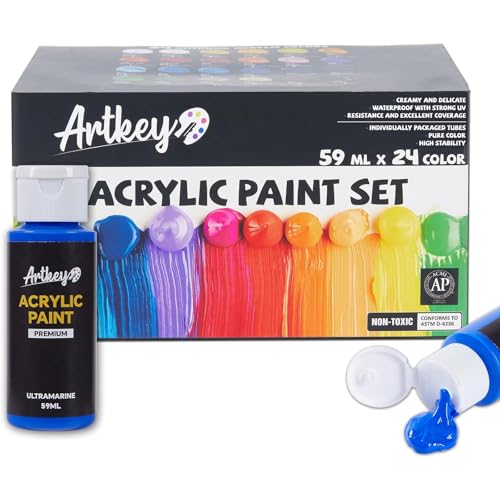
A 24-colour set in 2 oz bottles, described as professional grade by the listing. Bottles are convenient for pouring and fluid work. Check pigment information, as bottle sets vary widely in how they list it.
To buy this product, click here.
Meeden Artist Acrylic Paint Set

Nine 60 ml heavy-body tubes. A compact palette for artists who prefer to mix their own colours. The limited range may suit a disciplined palette, though you might want an extra white.
To buy this product, click here.
Acrylic Paint Set Of 36 Colors

A 36-colour bottle set with 2 fl oz bottles, marketed to kids and adults. This leans toward hobby use. It is useful for craft and experimentation, but an experienced painter focused on permanence should check pigment details.
To buy this product, click here.
Shuttle Art 18 Colors Acrylic Paint Bottle Set
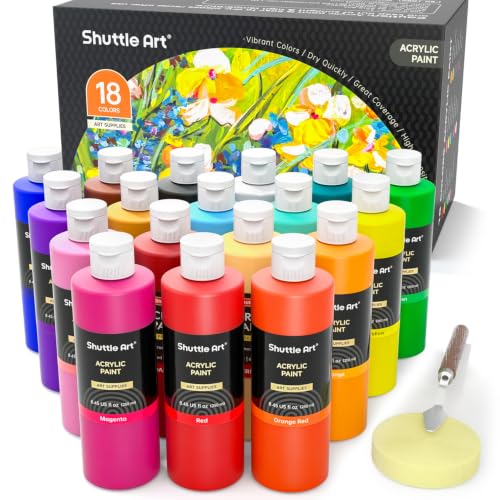
An 18-colour set in large 250 ml bottles. The bottle size gives a lot of paint per colour, which suits large canvases and underpainting. It is a bulk-style set; consider the weight and storage.
To buy this product, click here.
Shuttle Art Acrylic Paint Set

A 36-colour set with brushes and a palette. A hobby and craft set that can serve as a backup or for studies, though it is not a professional palette.
To buy this product, click here.
Unuast Acrylic Paint Sets For Adults

A 14-colour bulk set of 300 ml pump bottles with a colour wheel. The pump is handy for dispensing large quantities, and the volume suits murals, grounds and underpaintings. Check for clogging and clean the nozzles.
To buy this product, click here.
Mont Marte Acrylic Paint Set 24 Colours 36ml

A 24-colour, 36 ml tube set for use on many surfaces. Aimed at general artists and craft, with a mid-sized tube. The listing notes that not all colours may be lightfast, which matters for work you plan to keep.
To buy this product, click here.
Caliart 24 Colors Acrylic Paint Set

A 24-colour set with 12 brushes aimed at beginners and kids. Useful as a studies kit or for craft, but not designed for professional use.
To buy this product, click here.
Reading Labels Like a Professional
A tube or bottle usually carries more information than people notice. Look for the colour name, the pigment index code, an opacity symbol, the lightfastness rating, the series or price grade and the viscosity. A name containing the word hue often means the colour is imitated with a cheaper pigment mix rather than a single pigment, which affects mixing and permanence. Single-pigment colours tend to mix cleaner. If a product lists only colour names and no technical details, treat it as a hobby paint and plan accordingly.
Cost Per Millilitre and Value for Working Artists
Price alone misleads. A set with 24 small tubes may cost less than a set of nine large tubes, but cost per millilitre and pigment quality tell the real story. Divide the price by total volume, then consider how much of each colour you will actually use. White usually runs out first, so a set that includes a large white, or lets you buy one separately, is more practical. For a premium paint, a smaller set of reliable colours often outperforms a larger set of weaker ones.
Mediums, Varnish and Surface Pairings
Professional work does not stop at the tube. Gloss, matte and satin mediums change sheen and flow; retarders slow drying for blending; gel mediums add body and transparency. Varnish, applied after the painting has dried, unifies sheen and protects the surface. Pair paint with surfaces made for acrylic: primed linen, cotton canvas, panels or heavy paper. For more on pairing, the explanation of why an acrylic paint set is essential in a studio and the comparison of acrylic paint bottle set options may help.
Suggested Set Strategies by Painting Style
- Impasto and textured work: heavy-body tubes in a limited palette, plus a gel or paste for body.
- Glazing and realism: a transparent-leaning palette with fluid or soft-body paint and a glazing medium.
- Large abstracts and murals: bulk bottles or pumps for primaries, white and a dark, then smaller tubes for accents.
- Plein air and travel: small tubes of a reduced palette, a stay-wet palette and a couple of brushes.
Testing a New Set Before Committing
Whenever possible, try a single tube or sample before buying an entire set. Make swatches on gessoed paper in three ways: straight from the tube, thinned with a little water and mixed with white. Compare how each colour dries, since acrylics often shift darker. Let swatches cure, then expose one half to a sunny window for a few weeks if you want a rough sense of fading, remembering that this is informal. Keep notes with the date and paint names, and store them in a binder you can consult when you need to match colours later.
A Studio Workflow That Uses Different Paints Well
Experienced painters often use different grades of paint at different stages. A large bottle or pump of inexpensive colour can cover the ground and underpainting, where the material is mostly hidden. Heavier, high-pigment tubes then carry the visible layers, and transparent colours finish with glazes. This staged approach keeps the cost down without compromising the surface that people see. It also lets you reserve your most expensive colours for the passages that matter. Keep a note of which paint went into which layer, because colours with different binders or sheens can affect adhesion and varnish later on.
Keeping Paint in Good Condition
- Wipe tube threads and caps clean before closing; dried paint in the cap makes opening difficult and can let air in.
- Store tubes and bottles upright or on their side as the manufacturer suggests, away from freezing temperatures and strong heat.
- Use a stay-wet palette or a damp sponge-and-paper system to keep mixed paint workable for longer sessions.
- Decant fluid paint into smaller bottles with droppers for easier dispensing and reduced waste.
- Label mixed batches with a note of the colours used if you plan to repeat them.
Mixing Strategies With a Limited Set
Many experienced painters work from a limited palette because it produces harmony and teaches control. With a warm and cool version of each primary, plus white, you can mix greens, oranges and violets that are consistent across a painting. Add one earth colour for neutrals and a dark for value. Mixing neutrals from complements, rather than reaching for black, usually keeps shadows more alive. Write down your preferred recipes and keep a swatch chart, so large pieces stay consistent across sessions.
Common Mistakes When Upgrading to Professional Acrylics
- Buying everything at once. A smaller starter set plus a few single tubes is cheaper and teaches you what you actually use.
- Ignoring viscosity. Heavy body paint behaves differently from fluid paint, and brush choice and technique change with it.
- Skipping surface prep. Premium paint on a poorly primed surface still gives poor results.
- Judging colour while wet. Acrylics usually dry slightly darker, so test and allow for the shift.
- Overlooking varnish and isolation coats. Finishing steps protect the painting and make future cleaning possible.
Where Hobby Sets Still Make Sense
Experienced artists often keep a cheap set for underpainting, mural bases, texture experiments, workshops or teaching. A large 36-colour hobby set can also be a colour reference when you are learning a new subject. The key is to keep them separate from finished work if permanence matters. The guide to an acrylic paint set of 36 colors compares sets at that level.
Frequently Asked Questions
What should experienced artists look for in an acrylic set?
Look for pigment information, lightfastness ratings, consistent heavy-body or fluid viscosity and tube sizes that match how much you paint.
Is a bigger set always better?
No. A smaller set with high pigment load and good lightfastness is often more useful than a large hobby set, because you can mix your own colours.
Do I need heavy body or fluid acrylic?
It depends on your technique. Heavy body suits impasto and texture; fluid suits glazing and large washes. Many painters use both.
Are craft acrylics suitable for gallery work?
They can be used for studies, but check lightfastness and pigment quality for work you intend to sell or keep long term.
How do I test paint quality before buying a full set?
Buy a single tube or sample, make swatches straight from the tube and mixed with white, and compare how they dry and mix.
Choosing Acrylic Paint Sets for Experienced Artists
For acrylic paint sets for experienced artists, pigment information, consistency and volume matter more than the number of colours. Choose a set that covers a balanced palette, supplement it with single tubes where needed, and keep hobby-grade sets for studies and craft. Check each listing for current specifications before you buy, and when in doubt, buy one tube or sample first, test it against your usual materials and let the results guide the larger purchase.