

PaintingProGuide is reader-supported. When you buy through links on this page we may earn an affiliate commission at no extra cost to you.
The best acrylic paint depends less on the logo on the tube and more on three things: the grade (craft, student or artist), the body (heavy, soft, fluid or ink) and how much paint you actually need. A thick artist-grade tube is wasted on a kids craft table, and a thin craft paint will frustrate an oil painter switching to acrylic. Once you match grade and body to your work, choosing a brand becomes much easier.
This guide explains acrylic paint grades, bodies and quality signals, then reviews six acrylic paints and markers on Amazon for beginners, crafters, large-format painters and detail work. We also link our in-depth brand reviews of Daler-Rowney, Blick, Chroma and Atelier acrylics for painters ready to step up to artist lines.
Quick answer: For most beginners and hobby painters, the Caliart 36-color set in 2 oz bottles offers the best balance of color range, volume and price. The Shuttle Art 36-color set is a close alternative with a palette included. For big canvases, murals or pouring, the Nicpro 14-color 500 ml bottles give the most paint per dollar. For crafts and decor, Apple Barrel’s 16-color matte set is the classic choice.
Acrylic Paint Grades Explained
| Grade | Typical use | Pigment | Pros | Cons |
|---|---|---|---|---|
| Craft | Decor, kids, wood, crafts | Lowest; more filler | Cheap, many colors, matte finishes | Less coverage, weaker mixing |
| Student | Learning, practice, studies | Moderate; some hue colors | Good value, decent mixing | Not as intense or lightfast as artist grade |
| Artist (professional) | Finished and archival work | Highest; more single pigments | Strong color, lightfastness info, clean mixes | Highest cost |
Acrylic Paint Bodies: Which Consistency Do You Need?
- Heavy body: thick, holds brush and knife marks. Ideal for impasto and expressive work.
- Soft body: creamy, levels slightly. A versatile all-rounder for blending and general painting.
- Fluid: pourable, smooth. Great for glazing, detail, staining and pouring.
- High flow and acrylic ink: water-thin. For pens, airbrushing, washes and calligraphy.
- Open or slow-drying acrylic: stays workable longer, closer to oil handling.
- Acrylic gouache: opaque and matte, popular with illustrators.
- Acrylic paint markers: ink-like acrylic in a pen, for lines, lettering and crafts.
Quality Signals to Look For
Pigment information
Artist paints usually list pigment codes, such as PB29 for ultramarine. Single-pigment colors mix more cleanly. Student and craft paints often use hue mixtures, which is fine for learning.
Lightfastness
Lightfastness describes how well a color resists fading. Many artist paints print a lightfastness rating on the label, often based on ASTM standards. If you sell or gift paintings, this matters.
Coverage and opacity
Good paint covers in one or two coats. Thin craft paints may need several.
Color shift
Acrylic often dries slightly darker. Higher-quality binders tend to shift less, but test swatches with any brand.
Finish
Matte, satin or gloss. Craft paints are often matte; many student and artist lines are satin or gloss. Varnish can unify sheen later.
Safety labeling
Look for ASTM D-4236 conformance on any paint, especially for kids or classrooms.
Recommended Setups by Type of Painter
The absolute beginner
A 24 to 36-color student set in 2 oz bottles, plus an extra white. You get enough paint to practice daily and enough colors to see how each behaves, without the cost of artist tubes.
The crafter and decorator
Matte craft paint in bottles for wood, signs, terra cotta and seasonal decor, plus a set of acrylic markers for lettering. Seal anything that will be handled or placed outdoors.
The canvas painter stepping up
Keep a student set for underpainting and practice, and replace your most-used colors (white, a blue, a yellow, a red, a brown) with artist-grade tubes one at a time. This hybrid approach gives most of the benefit at a fraction of the cost.
The large-format or pour painter
Bulk bottles of a core palette and a pouring medium. Volume matters more than color count, because you can mix secondary colors yourself.
The illustrator
Fluid acrylics or acrylic gouache for flat, even color, acrylic inks for washes and line work, and fine-tip markers for details.
How Much Paint Do You Really Need?
Painters consistently underestimate white and overestimate everything else. In a typical palette, white can account for a large share of total paint used, because almost every tint and many mixes include it. Blues and earth colors come next. Bright accent colors such as magenta or turquoise last a very long time. Plan purchases accordingly: large white, medium tubes of core colors, small amounts of accents.
Our Top Picks at a Glance
- Caliart Acrylic Paint Set, 36 Colors, 2 oz — Best overall for beginners and hobby painters
- Shuttle Art Acrylic Paint, 36 Colors with Palette — Best alternative 36-color set
- Nicpro 14 Colors Bulk Acrylic Paint, 500 ml — Best for large canvases and pouring
- Apple Barrel Vibrant Spectrum 16 Color Set — Best for crafts and decor
- M&G 36 Colors Acrylic Paint Markers — Best acrylic markers for detail and crafts
- Apple Barrel Acrylic Paint, White, 2 oz — Best cheap white for base coats
| Product | Best For | Key Spec | Key Strength | Price Tier |
|---|---|---|---|---|
| Caliart 36 Colors | Beginners, hobby | 36 x 2 oz, 12 brushes, metallics | Range plus volume | $$ |
| Shuttle Art 36 Colors | Beginners, crafts | 36 x 2 oz, 12 brushes, palette | Palette included | $$ |
| Nicpro 14 Colors 500 ml | Large work | 14 x 16.9 oz bottles | Most paint per bottle | $$$ |
| Apple Barrel 16 Colors | Crafts, decor | 16 x 2 oz, matte | Made in USA, matte finish | $$ |
| M&G 36 Acrylic Markers | Detail, lettering | 36 bullet-tip markers, stackable case | Organized storage | $$ |
| Apple Barrel White | Base coats | 2 oz, matte | Lowest cost | $ |
How We Chose
We compared Amazon listings checked in October 2026 on grade and intended use, number of colors, volume per color, finish, safety statements such as ASTM D-4236, and how widely each product is reviewed by Amazon buyers. We focused on paints most readers will start with, and we link our separate reviews of artist-grade brands below.
- Color range and inclusion of white and black.
- Volume per color.
- Finish and stated surfaces.
- Value for the intended painter.
Best Acrylic Paint Reviewed
1. Caliart Acrylic Paint Set of 36 Colors with 12 Brushes — Best for beginners and hobby painters

Caliart’s set includes 36 colors in 2 oz bottles, with metallic gold and silver, and 12 brushes. The listing describes creamy, highly pigmented paint with good covering power, quick drying, water and fade resistance, ASTM D4236 conformance and acid-free formulation.
Two-ounce bottles in 36 colors is a generous combination for the price tier, and it covers canvas, wood, rock and craft surfaces.
Best suited for: Beginners, hobby painters, rock painters and crafters.
Key features:
- 36 x 2 oz bottles
- Matte and metallic colors
- 12 brushes
- ASTM D4236, acid-free
Pros:
- Strong value
- Wide color range
- Good volume per color
Cons and limitations:
- Not artist grade
- Brushes are basic
Buying consideration: Buy an extra white; it is the first bottle to run out.
2. Shuttle Art Acrylic Paint, 36 Colors with Brushes and Palette — Best for an alternative 36-color set

Shuttle Art’s set includes 36 colors in 2 oz bottles, with gold and silver, 12 brushes and a palette. The listing describes creamy paint that blends and layers easily with good coverage, fast drying, waterproof and fade-resistant results, and ASTM D-4236 conformance.
It is very similar in scope to the Caliart set, with the addition of a palette.
Best suited for: Beginners who want a palette included.
Key features:
- 36 x 2 oz
- 12 brushes and palette
- Gloss finish listed
- ASTM D-4236
Pros:
- Complete starter bundle
- Many surfaces
- Mid price tier
Cons and limitations:
- Gloss finish may not suit everyone
- Student-level pigment
Buying consideration: Choose between this and Caliart by finish preference and current price.
3. Nicpro 14 Colors Large Bulk Acrylic Paint, 500 ml — Best for large canvases and pouring

Nicpro supplies 14 essential colors, including white, Mars black, red, yellow, blue, green and burnt umber, in 16.9 oz squeeze bottles. The listing describes creamy consistency, fast drying, fade resistance and certified non-toxic ingredients, for canvas, rock, wood, glass and more.
Large bottles suit murals, big canvases, pouring and classrooms, where small bottles disappear in a session.
Best suited for: Large-format painters, pourers and teachers.
Key features:
- 14 x 500 ml bottles
- Core palette with white and black
- Gloss finish listed
Pros:
- Huge volume
- Low cost per ounce
- Easy-squeeze bottles
Cons and limitations:
- Highest upfront cost
- Fewer colors; mix the rest
Buying consideration: Pair with a pouring medium for fluid art or use straight for large canvases.
4. Apple Barrel Vibrant Spectrum Collection, 16 Colors — Best for crafts and decor
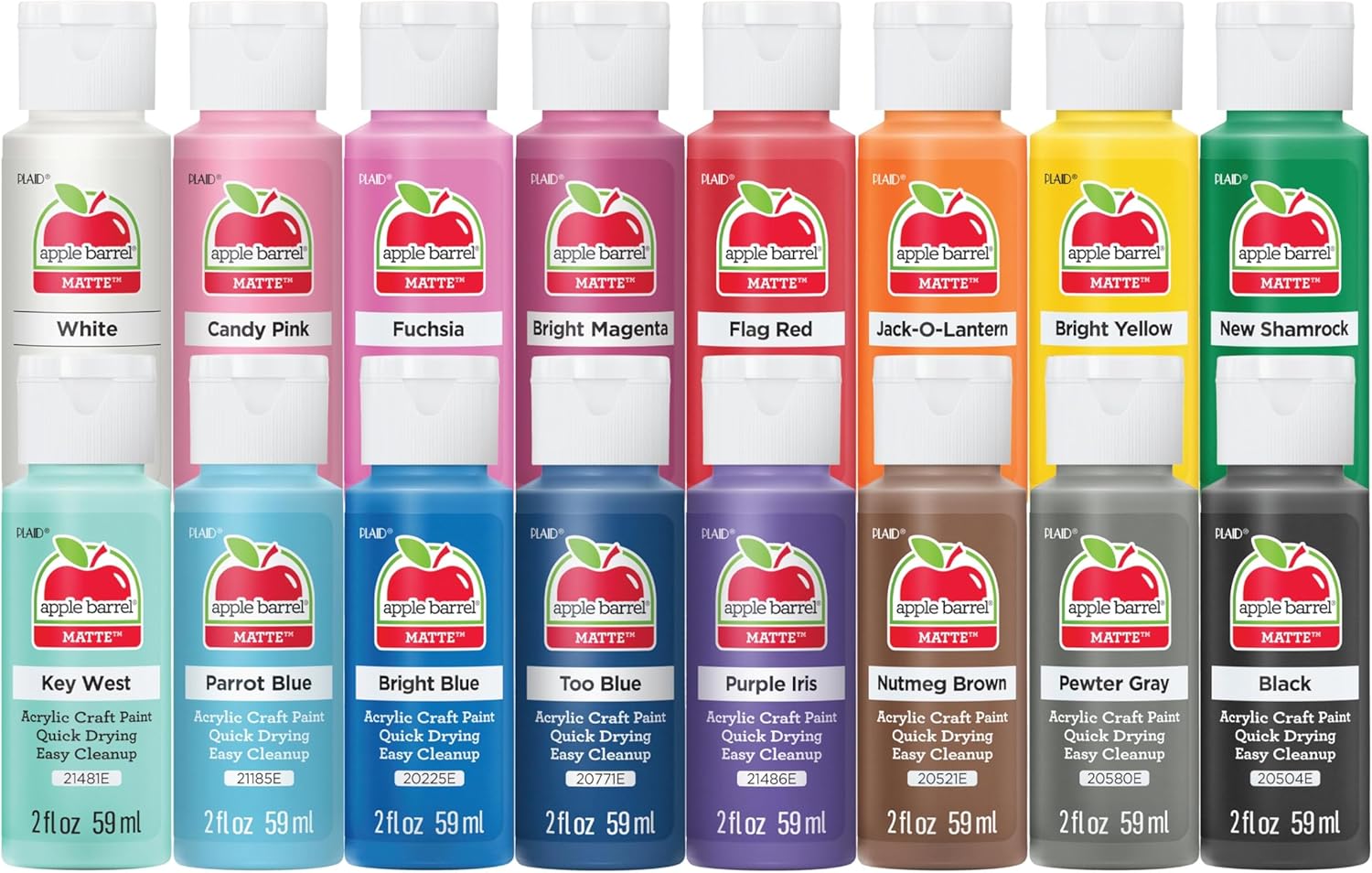
Apple Barrel’s set includes 16 bottles of 2 oz craft paint in colors including white, black, red, blue and pink, all drying to a matte finish. The listing lists wood, Styrofoam, plaster and terra cotta among surfaces, and notes the paint can be brushed, stamped, stenciled or sponged. It is made in the USA.
Craft paint is ideal for decor projects, signs and kids crafts, where matte finish and low cost matter more than pigment strength.
Best suited for: Crafters, decorators, teachers and families.
Key features:
- 16 x 2 oz bottles
- Matte finish
- Brush, stamp, stencil or sponge
- Made in USA
Pros:
- Classic craft brand
- Matte finish looks good on decor
- Mid price tier
Cons and limitations:
- Lower pigment than student paint
- Not ideal for fine art blending
Buying consideration: Seal outdoor craft projects with a clear sealer.
5. M&G 36 Colors Acrylic Paint Markers — Best for detail and craft work

M&G’s set includes 36 acrylic paint markers with bullet tips and triangular barrels in a stackable storage case with locking clips. The listing lists rock, wood, canvas, glass, ceramic and paper among surfaces.
Markers are the easiest way to add lines, lettering and fine detail over painted acrylic or directly on craft surfaces.
Best suited for: Rock painters, crafters, journalers and kids projects.
Key features:
- 36 colors
- Bullet tips
- Triangular non-roll barrels
- Stackable case
Pros:
- Organized storage
- Comfortable grip
- Mid price tier
Cons and limitations:
- Bullet tip less precise than extra-fine tips
- Not for blending large areas
Buying consideration: Let painted base coats dry fully before drawing over them.
6. Apple Barrel Acrylic Paint, White, 2 oz — Best for a cheap white for base coats

Apple Barrel’s 2 oz white dries to a matte finish and cleans up with soap and water while wet. The listing describes use on wood, paper, canvas, Styrofoam and paper mache. It was the least expensive paint in our listing check.
Keeping a cheap white for base coats and priming practice surfaces saves your better paint for the painting itself.
Best suited for: Anyone who goes through white quickly.
Key features:
- 2 oz bottle
- Matte finish
- Soap-and-water cleanup
Pros:
- Very low cost
- Good for base coats
- Widely available
Cons and limitations:
- Craft-grade coverage
- Small bottle
Buying consideration: Use it for underlayers and practice; use a stronger white for highlights.
Ready for Artist-Grade? Our Acrylic Brand Reviews
When you outgrow sets, individual artist-grade tubes give stronger color and better lightfastness information. Our detailed reviews cover several established lines:
- Daler-Rowney: our Daler-Rowney acrylic paint review, Daler-Rowney fluid acrylic review, Daler-Rowney acrylic ink review and Daler-Rowney acrylic gouache review.
- Blick: our Blick acrylic paint review, Blick Studio acrylic review, Blick fluid acrylic review, Blick acrylic ink review and Blick acrylic gouache review.
- Chroma and Atelier: our Chroma acrylic paint review, Atelier acrylic paint review and Atelier Open slow-drying acrylic review.
Buying Guide: How to Choose Acrylic Paint
Pick the grade for the job
Craft for decor and kids, student for learning and practice, artist for finished and archival work.
Pick the body for your style
Heavy body for texture, soft body for general painting, fluid for glazing and detail, inks and markers for line work.
Buy enough paint
Two-ounce bottles or larger tubes are better value than tiny tubes. Buy white bigger than everything else.
Check finish
Matte for crafts and illustration, satin or gloss for richer color; varnish can adjust later.
Look for pigment and lightfastness info
Important for artist-grade purchases and work you plan to sell.
Confirm safety labeling
ASTM D-4236 conformance is the baseline, especially for children.
Using Your Paints
Whatever you buy, swatch every color on a strip of paper or canvas before your first painting. Label each swatch with its name, let it dry, and note whether it looks opaque or transparent and how much it darkened. This ten-minute exercise tells you more about a set than any product description, and it becomes a reference card you will use for years. Store bottles upright with caps tightly closed, and wipe the threads so they do not glue shut.
Once you have your paint, try our simple acrylic painting ideas for beginners or our guide to DIY wall art with acrylic. If you paint on glass or ceramics, read our guide to using acrylic paint on glass jars first.
Common Mistakes to Avoid
- Buying artist grade for crafts. Craft paint is designed for those surfaces and costs far less.
- Buying craft paint for fine art. Weak pigment makes mixing frustrating.
- Too many colors, too little white. Prioritize volume of core colors.
- Thinning with lots of water. Use mediums for big glazes.
- Mixing finishes without varnish. Matte and gloss side by side look patchy.
- Ignoring the color shift. Swatch and let it dry before matching.
FAQs
What is the best acrylic paint for beginners?
A student-level set with good volume per color, such as a 36-color set in 2 oz bottles, gives beginners plenty of paint to practice with at a reasonable price.
What is the difference between craft and artist acrylic paint?
Craft paint has less pigment and more filler and is designed for decor surfaces. Artist paint has more pigment, better lightfastness information and mixes more cleanly.
Is heavy body or soft body acrylic better?
Neither is better overall. Heavy body suits texture and impasto; soft body suits smooth blending and general painting.
Which acrylic paint is best for canvas?
Student or artist acrylic paints are best for canvas. Craft paint works but needs more coats and mixes less well.
Does acrylic paint need to be sealed?
Finished paintings benefit from varnish for protection and even sheen. Craft projects that will be handled or placed outdoors should be sealed.
Are acrylic paint markers real acrylic?
Yes, most contain water-based acrylic paint in a marker format, which makes them useful for detail, lettering and crafts.
Final Recommendation
For most beginners and hobby painters, the Caliart 36-color set is the best starting point, with Shuttle Art a close alternative if you want a palette included. Choose the Nicpro 500 ml bottles for large canvases, murals and pouring, the Apple Barrel 16-color set for crafts and decor, and M&G markers for lettering and detail. Keep a cheap Apple Barrel white for base coats, and when you are ready for artist-grade color, use our Daler-Rowney, Blick, Chroma and Atelier reviews to choose individual tubes.





11 Comments