
PaintingProGuide is reader-supported. When you buy through links on this page we may earn an affiliate commission at no extra cost to you.
Blick fluid acrylic paint is the pourable, low-viscosity acrylic sold under the house label of Blick Art Materials, the large US art supply retailer. Painters usually search for it because they want fluid acrylic for glazing, staining, fine line work or pouring without paying top-tier prices. The catch for Amazon shoppers is simple: Blick’s house-brand paints are sold mainly through Blick’s own stores and website, and none appeared in the Amazon listings we checked in October 2026.
So this page does two jobs. It explains what to check on any fluid acrylic, Blick included, before you buy, and it reviews the fluid and soft-body acrylics on Amazon that do the same work, from a professional mixing set to pour-ready craft paint.
Quick answer: If you cannot get Blick fluid acrylics or want a comparable option on Amazon, the GOLDEN Fluid Acrylics Mixing Set is the strongest pick for serious glazing and color mixing. For a lower-cost, larger-volume fluid paint, look at Liquitex BASICS Acrylic Fluid in 118ml bottles. For pouring specifically, DecoArt Fluid Art Ready-to-Pour paint needs no additives.
Our Top Picks at a Glance
- GOLDEN Fluid Acrylics Mixing Set (10 x 30ml) — Best for professional glazing and limited-palette mixing
- Liquitex BASICS Acrylic Fluid (118ml bottles) — Best for large-area fluid work on a student budget
- Liquitex Soft Body Acrylic Essentials Set (12 x 22ml) — Best for painters who want fluid-leaning paint that still holds a brushstroke
- MEEDEN Soft Body Acrylic Set (24 x 60ml) — Best for color variety at a low cost per color
- DecoArt Fluid Art Ready-to-Pour Set — Best for acrylic pouring without mixing
- MONT MARTE Premium Acrylic Flow Medium (250ml) — Best for turning paint you already own into fluid acrylic
| Product | Best For | Key Spec | Key Strength | Price Tier |
|---|---|---|---|---|
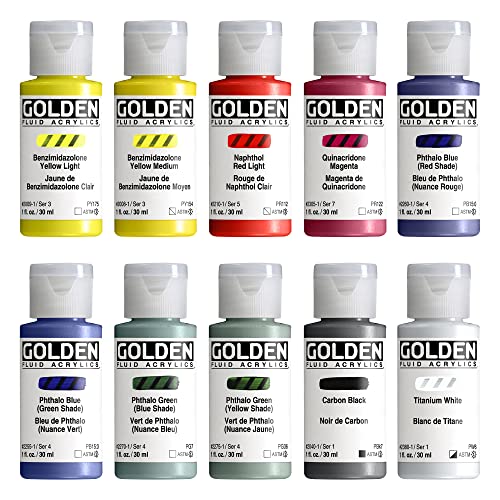
| GOLDEN Fluid Mixing Set | Glazing, mixing | 10 x 30ml; warm and cool primaries | Professional fluid with strong tinting | $$$ |
| Liquitex BASICS Fluid | Large-area fluid work | 118ml (4 oz) squeeze bottles | Use straight from bottle, satin sheen | $$$ |
| Liquitex Soft Body Essentials | Brushwork with flow | 12 x 22ml; low viscosity | Retains subtle brushstrokes | $$$ |
| MEEDEN Soft Body Set | Color variety | 24 x 60ml; matte | Many colors in large bottles | $$ |
| DecoArt Fluid Art Pour Set | Pouring | 6 x 4 oz; semi-gloss | No additives needed | $$ |
| MONT MARTE Flow Medium | Making paint fluid | 250ml; gloss | Thins without losing intensity | $ |
How We Chose
We have not painted with these products. The picks are based on the Amazon listing details and specifications checked in October 2026, how well each paint’s viscosity, pigment description and format fit the uses people buy fluid acrylic for, and how widely each product is reviewed by Amazon buyers. We did not include Blick products because none were available in the listings we checked, and we will not describe a paint’s performance without a listing to base it on.
Our criteria:
- Viscosity: true fluid, soft body, or pour-ready, and whether it can be used straight from the bottle.
- Pigment information: named pigments and claims about pigment load or tinting strength.
- Finish: matte, satin or gloss, which affects glazing and varnishing.
- Volume and format: bottle size, number of colors and how practical the container is.
- Intended use: fine art glazing and detail versus craft and pouring.
Blick Fluid Acrylic Paint Review: What to Check Before You Buy
Buying Blick’s own fluid acrylics from Blick and buying an alternative on Amazon come down to the same thing: a handful of label details tell you most of what you need to know.
- Pigment codes: artist-grade acrylics usually list the Colour Index pigment code, such as PB15 for phthalo blue. Single-pigment colors mix cleaner than blends.
- Lightfastness rating: look for a stated rating. Paints without one are fine for practice but riskier for work you plan to sell or keep.
- Grade: “student” or “studio” lines use less pigment or lower-cost pigments than “artist” or “professional” lines.
- Consistency: fluid acrylic should flow like heavy cream and level out; soft body is thicker and holds a soft stroke.
- Finish: satin and gloss fluids give glazes more depth; matte paints can look chalky when layered thinly.
If a Blick fluid acrylic you are considering checks those boxes at a lower price than a premium brand, it can be a good value. If you are buying through Amazon, the products below are the closest matches we found.
Best Fluid Acrylic Alternatives Reviewed
1. GOLDEN Fluid Acrylics Mixing Set — Best for Professional Glazing and Mixing

This is the benchmark professional fluid acrylic set in our product data. The ten 30ml colors are built as a mixing palette: a warm and cool version of each primary plus key extras. The listing names Benzimidazolone Yellow Light and Medium, Naphthol Red Light, Quinacridone Magenta, Phthalo Blue in red and green shades, Phthalo Green in blue and yellow shades, Carbon Black and Titanium White.
GOLDEN says the fluids keep color intensity, tinting strength, film integrity and adhesion while flowing smoothly, and that they blend with all acrylic colors and tint gels, mediums, gessoes and grounds. Listed uses include fine brushwork, glazing, staining and water-media techniques. The details describe them as creamy, leveling paints with a high pigment load.
Best suited for: painters who glaze, stain raw canvas or mix a full range from a limited palette.
Key features:
- 10 x 30ml bottles with named single pigments
- Warm and cool primaries for wide mixing range
- Mixes with all acrylic colors and tints gels and grounds
- Made in the USA by an employee-owned company
Pros:
- Pigment names are clearly stated
- Strong tinting colors stretch a long way in glazes
- Phthalo and quinacridone colors are excellent for transparent layering
Cons and limitations:
- Small 30ml bottles go quickly in pours or large backgrounds
- Highest price tier on this page
- Phthalos are very strong and can overwhelm mixes for beginners
Buying consideration: buy this for quality and mixing control, not for volume.
2. Liquitex BASICS Acrylic Fluid — Best for Large-Area Fluid Work on a Budget

Liquitex BASICS Fluid is designed to be used straight from the bottle with no diluting. The listing describes it as ultra smooth, very blendable and filled with fine art pigments, with a satin sheen. Suggested uses cover pouring, large-area coverage, fine detail and splattering. The squeezable bottle has a flip-top cap for one-handed use and a screw-off top with a wide neck.
The listing is inconsistent about contents: the title says a 6 x 118ml set, while a detail line says 12 x 118ml and the finish field says matte despite the satin sheen bullet. Confirm the count and colors on the product page before buying.
Best suited for: students and painters covering large canvases, murals or pours who want fluid paint in quantity.
Key features:
- 118ml (4 oz) squeeze bottles
- Fluid viscosity, ready to use without diluting
- Satin sheen per the bullets
Pros:
- Much more paint per bottle than professional fluid sets
- Practical bottle design for pouring and splatter
Cons and limitations:
- Student-grade line, so less pigment strength than professional fluids
- Listing conflicts on set count and finish
Buying consideration: good for coverage and experimentation; switch to a professional fluid for final glazes.
3. Liquitex Soft Body Acrylic Essentials Set — Best for Brushwork With Flow

Soft body acrylic sits between heavy body and fluid. Liquitex lists this set as low viscosity, highly pigmented, with a satin finish, great coverage and the ability to retain subtle brushstrokes. That last point is the difference from a true fluid: soft body still shows a soft mark, while fluids level out more.
Best suited for: painters who want fluid-leaning paint for smooth blending and detail but still want some brush character.
- 12 x 22ml colors
- Low viscosity, highly pigmented, satin finish
- Retains subtle brushstrokes
Pros:
- Professional Liquitex line rather than student grade
- Versatile: thin with water or medium for glazes
Cons and limitations:
- Small 22ml tubes
- Not as free-flowing as a dedicated fluid for staining or pouring
Buying consideration: a good single set if you want one paint that works for both brushwork and thinned glazes.
4. MEEDEN Soft Body Acrylic Set — Best for Color Variety at a Low Cost per Color

MEEDEN offers 24 colors in 60ml (2 oz) bottles with a matte finish. The listing describes a smooth, honey-like consistency usable straight from the bottle, high pigmentation, and moderate fluidity that allows long detailed lines without dipping in water. It is described as non-toxic (ASTM D4236), drying in 5 to 10 minutes to a permanent, waterproof finish.
Best suited for: hobby painters, crafters and beginners who want many ready-mixed colors.
- 24 colors x 60ml bottles
- Soft body, matte finish
- Listed for canvas, wood, metal and other surfaces
Pros:
- Large bottles and many colors for the cost
- Consistency suited to line work and detail
Cons and limitations:
- No pigment codes or lightfastness ratings in the listing
- Matte finish can look flat in thin glazes
Buying consideration: great for practice and crafts; use an artist-grade fluid for work you want to last.
5. DecoArt Fluid Art Ready-to-Pour Set — Best for Acrylic Pouring

This set is made for one job: pouring. DecoArt says the paints have the ideal consistency for flowing across canvas and wood with no additives needed. The Galactic set includes Sky Blue, Blue Violet, White, True Blue, Lavender and Jet Black in 4 fl oz bottles, with a semi-gloss sheen. DecoArt says the paints are made in the USA.
Best suited for: beginners trying fluid art who do not want to mix paint and pouring medium.
- 6 x 4 fl oz bottles
- Pre-mixed pouring consistency
- Semi-gloss finish
Pros:
- No measuring or mixing required
- Coordinated color palette designed to pour together
Cons and limitations:
- Pre-thinned for pouring, so less useful for brushwork or glazing
- Fixed palette of six colors
Buying consideration: ideal for a first pour; for regular pouring, a medium plus your own paints is more flexible.
6. MONT MARTE Premium Acrylic Flow Medium — Best for Making Your Own Fluid Acrylic

If you already own heavy or soft body acrylics, a flow medium can turn them into fluid paint. Mont Marte says this medium thins acrylic paints and mediums, increases translucency without affecting color intensity and vibrancy, and enhances flow. It is marketed for fluid art and has a gloss finish.
Best suited for: painters who want fluid consistency from paint they already have, for pouring or glazing.
- 250ml bottle
- Thins paint and increases translucency
- Gloss finish
Pros:
- Lowest-cost way to get fluid paint
- Keeps paint film intact better than thinning with lots of water
Cons and limitations:
- Thinning reduces color strength per layer
- Gloss finish may not suit matte work
Buying consideration: a smart add-on to any set on this page.
Buying Guide: How to Choose Fluid Acrylic Paint
Fluid, soft body or pour-ready
Fluid acrylics flow and level, ideal for glazing, staining and fine lines. Soft body acrylics are thicker and hold a soft stroke. Pour-ready paints are pre-thinned for pouring and are less useful for brushwork. Decide which job you need before comparing brands.
Pigment load and grade
Professional fluids aim to keep pigment strength while lowering viscosity. Student and craft paints often contain less pigment, so they cover less in thin layers. Look for named pigments and words like “tinting strength” or “high pigment load.”
Finish
Satin and gloss fluids give transparent glazes depth. Matte paints are easier to photograph and scan, but thin matte layers can look dull. A final varnish can even out the sheen.
Bottle size and format
Small 30ml bottles suit glazing and detail. Pouring and backgrounds need 4 oz bottles or larger. Squeeze bottles with fine tips or flip caps make dispensing easier.
Limited palette versus many colors
A mixing set like GOLDEN’s teaches you to mix and gives cleaner color. A 24-color set offers convenience but more single-use colors. If you want to learn color, start limited.
Water versus medium for thinning
Adding a little water is fine, but heavy dilution can weaken the acrylic film. For very thin glazes or pours, use a flow medium or glazing medium instead.
Which Fluid Acrylic Fits Which Technique
Fluid acrylic is not one technique but several. Matching the product to the job saves money and frustration.
Glazing
Glazing means laying thin, transparent color over a dry layer to shift its hue or deepen shadows. You want strong, transparent pigments that stay intense when thinned. The phthalo and quinacridone colors in the GOLDEN set are well suited to this, ideally thinned with a glazing or flow medium rather than water alone.
Staining raw or primed canvas
Staining soaks thinned color into the surface for soft, atmospheric effects. Fluid paint with a good pigment load spreads evenly without clumping. Larger bottles such as Liquitex BASICS Fluid make sense here because staining uses a lot of paint.
Line work and lettering
Fluid and soft body acrylics flow off a liner brush or out of a fine applicator tip for long, unbroken lines. MEEDEN specifically mentions long detailed lines without dipping the brush in water, and the Liquitex Soft Body set suits detail as well.
Pouring
Pours need paint that flows freely and levels without cracking as it dries. Pre-mixed DecoArt pour paints are the simplest route. For more control and lower cost per pour, mix fluid paint with a pouring or flow medium like Mont Marte’s.
Underpainting
A thin fluid acrylic underpainting dries quickly, so you can start the next layer in minutes. Any of the products here work; many painters keep a cheaper fluid for underpainting and save professional colors for final layers.
Put Fluid Acrylics to Work
Fluid acrylics are especially useful for decorative and large-format projects. For ideas, see our guide on making DIY wall art with acrylic. If you are just starting out, our list of simple acrylic painting ideas for beginners includes projects where fluid paint shines.
Common Mistakes to Avoid
- Thinning with too much water. It weakens adhesion and can leave a chalky film. Use a medium for heavy thinning.
- Using pour paint for glazing. Pour-ready paint is designed to flow, not to build controlled transparent layers.
- Ignoring the finish. Mixing matte and gloss products in one painting can create patchy sheen.
- Buying many small bottles for pours. Pours consume paint quickly; buy larger bottles or add a medium.
- Assuming store-brand means low quality, or premium means best for you. Check pigment info and grade instead of the logo.
- Shaking bottles too hard before pouring. It can trap air bubbles. Stir or roll gently.
FAQs
Can I buy Blick fluid acrylic paint on Amazon?
In the Amazon listings we checked in October 2026, no Blick house-brand fluid acrylics appeared. Blick’s own paints are sold mainly through Blick’s stores and website.
What is the difference between fluid and heavy body acrylic?
Fluid acrylic is much thinner and levels out, making it ideal for glazing, staining and fine lines. Heavy body holds peaks and visible brushstrokes. Professional brands aim to keep pigment strength similar across both.
Can I use fluid acrylics for acrylic pouring?
Yes, but most pourers mix fluid acrylic with a pouring or flow medium to get the right consistency and stretch the paint. Pour-ready paints like DecoArt’s skip that step.
Is GOLDEN Fluid a good alternative to Blick fluid acrylics?
For professional work, it is a strong alternative. The GOLDEN listing names its pigments and describes high pigment load and tinting strength, which are the key qualities to look for in fluid acrylic.
Can I make my own fluid acrylic?
Yes. Mix heavy or soft body acrylic with a flow medium, such as the Mont Marte Flow Medium, until it reaches the consistency you want.
Do fluid acrylics need varnish?
Varnish is optional but recommended for finished paintings, since it protects the surface and evens out differences in sheen between layers.
Final Recommendation
If you want Blick fluid acrylic specifically, buy it from Blick and judge it by pigment codes, lightfastness and grade. If you are shopping on Amazon, the GOLDEN Fluid Acrylics Mixing Set is the best pick for professional glazing and mixing.
For volume on a budget, choose Liquitex BASICS Fluid. For paint that still holds a soft brushstroke, the Liquitex Soft Body Essentials set fits. Hobby painters wanting many colors can start with MEEDEN, first-time pourers with DecoArt, and anyone with paint already on the shelf with the Mont Marte flow medium.




3 Comments