PaintingProGuide is reader-supported. When you buy through links on this page we may earn an affiliate commission at no extra cost to you.
Fluid acrylic is the thin, pourable end of the acrylic family: paint with the same binder and pigment as tube color, but loose enough to flow from a bottle, stain raw canvas, glaze in transparent layers or run through an airbrush with a little thinning. People searching for an Amsterdam fluid acrylic paint review usually want to know whether Royal Talens’ Amsterdam line, known for good value, can do that job.
The honest answer starts with what is actually on sale. In our October 2026 check of Amazon listings, the Amsterdam product available was a Standard Series tube, which the listing itself describes as medium viscosity, not fluid. Only one true fluid acrylic, Liquitex Basics Fluid, was listed alongside it. So this page does three things: it explains what the Amsterdam Standard Series tube is and how to turn it into a fluid paint, it compares it with a ready-made fluid, and it gives you a practical guide to choosing and using fluid acrylic.
Quick answer: If you want paint that is fluid straight from the container, the Liquitex Basics Acrylic Fluid in an 8.5 oz bottle is the ready-to-pour choice: it is designed to be used undiluted for pouring, large coverage, detail and splattering. The Amsterdam Standard Series 120 ml tube is a medium-viscosity paint with a 100 percent acrylic resin binder and lightfast pigments; choose it if you want one paint you can use thick or thin it yourself with water or a fluid medium.
Our Top Picks at a Glance
- Liquitex Basics Acrylic Fluid, 8.5 oz bottle — Best ready-to-use fluid acrylic
- Amsterdam Standard Series Acrylic, 120 ml tube — Best for painters who want to thin a medium-body paint themselves
| Product | Best For | Key Spec | Key Strength | Price Tier |
|---|---|---|---|---|
| Liquitex Basics Fluid (Titanium White) | Pouring, coverage, splatter | Fluid viscosity, satin sheen, flip-top bottle | No dilution needed | $ |
| Amsterdam Standard (Titanium Buff Light 289) | Versatile thick-to-thin use | Medium viscosity, 100% acrylic resin | Lightfast, alkali resistant | $ |
Only two products in our data genuinely fit this query, so this page focuses on explaining fluid acrylic in depth rather than padding the list with unrelated paints.
How We Chose
We worked from the Amazon listing details and specifications checked in October 2026, judged how closely each paint’s stated viscosity matches what fluid acrylic users need, and considered how widely each product is reviewed by Amazon buyers. We did not paint with either product. Technique advice below reflects well-established practice with acrylic paint.
- Stated viscosity — fluid, medium or heavy, as the listing describes it.
- Binder — acrylic resin and flexibility of the dried film.
- Container — squeeze bottle versus tube, which affects pouring and dispensing.
- Finish — satin, matte or gloss.
- Versatility — how many techniques the listing supports.
Amsterdam Fluid Acrylic Paint Review: What Amsterdam Actually Offers
The listing: Standard Series, medium viscosity
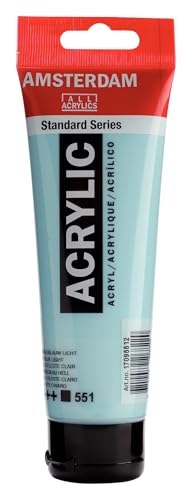
The Amsterdam product listed on Amazon is a single 120 ml (about 4 fl oz) tube of Standard Series acrylic in Titanium Buff Light 289, a warm off-white. The listing describes a medium viscosity formula for smooth application, visible brushstrokes and strong coverage.
Other listed properties:
- 100 percent acrylic resin binder with lightfast pigments.
- A flexible paint film with a satin finish and uniform gloss when dry (the product details field says matte, so expect a low-sheen satin).
- Thins easily with water and dries in about 30 minutes in thin layers.
- Alkali resistant, suitable for wall paintings and murals.
- Adheres to canvas, paper, cardboard, wood, stone and cement.
So is it a fluid acrylic?
No. Medium viscosity means it holds a soft brushstroke and will not pour on its own. That is not a flaw; it is simply a different product. Royal Talens has made art materials since 1921, and the Amsterdam range also includes acrylic inks, which sit at the very thin end of the scale. In the listings we checked, though, neither an Amsterdam ink nor a bottled Amsterdam fluid was available.
Who should still consider it
Painters who want one paint for both brushwork and thinned washes. Because acrylic paints share a binder type, you can add water or a fluid medium to the Standard Series and get a flowing paint suitable for glazing and staining. That flexibility is useful if you do not want separate tube and fluid sets.
Limitations
- Not fluid out of the tube, so pouring needs a pouring medium.
- Thinning with lots of water alone can weaken the paint film.
- Only one color in this listing; Titanium Buff is a tinted white, not pure white.
Fluid and Amsterdam Acrylic Reviewed
1. Liquitex Basics Acrylic Fluid, 8.5 oz — Best for ready-to-use fluid acrylic

Liquitex Basics Fluid is built to flow. The listing calls it ultra smooth and super blendable, filled with fine art pigments, and designed to be used straight from the bottle with no need to dilute.
It dries to a satin, mid-sheen finish and is pitched for pouring, large-area coverage, fine detail and splattering. The bottle is squeezable for directed dispensing, with a flip-top cap for one-handed use and a screw-off top with a wide neck for easier access.
Best suited for: Pour painters, muralists covering large areas and anyone who wants fluid paint without mixing.
Key features:
- Fluid viscosity, no dilution needed
- Satin, mid-sheen finish
- Squeezable bottle with flip-top cap
- Wide neck under screw-off top
- Titanium White in 8.5 oz
Pros:
- Truly fluid out of the bottle
- Large volume of white, which pours use heavily
- Convenient dispensing
Cons and limitations:
- Basics is a student-grade line
- Still needs pouring medium for cells and controlled pours
Buying consideration: White is the most-used color in pouring and background work, so a large fluid white is a practical buy even if you mix other brands.
2. Amsterdam Standard Series Acrylic, 120 ml — Best for thinning a medium-body paint yourself

This is the Amsterdam product in our data. It is a medium-viscosity tube paint, so it brushes with visible strokes and good coverage. The 100 percent acrylic resin binder and lightfast pigments put it in a sound quality bracket for its tier.
Titanium Buff Light is a warm, light neutral useful for toned grounds, skin and architecture. Its alkali resistance and wide surface list make it suitable for murals as well as canvas.
Best suited for: Painters who want a dependable medium-body paint they can thin into washes and glazes.
Key features:
- 120 ml tube, medium viscosity
- 100% acrylic resin binder, lightfast pigments
- Satin to low-sheen finish
- Thin films dry in about 30 minutes
- Alkali resistant for walls
Pros:
- Use thick or thinned
- Good surface adhesion list
- Lightfast pigment claim
Cons and limitations:
- Not a fluid acrylic
- Single color
Buying consideration: If you specifically need fluid acrylic, use this with a fluid or pouring medium rather than lots of water.
What Fluid Acrylic Is and What It Is For
Fluid acrylics have a viscosity close to heavy cream or thinner. Because they are made fluid by formulation rather than by adding water, they keep strong color and a sound film. They are used for:
- Pouring — mixed with pouring medium to create cells and flowing patterns.
- Glazing — thin transparent layers that shift underlying colors.
- Staining — soaking color into raw or lightly primed canvas.
- Detail and line work — fluid paint flows from a liner or rigger smoothly.
- Large coverage — backgrounds and murals cover quickly with less effort.
- Airbrushing — with additional thinning or airbrush medium.
- Splatter and drips — expressive effects that thick paint cannot produce.
How to Turn Amsterdam Standard Series Into a Fluid Paint
If you own Amsterdam tubes or like their value, you can approximate a fluid acrylic.
- Use a fluid or glazing medium, not just water. Mediums thin paint while keeping enough binder for a strong, flexible film. Start with about equal parts paint and medium and adjust.
- If using water, keep it modest. A small amount of water is fine for washes. Very heavy dilution can leave an underbound, chalky layer that rubs off.
- Mix thoroughly. Stir slowly to avoid bubbles; a palette knife or craft stick in a cup works well.
- For pouring, add pouring medium. A dedicated pouring medium levels the paint and reduces crazing. Aim for a consistency like warm honey.
- Test on scrap first. Check flow, opacity and drying before committing to a canvas.
- Store leftovers airtight. Small lidded cups or squeeze bottles keep mixed fluid paint usable for a while.
The Acrylic Viscosity Scale at a Glance
It helps to picture acrylic paints on a line from thickest to thinnest, because “fluid” is only one stop on it.
- Heavy body — stiff, buttery paint that keeps knife marks and peaks. Best for impasto and expressive brushwork.
- Medium or standard body — soft paste that keeps a gentle brushstroke and levels a little. This is where Amsterdam Standard Series sits, according to its listing.
- Soft body — creamy, smooth paint that brushes out with almost no marks.
- Fluid — pourable, like heavy cream. Liquitex Basics Fluid sits here.
- Ink — watery, often transparent, for pens, nibs, airbrush and staining.
All of these share the same basic chemistry, so they intermix. You can add a fluid white to a medium-body color to loosen it, or add heavy gel to a fluid to stiffen it. That is the main reason a medium-body paint like Amsterdam can still serve fluid techniques with the right medium.
Glazing With Fluid Acrylic, Step by Step
Glazing is one of the most rewarding uses of fluid paint. A glaze is a thin, transparent layer that tints whatever lies beneath it.
- Let the underlayer dry completely. Acrylic dries fast, but a fully dry layer keeps the glaze from lifting it.
- Mix a small amount of fluid paint with glazing medium. Start around one part paint to several parts medium. More medium means more transparency.
- Use a soft, wide brush. Lay the glaze in one direction with as few strokes as possible.
- Do not overwork it. Acrylic glazes begin to set in minutes; going back over them can leave streaks.
- Build gradually. Several thin glazes give richer color than one heavy layer.
Transparent pigments glaze best. A tinted white such as Titanium Buff is opaque, so it is better for scumbling (a thin, broken opaque layer) than for classic glazing.
Pouring Basics With a Fluid White
Most acrylic pours lean heavily on white. A simple starting routine:
- Mix fluid white with pouring medium in a cup until it runs off a stick in a smooth ribbon.
- Prepare two or three colors the same way, matching their consistency to the white.
- Layer the colors in a cup, flip it onto a level, primed canvas and tilt to spread.
- Let it dry flat and dust-free for at least a day, longer for thick pours, before varnishing.
Matching consistencies across all colors is the single most important habit; mismatched thickness causes muddy blends and cracking.
Amsterdam Standard vs Liquitex Basics Fluid
Viscosity
Liquitex Basics Fluid is fluid by design; Amsterdam Standard Series is medium. If flow out of the container matters, Liquitex wins.
Versatility
Amsterdam can be used thick for brushwork or thinned; Liquitex Basics Fluid is better suited to thin applications.
Finish
Both are described as satin, with Amsterdam’s detail field noting matte.
Container
A squeeze bottle with flip-top is far easier for pouring than a tube.
Durability claims
Amsterdam lists a 100 percent acrylic resin binder, lightfast pigments and alkali resistance. Liquitex Basics lists fine art pigments and a smooth blendable formula.
Choosing a Surface for Fluid Acrylic
Thin paint behaves differently on different supports, so match the surface to the technique.
Primed canvas and panels
The default for pours and glazes. A well-primed surface lets fluid paint flow and level instead of soaking in. For pours, a rigid panel or a canvas supported from behind prevents paint pooling in the center.
Raw or lightly primed canvas
Staining techniques use unprimed or thinly primed canvas so the paint sinks in and becomes part of the fabric. Fluid paint does this far better than thick paint.
Paper
Heavy watercolor or mixed-media paper handles thinned acrylic washes. Lightweight paper buckles under fluid paint, so tape it down or choose a block.
Walls and murals
The Amsterdam listing specifically notes alkali resistance and suitability for wall paintings. On a primed interior wall, thinned Amsterdam can lay in large areas of soft color quickly.
Wood, stone and cement
Amsterdam lists all three. Seal porous surfaces first so fluid paint does not disappear into them.
Buying Guide: How to Choose a Fluid Acrylic Paint
Check the stated viscosity
Listings say fluid, soft body, medium or heavy body. Only fluid or soft body will pour without help.
Choose the container for your technique
Bottles suit pouring; tubes suit palette mixing.
Buy white in bulk
Pours and backgrounds use far more white than any other color.
Look for binder information
Acrylic resin binders and lightfast pigments indicate better longevity.
Plan for mediums
Pouring medium, glazing medium and airbrush medium each change fluid paint in useful ways.
Consider student vs artist grade
Student lines like Liquitex Basics are economical for practice and large areas. Artist-grade fluids generally carry stronger pigment loads.
Projects to Try With Fluid Acrylic
Fluid paint is ideal for large decorative pieces; see our guide to making DIY wall art with acrylic. For simple starting points, try these acrylic painting ideas for beginners, and if you want to decorate glass, read whether you can use acrylic paint on glass jars.
Common Mistakes to Avoid
- Thinning medium-body paint with lots of water instead of a medium.
- Pouring without a pouring medium, leading to cracks and muddy colors.
- Shaking bottles hard and trapping bubbles before a pour.
- Expecting a tinted white like Titanium Buff to act as pure white.
- Varnishing before thick pours have cured fully.
FAQs
Does Amsterdam make fluid acrylic paint?
The Amsterdam product in the Amazon listings we checked in October 2026 was a Standard Series tube, described as medium viscosity. Amsterdam also makes acrylic inks, which are much thinner.
Can I use Amsterdam Standard Series for acrylic pouring?
Yes, if you mix it with a pouring medium. On its own it is too thick to pour.
How much water can I add to acrylic paint?
A modest amount is fine for washes. For very thin, flowing paint, use a fluid or glazing medium to keep the film strong.
Is Liquitex Basics Fluid good for pouring?
The listing names pouring as a main use and says it needs no dilution. Most pour painters still add a pouring medium for better flow and cells.
What is Titanium Buff Light?
A warm, light off-white color in the Amsterdam range, useful for toned grounds and soft neutrals.
Fluid acrylic or acrylic ink?
Fluid acrylic is thicker and more opaque on average. Acrylic ink is very thin and often more transparent, suited to pens, dip nibs and airbrush.
Final Recommendation
If what you need is a fluid acrylic, buy Liquitex Basics Fluid; it flows straight from the bottle and comes in a generous size for pours and backgrounds. If you were drawn to Amsterdam for its value and durability, the Standard Series tube is a good medium-body paint that you can turn into a fluid with a medium. Many painters keep both: Amsterdam for brushwork, a fluid white for pours.