
PaintingProGuide is reader-supported. When you buy through links on this page we may earn an affiliate commission at no extra cost to you.
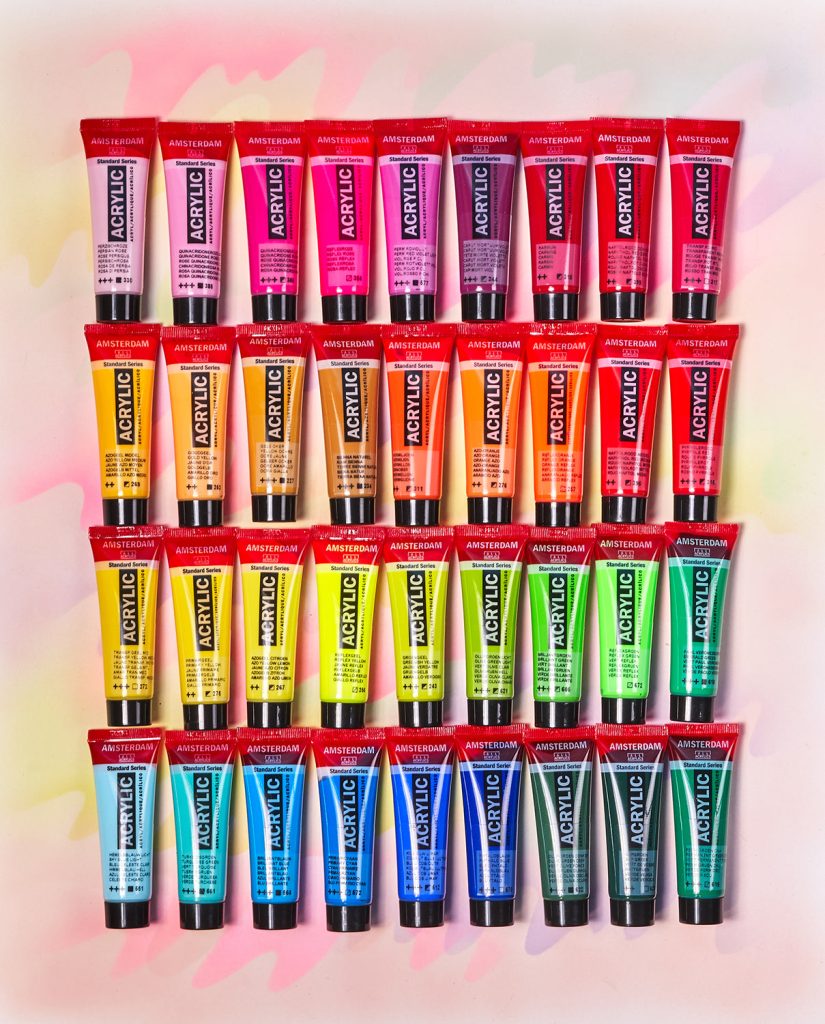
Amsterdam acrylic paint is made by Royal Talens in the Netherlands, the same company behind Rembrandt and Van Gogh oils. It sits in a useful middle ground: better pigmented and more durable than most craft acrylics, but priced well below professional lines from brands like Golden. That is why Amsterdam tends to be recommended to students who have outgrown craft paint and to working artists who need large volumes for big canvases and murals.
This guide explains the Amsterdam range (Standard Series versus Expert Series, plus inks and other formats), what the listing tells us about the Standard Series primary set sold on Amazon, how it compares with budget bulk sets, and how to get the most from it.
Quick answer: For most painters, the Amsterdam Standard Series primary set (5 x 120 ml) is the best way to try the brand: large tubes, a 100% acrylic resin binder and a satin finish, suited to canvas and even wall painting. If you mainly need lots of color for crafts at a lower price, Shuttle Art’s 18 x 250 ml bottles are the bulk alternative.
Our Top Picks at a Glance
- Amsterdam Standard Series Primary Set, 5 x 120 ml — Best way to buy Amsterdam acrylic
- Shuttle Art 18 Colors, 250 ml Bottles — Best bulk alternative for crafts and murals
- Artbreezing 48 Colors, 22 ml Tubes — Best alternative for color range
- Flood Floetrol — Best additive for pouring with Amsterdam paint
| Product | Best For | Key Spec | Key Strength | Price Tier |
|---|---|---|---|---|
| Amsterdam Standard Primary Set | Canvas, color mixing, murals | 5 x 120 ml, satin | 100% acrylic resin binder | $$ |
| Shuttle Art 18 x 250 ml | Crafts, classrooms, big projects | 18 bottles, matte | Volume per color | $$ |
| Artbreezing 48 Colors | Color variety, small works | 48 x 22 ml, gloss | Many ready-mixed hues | $$ |
| Flood Floetrol | Acrylic pouring | 1 gallon additive | Improves flow, helps cells | $$ |
The Amsterdam Acrylic Range Explained
Standard Series
The Standard Series is the core line and the one most people mean by “Amsterdam acrylic.” It comes in tubes and larger containers in a wide color range and is positioned for students and painters who want reliable quality at a moderate price. Its consistency is creamy and moderately thick: it holds some brush texture but flows more than a true heavy body. See our full Amsterdam Standard Series review for handling details.
Expert Series
The Expert Series is Amsterdam’s professional line, with higher pigment concentration and a more limited set of single-pigment colors aimed at experienced painters. We compare it with Standard in our Amsterdam Expert Series review.
Other Amsterdam formats
The brand also offers acrylic inks for washes, pen work and pouring, plus fluid and heavier-bodied options and gouache-style acrylics for matte, opaque work. If you are choosing between them, our individual reviews cover the Amsterdam heavy body acrylic, the Amsterdam fluid acrylic, the Amsterdam acrylic ink and the Amsterdam acrylic gouache.
How We Chose
We have not painted with these products. Picks are based on Amazon listing details and specifications checked in October 2026, how each product fits painters considering Amsterdam acrylic, and how widely each is reviewed by Amazon buyers. Only one Amsterdam product appeared in our Amazon product data, so we pair it with the closest alternatives and one useful additive rather than padding the list. We weighed:
- Binder quality and film durability stated on the listing
- Tube or bottle size and value per milliliter
- Color selection and finish
- Fit for canvas, murals, crafts or pouring
Amsterdam Standard Series Primary Set: Full Overview
1. Amsterdam Standard Series Primary Set, 5 x 120 ml — Best for trying Amsterdam acrylic

This Royal Talens set (item 17790905) contains five 120 ml tubes of Standard Series acrylic in a primary palette. A primary set is designed for mixing: with a warm-leaning trio of primaries plus white you can build most hues, which makes it a great way to learn color while getting generous quantities of paint.
The listing highlights an exceptionally durable paint film because the binder is 100% acrylic resin, and notes it is alkali resistant and therefore suitable for wall paintings. It thins easily with water and thin films dry within half an hour. The finish is listed as satin.
Best suited for: Students moving up from craft paint, painters learning color mixing, and mural or large-canvas work.
Key features:
- 5 x 120 ml tubes, primary palette
- 100% acrylic resin binder
- Alkali resistant, suitable for walls
- Thin films dry within about 30 minutes; satin finish
Pros:
- Large tubes for the price of small sets
- Durable, mural-capable film
- Mixing-focused palette teaches color
Cons and limitations:
- Only five colors
- Mixing secondary colors takes practice
Buying consideration: If you want ready-mixed earth tones, add single tubes of burnt umber and yellow ochre. Otherwise, this set plus a palette knife is a complete mixing kit.
Who Amsterdam Standard suits
- Art students who need a dependable paint in quantity
- Painters moving up from craft acrylics who want better pigment and film strength
- Muralists working indoors on primed walls, since the listing states alkali resistance
- Teachers who want a step above craft paint for classroom painting
Limitations to know
- It is not a professional single-pigment paint like the Expert Series; some mixed colors may be less intense than artist-grade equivalents.
- The fast drying of thin films (about half an hour per the listing) means you may want a wet palette or retarder for blending.
- Like all acrylics, colors can shift slightly darker as they dry.
How to Mix a Full Palette From a Primary Set
A primary set looks limited until you start mixing. The basic recipes below work with any warm-and-cool-balanced primaries plus white, and they are the fastest way to get value from five big tubes.
- Secondaries first. Mix yellow and blue for greens, yellow and red for oranges, and red and blue for purples. Vary the ratio to get yellow-greens, blue-greens, red-oranges and so on. Make a small chart on scrap paper the first time.
- Earth tones. Mix all three primaries in roughly equal amounts to get a neutral brown, then push it warmer with red and yellow or cooler with blue. A touch of orange plus a little blue gives a convincing burnt sienna-like tone.
- Chromatic darks. Instead of black, mix blue with red and a little yellow for a rich dark that harmonizes with the rest of the painting.
- Tints. Add color to white, not white to color. White is strong in acrylic and a small amount of color goes a long way.
- Grays. Mix a complementary pair (orange and blue, red and green) and lighten with white for lively grays.
Mixing everything also keeps a painting color-harmonious, because every hue shares the same three parent pigments. Many teachers start students on exactly this limited palette for that reason.
Where Amsterdam Sits Among Acrylic Grades
| Grade | Typical Use | Pigment and Binder | Strength | Trade-off |
|---|---|---|---|---|
| Craft acrylic (Apple Barrel, Craft Smart) | Decor, kids, crafts | Lower pigment, more filler | Cheap, many ready colors | Weaker mixing, may need extra coats |
| Student and mid-grade (Amsterdam Standard, Liquitex BASICS) | Learning, large works, murals | Good pigment load, durable binder | Quality per dollar | Some colors use pigment substitutes |
| Professional (Amsterdam Expert and similar) | Exhibition work, demanding glazes | High pigment, single-pigment colors | Intensity and clean mixing | Higher cost |
Most painters get the best value by using a mid-grade paint like Amsterdam Standard for underpainting and large areas, then reserving a few professional tubes for the colors where intensity matters most.
Alternatives Worth Comparing
2. Shuttle Art 18 Colors, 250 ml Bottles — Best for bulk crafts and murals

If quantity matters more than brand, Shuttle Art sells 18 colors in 250 ml (8.45 oz) bottles. The listing describes thick, creamy, artist-grade paint that mixes and blends well and covers with little paint, drying permanent, waterproof and fade-proof.
It conforms to ASTM D-4236 and EN71-3, and lists surfaces from canvas and wood to glass, rocks, leather and ceramic. Finish is matte. It is a practical choice for classrooms, paint parties and big decorative projects.
Best suited for: Classrooms, crafts, large decorative canvases and group painting.
Key features:
- 18 colors x 250 ml
- Matte finish
- ASTM D-4236 and EN71-3
- Multi-surface
Pros:
- Much more paint per color
- Ready-mixed colors save time
- Good for groups
Cons and limitations:
- Less established artist reputation than Royal Talens
- Bottles take more storage space
Buying consideration: Choose this when you burn through paint quickly and color accuracy is less critical.
3. Artbreezing 48 Colors, 22 ml Tubes — Best for color range
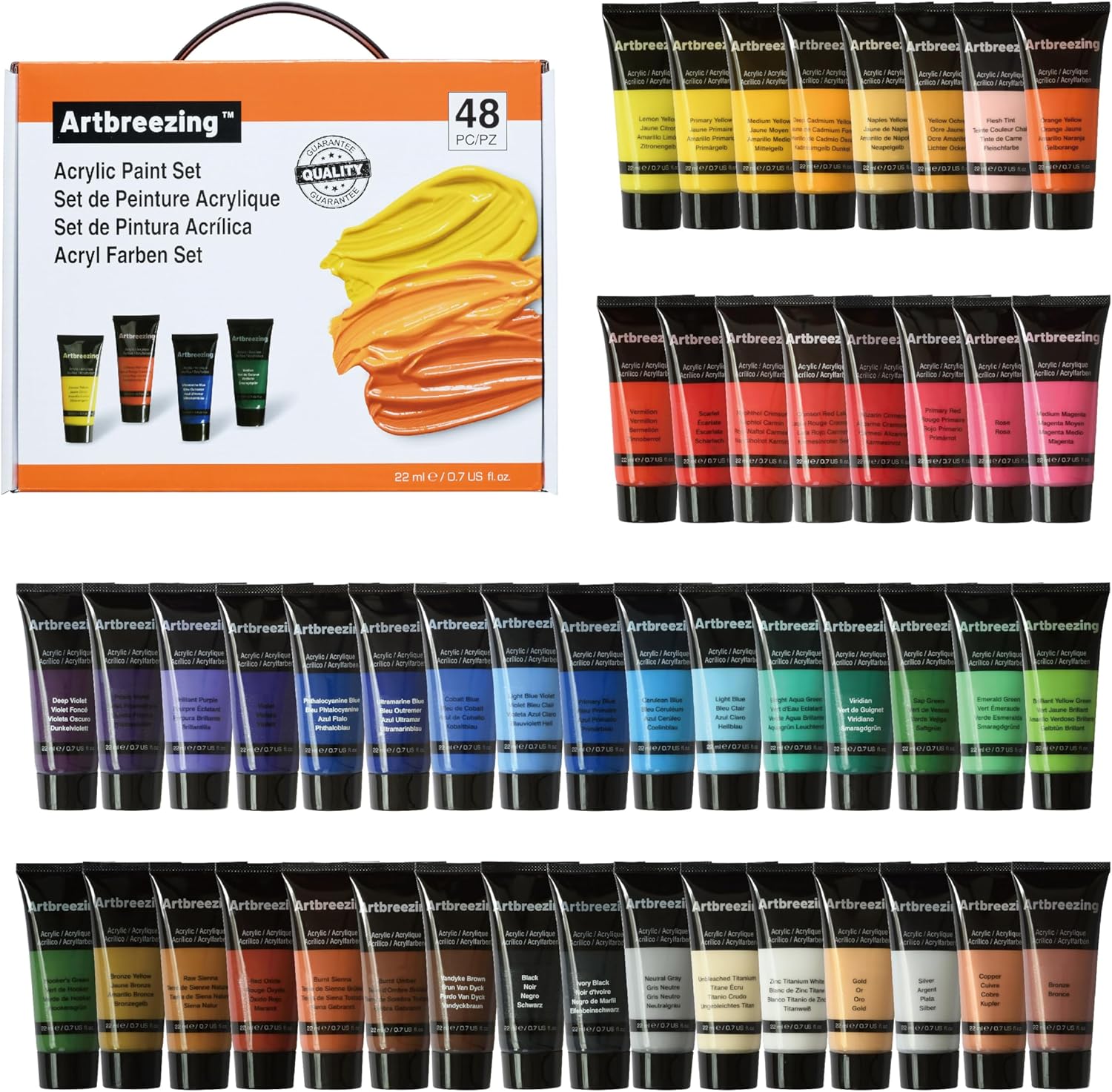
Artbreezing offers 48 colors in 22 ml tubes, spanning warm to cool tones. The listing describes a pigment-rich, smooth, fast-drying formula that is lightfast, water-resistant and crack-free, with a gloss finish.
Where the Amsterdam primary set is about mixing, this set is about having many colors ready to go, which suits illustrators, small canvases and color exploration.
Best suited for: Painters who prefer ready-mixed colors and small to medium works.
Key features:
- 48 colors x 22 ml
- Gloss finish listed
- Lightfast and crack-free per listing
- For canvas, wood and paper
Pros:
- Huge color range
- Small tubes for exploration
- Gift-ready set
Cons and limitations:
- Small tubes run out on large canvases
- Brand claims are not independently verified
Buying consideration: Buy a big white separately; 22 ml of white disappears fast.
Supplies That Help
4. Flood Floetrol — Best for pouring with Amsterdam paint

Floetrol is a paint conditioner originally made for latex house paint, but the listing explicitly calls it a go-to additive for fluid art and paint pouring, where it helps paint flow, creates cells and reduces cracking. Many pour artists mix it with acrylics like Amsterdam Standard to stretch paint and improve flow.
A one-gallon jug lasts a long time for art use. It cleans up with soap and water.
Best suited for: Artists trying acrylic pours with tube paint.
Key features:
- 1 gallon (128 fl oz)
- Improves flow and leveling
- Listed as a pouring medium for acrylic art
- Soap-and-water cleanup
Pros:
- Inexpensive per pour
- Helps form cells
- Large quantity
Cons and limitations:
- Not an artist-brand medium
- Gallon size is a lot for occasional use
Buying consideration: Test ratios on scrap canvas; a common starting point is roughly equal parts paint and additive, then thin with water as needed.
Buying Guide: Choosing Amsterdam Acrylic Paint
Standard or Expert?
Standard Series covers learning, large works and most hobby painting. Expert Series is for painters who need maximum pigment strength and single-pigment colors for clean mixing.
Tube size
120 ml tubes are the sweet spot for most painters. Larger containers make sense for murals and classrooms; small tubes suit testing colors.
Palette approach
A primary set teaches mixing and keeps costs down. A broad color set saves time. Many painters combine a primary set with a few earth colors.
Surface
Amsterdam works on primed canvas, panels and paper. The listing notes alkali resistance for walls. For glass or fabric, use suitable mediums or specialty paints.
Consistency
Choose heavy body for impasto and knife work, Standard for general painting, fluid and inks for glazes, washes and pours.
Finish and varnish
Standard dries satin. Use a gloss or matte varnish to unify the surface and protect finished paintings.
Using Amsterdam Acrylic for Murals and Large Canvases
Large tubes and an alkali-resistant film make the Standard Series a reasonable choice for indoor murals, as the listing suggests. A few practical points help a wall painting last. Start with a clean, sound wall and an appropriate primer so the paint is not fighting chalky or glossy old paint. Mix big batches of each main color in lidded cups, because matching a hand-mixed color halfway across a wall is hard. Work in sections you can finish while edges are still soft, and keep a spray bottle handy to mist the paint on the wall and on your palette.
For big canvases the same logic applies: block in with a large flat or a foam brush using generous amounts of paint, then refine with smaller brushes. When the work is fully dry, a clear acrylic varnish evens out sheen differences between thick and thin areas.
Storing Amsterdam Tubes
Wipe the tube threads before replacing the cap so it does not glue itself shut. Store tubes at room temperature, cap side down if paint is getting stiff at the crimp end. If a cap does stick, warm it under hot tap water for a few seconds rather than twisting hard enough to split the tube.
Getting the Most From Amsterdam Acrylic
- Use a wet palette to keep paint workable longer.
- Thin with water for washes, but for glazes use an acrylic glazing medium to keep the film strong.
- Mix slightly lighter than your target to allow for drying shift.
- Prime walls properly before painting murals, then seal with a suitable varnish.
- Clean brushes promptly with soap and water.
Ready to paint? Try our simple acrylic painting ideas for beginners or a larger piece from the DIY wall art with acrylic guide.
Common Mistakes to Avoid
- Over-thinning with water. Too much water weakens the paint film; use mediums for very thin layers.
- Expecting professional intensity from Standard. It is a strong mid-grade paint, not an Expert Series substitute.
- Mixing on a dry plastic palette in a warm room. Paint skins quickly; use a wet palette.
- Skipping primer on walls. Even an alkali-resistant paint needs a sound, primed surface.
- Pouring without testing additives. Ratios vary by color; test first.
FAQs
Is Amsterdam acrylic paint good quality?
Amsterdam is generally regarded as a strong mid-grade acrylic: better pigmented and more durable than craft paint, and more affordable than professional brands. The Standard Series listing notes a 100% acrylic resin binder for a durable film.
Who makes Amsterdam acrylic paint?
Amsterdam is made by Royal Talens of the Netherlands, which also produces Rembrandt and Van Gogh artist paints.
What is the difference between Amsterdam Standard and Expert?
Standard Series is the core, moderately priced line for students and general painting. Expert Series is the professional line with higher pigment concentration.
Can Amsterdam acrylic be used on walls?
The Standard Series listing states the paint is alkali resistant and therefore suitable for wall paintings. Prepare and prime the wall properly first.
How fast does Amsterdam acrylic dry?
According to the listing, thin films dry within about half an hour. Thicker layers take longer.
Is Amsterdam better than Liquitex BASICS?
Both are popular student-grade lines. Amsterdam Standard is often described as creamier and well pigmented for its price. The best choice depends on the specific colors and consistency you prefer.
Final Recommendation
Amsterdam acrylic is a smart step up from craft paint. The Standard Series primary set is the best way to try it: big 120 ml tubes, a durable 100% acrylic binder and a mixing palette that teaches color. If you need cheap volume, Shuttle Art’s 250 ml bottles are the bulk alternative, Artbreezing’s 48 tubes suit painters who prefer ready-mixed colors, and Floetrol helps when you want to pour.



One Comment