PaintingProGuide is reader-supported. When you buy through links on this page we may earn an affiliate commission at no extra cost to you.
An acrylic retarder medium buys you time. Acrylic paint dries by water evaporating, which is wonderful for layering and frustrating for blending skies, skin tones and soft gradients. A retarder slows that evaporation so paint stays workable on the canvas and on the palette for longer. The best acrylic retarder medium extends open time without making paint sticky, shifting color or weakening the dry film.
There are two kinds of product here, and the difference matters. A pure retarder is a binder-free additive used in small amounts. A slow-drying medium contains acrylic binder, so you can add more of it without starving the paint. This guide explains both and ranks the best options for blending, palette life and budget.
Quick answer: GOLDEN Retarder is the best acrylic retarder for most painters: a professional additive that increases open time for wet-in-wet work and reduces skinning on the palette. If you want to add generous amounts without worrying about weakening the paint, Winsor & Newton Professional Slow Drying Medium is the better choice; its listing says a 1:1 ratio doubles drying time. Liquitex Slow-Dri Fluid Retarder is a strong alternative in a small bottle.
Our Top Picks at a Glance
- GOLDEN Retarder — Best overall acrylic retarder
- Winsor & Newton Professional Slow Drying Medium — Best slow-drying medium for generous use
- Liquitex Slow-Dri Fluid Retarder — Best small bottle for blending and detail
- U.S. Art Supply Acrylic Retarder — Best budget tube
- Sax True Flow Drying Retarder — Best pint for classrooms
- Handy Art Acrylic Retarder — Best quart for heavy users
- Falling in Art Retarder Medium — Best low-cost starter bottle
| Product | Best For | Key Spec | Key Strength | Price Tier |
|---|---|---|---|---|
| GOLDEN Retarder | Wet-in-wet, palette life | 8 oz, additive | Professional formulation | $$ |
| W&N Slow Drying Medium | Generous use, blending | 250 ml, medium with binder | 1:1 doubles drying time (listed) | $$ |
| Liquitex Slow-Dri | Blending and detail | 4 oz, binder-free fluid | Reduces palette skinning | $$ |
| U.S. Art Supply Retarder | Budget | 200 ml tube | Non-yellowing, clear (listed) | $ |
| Sax True Flow | Classrooms | 16 oz bottle | Up to 3x drying time (listed) | $$ |
| Handy Art Retarder | Heavy users | 32 oz quart | Large volume | $$ |
| Falling in Art | Trying retarder | 8 oz | Low cost | $ |
How We Chose
These picks are based on the Amazon listing details and specifications for each product as checked in October 2026, how well each one’s formulation and size fit blending and open-time needs, and how widely each is reviewed by Amazon buyers. We have not timed drying ourselves; figures such as “doubles drying time” are the manufacturers’ and are labeled that way.
- Formulation: binder-free retarder versus slow-drying medium.
- Stated effect: open time, palette skinning and blending.
- Color and finish: no color shift and no yellowing.
- Usage guidance: clear ratios or limits on the label.
- Size and value: small bottles for testing, large ones for classes.
Retarder vs Slow-Drying Medium
A retarder is a binder-free additive, usually based on slow-evaporating humectants. Because it contains no acrylic binder, too much can leave paint tacky, slow to cure or weaker in film strength. Manufacturers typically advise using only a small proportion relative to paint, so check the label of the one you buy.
A slow-drying medium combines a retarder with acrylic binder. You can add more of it, sometimes equal parts with paint, without the same risk of weakening the film. It also slightly changes consistency and transparency. Winsor & Newton’s Slow Drying Medium is this type.
A third approach is a wet palette, which keeps paint workable on the palette without additives. Many painters combine a wet palette with a little retarder in the paint itself.
Best Acrylic Retarder Mediums Reviewed
1. GOLDEN Retarder — Best Overall Acrylic Retarder
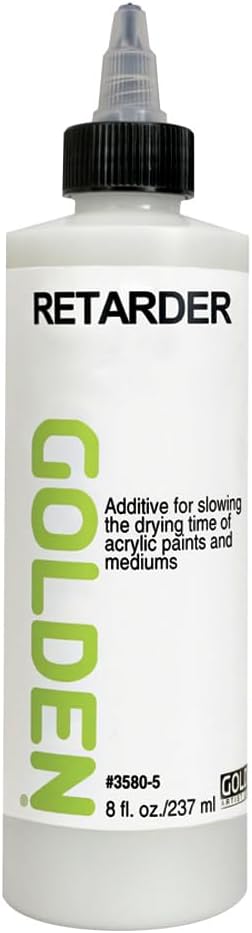
GOLDEN describes Retarder as an additive used to increase the open, or drying, time of acrylic paints, useful for wet-in-wet techniques and for reducing skinning on the palette. It is made in the USA by an employee-owned company with decades of experience in professional paint.
As a pure additive, it is meant to be used sparingly. A small amount mixed into each pile of color, or misted onto the palette with water, keeps paint workable long enough for soft transitions without changing consistency much.
The 8 oz bottle lasts a long time at sensible usage rates.
Best suited for: Painters who blend skies, portraits and gradients and want a professional retarder to use in small amounts.
Key features (from the listing):
- Additive to increase open time
- For wet-in-wet and reduced palette skinning
- 8 fl oz (237 ml) bottle
- Semi-gloss finish (listed)
- Made in the USA
Pros:
- Professional, consistent formulation
- Small amounts are effective
- Works with most acrylics
Cons and limitations:
- Overuse can leave paint tacky
- Does not add body
- Mid tier
Buying consideration: Add retarder to paint, not to the canvas. Brushing pure retarder onto a surface can cause soft, sticky patches.
2. Winsor & Newton Professional Acrylic Slow Drying Medium — Best Slow-Drying Medium for Generous Use
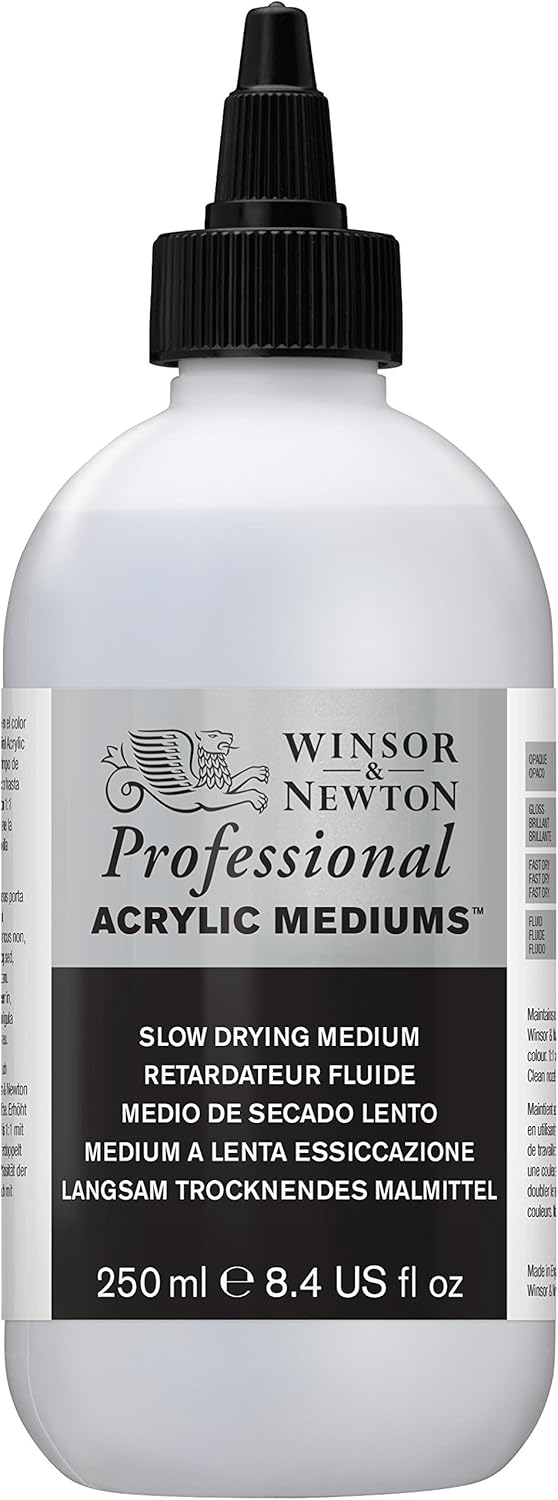
Winsor & Newton’s Slow Drying Medium is a medium rather than a pure retarder. The listing says it slows drying for extended blending and manipulation, that a 1:1 ratio of color to medium doubles the drying time, and that it maintains color viscosity with no color shift from wet to dry when used with artists’ acrylic.
That clear ratio guidance is valuable. You can mix generous amounts for portrait and landscape blending without worrying about the film, which makes it easier for beginners than a pure retarder.
Best suited for: Painters who want predictable, generous slow drying for blending and glazing.
Key features (from the listing):
- 250 ml
- Slow-drying medium
- 1:1 ratio doubles drying time (listed)
- No color shift wet to dry (listed)
- Matte or satin finish
Pros:
- Clear usage guidance
- Can be used generously
- Maintains viscosity
Cons and limitations:
- Changes finish slightly toward matte or satin
- More product used per painting
- Mid tier
Buying consideration: Because you use more of it, budget for a larger quantity than you would with a pure retarder.
3. Liquitex Professional Slow-Dri Fluid Retarder — Best Small Bottle for Blending and Detail
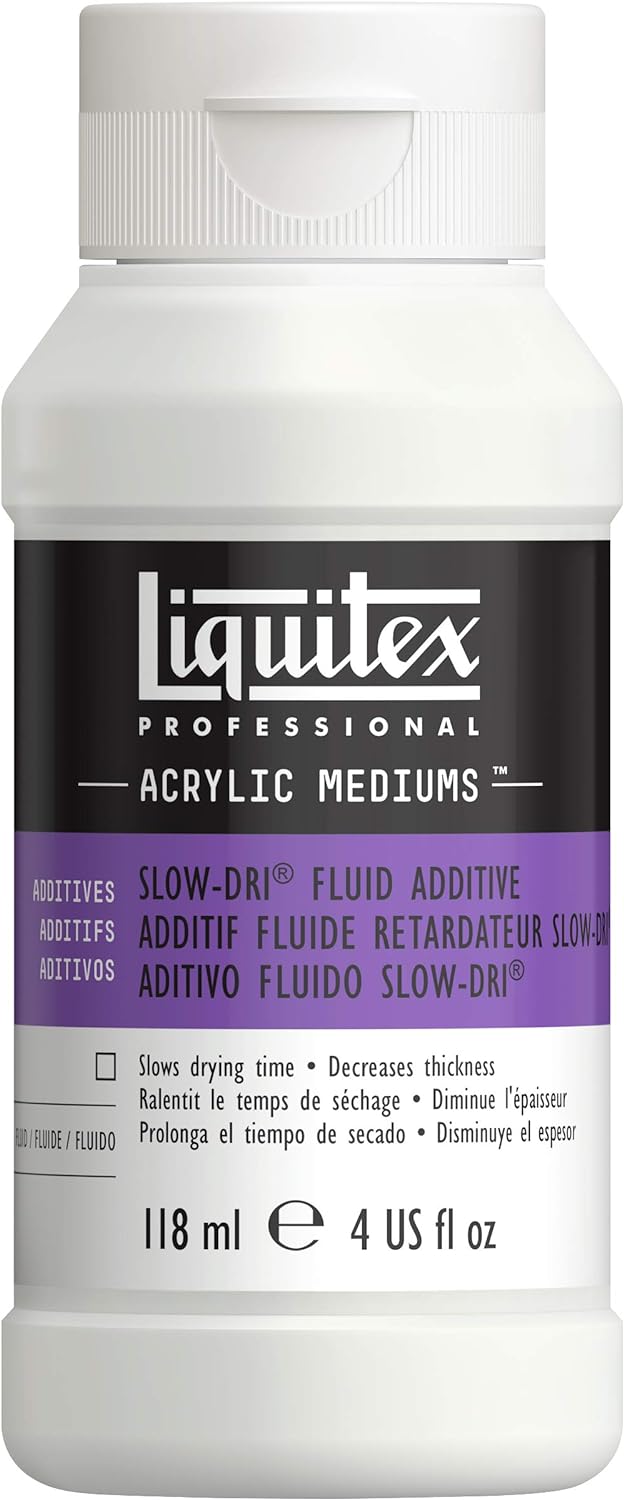
Liquitex Slow-Dri Fluid Retarder is a binder-free fluid with slow-drying agents. The listing says it increases open time, reduces skinning on the palette and increases blending time, making color blending and detail brushwork easier.
The 4 oz bottle is a good size for a pure additive used in small amounts. It suits painters who want a professional retarder at a slightly lower entry tier than larger bottles.
Best suited for: Painters doing detail work and soft blending in Liquitex or other professional acrylics.
Key features (from the listing):
- 4 oz (118 ml)
- Binder-free fluid retarder
- Increases open and blending time
- Reduces palette skinning
- Gloss finish (listed)
Pros:
- Professional brand
- Right size for an additive
- Clear purpose
Cons and limitations:
- Binder-free, so use sparingly
- Small bottle for heavy users
- Can make paint sticky if overused
Buying consideration: Mix a few drops into paint with a palette knife rather than dipping the brush in retarder.
4. U.S. Art Supply Acrylic Paint Retarder Medium, 200 ml — Best Budget Tube

U.S. Art Supply’s retarder comes in a 200 ml tube. The listing says it slows drying for increased blending, dries to a durable, clear, water-resistant and non-yellowing finish, does not shift hue, and helps prevent palette skinning.
It also claims not to change paint texture or flow. The tube format makes dispensing small amounts easy.
Best suited for: Budget-conscious painters and students who want a simple retarder.
Key features (from the listing):
- 200 ml (6.76 oz) tube
- Slows drying and reduces skinning
- Clear, non-yellowing, water-resistant (listed)
- Matte finish (listed)
Pros:
- Low tier
- Easy-to-dispense tube
- Clear description
Cons and limitations:
- Less brand documentation on ratios
- Matte finish may change sheen slightly
- Listing mixes retarder and flow improver terms
Buying consideration: Without a stated ratio, start small and increase until you get the working time you want.
5. Sax True Flow Acrylic Drying Retarder, 1 Pint — Best Pint for Classrooms

Sax, a school supply brand, sells True Flow Retarder in a 16 oz break-resistant plastic bottle. The listing says it lengthens drying up to three times for extended sessions, helps blending, and is a clear liquid that does not alter color.
The break-resistant bottle and pint size suit classrooms and community studios.
Best suited for: Art teachers and group studios.
Key features (from the listing):
- 16 oz bottle, break-resistant
- Up to 3x drying time (listed)
- Clear liquid
- Non-toxic
Pros:
- Classroom-friendly bottle
- Good volume
- Clear purpose
Cons and limitations:
- School-grade positioning
- Matte finish listed
- Little ratio guidance
Buying consideration: Pre-mix retarder into class paint cups to keep acrylic workable through a whole lesson.
6. Handy Art Acrylic Retarder, 32 oz — Best Quart for Heavy Users

Handy Art’s retarder comes in a resealable, wide-mouth 32 oz container. The listing describes slowing acrylic drying for blending, layering and manipulation, supporting wet-in-wet, glazing, portraiture and gradients. It is AP certified non-toxic and made in the USA.
A quart is a lot of retarder. It makes sense for murals, very large canvases and teaching.
Best suited for: Muralists, large-format painters and teachers.
Key features (from the listing):
- 32 oz quart
- Slows drying for blending and glazing
- AP certified non-toxic
- Made in the USA
Pros:
- Large volume
- Wide-mouth container
- Domestic manufacture
Cons and limitations:
- Far more than most painters need
- Matte finish listed
- Container wording copied from gel listing
Buying consideration: Decant into a small dropper bottle for daily use so the quart stays clean and sealed.
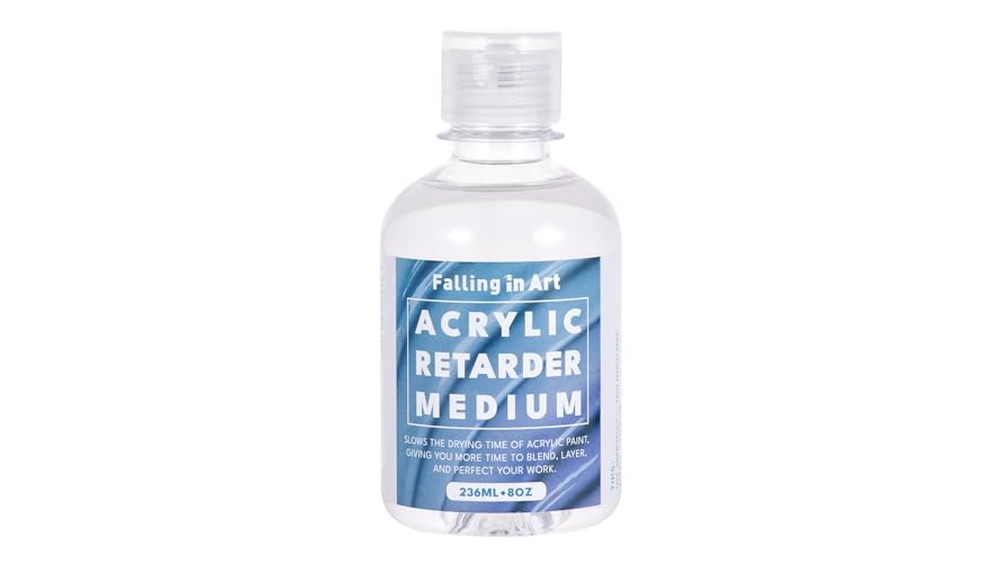
7. Falling in Art Acrylic Paint Retarder Medium, 8 oz — Best Low-Cost Starter Bottle

Falling in Art’s 8 oz retarder is described as significantly slowing acrylic drying for detailed blending and smooth gradients, using non-toxic ingredients, and maintaining color intensity.
It is a low-cost way to see how retarder changes your painting before committing to a professional brand.
Best suited for: Beginners curious about retarders.
Key features (from the listing):
- 8 oz
- Slows drying
- Non-toxic (listed)
- For canvas, wood and paper
Pros:
- Low tier
- Generous size for the tier
- Simple to use
Cons and limitations:
- Little technical detail
- No ratio guidance
- Lesser-known brand
Buying consideration: Test a few ratios on scrap paper and note the result, so you know how much to use on real work.
How to Use an Acrylic Retarder
Mix retarder into paint on the palette with a knife, starting with a few drops per pile of color. For a slow-drying medium, follow the ratio on the label; Winsor & Newton’s 1:1 guidance is a good example. Paint as normal and notice how long edges stay soft. If paint starts feeling tacky or stays soft for too long, you have added too much.
On the palette, a light mist of water mixed with a little retarder keeps paint from skinning. A wet palette is even better for long sessions. Do not coat a canvas with pure retarder before painting; it can interfere with adhesion and curing.
Blending Techniques That Benefit from Retarder
Soft skies and gradients
Lay two or three bands of color with a little retarder, then drag a clean, damp brush across the joins. With added open time, the bands merge into a smooth gradient instead of leaving hard lines where one stroke dried before the next arrived.
Portrait skin tones
Faces need subtle transitions between light, halftone and shadow. A slow-drying medium lets you place those values and knit them together while they are still wet, which is far easier than glazing a dozen thin layers to fake a blend.
Wet-in-wet florals
Dropping one color into another while both are wet creates soft, organic blooms of color in petals and leaves. Retarder gives you time to touch in highlights and shadows before the base dries.
Glazing
Glazes can streak when they start drying under the brush. A little retarder in a glaze lets you even it out and soften edges before it sets. Let each glaze dry fully before the next one.
Buying Guide: How to Choose an Acrylic Retarder Medium
Pure retarder or slow-drying medium
Choose a pure retarder if you want a small, concentrated additive and are comfortable using it sparingly. Choose a slow-drying medium if you want to use more without worrying about film strength.
Effect on sheen
Some retarders list gloss, semi-gloss or matte finishes. In small amounts, the effect is minor; with slow-drying mediums used generously, sheen changes more.
Color stability
Look for clear, non-yellowing formulations that do not shift color from wet to dry.
Brand compatibility
Most retarders work with most acrylics, but using the same brand as your paint makes it easier to follow guidance.
Container size
Pure retarders go a long way; 4 to 8 oz lasts most painters a long time. Slow-drying mediums are used in larger amounts.
Your climate
In dry or hot conditions, acrylic dries faster and retarder helps more. In humid climates you may need less.
Retarder Comparisons
Still deciding which product type you need? Compare options in our guides on acrylic retarder vs medium, acrylic retarder vs gel medium and acrylic retarder vs slow-drying medium. For the bigger picture, see what medium to use with acrylic paint.
Common Mistakes to Avoid
- Adding too much binder-free retarder, leaving paint tacky.
- Brushing pure retarder onto the canvas.
- Expecting acrylic with retarder to behave exactly like oil paint.
- Varnishing before retarder-heavy layers have cured.
- Using retarder instead of a wet palette for all-day palette life.
- Ignoring the manufacturer’s ratio guidance.
FAQs
What does an acrylic retarder do?
It slows the evaporation of water from acrylic paint, extending the time you can blend and manipulate paint on the canvas and keeping paint fresher on the palette.
What is the best acrylic retarder?
GOLDEN Retarder is a strong professional choice for most painters. Winsor & Newton Slow Drying Medium is better if you want to use larger amounts.
How much retarder should I add to acrylic paint?
For pure retarders, use small amounts, starting with a few drops per pile of paint and following the label. For slow-drying mediums, follow the stated ratio, such as 1:1.
Is a retarder the same as a slow-drying medium?
No. A retarder is binder-free and used sparingly; a slow-drying medium includes binder and can be added in larger amounts.
Can retarder make acrylic paint sticky?
Yes, if you use too much binder-free retarder. The paint may stay tacky and take much longer to cure.
Will retarder change the color of my paint?
Quality retarders are clear and should not shift color. Some may slightly change sheen when used generously.
Final Recommendation
For most acrylic painters, GOLDEN Retarder is the best acrylic retarder medium to keep blends open and palettes fresh. If you want generous, predictable slow drying, choose Winsor & Newton’s Slow Drying Medium, and if you prefer a small professional bottle, Liquitex Slow-Dri. Students can start with U.S. Art Supply or Falling in Art, while Sax and Handy Art make sense for classrooms and large-scale work.