

PaintingProGuide is reader-supported. When you buy through links on this page we may earn an affiliate commission at no extra cost to you.
Spending serious money on a drawing tablet only makes sense if the extra cost buys something you will feel in every stroke. The best high end tablets for digital painting earn their price through four things: a display that shows color you can trust, a pen that disappears in your hand, a surface that stays close to the nib, and ergonomics that let you work eight hours without a sore neck.
When we checked Amazon listings for this page in October 2026, the results for this query were dominated by drafting tables and side tables rather than actual tablets, so we will not pretend to rank premium tablets we cannot source data for. Instead, this guide explains exactly what to look for in a premium tablet, how the main categories differ, and which workstation products in our data genuinely help a high-end setup.
Quick answer: A high-end painting tablet should have a fully laminated, color-accurate display (look for wide Adobe RGB or DCI-P3 coverage and factory calibration), a battery-free or long-life pen with tilt and low activation force, and a stand or desk that lets you work at an angle. For the workspace, the Nnewvante foldable drafting desk holds tablets up to an 11-inch iPad Pro at an angle, and the MEEDEN 35.5 x 23.5 inch drafting table gives a pen display room to sit with a keyboard.
Our Top Picks at a Glance
Because the listings returned for this query were furniture rather than tablets, our picks here are categories plus two workstation products that suit a premium tablet setup:
- Large pen display (16 inches and up) — Best for studio illustrators and concept artists
- Premium standalone tablet — Best for painters who travel or work away from a desk
- Large screenless pro tablet — Best for painters who prioritize a calibrated main monitor
- Nnewvante Foldable Drafting Desk — Best for propping a tablet at an angle on any surface
- MEEDEN 35.5 x 23.5 in Drafting Table — Best for a full sit-or-stand painting station
| Product | Best For | Key Spec | Key Strength | Price Tier |
|---|---|---|---|---|
| Large pen display | Studio work, long sessions | 16–27 in laminated screen, wide gamut | Paint directly on a big canvas | Varies |
| Premium standalone tablet | Mobile and plein-air digital | Built-in OS, OLED or high-res LCD | No computer needed | Varies |
| Large screenless pro tablet | Color-critical work | Large active area, pro pen | Keeps eyes on a calibrated monitor | Varies |
| Nnewvante Foldable Drafting Desk | Angled tablet use, small spaces | 0–65° tilt, tablet and phone slots | Folds into a tabletop easel | $$$ |
| MEEDEN 35.5 x 23.5 in Drafting Table | Full painting workstation | 0–60° top, 29.7–38.4 in height | Large surface for display plus keyboard | $$ |
How We Chose
We have not tested tablets for this guide. The recommendations below are based on Amazon listing details and specifications checked in October 2026, on how well each product’s format and features fit a professional digital painting setup, and on how widely each product is reviewed by Amazon buyers. When no premium tablet appeared in that data, we described the category and its specs rather than inventing listings.
The criteria that define “high end” for painters:
- Display quality: full lamination, matte etched glass, wide color gamut and calibration options.
- Pen performance: low initial activation force, tilt, minimal jitter on slow diagonal lines.
- Size and resolution: enough pixels per inch that brush texture reads clearly.
- Ergonomics: a stand or desk that supports angled work and good posture.
- Long-term support: driver updates and replaceable parts such as nibs and pens.
We excluded the side tables in the results because they are not built for drawing at an angle, and the very expensive glass drafting stations because their listings did not show advantages over the simpler options for a tablet setup.
Best High-End Tablets for Digital Painting: The Categories Reviewed
1. Large Pen Displays — Best for Studio Painters
A large pen display is the closest digital equivalent to an easel-mounted canvas. You see the painting under your hand, and at 16 inches or larger you can work at full arm movement instead of wrist flicks. Premium models typically add a fully laminated screen, etched anti-glare glass that gives the nib a slight tooth, and high color gamut coverage suitable for print work.
Best suited for: illustrators, concept artists and portrait painters who spend most of their day at one desk.
What to look for
- Full lamination to reduce parallax
- Published Adobe RGB or DCI-P3 coverage, not just sRGB
- Support for hardware calibration
- An adjustable stand or VESA mount
Pros
- Most natural drawing feel
- Room for broad, gestural strokes
Cons
- Heavy and desk-bound
- Hand covers part of the image
- Needs a capable computer and video output
Buying consideration: Plan your desk before the display. A 16-inch or larger display plus a keyboard needs a deep surface, ideally one that tilts.
2. Premium Standalone Tablets — Best for Painting Anywhere
Standalone tablets run their own operating system, so you paint on the couch, on a train or outdoors without a laptop. At the premium end you see sharper displays, sometimes OLED, faster processors and pro-grade pens with tilt. The trade-off is that you are tied to the apps available on that platform.
Best suited for: painters who sketch on location, students moving between classes, and artists who want one device for drawing and reference.
What to look for
- At least 8GB RAM for large canvases and many layers
- Generous storage, since painting files grow quickly
- Support for your preferred app, such as Clip Studio Paint, Krita or Procreate on iPad
- A pen that does not need constant charging
Pros
- Portable studio
- Simple setup
Cons
- Smaller screens than desktop displays
- App ecosystem limits
Buying consideration: Check maximum canvas size and layer limits in your app on that specific device. Memory sets those limits more than screen size does.
3. Large Screenless Pro Tablets — Best for Color-Critical Work
Some professionals deliberately choose a large screenless tablet. You keep your eyes on a calibrated reference monitor, your posture stays upright, and the pen can be the same premium pen used on the maker’s displays. The learning curve is real, but once adapted many painters prefer it for long sessions.
Best suited for: painters doing print or client work where color accuracy matters more than direct drawing.
What to look for
- Medium or large active area matched to your monitor
- Replaceable surface sheets
- On-tablet keys or a separate keypad
Pros
- Better posture than leaning over a display
- Pairs with any high-end monitor
Cons
- Hand-eye adjustment period
- Less intuitive for beginners
Buying consideration: Your monitor becomes the expensive part. Budget for a well-calibrated screen alongside the tablet.
4. Nnewvante Foldable Drafting Desk — Best for Angled Tablet Use
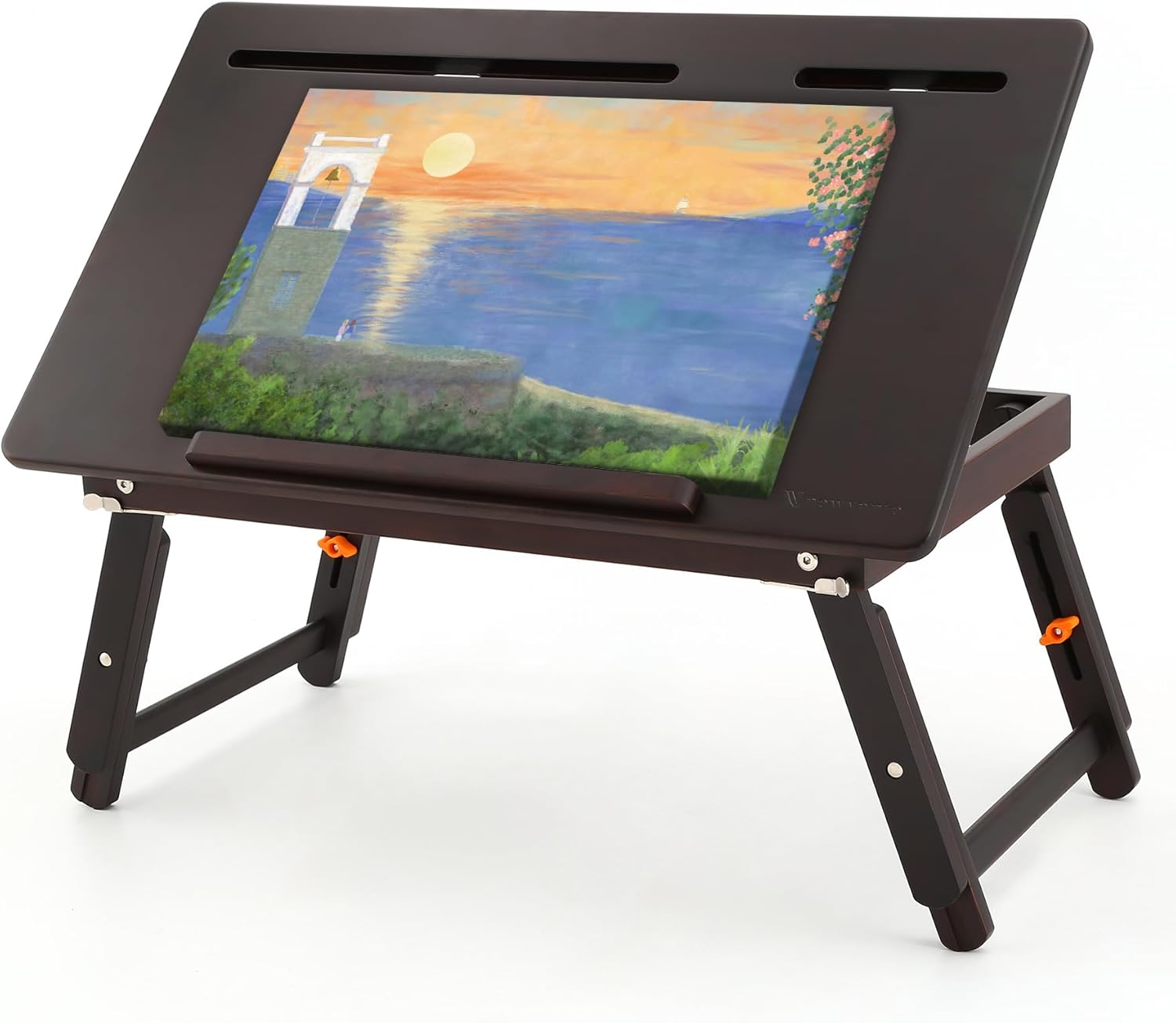
This compact bamboo desk is the most tablet-friendly product in our results. The listing describes a 0–65° tilt with seven positions, a height range of 9.3 to 12.6 inches and dedicated slots for tablets and phones compatible with devices up to an 11-inch iPad Pro. The legs fold so it becomes a tabletop easel on a desk, bed or floor.
For a premium standalone tablet, painting flat on a desk strains your neck within an hour. Raising the device to an angle like this is one of the cheapest ergonomic upgrades available.
Best suited for: standalone tablet and iPad painters who want an angled surface without a full drafting table.
Key features
- 0–65° adjustable angle, 7 positions
- Height 9.3–12.6 in with 4 settings
- Tablet and phone slots
- 23.6 x 13.8 in bamboo surface
Pros
- Works on any surface
- Folds for storage
Cons
- Too small for large pen displays
- Low height is meant for sitting at a table or floor
Buying consideration: The slot is listed for devices up to 11 inches; larger tablets will rest on the surface instead.
5. MEEDEN 35.5 x 23.5 in Drafting Table — Best for a Full Workstation

A large pen display needs a desk that tilts and leaves space for a keyboard. The MEEDEN table’s listing describes a 35.5 x 23.5 inch top, 0–60° angle adjustment, height from 29.7 to 38.4 inches and a 25-inch pencil ledge. Beech legs and an A-frame support the particleboard top.
The pencil ledge is useful here: at a moderate angle it can stop a display from sliding, though you should always confirm your display’s stand or a non-slip mat holds it securely.
Best suited for: painters building a dedicated studio corner around a pen display or large screenless tablet.
Key features
- 35.5 x 23.5 in work surface
- 0–60° tilt
- Height adjustable for sitting or standing
- 25 in ledge
Pros
- Large enough for display plus keyboard
- Sit or stand heights
Cons
- Particleboard top, not solid wood
- Electronics on a steep angle need securing
Buying consideration: Keep heavy displays at gentle angles on any tilting table, and route cables so they cannot pull the device.
Is a High-End Tablet Worth It for You?
Budget tablets have improved so much that a premium model is no longer the only route to professional results. Plenty of finished commercial illustrations have been painted on modest screenless tablets. So the honest question is not “will a high-end tablet make me a better painter” but “which specific limits am I hitting right now?”
Upgrading makes sense when you can name the problem:
- Your colors look different on every screen. A wide-gamut, calibratable display solves a real business problem if you deliver print files.
- Your lines wobble on slow strokes. Jitter on diagonal lines is a pen and digitizer issue, and premium pens tend to handle it better.
- You feel disconnected from the canvas. If years on a screenless tablet still feel awkward, a laminated display may unlock a more natural workflow.
- Your sessions end with neck or wrist pain. Stands, larger surfaces and lighter pens address this directly.
Upgrading makes less sense when the issue is skill-based. Value structure, edge control and color harmony improve with practice on any tablet. If you cannot point to a hardware limit, spend on lessons, reference books or a better chair first.
How a premium setup fits together
Think of a high-end painting station as a system: the tablet or display, the computer driving it, a calibrated monitor if you use one, a tilting surface and a keypad or keyboard for shortcuts. A weak link anywhere drags the rest down. A beautiful 4K display connected to a laptop that stutters on large brushes feels worse than a mid-range display on a capable machine. Budget for the whole chain, not just the headline device.
Buying Guide: How to Choose High-End Tablets for Digital Painting
Lamination and surface texture
Lamination bonds the glass to the display panel. Without it, a small gap makes the cursor seem to float below the nib. Etched glass adds a light tooth that slows the pen slightly, which many painters prefer for control. Glossy glass looks sharper but feels slippery.
Color gamut and calibration
If you sell prints or deliver client files, the display needs to show color that matches other screens and paper. Look for published Adobe RGB or DCI-P3 coverage and support for hardware calibration. A calibrated display is worth more than a higher resolution one.
Pen feel
Premium pens are defined by low initial activation force (the lightest pressure that registers), clean tilt data and no jitter on slow lines. These traits matter for soft airbrush glazes and delicate hair strands far more than headline pressure numbers.
Resolution and pixel density
On a 13-inch screen, Full HD is sharp enough for most painting. At 16 inches and up, 2.5K or 4K keeps brush texture crisp. Higher resolutions demand more from your computer, so check your graphics hardware.
Ergonomics and stands
A high-end display is a long-session tool. An adjustable stand, a tilting desk and a chair at the right height prevent the neck and shoulder strain that ends sessions early. Factor these costs into your budget.
Platform and app ecosystem
Standalone tablets lock you into an operating system. Make sure your preferred painting app runs well there before you commit, and check whether brushes and files transfer from your desktop workflow.
Support and replacement parts
Nibs wear out; pens get lost. Buy into a brand whose pens, nibs and surface sheets are easy to replace, and whose drivers are updated for new operating systems.
Keep Building Your Skills
A premium tablet only pays off if you use it to paint. Practice atmospheric work with our guide to painting digital waves and ocean scenes, then push value control with these tips for painting digital night scenes.
Common Mistakes to Avoid
- Paying for resolution your computer cannot drive. A 4K display on an underpowered machine lags on large brushes.
- Skipping calibration. Out of the box, even premium displays may need calibration for consistent color.
- Painting flat for hours. Angle the tablet with a stand or drafting table.
- Buying the biggest display for a small desk. Measure depth for display plus keyboard first.
- Ignoring app availability. A beautiful standalone tablet is useless if your main app is not available or runs poorly on it.
- Forgetting nibs. Etched glass wears nibs faster; keep spares.
FAQs
What makes a drawing tablet high end?
A fully laminated, color-accurate display, a pen with low activation force and clean tilt, solid build quality, ergonomic stand options and long driver support. Pressure level numbers alone do not define a premium tablet.
Is a pen display better than a screenless tablet for professionals?
Not automatically. Many professionals choose screenless tablets for posture and color accuracy on a main monitor. Pen displays suit painters who want direct drawing and are comfortable with a larger desk setup.
What size display should a professional painter choose?
Sixteen inches is a common starting point for studio work, with 22 to 27 inches favored by painters who use broad arm movements. Standalone tablets are usually 11 to 14 inches for portability.
Do I need a drafting table for a pen display?
Not strictly, but some form of angled support helps. A tilting desk or adjustable stand lets you paint without hunching, which matters on long sessions.
How much RAM does a standalone tablet need for painting?
For large canvases with many layers, 8GB or more is a sensible target. Less memory usually means lower layer limits in painting apps.
Final Recommendation
Decide where you paint before you decide what to buy. If you work at one desk all day, a large laminated pen display or a large screenless tablet with a calibrated monitor gives the best results. If you paint in different places, a premium standalone tablet with enough memory for your canvases makes more sense.
Then finish the setup properly: the Nnewvante foldable desk is an easy way to angle an iPad-size tablet, and the MEEDEN 35.5 x 23.5 inch drafting table gives a pen display and keyboard a stable, tilting home. A premium tablet on a poor workstation will always feel less premium than it should.





One Comment