

PaintingProGuide is reader-supported. When you buy through links on this page we may earn an affiliate commission at no extra cost to you.
A student oil painting kit has to strike a balance. It needs paint good enough to mix clean colors and teach real technique, brushes that can handle stiff oil paint, and enough supporting tools to get started, without the cost of professional materials a student will use up quickly while learning. The best oil painting kits for students either give you a solid set of student-grade oil colors to build around, or bundle paint, brushes, a palette and a surface into one box so a class or self-taught beginner can start the same day.
What most kits leave out is just as important: a safe solvent or solvent-free cleanup method, a painting medium, and enough canvases. We cover what to add at the end, so your first oil paintings go smoothly.
Quick answer: For students who want the best paint quality to learn with, the Winsor & Newton Winton 10-color set offers 10 essential student colors from a long-established artist brand, with a stated high pigment load. For an all-in-one starter, the Norberg & Linden XXL Oil Paint Set includes 24 oils, 25 brushes, a metal palette and a canvas. For a complete portable studio, the DJAR 169-piece beech French easel kit adds a field easel with shoulder strap.
Our Top Picks at a Glance
- Winsor & Newton Winton Oil Color Set, 10 x 12 ml — Best paint quality for students
- Norberg & Linden XXL Oil Paint Set — Best all-in-one oil starter kit
- Ohuhu Oil Paint Set, 24 Colors — Best budget color range
- DJAR 169-Piece Wooden French Easel Kit — Best complete studio for art students
- ESRICH 141PCS Deluxe Painting Set — Best multi-media kit with oil included
- ESRICH 166 Pcs Deluxe Painting Set — Best for trying four media
| Product | Best For | Key Spec | Key Strength | Price Tier |
|---|---|---|---|---|
| W&N Winton 10 | Learning technique | 10 x 12 ml student oils | High pigment load per listing | $$ |
| Norberg & Linden XXL | One-box start | 24 oils, 25 brushes, metal palette, canvas | Everything to begin | $$ |
| Ohuhu 24 | Budget range | 24 x 12 ml oils | Many colors, low cost | $$ |
| DJAR 169 French Easel | Art students | Beech French easel, paints, brushes | Portable studio | $$$ |
| ESRICH 141 | Multi-media | 24 oil, 36 acrylic, 24 watercolor, 2 easels | Three media | $$$ |
| ESRICH 166 | Multi-media | 24 each oil, acrylic, watercolor, gouache | Four media | $$$ |
How We Chose
We have not painted with these kits. The picks are based on the Amazon listing details and specifications checked in October 2026, how well each kit’s oil paint, brushes and tools suit a student learning oil painting, and how widely each product is reviewed by Amazon buyers. An acrylic-only kit in the same search was left out because it does not include oil paint.
- Oil paint quality and range: student-grade colors that mix cleanly, ideally with a practical palette.
- Brushes suited to oil: bristle brushes for stiff paint, plus synthetics for detail.
- Completeness: palette, surface and easel where included.
- Value for learners: enough paint to practice without professional prices.
- Format: paint-only sets to build around, or all-in-one kits.
Best Oil Painting Kits for Students Reviewed
1. Winsor & Newton Winton Oil Color Set, 10 x 12 ml — Best for learning with quality paint

Winton is Winsor & Newton’s student oil range. This set contains 10 essential starter colors in 12 ml tubes made from quality fine art pigments, per the listing. It states a pigment load higher than many artists’ ranges, a uniform, slightly stiffer consistency than W&N’s Artists’ Oil Color with excellent retention of brush and palette knife strokes, and the selection of the most permanent pigments wherever possible for lightfastness.
Ten colors is the right number for a student. It is enough to mix a full range while forcing you to learn color mixing, which is the core oil painting skill. Paint quality matters: cleaner mixes and better coverage make early paintings far more encouraging.
It is paint only, so pair it with brushes, a palette and canvases.
Best suited for: Students and self-taught beginners who want reliable paint to learn color mixing.
Key features:
- 10 x 12 ml tubes
- Student-grade Winton oils
- High pigment load per listing
- Lightfast pigments where possible
Pros:
- Trusted artist brand
- Teaches mixing
- Good brush and knife retention
- Stated permanence
Cons and limitations:
- Paint only
- Small tubes; white runs out first
- Limited palette for some subjects
Buying consideration: Buy a large tube of titanium white alongside the set; you will use it in almost every mix.
2. Norberg & Linden XXL Oil Paint Set — Best for an all-in-one starter kit

Norberg & Linden’s XXL set includes 24 oil paint tubes (12 ml each) in assorted colors including primaries, earth tones, blues, greens and skin-tone shades, plus 25 paint brushes in bristle, nylon and foam, a metal palette and an 8×10 stretched canvas panel, per the listing.
For a student starting from scratch, that is everything needed for a first oil painting in one box. Including bristle brushes alongside nylon is important for oil, and a metal palette is easy to clean.
One canvas is not much; add a pack of canvas panels.
Best suited for: Beginners and students who want to start with one purchase.
Key features:
- 24 oil paints, 12 ml
- 25 brushes: bristle, nylon, foam
- Metal palette
- 8×10 stretched canvas
Pros:
- Complete starter
- Bristle brushes included
- Good color variety
- Mid price tier
Cons and limitations:
- Only one canvas
- Brush quality is entry-level
- No solvent or medium
Buying consideration: Use the bristle brushes for blocking in and the nylon ones for details and blending.
3. Ohuhu Oil Paint Set, 24 Colors — Best for a budget color range
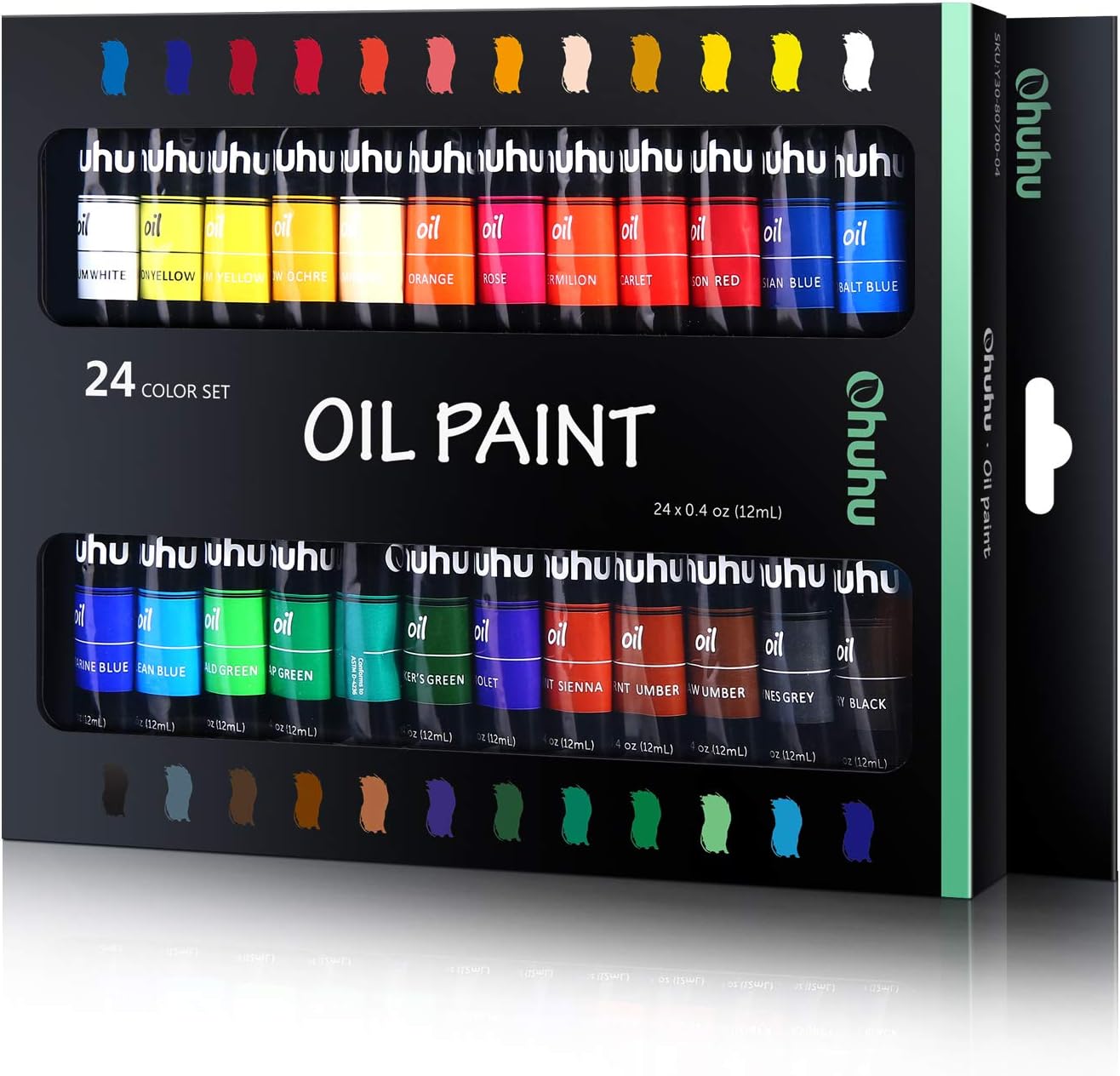
Ohuhu’s set includes 24 oil-based colors in 12 ml tubes, including titanium white, lemon yellow, medium yellow, yellow ochre, flesh tint and more, per the listing. It is described as non-toxic and aimed at beginners, with a good range of colors for scenery, abstract, landscape and portrait painting.
It is the lowest-cost way to get a wide oil palette. For students on a tight budget or those who want many convenience colors for practice, it is a reasonable start.
It is paint only.
Best suited for: Budget-conscious students and hobbyists.
Key features:
- 24 x 12 ml oil tubes
- Includes white, yellows, ochre, flesh tint
- Non-toxic per listing
- Portable tubes
Pros:
- Low price tier
- Wide range
- Good for practice
- Easy to carry
Cons and limitations:
- Student budget quality
- Paint only
- Small tubes
Buying consideration: Practice mixing your own versions of the convenience colors; it builds skills faster.
4. DJAR 169-Piece Wooden French Easel Kit — Best for a complete studio for art students

DJAR’s 169-piece set is built around a solid European beechwood French easel with a shoulder strap for portability, per the listing, and includes paints, brushes and papers for acrylic, oil and watercolor painting.
A French easel combines a sketch box, a palette surface and adjustable legs, so it works in the studio, the classroom and outdoors. For an art student, it is a piece of equipment that lasts well beyond the included paints.
Check the listing for the exact oil paint count; it is a multi-media kit.
Best suited for: Art students and serious beginners who want a portable studio for years.
Key features:
- Beechwood French easel with shoulder strap
- Multi-media paints and brushes
- Papers included
- 169 pieces
Pros:
- Durable, portable easel
- Studio and plein air use
- Multi-media
- Gift-worthy
Cons and limitations:
- Highest price tier here
- Oil is one of several media
- Heavier to carry than a tabletop easel
Buying consideration: Practice setting up and folding the French easel at home before taking it outdoors.
5. ESRICH 141PCS Deluxe Painting Set — Best for a multi-media kit with oil

ESRICH’s 141-piece set includes 84 paints across three types (36 acrylic, 24 oil and 24 watercolor), a wooden table easel and a foldable metal easel, 12 acrylic brushes and 10 oil brushes, per the listing, which states ASTM D-4236 conformance.
For students who are still deciding which medium to focus on, having oil, acrylic and watercolor in one kit lets them compare. Separate oil brushes are a sensible inclusion, since oil and water-based brushes are best kept apart.
Paint amounts per medium are modest.
Best suited for: Art students exploring several media.
Key features:
- 84 paints: 36 acrylic, 24 oil, 24 watercolor
- Wooden table easel and foldable metal easel
- 12 acrylic + 10 oil brushes
- ASTM D-4236
Pros:
- Three media to compare
- Two easels
- Dedicated oil brushes
- Stated safety conformance
Cons and limitations:
- Higher price tier
- Less oil paint than a dedicated set
- Many pieces to organize
Buying consideration: Keep oil and acrylic brushes clearly labeled; mixing them shortens brush life.
6. ESRICH 166 Pcs Deluxe Painting Set — Best for trying four media

ESRICH’s 166-piece set adds gouache to the mix, with 24 colors each of acrylic, oil, watercolor and gouache (96 paints), a wooden table easel and a metal easel, and brushes for each, per the listing, with ASTM D-4236 conformance.
It is the broadest exploration kit here. For a foundation-year art student or a curious adult learner, it offers a way to try every major paint type before committing.
As with the 141-piece set, each medium has limited quantity.
Best suited for: Students who want to sample four paint types.
Key features:
- 96 paints: 24 each of acrylic, oil, watercolor, gouache
- Wooden table easel and metal easel
- Brushes for each medium
- ASTM D-4236
Pros:
- Four media
- Two easels
- Broad exploration
- Good gift for art students
Cons and limitations:
- Higher price tier
- Limited oil quantity
- Can overwhelm a focused oil learner
Buying consideration: Pick one medium per month to explore deeply rather than switching every session.
What Student Kits Usually Leave Out
- Canvases or panels: most kits include one or none. Buy a pack of primed canvas panels for practice.
- Odorless mineral spirits or a solvent-free method: for thinning early layers and cleaning brushes. Many students start solvent-free with linseed or safflower oil and soap.
- A painting medium: such as a linseed-based or alkyd medium to adjust flow and drying.
- A palette knife: for mixing and textural work.
- Rags or paper towels: oil painting uses a lot of them.
- A large tube of white: it runs out first.
- A sealed container for oily rags: for safe disposal.
Student-Grade vs Artist-Grade Oil Paint
Student-grade oils in general keep costs down by using less expensive pigments for some colors (often labeled “hue”, meaning a substitute mixture that imitates a costly pigment) and sometimes more filler. Artist-grade oils use the original pigments at higher concentrations, which gives stronger tinting and cleaner mixes. For learning, student-grade paint is perfectly adequate and lets you use paint generously, which matters more than purity at this stage. Many painters later upgrade only a few key colors, such as white and the primaries, to artist grade. Brands differ, so read each range’s own description; Winsor & Newton, for example, states that Winton has a higher pigment load than many artists’ ranges.
A Student’s Starter Palette
Whatever kit you choose, a simple core palette makes learning easier: titanium white, a warm and cool yellow (such as cadmium yellow hue and lemon), a warm and cool red (such as cadmium red hue and alizarin crimson hue), a warm and cool blue (ultramarine and phthalo or cerulean), yellow ochre and burnt umber. With these, you can mix almost any color while learning how pigments behave.
First Oil Painting Lessons for Students
- Value study: paint a simple object in burnt umber and white only.
- Color mixing chart: mix each primary with each other and with white.
- Fat over lean exercise: paint a lean underpainting, then a fatter top layer.
- Alla prima still life: paint a piece of fruit in one session.
- Landscape sketch: paint a simple sky, ground and tree in three values.
Group painting sessions are a fun way to practice. Our sip and paint ideas include simple subjects that work well for students learning together.
Buying Guide: How to Choose an Oil Painting Kit for Students
Prioritize paint quality
Better student paint mixes cleaner colors and teaches more. A smaller set of good paint beats a big set of weak paint.
Check the brushes
Oil needs some stiff bristle brushes. Kits with only soft nylon can make thick oil frustrating to move around the canvas.
Decide between paint-only and all-in-one
Paint-only sets let you choose brushes and surfaces. All-in-one kits are convenient for a quick start.
Consider an easel
A tabletop or French easel improves posture and lets you step back from your work. Painting flat on a table distorts proportions because you view the canvas at an angle.
Plan for safety
Before the first session, ventilate the room, use odorless solvents sparingly or go solvent-free, and dispose of oily rags safely.
Common Mistakes to Avoid
- Using too much solvent. It weakens paint and adds fumes; use it sparingly or not at all.
- Ignoring fat over lean. It causes cracking later.
- Painting on unprimed surfaces. Oil needs a primed ground.
- Buying too many colors. Learn to mix from a limited palette.
- Leaving brushes dirty. Oil hardens in brushes overnight.
- Throwing oily rags in the trash. They can self-heat; store or dry them safely.
FAQs
What is the best oil paint for students?
A reliable student-grade range like Winsor & Newton Winton offers good pigment load and consistency at a student price. Budget sets like Ohuhu are fine for practice.
Do oil painting kits include everything needed?
Rarely. Most lack canvases, solvent or a solvent-free cleaning method, a medium and enough white paint.
Can students paint oil without solvents?
Yes. Clean brushes with linseed or safflower oil and soap, and use oil-based mediums instead of solvent for thinning.
How many oil colors does a student need?
Eight to twelve, including white, warm and cool primaries, and a couple of earths, is enough to mix most colors.
Is a French easel worth it for students?
For art students who paint in class and outdoors, yes. It combines storage, a palette and an adjustable easel in one portable unit.
How long does oil paint take to dry?
Thin layers are often touch-dry in a day or a few days; thick layers take much longer. Mediums and pigments affect drying time.
Final Recommendation
For students who want to learn on dependable paint, start with the Winsor & Newton Winton 10-color set and add brushes, a palette and canvases. If you prefer one box to begin, the Norberg & Linden XXL set is the most complete oil-only starter, and Ohuhu’s 24 colors are the budget alternative.
Art students who need a portable studio should consider the DJAR French easel kit, while ESRICH’s 141- and 166-piece sets suit students who want to compare oil with other media before committing.




