PaintingProGuide is reader-supported. When you buy through links on this page we may earn an affiliate commission at no extra cost to you.
Students use a lot of paint. Between color charts, value studies, class exercises and the inevitable do-overs, a beginner can empty a tube of titanium white in a few weeks. That is why the best oil painting sets for students are judged on three things more than any brand name: enough volume of the colors you actually use, a sensible range of hues for mixing, and paint that handles well enough to teach good habits.
We compared six student oil sets on Amazon, from a classic 10-tube Winsor & Newton Winton starter to a 20-tube set of large 50 ml tubes. Below, we break down total paint volume, explain the difference between student and artist grade, list the ten colors most courses ask for, and cover the extras every student needs beyond the paint.
Quick answer: For a classic student set with large tubes, the Winsor & Newton Winton Oil Starter Set gives ten 37 ml tubes of a long-established student line. If you want the most paint per set, the Paul Rubens 20 x 50 ml set provides a full liter of color. On a tight budget, the Castle Art Supplies 24 x 12 ml set covers a wide range with lightfast-rated pigments.
Our Top Picks at a Glance
- Winsor & Newton Winton Oil Color Starter Set — Best classic student set
- Paul Rubens Oil Paint, 20 x 50 ml — Best for volume and value
- Castle Art Supplies 24 x 12 ml Oil Paint Set — Best budget set with lightfast pigments
- Magicfly 40 x 18 ml Oil Paint Set — Best wide range with extra whites
- MyArtscape 48 x 12 ml Oil Paint Set — Best for exploring many colors
- RoseArt Premium Oil Paint, 24 Colors — Best low-cost starter for casual students
| Product | Best For | Key Spec | Key Strength | Price Tier |
|---|---|---|---|---|
| Winsor & Newton Winton Starter | Classic student course | 10 x 37 ml (370 ml total) | Established student line | $$$ |
| Paul Rubens 20 x 50 ml | Volume | 20 x 50 ml (1,000 ml total) | Large tubes, refined linseed oil | $$$ |
| Castle Art Supplies 24 x 12 ml | Budget range | 24 x 12 ml (288 ml total) | Lightfast-rated, vegan-friendly | $$ |
| Magicfly 40 x 18 ml | Wide range | 40 x 18 ml (720 ml total) | Extra white tubes, metallics | $$ |
| MyArtscape 48 x 12 ml | Color exploration | 48 x 12 ml (576 ml total) | Most hues | $$ |
| RoseArt Premium 24 | Casual students | 24 x 12 ml (288 ml total) | Low price tier | $ |
How We Chose
We did not paint with these sets for this guide. Picks are based on the Amazon listing details and specifications checked in October 2026, how well each set’s tube size, color range and stated pigment qualities fit student use, and how widely each product is reviewed by Amazon buyers.
- Total paint volume: tube size multiplied by tube count.
- Useful color range: primaries, earths and a strong white.
- Stated quality: pigmentation, lightfastness and safety labels.
- Tube size balance: large tubes for the colors students run out of.
- Value tier: affordable enough to use freely.
Student Grade vs Artist Grade Oil Paint
Student-grade paints typically use less pigment, more filler and more affordable substitutes for costly pigments, often labeled “hue.” Artist-grade paints carry higher pigment loads and single-pigment colors. Students do not need artist grade for everything; the smart approach is a student set for most colors and, later, artist-grade titanium white and one or two favorite colors, since those get used most.
| Feature | Student Grade | Artist Grade |
|---|---|---|
| Pigment load | Lower, more filler | Higher |
| Costly pigments | Often replaced with “hue” versions | Genuine pigments |
| Mixing strength | Good for learning | Stronger tinting |
| Price per ml | Lower | Higher |
| Best for | Practice, classes, studies | Finished work, key colors |
Best Oil Painting Sets for Students Reviewed
1. Winsor & Newton Winton Oil Color Paint Starter Set, 10 x 37 ml — Best for a classic student course

Winton is Winsor & Newton’s long-established student oil line. This introductory set includes ten 37 ml tubes, and the listing describes it as ideal for student and amateur artists, or more accomplished painters who need large volumes of color within moderate cost limits. It notes a high level of pigmentation for good covering power and tinting strength.
Ten colors is a sensible teaching palette: enough to mix a full range, few enough that students learn to mix rather than reach for a pre-made tube. The 37 ml tubes last far longer than the 12 ml tubes in most big sets.
Best suited for: Students in classes or courses that follow a limited-palette approach.
Key features:
- 10 tubes x 37 ml
- Established student-grade line
- High pigmentation per listing
- Matte finish listed
Pros:
- Larger tubes for heavily used colors
- Trusted student brand
- Teaches mixing with a limited palette
Cons and limitations:
- Only ten colors
- Higher price tier
- Colors in the set may not match a specific course list
Buying consideration: Check your course’s required color list against the set, and buy a large titanium white separately.
2. Paul Rubens Oil Paint, 20 Colors x 50 ml — Best for volume and value

Paul Rubens packs 20 colors in large 50 ml tubes, a full liter of paint. The listing describes high pigmentation, refined linseed oil, excellent lightfastness and a color selection chosen for landscape, seascape, portrait and still life.
For a student who paints every day, volume matters. Fifty milliliters of each color means you can paint freely, use generous amounts for alla prima, and not ration your whites.
Best suited for: Committed students, art school prep and painters who work large.
Key features:
- 20 tubes x 50 ml
- Refined linseed oil binder
- Listed as lightfast and non-toxic
- Range chosen for multiple subjects
Pros:
- Largest total volume here
- Generous tubes for heavy use
- Wide subject coverage
Cons and limitations:
- Higher upfront cost
- Bulky storage
- Less-known brand than Winsor & Newton
Buying consideration: Store large tubes upright, cap-up, and wipe the threads before closing so caps do not seize.
3. Castle Art Supplies 24 x 12 ml Oil Paint Set — Best for a budget range with lightfast pigments

Castle’s set of 24 x 12 ml tubes is listed with a new formula: richer pigments, smoother blending, vegan-friendly ingredients and lightfast-rated pigments. The listing also notes fat-over-lean compatibility for stable layering.
For students, 24 colors in small tubes is a good way to try a wide range before deciding which colors to buy in larger sizes.
Best suited for: Beginners and students on a budget who want variety.
Key features:
- 24 tubes x 12 ml
- Lightfast-rated pigments
- Vegan-friendly formula
- Gloss finish listed
Pros:
- Wide range at a low tier
- Lightfastness noted
- Buttery consistency per listing
Cons and limitations:
- Small 12 ml tubes run out fast
- Whites deplete first
- Individual pigment details not listed
Buying consideration: Note which colors you finish first and replace them with larger tubes.
4. Magicfly Oil Paint Set, 40 x 18 ml — Best for a wide range with extra whites
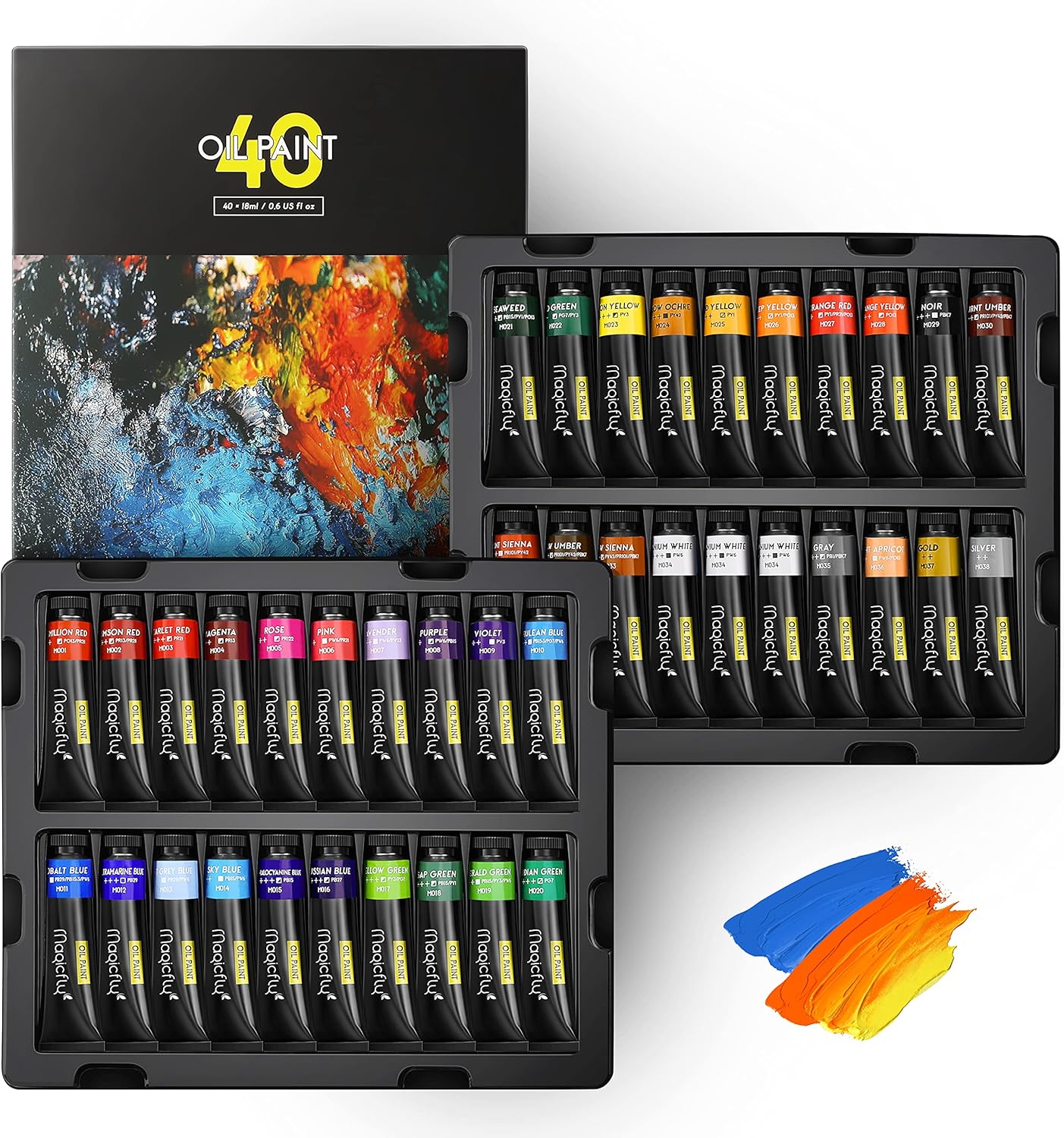
Magicfly includes 40 colors in 18 ml tubes, including metallic gold and silver, and adds two more white tubes than standard sets, which addresses the most common shortage in any oil kit. It conforms to ASTM D-4236 and the listing describes thick consistency and good coverage.
At 720 ml total, it balances range and volume. The 18 ml tubes are 50 percent larger than the typical 12 ml.
Best suited for: Students who want lots of colors and fewer emergency trips for white.
Key features:
- 40 tubes x 18 ml
- Extra white tubes
- Metallic gold and silver
- ASTM D-4236
Pros:
- Good balance of range and volume
- Extra whites
- 18 ml tubes larger than average
Cons and limitations:
- Many colors may encourage less mixing
- Metallics have limited use in study work
- Mid price tier
Buying consideration: Start with a limited palette from the set, such as a warm and cool of each primary plus white, before using the full 40.
5. MyArtscape Oil Paint Set, 48 x 12 ml — Best for exploring many colors

MyArtscape provides 48 colors in 12 ml tubes, described as artist-quality with a traditional high-sheen finish and lightfast, fade-resistant pigments. The listing says it suits canvas, pads, boards, panels and paper.
Forty-eight colors is a big palette for a student, which is both a strength and a trap. It is great for exploring color and swatching, but mixing skills develop faster with fewer tubes.
Best suited for: Students who enjoy color exploration and want a broad reference set.
Key features:
- 48 tubes x 12 ml
- Lightfast colors per listing
- High-sheen finish
- Non-toxic listed
Pros:
- Most colors here
- Good for color charts
- Mid price tier
Cons and limitations:
- Small tubes
- Too many colors for beginners to learn mixing
- Whites run out quickly
Buying consideration: Make a swatch chart of all 48 on your first day; it becomes a reference for choosing which colors to buy larger.
6. RoseArt Premium Oil Paint, Set of 24 — Best for a low-cost casual starter

RoseArt’s Premium set has 24 tubes of 12 ml, described as maximum-strength pigmented with a smooth, buttery texture, and listed as non-toxic with oil as the paint type. Colors include sap green, yellow ochre, vermilion, cadmium red, alizarin rose and titanium white, among others.
One caution: the listing text also mentions “acrylic paint” in a bullet, which conflicts with the oil paint type shown elsewhere. Confirm the tubes are labeled as oil when they arrive.
Best suited for: Casual students and hobbyists testing whether oil painting is for them.
Key features:
- 24 tubes x 12 ml
- Includes sap green, yellow ochre, vermilion, titanium white
- Non-toxic listed
- Semi-gloss finish listed
Pros:
- Lowest price tier
- Useful earth and green range
- Good for first experiments
Cons and limitations:
- Listing has a conflicting acrylic mention
- Small tubes
- Less detail on pigments
Buying consideration: Check tube labels on arrival; if they say oil, use them as your practice set.
Buying Guide: How to Choose Oil Painting Sets for Students
Calculate total volume
Multiply tube count by tube size. A 48 x 12 ml set is 576 ml; a 10 x 37 ml set is 370 ml but in fewer, more useful colors. Volume per color matters more than color count.
Look for a strong core palette
Most courses build around titanium white, a warm and cool yellow, a warm and cool red, a warm and cool blue, an earth like yellow ochre and burnt umber, and sometimes a green.
If a set lacks these, add them individually.
Prioritize white
White is used in almost every mix. Buy a large separate tube of titanium white no matter which set you choose.
Check lightfastness and safety
Look for lightfast claims and ASTM D-4236 labels. Hue versions of costly pigments are normal in student paints.
Course requirements
If you are in a class, the instructor’s color list wins. Buy the closest set and fill gaps with single tubes.
Plan for the extras
Paint is only part of the cost. Budget for brushes, a palette, odorless mineral spirits or a solvent-free cleaner, a medium like linseed oil, and surfaces.
The 10 Colors Most Student Courses Use
| Color | Role |
|---|---|
| Titanium white | Tinting, highlights; used in most mixes |
| Cadmium yellow light (or hue) | Warm bright yellow |
| Lemon yellow | Cool yellow for greens |
| Cadmium red (or hue) | Warm red |
| Alizarin crimson (or permanent alternative) | Cool red for purples |
| Ultramarine blue | Warm blue |
| Phthalo or Prussian blue | Cool, strong blue |
| Yellow ochre | Earth yellow for landscapes and skin |
| Burnt umber | Dark earth; underpainting |
| Burnt sienna | Warm earth; mixing neutrals |
Student Starter Checklist Beyond the Paint
- Three to six brushes: a large flat, a medium filbert, a small round and a liner.
- A palette knife for mixing and cleaning the palette.
- A glass, wood or disposable paper palette.
- Odorless mineral spirits or a solvent-free brush cleaner, with a lidded jar.
- Refined linseed oil as a basic medium.
- Canvas panels or oil paper pads for studies.
- Rags or paper towels and an apron.
Making a Student Set Last a Semester
A set that looks generous on day one can run dry by midterm if paint is wasted. A few habits stretch it considerably. Lay out paint in pea- to grape-size dabs along the edge of the palette, starting with white and moving through warm to cool colors, so you always know where each color lives. Mix in the center, and scrape leftover mixtures into a single “palette gray” pile rather than wiping them away; that neutral is useful for toning grounds and underpaintings.
Between sessions, cover the palette with plastic wrap or slide it into a sealed box and keep it in a cool place. Oil paint skins over slowly, so a covered palette is often usable the next day. Clean tube threads before recapping, and roll tubes from the bottom like toothpaste. If a cap seizes, run it under warm water for a few seconds rather than forcing it with pliers.
First Projects for Student Sets
Once you have a set, practice with short guided projects. Our oil seashell painting guide teaches form and highlights with a limited palette, painting fog in oil is an excellent lesson in values and soft edges, and painting grass in oil covers texture and brushwork.
Common Mistakes to Avoid
- Buying the biggest color count. Volume and core colors matter more.
- Running out of white mid-painting. Always keep a large spare tube.
- Squeezing out every color. Lay out only what the painting needs.
- Using solvent carelessly. Keep it lidded and work with ventilation.
- Skipping color charts. Mixing charts are the fastest way to learn a new set.
- Painting thick first. Follow fat over lean to avoid cracking.
FAQs
What is the best oil paint set for art students?
The Winsor & Newton Winton starter set is a classic choice with 37 ml tubes. For more volume, the Paul Rubens 20 x 50 ml set offers a liter of paint.
How many colors do students need for oil painting?
Eight to twelve well-chosen colors, including titanium white, warm and cool primaries and a few earths, are enough to mix almost anything.
Is student-grade oil paint good enough?
Yes, for learning, practice and most class work. Many students upgrade only their white and a few favorite colors to artist grade later.
What size oil paint tubes should students buy?
Larger tubes, 37 ml or more, for heavily used colors like white and earth tones; 12 to 20 ml is fine for accent colors.
Do students need solvents for oil painting?
Not necessarily. Brushes can be cleaned with oil and soap, though many courses use odorless mineral spirits with good ventilation.
What surfaces should students paint on?
Canvas panels and oil paper pads are affordable for studies. Stretched canvas is best saved for finished work.
Final Recommendation
Students following a structured course will do well with the Winsor & Newton Winton starter set and its larger 37 ml tubes. Choose Paul Rubens when you want the most paint per dollar of the sets here, Castle for a budget range with lightfast-rated pigments, and Magicfly for wide variety with extra whites. MyArtscape suits color exploration and swatching, and RoseArt is a low-cost way to find out whether oil painting is for you.