PaintingProGuide is reader-supported. When you buy through links on this page we may earn an affiliate commission at no extra cost to you.
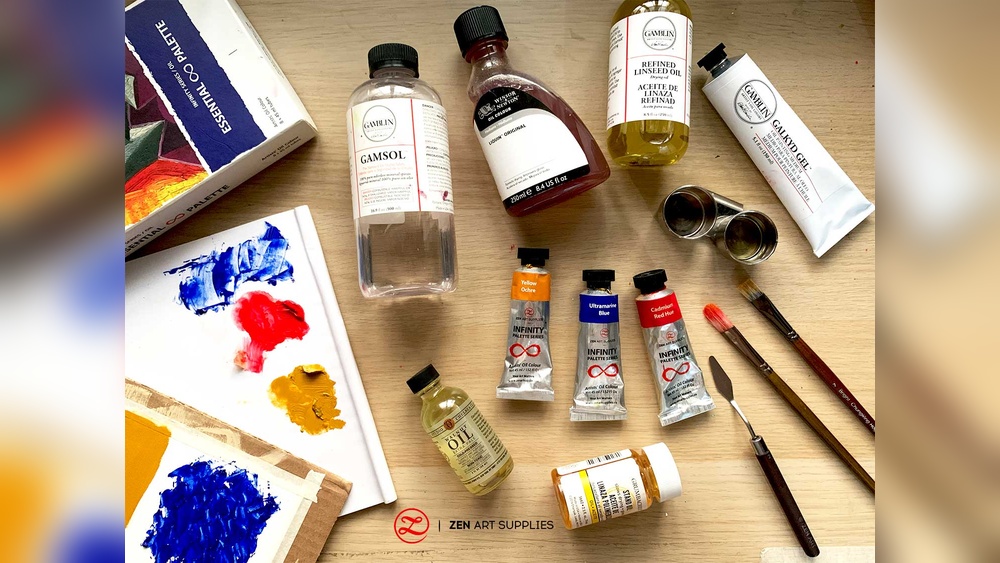
Walk into the oil painting aisle and the shelf of bottles can be more confusing than the paint itself: refined linseed, cold-pressed linseed, stand oil, safflower, poppy, odorless mineral spirits, alkyd mediums, glazing mediums, impasto gels, cold wax. They all change paint in one of a few ways: thinner or thicker, faster or slower drying, glossier or more matte, more transparent or more textured. Once you know which job each one does, choosing is simple.
This guide explains oil painting mediums in plain terms, how to use them safely with the fat over lean rule, and which combinations suit beginners. At the end you will find a short list of books that go deeper into technique and color.
Quick answer: Oil painting mediums are liquids or gels you mix into oil paint to change how it flows, dries and looks. The essentials are a solvent (such as odorless mineral spirits) to thin early layers and clean brushes, a drying oil (usually refined linseed) to add richness to later layers, and optionally an alkyd medium to speed drying and help glazing. Use more solvent in early layers and more oil in later layers, following fat over lean.
Oil Painting Mediums Explained: The Main Types
| Medium type | Examples | What it does | When to use it |
|---|---|---|---|
| Solvents | Odorless mineral spirits, gum turpentine | Thins paint, speeds evaporation, cleans brushes | Underpaintings and first layers; cleanup |
| Drying oils | Refined linseed, cold-pressed linseed, safflower, poppy, walnut | Adds flow and gloss, increases “fat” content | Middle and final layers |
| Thickened oils | Stand oil, sun-thickened linseed | Levels brush marks, adds gloss and flexibility | Glazes and smooth enamel-like finishes |
| Alkyd mediums | Alkyd resin gels and liquids | Speeds drying, improves flow and glazing | When you want faster layering |
| Glazing mediums | Oil- or alkyd-based glazing blends | Makes paint transparent while keeping body | Thin, luminous color layers |
| Impasto mediums | Thickening gels, cold wax medium | Bulks up paint, holds texture, often matte | Knife work and textured surfaces |
| Solvent-free mediums | Oil-based gels and fluids without solvent | Thins and extends without fumes | Studios with limited ventilation |
Solvents
Solvents do not stay in the paint film; they evaporate. That is why they make paint “lean.” Odorless mineral spirits (OMS) are the most common choice today because they are less pungent than turpentine, though “odorless” does not mean harmless, so ventilate. Gum turpentine is traditional and dissolves resins well but has a strong smell. Use solvents sparingly in paint; too much makes it weak, matte and chalky.
Linseed oil and other drying oils
Linseed oil is the binder in most oil paints, so adding a little makes paint more fluid and glossy and slows drying slightly. Refined linseed is pale and general-purpose. Cold-pressed linseed is prized for its quality. Safflower and poppy oils yellow less and are often used in whites and pale colors, but they dry more slowly and form softer films. Walnut oil is another traditional option with good flow.
Stand oil
Stand oil is linseed oil heated without air to thicken it. It is honey-like, levels out brush marks and forms a flexible, glossy film. Because it is thick, it is usually mixed with solvent or another oil rather than used alone.
Alkyd mediums
Alkyd mediums contain a synthetic resin that speeds drying, often to touch-dry overnight in thin layers, and improves flow for glazing. They are popular with painters who want to work in layers without waiting days. Use them in moderation and follow the label, since too much can make paint rubbery.
Glazing and impasto mediums
Glazing mediums let a small amount of paint spread into a thin, transparent veil over a dry layer, which deepens color and creates glow; our oil painting glazing technique guide walks through the process step by step. Impasto mediums and cold wax do the opposite: they bulk paint up so it holds knife and brush marks. Cold wax also gives a matte, layered surface popular in abstract work.
Fat Over Lean: The Rule Behind Every Medium
Oil paint dries by oxidizing, not by evaporating, and oilier layers stay flexible longer. If a lean, fast-drying layer sits on top of an oily, flexible layer, it can crack as the layer underneath keeps moving. The fix is to increase oil content as you go up:
- First layer (lean): paint thinned with solvent, for example roughly 1 part paint to 1 part solvent for a wash-like underpainting.
- Middle layers: paint with a little medium, such as a mix of solvent and oil.
- Final layers (fat): paint with more oil or an oil-rich medium, little or no solvent.
A traditional all-purpose painting medium mixes equal parts linseed oil, solvent and damar varnish. Many painters today simplify by using solvent early and an alkyd or oil medium later.
Beginner Medium Setups
| Setup | What you need | Good for |
|---|---|---|
| Simplest | Odorless mineral spirits + refined linseed oil | Learning fat over lean with two bottles |
| Faster drying | OMS + an alkyd medium | Layering and glazing in fewer days |
| Solvent-free | Linseed or safflower oil + a solvent-free gel | Small rooms, sensitive noses, home studios |
| Textural | Cold wax or impasto medium + OMS for cleanup | Abstract and knife painting |
Safety Notes for Oil Mediums
- Ventilate. Solvent vapors should not build up; open windows or use a fan pulling air outside.
- Oily rags can self-heat. Rags soaked in drying oils can spontaneously combust as they oxidize. Lay them flat to dry outdoors or store them in a sealed metal container filled with water before disposal.
- Keep solvents capped. Use a lidded brush washer and reuse settled solvent.
- Protect skin. Wear gloves or a barrier cream, and do not clean hands with solvent.
- Dispose responsibly. Take used solvent and sludge to a household hazardous waste site rather than pouring it down the drain.
Mediums vs Varnish
Mediums are mixed into paint while you work. Varnish is a separate protective layer applied once the painting is fully dry, often after six months or more for thick oil paintings. Varnish evens out the sheen and protects against dust and UV. For timing and technique, see our guide on how to varnish an oil painting correctly.
Supplies That Help: Recommended Books at a Glance
- The Encyclopedia of Oil Painting Techniques (Jeremy Galton) — Best for a visual reference to oil techniques
- Color Mixing Bible (Ian Sidaway) — Best for mixing color across media, including oil
- Color and Light: A Guide for the Realist Painter (James Gurney) — Best for understanding light and color in realism
- The Beginner’s Guide to Oil Painting (Craig Stephens) — Best for project-based learning for beginners
- The Beginners Guide to Plein Air Oil Painting (Jenny Aitken) — Best for painting outdoors with oils
| Product | Best For | Key Spec | Key Strength | Price Tier |
|---|---|---|---|---|
| The Encyclopedia of Oil Painting Techniques (Jeremy Galton) | a visual reference to oil techniques | Paperback, visual directory format | Technique-by-technique reference | $$ |
| Color Mixing Bible (Ian Sidaway) | mixing color across media, including oil | Paperback, covers oil, acrylic, watercolor and more | Broad color-mixing reference | $ |
| Color and Light: A Guide for the Realist Painter (James Gurney) | understanding light and color in realism | Paperback, Volume 2 of James Gurney Art | Focus on light and color behavior | $$ |
| The Beginner’s Guide to Oil Painting (Craig Stephens) | project-based learning for beginners | Paperback, simple still life projects | Step-by-step projects | $$ |
| The Beginners Guide to Plein Air Oil Painting (Jenny Aitken) | painting outdoors with oils | Paperback, 8 projects | Outdoor-focused projects | $$ |
How We Chose
We have not reviewed the full contents of these books. The selections are based on the Amazon listing details checked in October 2026, how well each book’s stated subject fits learning oil technique and color (the skills that make mediums useful), and how widely each title is reviewed by Amazon buyers. We favored:
- Clear subject focus: techniques, color mixing or light, as stated in the title.
- Beginner accessibility: project-based or visual reference formats.
- Established authors and publishers where the listing makes that clear.
Books That Help You Master Oil Technique
1. The Encyclopedia of Oil Painting Techniques (Jeremy Galton) — Best for a visual reference to oil techniques

As its subtitle says, this is a visual directory of oil painting techniques with guidance on how to use them. A reference format suits mediums well, because so many techniques, from glazing to impasto and scumbling, depend on how paint is thinned or thickened.
It is the kind of book you return to when you want to try a specific effect, rather than reading front to back.
Best suited for: Beginners and improving painters who want a technique reference to dip into while experimenting with mediums.
Key features:
- Paperback
- Visual directory of oil painting techniques
- Guidance on how to use each technique
- By Jeremy Galton
Pros:
- Easy to browse by technique
- Pairs well with medium experiments
- Useful long-term reference
Cons/limitations:
- Not a step-by-step course
- Listing gives limited detail on page count or edition
Buying consideration: Check the edition and preview pages on the listing before buying to confirm the format suits you.
2. Color Mixing Bible (Ian Sidaway) — Best for mixing color across media, including oil

The title promises all you need to know about mixing pigments in oil, acrylic, watercolor, gouache, soft pastel, pencil and ink. For oil painters, mediums change transparency, and transparency changes how mixed colors look, so a mixing reference is a natural companion.
Because it covers several media, it is also useful if you switch between oil and acrylic.
Best suited for: Painters who want to understand pigment mixing and work in more than one medium.
Key features:
- Paperback
- Covers oil, acrylic, watercolor, gouache, pastel, pencil and ink
- Focused on mixing pigments
- Ian Sidaway credited on listing
Pros:
- Useful across media
- Directly supports better color decisions
- Compact reference
Cons/limitations:
- Not oil-specific
- Less about mediums themselves
Buying consideration: Ideal if color mixing, rather than technique, is where you feel least confident.
3. Color and Light: A Guide for the Realist Painter (James Gurney) — Best for understanding light and color in realism

James Gurney’s book, as its title states, is a guide to color and light for realist painters. It sits a level above mediums: it is about seeing and representing light, which is what glazes, scumbles and opaque passages are ultimately for.
It suits painters who have the basics and want their work to look more convincing.
Best suited for: Intermediate painters interested in realism, landscape and figurative work.
Key features:
- Paperback
- Guide to color and light for realist painters
- Part of the James Gurney Art series
- By James Gurney
Pros:
- Builds deeper understanding of light
- Applicable to any medium
- Well-known title
Cons/limitations:
- Not a materials or mediums manual
- Better after the basics
Buying consideration: Pair it with a technique book if you also want practical medium instruction.
4. The Beginner’s Guide to Oil Painting (Craig Stephens) — Best for project-based learning for beginners

The subtitle describes simple still life projects to help you master the basics. Project-based books are a good way to practice fat over lean and basic medium use in a controlled setting, since still life subjects stay put while you learn.
It is a gentle starting point for someone who has just bought their first paints and mediums.
Best suited for: Complete beginners who learn best by following projects.
Key features:
- Paperback
- Simple still life projects
- Focused on mastering basics
- By Craig Stephens
Pros:
- Structured for beginners
- Projects give clear goals
- Still life is forgiving to practice
Cons/limitations:
- Limited to still life subjects
- Less depth for experienced painters
Buying consideration: Work through a few projects using a simple two-bottle medium setup to build habits.
5. The Beginners Guide to Plein Air Oil Painting (Jenny Aitken) — Best for painting outdoors with oils

This title covers learning to paint outdoors through eight simple projects. Plein air painting raises practical medium questions, such as how to keep kit minimal, use less solvent and transport wet paintings, so an outdoor-focused book complements this guide.
It suits painters ready to take a small oil kit outside.
Best suited for: Beginners interested in landscape and outdoor painting.
Key features:
- Paperback
- 8 projects
- Focused on plein air oil painting
- By Jenny Aitken
Pros:
- Practical outdoor focus
- Project-based
- Encourages painting from life
Cons/limitations:
- Specialized subject
- Less about studio mediums
Buying consideration: For outdoor work, a solvent-free medium setup keeps your kit lighter and safer.
Buying Guide: How to Choose Oil Painting Mediums
Start with two bottles
A solvent and a drying oil teach fat over lean better than a cupboard of specialty products. Add others only when you hit a specific need.
Choose by drying time
Want faster layers? Add an alkyd medium. Want more blending time? Use slower oils such as safflower or poppy and avoid driers.
Choose by finish
Stand oil and alkyds increase gloss; cold wax and some impasto gels give matte texture. Varnish can unify sheen at the end.
Choose by ventilation
If you paint in a bedroom or small apartment, solvent-free mediums and careful cleanup methods reduce fumes.
Check compatibility
Stick to mediums labeled for oil paint, and do not mix acrylic mediums into oils.
Common Mistakes to Avoid
- Using solvent in every layer. Top layers become lean and can crack or look dull.
- Adding too much oil early. Fat underlayers break the fat over lean rule.
- Overusing alkyds or driers. Too much can cause brittleness or wrinkling.
- Throwing oily rags in the trash. They can self-heat; store or dry them safely.
- Varnishing too soon. Wait until the painting is fully dry.
- Painting in an unventilated room with solvents. Fumes build up quickly.
FAQs
What is the best oil painting medium for beginners?
A simple setup of odorless mineral spirits and refined linseed oil is the easiest way to learn. An alkyd medium is a good third bottle if you want faster drying.
Do I need a medium for oil painting?
Not always. You can paint straight from the tube, but mediums help with thin underpaintings, glazes, faster drying and following fat over lean.
What is the difference between linseed oil and stand oil?
Stand oil is linseed oil thickened by heating. It is thicker, levels brush marks, adds gloss and yellows less than raw linseed in many uses.
Can I oil paint without solvents?
Yes. Solvent-free mediums and oil-only methods let you thin paint and clean brushes with oil and soap instead of solvent.
What medium makes oil paint dry faster?
Alkyd mediums are the most common way to speed drying. Thin layers and lean early layers also dry faster.
What is fat over lean?
It means each layer should contain the same or more oil than the one beneath, which helps prevent cracking as the painting dries.
Final Recommendation
Begin with odorless mineral spirits and refined linseed oil, paint lean to fat, and add an alkyd medium if waiting for layers to dry slows you down. Choose stand oil for smooth glazes, cold wax or impasto medium for texture, and solvent-free options if ventilation is limited. To deepen your technique, start with Jeremy Galton’s technique encyclopedia, add Ian Sidaway’s Color Mixing Bible for color, and move on to James Gurney’s Color and Light when you are ready to study light itself.