PaintingProGuide is reader-supported. When you buy through links on this page we may earn an affiliate commission at no extra cost to you.
The best online painting classes for kids are short, age-matched and interactive enough to keep a child engaged, with a teacher who demonstrates slowly and a supply list a family can actually gather. For children under about seven, that usually means brief, playful video lessons with a parent nearby. For ages seven to twelve, live small-group classes add feedback and social motivation. Teens can handle longer recorded courses that teach real technique in watercolor or acrylic.
This guide explains the main types of online classes, how to judge quality and safety before you sign up, how to set up a home “classroom,” and which books and supply kits from the Amazon listings we checked pair well with online lessons.
Quick answer: Pick the format by age: short recorded videos for ages 3 to 6, live small-group classes for ages 7 to 12, and structured recorded courses for teens. Whatever class you choose, have supplies ready before it starts; the Inburit Acrylic Paint Set with Canvas covers most acrylic lessons, and a step-by-step book like How to Paint in Watercolor for Kids gives kids something to practice between sessions.
Types of Online Painting Classes for Kids
Live small-group classes
A teacher leads a scheduled video session for a handful of children. Kids can ask questions, show their work and get feedback in real time. Class marketplaces such as Outschool list many of these, run by independent teachers. Live classes suit ages seven and up who can follow instructions on screen and benefit from accountability.
Recorded video lessons
Pre-recorded tutorials kids can pause and replay. Free channels on YouTube, such as Art for Kids Hub, are popular for drawing and simple painting projects. Recorded lessons are flexible and low-cost but offer no personal feedback, so a parent’s encouragement matters more.
Structured courses
Multi-lesson programs that build skills in sequence, such as a watercolor course covering washes, blending and layering over several weeks. These suit older kids and teens who want to improve, not just complete a project.
Local studios offering virtual sessions
Many community art centers and private teachers run online versions of their in-person classes. They often feel more personal and may offer occasional in-person meetups.
How to Choose a Good Online Painting Class
- Age range: a class for “ages 5 to 12” is often too broad; narrower ranges keep pacing right.
- Class length: 20 to 30 minutes for young children, 45 to 60 minutes for older kids.
- Group size: six to ten children allows real feedback in live classes.
- Teacher background: look for experience teaching children, not just painting skill.
- Clear supply list: good classes publish materials in advance with affordable substitutes.
- Camera setup: an overhead view of the teacher’s hands and paper makes demonstrations easier to follow.
- Trial or sample lesson: lets your child see whether the teacher’s style clicks.
Getting the Most From Each Class
Online classes demand more from families than in-person ones, because the teacher cannot walk over and adjust a brush grip or top up a water cup. A few habits close that gap.
Before class
Do a two-minute tech check: camera angle, sound, and a charged device. Lay out every supply on the list, fill both water cups and tape the paper down so it does not slide. If the teacher shares a reference image in advance, look at it together so your child knows what they are aiming for.
During class
For younger children, sit nearby without taking over. Help with practical things, like squeezing paint or rinsing a brush, and let the child make the creative choices. Encourage older kids to ask the teacher questions and hold their work up to the camera when invited; that feedback is what makes a live class worth paying for.
After class
Ask your child to explain one thing they learned and one thing they would change next time. Date the painting and keep it in a folder or on a wall; looking back after a few months shows real progress and keeps motivation high.
Safety and Privacy for Kids’ Online Classes
- Use platforms that verify teachers and offer parent accounts.
- Check whether classes are recorded and how recordings are stored.
- Turn off private chat features where possible.
- Keep the device in a shared space, not a bedroom, for younger children.
- Teach kids not to share last names, schools or locations on camera.
- Stay within earshot for the first few sessions.
Setting Up a Home Painting Classroom
- Position the screen at eye level beside the painting area, not on it.
- Cover the table with a washable cloth or newspaper.
- Lay out supplies before class so no lesson time is lost searching.
- Use two water cups: one for rinsing, one clean for mixing.
- Keep paper towels nearby for blotting brushes.
- Allow drying space for finished work after class.
Supplies That Help: Our Top Picks at a Glance
- Inburit Acrylic Paint Set with Canvas — Best all-in-one kit for acrylic classes
- How to Paint in Watercolor for Kids (Jennifer Margrave-Garcia) — Best practice book for ages 8 to 11
- My First Watercolor Painting (Maple & Moss) — Best practice book for ages 3 to 7
- Painting with Bob Ross for Kids — Best for landscape-loving kids
- goldentime 8 Pack 5×7 Pre-Drawn Canvas Set — Best for project-style classes
- goldentime 6 Pre-Drawn Canvas Paint by Number Kit — Best guided canvas practice
- YPLUS Paint with Water Coloring Books — Best for toddlers watching along
| Product | Best For | Key Spec | Key Strength | Price Tier |
|---|---|---|---|---|
| Inburit Acrylic Set | Acrylic classes | 18 colors, 8 brushes, 5 canvas panels 8×10, pad | Complete starter kit | $$ |
| How to Paint in Watercolor for Kids | Ages 8-11 | Step-by-step watercolor book | Flowers, animals, characters | $ |
| My First Watercolor Painting | Ages 3-7 | Step-by-step watercolor book | Very young beginners | $ |
| Painting with Bob Ross for Kids | Landscapes | Simple lessons | Famous TV painter’s approach | $ |
| goldentime 5×7 Pre-Drawn, 8 Pack | Project classes | 8 canvases, 48 paints, 8 brushes | Ready-made outlines | $$ |
| goldentime 6 Canvas Paint by Number | Guided practice | 6 canvases 6×6, 17 paints, 6 brushes | Numbered designs | $$ |
| YPLUS Paint with Water Books | Toddlers | 20 pages, 7 themes, thick paper | No-mess water painting | Varies |
How We Chose
We have not taken these classes or used these supplies with children. The supply picks are based on the Amazon listing details and specifications checked in October 2026, how well each product supports typical online kids’ painting lessons, and how widely each product is reviewed by Amazon buyers. For books, the listings give titles, authors and stated age ranges, which is what we describe.
Best Supplies for Online Painting Classes for Kids Reviewed
1. Inburit Acrylic Paint Set for Kids and Adults with Canvas — Best for acrylic-based online classes

Inburit’s kit includes 18 acrylic colors, eight assorted brushes, five 8 x 10 inch canvas panels, a 15-sheet acrylic paper pad and a plastic palette, according to the listing. That covers the standard supply list for most beginner acrylic classes: enough colors to mix, a range of brush shapes, and both canvas and paper.
Having canvas panels and a paper pad means kids can practice on paper and save the canvases for finished pieces.
Best suited for: Kids around 8 and up joining acrylic painting classes.
Key features:
- 18 acrylic colors
- 8 brushes
- 5 canvas panels, 8 x 10 inches
- 15-sheet acrylic paper pad
- Palette
Pros:
- Covers most class supply lists
- Practice paper plus canvases
- Gift-ready box
- Mid price tier
Cons and limitations:
- Acrylic is not washable once dry
- Younger children may need washable paint instead
Buying consideration: Check the class supply list against the kit; most beginner acrylic lessons ask for exactly these basics.
2. How to Paint in Watercolor for Kids by Jennifer Margrave-Garcia — Best for practice between watercolor classes for ages 8 to 11

The title describes a step-by-step beginner art book covering flowers, plants, animals and characters for ages 8 to 11. It is a good companion to online watercolor classes: kids can repeat techniques from class with a structured project.
It sits in the low price tier, making it an easy addition.
Best suited for: Kids aged 8 to 11 taking watercolor classes.
Key features:
- Paperback
- Step-by-step projects
- Ages 8 to 11 per title
Pros:
- Age-matched
- Varied subjects
- Low price tier
Cons and limitations:
- Requires separate watercolor supplies
- Listing gives limited content detail
Buying consideration: Use it on non-class days so skills keep building between sessions.
3. My First Watercolor Painting by Maple & Moss — Best for practice for ages 3 to 7

This paperback is described as an easy step-by-step watercolor book for beginners aged 3 to 7. Young children often find live classes too fast; a book they can follow at their own pace with a parent is a gentle complement or alternative.
Best suited for: Young children starting watercolor with a parent.
Key features:
- Paperback
- Ages 3 to 7 per title
- Step-by-step
Pros:
- Pitched at very young beginners
- Lowest price tier among the books
Cons and limitations:
- Needs watercolor supplies
- Simple projects may not challenge older kids
Buying consideration: Pair it with a basic washable watercolor set and thick paper so the paper does not tear when wet.
4. Painting with Bob Ross for Kids — Best for landscape-loving kids

Published by Bob Ross Inc., this book promises simple-to-follow lessons that help kids paint in the style of the famous television painter. For children who enjoy watching recorded painting videos, it offers a printed path through landscape basics.
Best suited for: Kids who love painting skies, trees and mountains.
Key features:
- Paperback
- Simple lessons
- Landscape focus
Pros:
- Familiar approach many families enjoy
- Low price tier
Cons and limitations:
- Landscape-only focus
- Bob Ross’s full technique uses oil paints adults should handle
Buying consideration: Use acrylic or washable paint for kids rather than the oil-based materials associated with the TV show.
5. goldentime 8 Pack 5×7 Pre-Drawn Canvas Set — Best for project-style classes
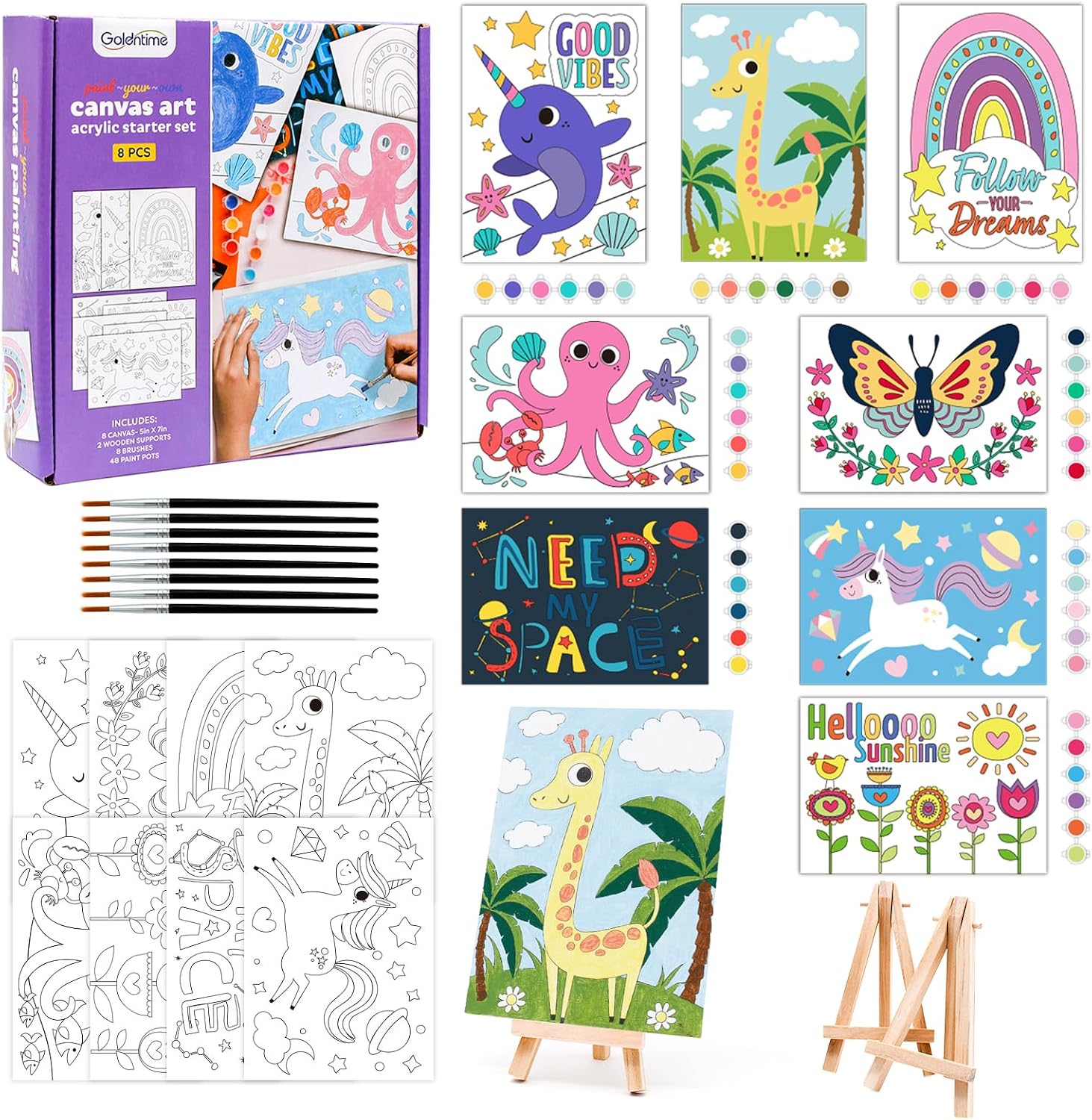
goldentime’s set includes eight 5 x 7 inch pre-drawn canvases, eight brushes, two easels and 48 paint pots. Canvases are gesso-primed with crisp black outlines.
Many online kids’ classes are project-based (“paint a unicorn today”), and pre-drawn canvases let younger children keep up without needing to sketch first.
Best suited for: Ages 4 to 8 following project-of-the-week classes.
Key features:
- 8 pre-drawn 5×7 canvases
- 48 paint pots
- 8 brushes, 2 easels
Pros:
- Removes the drawing step
- Enough for several sessions
- Low-to-mid price tier
Cons and limitations:
- Fixed designs limit creativity
- Small canvases
Buying consideration: Save a few canvases for free painting so kids also practice their own ideas.
6. goldentime Kids Paint by Number Kit, 6 Pre-Drawn Canvases — Best for guided canvas practice

This goldentime kit includes six 6 x 6 inch pre-drawn, numbered canvases, six brushes, 17 paints and two easels, for ages 4 to 12 according to the listing. Numbered designs teach color placement and brush control.
Best suited for: Kids who enjoy calm, guided painting between classes.
Key features:
- 6 pre-drawn 6×6 canvases
- Numbered designs
- 17 paints, 6 brushes, 2 easels
Pros:
- Guided success
- Wide age range
- Mid price tier
Cons and limitations:
- Less creative freedom
- Detailed numbering may frustrate youngest kids
Buying consideration: Treat these as brush-control practice rather than creative projects.
7. YPLUS Paint with Water Coloring Books for Toddlers — Best for toddlers watching along

YPLUS’s book has 20 pages across seven themes with super-thick paper designed to prevent water bleeding through, according to the listing. Number guides on each pattern lead kids to match colors, and pages tear out easily.
Younger siblings often want to join when an older child takes a class. A paint-with-water book lets them paint alongside with almost no mess.
Best suited for: Toddlers aged 1 to 3 and younger siblings.
Key features:
- 20 pages, 7 themes
- Thick paper
- Number-guided coloring
- Tear-out pages
Pros:
- Very low mess
- Keeps little ones involved
Cons and limitations:
- Not a skill-building tool for older kids
- Price not listed in our check
Buying consideration: Give the toddler their own water cup and brush at the same table so they feel part of the class.
Buying Guide: Choosing Online Classes and Supplies Together
Start with your child’s age and attention span
Short recorded lessons for under 7, live 45-minute classes for 7 to 12, and longer courses for teens.
Pick the medium
Watercolor is low-mess and forgiving; washable tempera is great for little ones; acrylic suits older kids and canvas projects.
Read the supply list before buying
Buy only what the class requires at first. All-in-one kits like Inburit cover most acrylic lists.
Try before committing
Book a single class or watch a free sample video before paying for a series.
Plan practice between classes
A step-by-step book keeps skills building on off days.
Value feedback
Live classes that show and discuss student work help kids improve faster than passive watching.
Free projects are a good way to try painting at home before signing up. Our easy guides to painting a dinosaur for kids, painting a ladybug and making painted rock critters work like short video lessons in written form.
Common Mistakes to Avoid
- Choosing classes that are too long: young kids lose focus after 20 to 30 minutes.
- Buying every supply on the list at premium quality: student-grade materials are fine for kids.
- Setting up at the last minute: scrambling for water and paper wastes class time.
- Ignoring privacy settings: check how platforms handle chat and recordings.
- Expecting identical results to the teacher: praise effort and personal choices.
- Using adult oil painting materials: stick to kid-appropriate paints.
FAQs
What age can kids start online painting classes?
Children around 3 to 6 can enjoy short recorded lessons with a parent. Live classes usually work best from about age 7, when kids can follow on-screen instructions.
Are live or recorded classes better for kids?
Live classes offer feedback and social motivation; recorded lessons are flexible and inexpensive. Many families mix both.
What supplies do kids need for an online painting class?
Check the class list. Most need paint, a few brushes, paper or canvas, two water cups, paper towels and a covered table. All-in-one kits like the Inburit set cover common acrylic lists.
How long should an online painting class be for kids?
About 20 to 30 minutes for young children and 45 to 60 minutes for older kids and teens.
Are free YouTube painting lessons good for kids?
Many are excellent for fun projects. They lack personal feedback, so parents can help by encouraging kids and talking about their work.
How do I keep my child safe in live online classes?
Use platforms with verified teachers, limit private chat, keep the device in a shared space, and remind kids not to share personal details.
Final Recommendation
The best online painting class is the one that fits your child’s age, attention span and interests: playful recorded lessons for preschoolers, live small-group classes for school-age kids, and structured courses for teens. Try a sample before committing, and choose classes with clear supply lists and teachers experienced with children.
Set your child up with the right materials before the first lesson. The Inburit Acrylic Set covers most acrylic classes, How to Paint in Watercolor for Kids and My First Watercolor Painting keep practice going between sessions, and goldentime pre-drawn kits help younger kids keep pace with project classes. Younger siblings can join in with a YPLUS paint-with-water book.