PaintingProGuide is reader-supported. When you buy through links on this page we may earn an affiliate commission at no extra cost to you.
Glass is the least forgiving surface most crafters paint on. It has no tooth to grab paint, so every brushstroke, ridge and streak shows, and light passing through the glass reveals thin spots that look fine on an opaque surface. The best paint brushes for painting glass are soft synthetic brushes that lay paint down smoothly without dragging: flat and filbert shapes for even fills, fine rounds and liners for outlines and lettering, and very small detail brushes for dots and fine designs on wine glasses, jars, ornaments and windows. Because glass paints and enamels can be hard on brushes, inexpensive multi-packs make sense.
Quick answer: For most glass projects, the Benicci 12-piece brush set is our top pick: soft nylon flats, rounds, fans and filberts that the listing says do not shed, which matters because a stray bristle shows under transparent glass paint. For fine outlines, dots and lettering on glassware, the pacocoast 12-piece detail set runs down to size 2/0 with triangular handles. For classrooms and big batches of ornaments or jars, the ONEXIZ 162-piece bulk pack gives you flat and round brushes in quantity.
How Glass Changes Your Brush Choice
Smooth, non-porous surface
Paint sits on top of glass rather than soaking in. Stiff bristles drag through wet paint and leave ridges. Soft synthetic filaments glide and let paint level out.
Transparency shows everything
Translucent glass paints reveal overlapping strokes and uneven thickness when light shines through. Load the brush well and lay paint in one direction with minimal reworking.
Paint types
Crafters use water-based glass and tile paints, enamel paints, and acrylic paints with a glass medium. Many glass paints are designed to be oven-cured or air-cured for durability; always follow the paint label. Some solvent-based glass paints require brushes cleaned with a specific cleaner.
Outlines and stained-glass effects
Faux stained glass uses raised outliner, then fills cells with transparent color. Small rounds and liners help with neat fills inside the outlines.
Shedding is visible
A loose bristle trapped in glass paint is obvious. Choose brushes with well-crimped ferrules and rinse new brushes before first use to remove loose fibers.
Stippling as an alternative
For large, even coverage, many glass painters stipple with a sponge dauber rather than brushing. Brushes then handle detail and edges.
Our Top Picks at a Glance
- Benicci 12-Piece Professional Brush Set — Best overall brushes for glass painting
- pacocoast 12-Piece Detail Paint Brushes — Best for outlines, dots and lettering
- Soucolor 20-Piece Pointed Tip Brushes — Best budget rounds for glassware
- Phinus 20-Piece Pointed Round Brushes — Best alternative fine rounds
- ONEXIZ 162-Piece Bulk Brush Set — Best for classrooms and batch projects
- AROIC 60-Piece Paint Brush Set — Best mid-size multi-pack
- AROIC 10-Piece Paint Brush Set — Best small starter set
| Product | Best For | Key Spec | Key Strength | Price Tier |
|---|---|---|---|---|
| Benicci 12-Piece | Smooth fills and edges | Flat, round, fan, filbert; nylon; non-shedding claim | Soft, shaped for fills | $ |
| pacocoast 12-Piece Detail | Outlines, dots, lettering | Rounds 2/0–9 plus angle and flat; nylon; triangular handles | Fine points | $ |
| Soucolor 20-Piece | Budget glassware | 20 pointed rounds, 10 sizes, nickel ferrules | Two of each size | $ |
| Phinus 20-Piece | Fine rounds | 20 rounds, 10 sizes, nylon, double crimped | Very low cost | $ |
| ONEXIZ 162-Piece | Batch projects | 81 flats + 81 rounds, nylon, aluminum ferrules | Huge quantity | $ |
| AROIC 60-Piece | Groups | 60 brushes in 10 sizes, nylon, nickel ferrules | Mid-size bulk | $ |
| AROIC 10-Piece | Starter | 10 brushes in 10 sizes, nylon | Lowest upfront cost | $ |
How We Chose
We selected these brushes from the Amazon listing details and specifications checked in October 2026, judging how well each set’s filament softness, shapes and sizes suit painting on glass, and how widely each product is reviewed by Amazon buyers. We have not painted glass with these brushes. Durability and shedding claims are as stated by each maker.
- Soft synthetic filaments that glide on smooth surfaces.
- Fine points for outlines and details.
- Flat and filbert shapes for even fills.
- Shedding resistance claimed in the listing.
- Quantity and cost, since glass paints can be hard on brushes.
Best Paint Brushes for Painting Glass Reviewed
1. Benicci 12-Piece Professional Brush Set — Best for smooth fills and edges

Benicci’s 12-piece set includes flat, round, fan and filbert shapes in high-grade nylon that the listing says keeps its shape, does not shed and holds paint evenly. The handles are ergonomic wood, and the set is sold for acrylic, watercolor and mixed media, with fabric, wood and board also mentioned.
On glass, the flats and filberts are the workhorses. A soft flat lays a band of color across a jar or panel in one pass, and a filbert softens the edge of a fill. Rounds handle petals and leaves.
The non-shedding claim is particularly relevant here, because a single bristle trapped in transparent glass paint ruins a clean finish.
Best suited for: Crafters painting glass jars, vases, windows and panels who want a reliable mid-range set.
Key features:
- 12 brushes
- Flat, round, fan and filbert
- Nylon bristles
- Ergonomic wooden handles
Pros:
- Soft fills
- Shedding resistance stated
- Useful shapes
Cons and limitations:
- No very fine detail brushes
- Mid price tier
Buying consideration: Rinse new brushes in warm soapy water before first use to remove any loose fibers.
2. pacocoast 12-Piece Detail Paint Brushes — Best for outlines, dots and lettering

pacocoast’s detail set includes rounds from 2/0 to 9 plus additional shapes, with soft synthetic nylon bristles, chrome-plated copper ferrules and triangular birch handles coated with UV-cured paint. The listing describes them for fine detailing and reaching tight spots.
Glassware designs, such as names on wine glasses, dots around a jar rim or vines on a vase, rely on small, controlled marks. A triangular handle helps keep the brush steady on a curved surface.
Best suited for: Painters adding lettering, dots and fine designs to glassware.
Key features:
- 12 detail brushes
- Rounds 2/0 to 9
- Nylon bristles
- Chrome-plated copper ferrules
- Triangular handles
Pros:
- Fine points
- Ergonomic grip
- Good for curved surfaces
Cons and limitations:
- Detail only
- Small brushes wear with heavy enamel
Buying consideration: Thin glass paint slightly with its recommended medium for flowing lines.
3. Soucolor 20-Piece Pointed Tip Brushes — Best for budget glassware projects

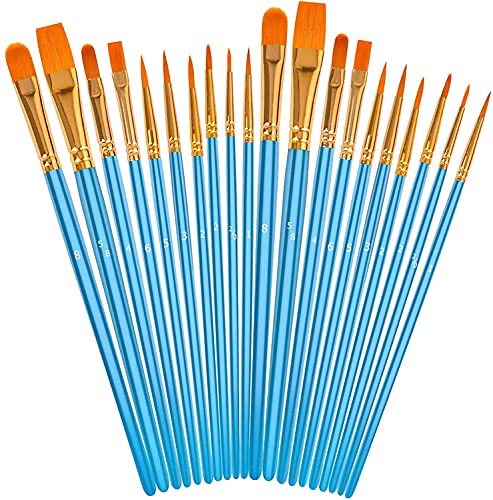
Soucolor’s set has 20 pointed brushes in 10 sizes with nickel ferrules and blue wooden handles. The listing names glass, cups and ceramics among its uses, along with enamel, acrylic and watercolor, and says bristles return to shape after washing.
Two of each size lets you keep one brush per color for transparent glass paints, which avoids muddy mixes.
Best suited for: Budget glass and ceramic painters.
Key features:
- 20 brushes, 10 sizes
- Pointed tips
- Nickel ferrules
- Glass listed as a use
Pros:
- Very low cost
- Two of each size
- Glass and enamel named
Cons and limitations:
- Rounds only
- No flats for large fills
Buying consideration: Dedicate one set to solvent-based glass paints if you use them.
4. Phinus 20-Piece Pointed Round Brushes — Best for fine rounds

Phinus offers 20 round-pointed brushes in 10 sizes down to 2/0, with nylon bristles, rust-resistant nickel ferrules and double-crimped wooden handles. The listing highlights tiny dots and precise details.
For dot mandalas on glass ornaments and fine lines on jars, these work similarly to the Soucolor set.
Best suited for: Crafters who need many small rounds for dots and lines.
Key features:
- 20 brushes, 10 sizes
- Nylon
- Nickel ferrules
- Double crimped
Pros:
- Very low price tier
- Fine tips
Cons and limitations:
- Rounds only
Buying consideration: Use the smallest sizes for dots and the larger rounds for petals.
5. ONEXIZ 162-Piece Bulk Brush Set — Best for classrooms and batch projects

ONEXIZ’s bulk pack contains 81 flat brushes with a 0.59 inch edge and 81 round brushes with 0.39 inch tips. The listing describes triple-crimped nylon bristles and aluminum ferrules, and mentions ceramic decorating and classroom projects.
Glass painting events, like holiday ornament workshops or jar-painting classes, need a lot of brushes, and glass paints often ruin a few. A bulk pack lets you hand out fresh brushes freely.
Best suited for: Teachers, workshop hosts and batch crafters.
Key features:
- 162 brushes
- 81 flats (0.59″) + 81 rounds (0.39″)
- Nylon
- Aluminum ferrules
Pros:
- Huge quantity
- Low cost per brush
- Two practical shapes
Cons and limitations:
- Only two sizes
- Basic quality
Buying consideration: Pre-sort brushes into cups by shape before an event.
6. AROIC 60-Piece Paint Brush Set — Best for a mid-size multi-pack

AROIC’s 60-piece set includes 10 sizes in various shapes with nylon bristles, anti-rust nickel ferrules and solid wood handles. The listing says the bristles resist falling out and give smooth, streak-free strokes.
Sixty brushes covers a household or small class with plenty of spares for glass paint, which can be harder to clean than acrylic.
Best suited for: Families and small groups painting glass.
Key features:
- 60 brushes
- 10 sizes
- Nylon
- Nickel ferrules
Pros:
- Good quantity
- Range of sizes
- Low price tier
Cons and limitations:
- Budget build
Buying consideration: Clean brushes immediately after glass paint; it sets quickly.
7. AROIC 10-Piece Paint Brush Set — Best for a small starter set

The ten-piece AROIC set covers 10 sizes with the same nylon bristles and nickel ferrules as the larger pack.
It is an inexpensive way to try glass painting on a few jars or a window before buying more.
Best suited for: First-time glass painters.
Key features:
- 10 brushes
- 10 sizes
- Nylon
- Nickel ferrules
Pros:
- Lowest upfront cost
- Range of sizes
Cons and limitations:
- Few brushes
- Basic quality
Buying consideration: Pair it with a sponge dauber for large fills.
Glass Projects and the Brushes They Need
Wine glasses and tumblers
Curved stemware is painted mostly with small rounds and fine detail brushes. Hold the glass by the stem or slip your hand inside a tumbler, and rotate it rather than moving the brush around the curve. Dots, vines, initials and polka dots are classic designs. Keep paint below the rim.
Mason jars and vases
Larger, flatter areas suit soft flats and filberts. Many crafters paint the inside of clear jars with a pour or a sponge for an even frosted color, then add details on the outside with rounds.
Ornaments
Glass ornaments are fragile and round. A small flat lays down bands of color, and a fine round adds names and dates. Hang ornaments from a dowel to dry so nothing touches the wet paint.
Windows and suncatchers
Window art uses transparent paints and often a raised outliner. Small rounds and liners fill each cell neatly, working paint into the corners before it sets. Light shining through will show every gap, so fill fully.
Picture frame glass and panels
Flat glass is the easiest to paint because you can work on a table. A pattern taped underneath acts as a guide. Flats and filberts cover large areas; detail brushes handle the design.
Reverse glass painting
In reverse painting, you paint on the back of the glass, starting with highlights and details and finishing with the background. Fine detail brushes are essential for the first layers, and flats finish the background.
How to Paint on Glass With a Brush
- Wash the glass with soapy water, dry it, then wipe with rubbing alcohol to remove oils.
- Tape a paper pattern inside a jar or behind a panel to trace designs.
- Load the brush generously and lay paint in one direction; avoid going back over partly dry paint.
- Let each color dry before painting next to it, unless you want colors to blend.
- For large areas, stipple with a sponge for even coverage.
- Cure according to the paint maker’s instructions, which may involve air drying for days or baking in an oven.
- Keep paint away from rims that touch lips and food surfaces unless the product label says it is safe for that use.
Buying Guide: How to Choose Brushes for Glass
Soft synthetic bristles
Soft nylon and taklon reduce brush marks on smooth glass. Stiff hog bristle and cheap craft brushes leave visible ridges that show when light comes through the glass.
Shapes
Flats and filberts for fills, rounds for shapes, fine rounds and liners for detail. A set that combines these saves buying brushes one by one.
Size range
Include sizes from 2/0 for dots up to wider flats for bands of color. Curved glassware favors smaller brushes, because a wide flat cannot follow a tight curve.
Shedding resistance
Look for crimped ferrules and listings that address shedding, and rinse new brushes before the first use.
Quantity
Glass paints can be tough on brushes; inexpensive packs let you replace them freely. Many glass painters keep a “good” set for visible finish work and a cheap set for outliners, mediums and experiments.
Cleanup compatibility
Match brush cleaning to your paint: water for water-based, the recommended cleaner for solvent-based. Clean promptly, since many glass paints are formulated to bond hard once dry.
Related Brush Care Guides
Keep brushes in shape for smooth glass work. See how to keep paint brushes from shedding and how to dry paint brushes correctly.
Common Mistakes to Avoid
- Skipping the alcohol wipe, so paint beads or peels.
- Overworking strokes and leaving ridges.
- Using stiff bristle brushes that drag through paint.
- Painting where lips or food will touch without checking the label.
- Letting glass paint dry in the brush.
- Touching or stacking pieces before the paint has cured, which leaves fingerprints and scuffs that are hard to fix.
- Painting in a dusty room; specks settle on wet glass paint and show clearly when light passes through.
FAQs
What brushes are best for painting glass?
Soft synthetic brushes: flats and filberts for fills and fine rounds for detail.
How do I avoid brush strokes on glass?
Use soft brushes, load them well, paint in one direction and avoid reworking. Stipple large areas with a sponge.
Can I use acrylic paint on glass?
Yes for decorative pieces, ideally with a glass medium or a paint made for glass. Follow the product’s curing instructions.
Do I need special brushes for glass paint?
No, but soft synthetic artist brushes give smoother results than stiff craft brushes.
How do I clean brushes after glass paint?
Use water for water-based glass paint and the maker’s recommended cleaner for solvent-based paint.
Can painted glass go in the dishwasher?
Only if the paint label says so after proper curing; many painted pieces should be hand washed.
Final Recommendation
Choose the Benicci 12-piece set for smooth fills and edges, and add the pacocoast detail brushes for lettering and dots. Soucolor and Phinus are inexpensive rounds for glassware. For workshops, the ONEXIZ 162-piece pack and AROIC 60-piece set supply plenty of brushes, while the AROIC 10-piece set is a low-cost way to try glass painting.