PaintingProGuide is reader-supported. When you buy through links on this page we may earn an affiliate commission at no extra cost to you.
Stain is not paint. It is thin, it soaks into the wood rather than forming a film, and its color depends on how much the wood absorbs before you wipe away the excess. That changes what a good stain brush has to do. It needs to carry plenty of thin liquid without dripping everywhere, spread it quickly and evenly so one area does not soak up more than the next, and get into grain, corners and carvings. The best paint brushes for staining are wide, dense brushes for large flat surfaces, inexpensive chip and foam brushes for furniture and small projects where you wipe back the stain, and a small angled brush for edges and inside corners. Filament matters less than with paint, but follow the stain label: synthetic for water-based stains, natural bristle or blends for oil-based.
Quick answer: For furniture, frames and small woodworking projects, the Bates 16-pack of 2 inch foam brushes is the most practical pick: foam spreads thin stain evenly without brush marks or loose bristles, and at this price you can use a fresh one for each color. For larger flat surfaces like tabletops, doors and paneling, the Bates 4 inch deck stain brush 2-pack covers ground quickly. For general stain work with real bristles, the Genixart 3 inch double-thick brush is listed for water and oil-based stains.
How Staining Differs From Painting
Penetration, not coverage
Stain soaks into wood fibers. The goal is an even amount of stain across the surface, applied quickly, then wiped back after the time on the label. The brush is mainly a delivery tool.
Wipe-on, wipe-off
For most interior stains, you brush or wipe stain on, wait a few minutes, then wipe off the excess with a clean rag. That makes brush marks largely irrelevant, which is why inexpensive brushes work well.
Gel stains
Gel stains are thicker and sit more on the surface. They are often applied with foam brushes or rags and wiped back gently.
Exterior and deck stains
Exterior stains for decks and siding are often left on rather than wiped off, so brushing quality and back-brushing matter more. Wide, dense brushes are the standard.
Blotchy woods
Pine, maple, birch and cherry can absorb stain unevenly. A pre-stain wood conditioner, applied with any brush, helps even absorption.
Topcoats
After staining, most projects get a clear topcoat. That step deserves a better brush than the stain itself; see our wood brush guide for finish brushes.
Our Top Picks at a Glance
- Bates 16-Pack 2 Inch Foam Brushes — Best overall for furniture and small projects
- Bates 4 Inch Deck Stain Brush, 2-Pack — Best for large flat surfaces
- Genixart 3 Inch Double Thick Stain Brush — Best all-round bristle stain brush
- Great Andrew 10-Pack 2 Inch Flat Brushes — Best bulk bristle brushes for stain
- Newkita 3-Piece Chip Brushes — Best disposable chip brushes
- Pro Grade 5-Piece Brush Set — Best for corners, edges and trim
- Bates 6-Pack Flat and Angled Brushes — Best budget set for oil-based stain
| Product | Best For | Key Spec | Key Strength | Price Tier |
|---|---|---|---|---|
| Bates Foam 16-Pack | Furniture, frames, crafts | 16 x 2″ foam brushes, wooden handles | No bristles, no brush marks | $ |
| Bates 4″ Stain 2-Pack | Tabletops, doors, decks | 2 x 4″ synthetic stain brushes | Wide coverage | $ |
| Genixart 3″ Double Thick | General staining | 3″ synthetic and tapered nylon, double-thick | Water and oil stains listed | $ |
| Great Andrew 10-Pack 2″ | Bulk staining | 10 x 2″ flat, dense bristles, plastic handles | Cheap per brush | $ |
| Newkita Chip 3-Pack | Wipe-on stain, gesso | 3 chip brushes, synthetic | Disposable | $ |
| Pro Grade 5-Piece | Edges and trim | Flats, angles and angle stubby; SRT filament | Reaches corners | $ |
| Bates 6-Pack | Oil-based stain | 3 flat, 3 angled, natural/synthetic blend | Natural bristle blend | $ |
How We Chose
We chose these brushes from the Amazon listing details and specifications checked in October 2026, by how well each brush’s width, material and price suit applying wood stain, and by how widely each product is reviewed by Amazon buyers. We have not stained wood with these brushes. Material and compatibility claims are as stated in the listings.
- Liquid capacity for thin stains.
- Width matched to project size.
- Low cost per use, since stain brushes are often discarded.
- Compatibility with water-based and oil-based stains.
- Reach for corners and carvings.
Best Paint Brushes for Staining Reviewed
1. Bates 16-Pack 2 Inch Foam Brushes — Best for furniture and small projects

Bates’ foam brushes come in a 16-pack at 2 inches wide, with foam tips securely glued to wooden handles. The listing says they cover evenly with fewer strokes, work with any type of paint or varnish on virtually any surface, and have absorbent foam cells that reduce dripping. Window frames, door jambs and other narrow areas are named as good uses.
For staining, foam has real advantages. There are no bristles to shed into the stain, the foam spreads thin liquid evenly, and it gets into corners on drawers and frames. Because they are inexpensive, you can use a new brush for each stain color and throw it away afterward.
Foam is also a good applicator for gel stains and for water-based topcoats on small pieces.
Best suited for: Furniture refinishers, woodworkers and crafters staining small to medium pieces.
Key features:
- 16 foam brushes
- 2″ wide
- Wooden handles
- Listed for any paint or varnish
- Absorbent foam cells
Pros:
- No shed bristles
- Even application
- Very low cost per brush
- Good for gel stain
Cons and limitations:
- Foam can tear on rough or splintery wood
- Not reusable for long
Buying consideration: Press lightly; squeezing foam against the wood releases too much stain at once.
2. Bates 4 Inch Deck Stain Brush, 2-Pack — Best for large flat surfaces

Bates’ stain brush pair has 4 inch synthetic brushes with densely packed bristles and ergonomic wooden handles. The listing describes them as designed for decks and other large wood surfaces, with smooth, even application of stain or sealant.
On a tabletop, a door, a wall of paneling or a deck, a wide brush gets stain on fast enough that the whole surface absorbs evenly. Two brushes mean one person can stain while another wipes, or you can keep one per color.
Best suited for: Staining tabletops, doors, paneling, decks and other large surfaces.
Key features:
- 2 x 4″ brushes
- Synthetic bristles
- Densely packed
- Wooden handles
Pros:
- Fast coverage
- Two brushes
- Low price tier
Cons and limitations:
- Too wide for small furniture parts
Buying consideration: Work with the grain in sections small enough that you can wipe back on time.
3. Genixart 3 Inch Double Thick Stain Brush — Best for general staining
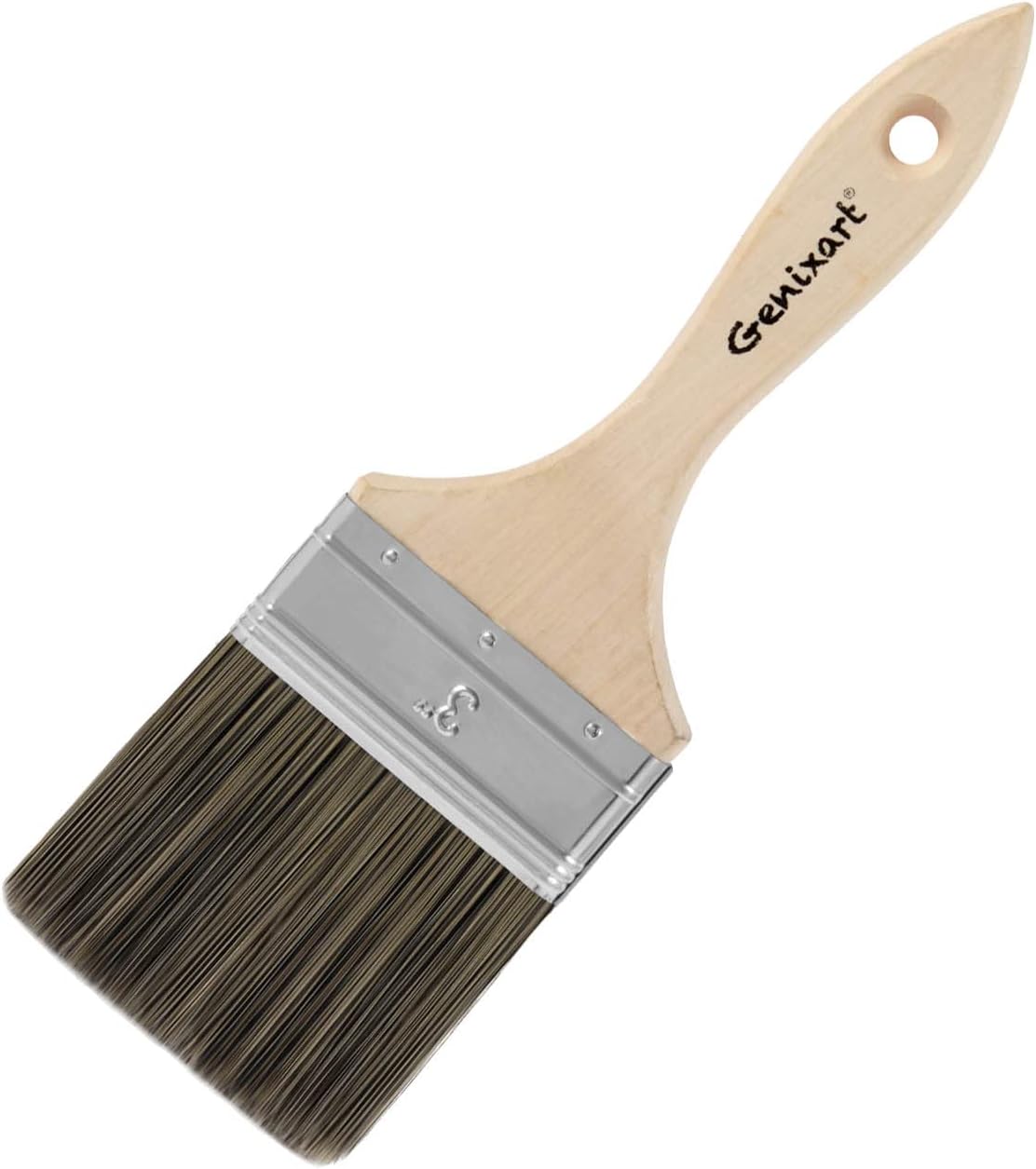
Genixart’s 3 inch brush is double-thick, with soft synthetic bristles mixed with solid round tapered nylon filaments and a sanded wooden handle. The listing says it suits all water and oil-based stains, paints and sealers, as well as polyurethane and varnish.
Three inches is a versatile staining width for bookcases, chair seats, shelves and fences. The double-thick head carries more stain per dip.
Best suited for: General woodworking and furniture staining.
Key features:
- 3″ width
- Double-thick head
- Synthetic and tapered nylon
- Water and oil-based stains listed
Pros:
- Holds a lot of stain
- Versatile width
- Very low cost
Cons and limitations:
- Chip-style brush may leave stray bristles
Buying consideration: Pull any loose bristles before starting, and keep a rag handy for drips.
4. Great Andrew 10-Pack 2 Inch Flat Brushes — Best for bulk staining

Great Andrew’s pack contains ten 2 inch flat brushes with densely packed bristles, metal ferrules that reduce shedding and lightweight plastic handles. The listing names fence painting and deck staining.
Ten identical brushes make sense for larger projects with several stain colors, classes, or volunteer staining days.
Best suited for: Big projects, multiple colors and group work.
Key features:
- 10 x 2″ flat brushes
- Dense bristles
- Metal ferrule
- Plastic handles
Pros:
- Low cost per brush
- Consistent size
Cons and limitations:
- Single size
- Plastic handles feel basic
Buying consideration: Label brushes by stain color with tape on the handle.
5. Newkita 3-Piece Chip Brushes — Best for disposable staining

Newkita’s set includes three chip brushes in different sizes with synthetic bristles and wooden handles. The listing says they work with paints, stains, varnishes, acrylics and gesso, and should be washed while wet with soap and water.
Chip brushes are the classic disposable stain applicator. When you wipe stain off with a rag, the brush just needs to get stain onto the wood.
Best suited for: Small wipe-on stain projects.
Key features:
- 3 chip brushes
- Synthetic
- Wooden handles
Pros:
- Very cheap
- Several sizes
Cons and limitations:
- Basic build
Buying consideration: Comb out loose bristles with your fingers before use.
6. Pro Grade 5-Piece Brush Set — Best for corners, edges and trim

Pro Grade’s set includes 1 and 2 inch flats and 1.5, 2 and 2.5 inch angled brushes, including a 2 inch angle stubby, with SRT filaments and adhesive-bonded bristles. The listing names stain among uses and mentions primers, stains, varnishes and polyurethane.
Angled brushes help with staining inside corners of cabinets, around spindles and along molding.
Best suited for: Detailed staining on cabinets, trim and furniture with corners.
Key features:
- 5 brushes incl. angle stubby
- SRT filaments
- Adhesive-bonded bristles
Pros:
- Reaches tight spots
- Low price tier
Cons and limitations:
- Synthetic may not suit every oil-based product
Buying consideration: Use the stubby inside cabinet boxes and drawer openings.
7. Bates 6-Pack Flat and Angled Brushes — Best for oil-based stain

Bates’ six-pack has three flat and three angled brushes with natural bristles mixed with synthetic filaments. The listing says they work with oil-based paints and latex stains for decks, fences and DIY projects.
Natural bristle is traditional for oil-based stains and finishes because it carries solvent-based products well.
Best suited for: Oil-based stain projects on a budget.
Key features:
- 6 brushes
- 3 flat, 3 angled
- Natural and synthetic blend
Pros:
- Natural bristle content
- Very low cost per brush
Cons and limitations:
- Budget quality
Buying consideration: Clean with the solvent on the stain label, then soap and water.
How to Stain Wood With a Brush
- Sand the wood evenly, finishing with the grit recommended by the stain maker.
- Remove all dust with a vacuum and tack cloth.
- Apply pre-stain conditioner on blotch-prone woods if needed.
- Stir the stain well; pigments settle.
- Brush stain on generously along the grain, working in manageable sections.
- Wait the time on the label, then wipe off excess with a clean, lint-free rag along the grain.
- Apply a second coat for a deeper color if desired, after the first dries.
- Finish with a clear topcoat once the stain is fully dry.
Staining Different Woods
Oak and ash
Open-grained woods take stain readily and show strong grain patterns. A bristle brush helps push stain into the pores, and wiping across then along the grain fills them evenly.
Pine and fir
Softwoods are prone to blotching because earlywood and latewood absorb differently. Use a conditioner, work quickly with a wide brush or foam brush, and consider a gel stain for more even color.
Maple, birch and cherry
These dense, closed-grain hardwoods can look blotchy with liquid stain. Gel stains and dye stains often give more even results.
Walnut and mahogany
Already richly colored, these woods often need only a clear finish or a light toning stain.
Plywood and veneer
Veneers are thin, so sand lightly. Test stain on an offcut or the back, since veneers can absorb differently from solid wood.
Choosing a Stain Applicator
Foam brushes
Even, bristle-free application on furniture and small parts. Disposable.
Bristle brushes
Better on rough or textured wood and for getting stain into grain and carvings.
Wide stain brushes
Best on large surfaces where speed keeps absorption even.
Rags
Many woodworkers wipe stain on with a rag, which gives the most control. Brushes are faster on large or detailed pieces, and they keep your hands cleaner when combined with gloves. Many finishers use both: a brush to apply, a rag to wipe off and even out.
Buying Guide: How to Choose Brushes for Staining
Match width to the project
2 inch for furniture, 3 to 4 inch for tabletops and doors, wider for decks. Too narrow a brush on a big surface leaves overlaps where stain doubles up.
Check stain type
Synthetic for water-based, natural or blend for oil-based. Foam works with most. Water-based stains dry faster, so speed and a wide applicator matter more.
Plan for disposal
Stain brushes are often single-use; buy inexpensive packs. Cleaning oil-based stain out of a cheap brush often costs more in solvent than the brush is worth.
Reach corners
An angled brush or small foam brush handles inside corners where stain tends to pool.
Bristle shedding
Comb out loose bristles from cheap brushes before use, or use foam.
Separate topcoat brush
Use a better brush for the clear finish that goes over the stain, since topcoat brush marks stay visible once the finish cures.
Related Brush Guides
Reduce loose bristles with our anti-shedding tips, learn how to dry brushes properly, and see how to work with large brushes on big surfaces.
Common Mistakes to Avoid
- Staining without sanding evenly, which causes blotches.
- Leaving stain on too long and getting a darker, uneven color.
- Not stirring the stain.
- Using a shedding brush on a fine piece.
- Applying topcoat before the stain is dry.
- Discarding oily rags carelessly; follow the label instructions for safe disposal of rags used with oil-based stains.
FAQs
What is the best brush for applying stain?
Foam brushes for furniture and small parts, wide bristle brushes for large surfaces, and angled brushes for corners.
Is it better to brush or wipe on stain?
Both work; many woodworkers brush it on and wipe it off for even color.
Can I use a foam brush for oil-based stain?
Many foam brushes work with oil-based stains; check the brush and stain labels.
Do I need a natural bristle brush for oil stain?
Natural bristle is traditional for oil-based products, but many synthetic and foam brushes also work.
How do I avoid blotchy stain?
Sand evenly, use a pre-stain conditioner on blotch-prone woods and apply stain quickly and evenly.
Can I reuse stain brushes?
Yes if cleaned promptly, but many people treat them as disposable.
Final Recommendation
For furniture and small staining projects, Bates foam brushes give even, bristle-free results at very low cost. Use the Bates 4 inch pair for tabletops, doors and decks, and the Genixart 3 inch brush for general staining with bristles. The Great Andrew 10-pack suits large projects, Newkita chip brushes are disposable workhorses, Pro Grade handles corners and trim, and the Bates six-pack is a budget option for oil-based stains.