
PaintingProGuide is reader-supported. When you buy through links on this page we may earn an affiliate commission at no extra cost to you.
The best paint for air dry clay is a water-based acrylic, followed by a clear sealer once the color has cured. Acrylic grips the porous, slightly chalky surface of dried clay, flexes a little as the piece settles, and dries to a permanent film that tempera and kids’ poster paint simply can’t match. The catch is that air dry clay never becomes waterproof on its own, so the finishing coat matters almost as much as the color.
Below you’ll find seven picks that cover both halves of the job: acrylic sets for color and two gloss glazes for sealing. Each one is matched to a specific kind of clay project, from tiny jewelry beads to trinket dishes and planters.
Quick answer: For most clay crafters, the Caliart 24-color acrylic set is the strongest all-round choice: 2 oz bottles, a broad artist-style palette and a listing that names clay and plaster among its intended surfaces. If you want brushes and a palette in the box, pick the Nicpro 24-color set. To seal finished pieces with a glassy shine, add the EIGTWEN Air Dry Clay Glaze.
Our Top Picks at a Glance
- Caliart Acrylic Paint Set, 24 Colors — Best overall paint for air dry clay
- Nicpro Acrylic Paint Set, 24 Colors with Brushes and Palette — Best complete starter kit
- Apple Barrel Vibrant Spectrum, 16 Matte Colors — Best for a flat, ceramic-look finish
- GOTIDEAL Acrylic Paint Set, 18 Colors — Best mid-size set for family craft sessions
- Shuttle Art Acrylic Paint Set, 15 Tubes — Best budget pick for small figurines and beads
- EIGTWEN Air Dry Clay Glaze, 100ml — Best gloss sealer for painted clay
- EIGTWEN Clay Glaze with 29-Piece Tool Kit — Best sealer bundle for beginners who also sculpt
| Product | Best For | Key Spec | Key Strength | Price Tier |
|---|---|---|---|---|
| Caliart 24-Color Acrylic Set | Overall clay painting | 24 x 2 oz bottles, matte | Lists clay and plaster as surfaces; wide color range | $$ |
| Nicpro 24-Color Acrylic Set | Complete beginner kit | 24 x 2 oz, 12 brushes, palette | Everything needed in one box, plus a color wheel guide | $$ |
| Apple Barrel Vibrant Spectrum | Matte, earthenware look | 16 x 2 oz bottles, matte | Made in the USA; lists terra cotta and plaster | $$ |
| GOTIDEAL 18-Color Acrylic Set | Group and family crafts | 18 x 2 oz, 10 brushes | AP, ASTM D-4236 and EN71-3 labeling | $$ |
| Shuttle Art 15-Tube Set | Small pieces, trying the hobby | 15 x 12 ml tubes, 3 brushes | Lowest entry cost; thick pigment | $ |
| EIGTWEN Air Dry Clay Glaze | Sealing painted work | 100 ml, gloss acrylic | Transparent high-gloss protective film | $ |
| EIGTWEN Glaze + 29 Tools | Sculpting plus sealing | 100 ml glaze, 29 tools | Covers shaping and finishing in one purchase | $$ |
How We Chose
We did not paint clay samples for this guide. Our picks are based on the Amazon listing details and specifications checked in October 2026, how well each product’s format, finish and surface claims fit air dry clay specifically, and how widely each product is reviewed by Amazon buyers. A set that is popular but never mentions porous surfaces ranks lower than one that does.
These were the criteria that shaped the list:
- Paint chemistry: water-based acrylic only, since it bonds to dry clay and cures permanent once dry.
- Surface fit: extra weight for listings that name clay, plaster, terra cotta or ceramic as suitable surfaces.
- Coverage claims: thick, high-pigment formulas, because thin paint soaks into raw clay and needs many coats.
- Finish: matte paints for an earthy look, plus gloss sealers for shine and protection.
- Quantity versus project size: 12 ml tubes for beads and miniatures, 2 oz bottles for planters, bowls and batches.
- Safety labeling: ASTM D-4236 conformity and non-toxic water-based formulas for home and classroom use.
Best Paint for Air Dry Clay Reviewed
1. Caliart Acrylic Paint Set, 24 Colors — Best Overall

Caliart’s 24-bottle set is the one we’d hand to someone who has just pulled their first batch of clay pieces off the drying rack. The listing explicitly names clay and plaster in its surface list, alongside ceramics, wood and stone, and the formula is described as creamy, high-pigment and fast-drying, which is exactly what you want on a thirsty clay surface.
The palette leans toward traditional artist colors rather than pure craft brights: Yellow Ochre, Burnt Sienna, Burnt Umber, Phthalo Blue, Cerulean, Viridian and Sap Green sit next to Crimson and Magenta. That range makes it easier to mix believable stone, wood or terracotta tones on figurines and home decor.
Best suited for: crafters who paint a mix of decorative bowls, ornaments and sculptures and want enough paint and color variety to experiment.
Key features:
- 24 colors in 2 oz (59 ml) bottles, 48 fl oz of paint total
- 12 brushes included
- Matte finish; listed as crack resistant, fade resistant and fast-drying
- Water-based and labeled non-toxic
Pros:
- Clay and plaster are named surfaces, not an afterthought
- Earth tones included, so natural-looking pieces need less mixing
- 2 oz bottles last through many small projects
Cons:
- Bundled brushes are basic; detail work benefits from a better round brush
- Matte finish still needs a sealer for any shine or moisture protection
Buying consideration: With 24 colors you may never open some of them. If you mostly paint one style, such as pastel trinket dishes, a smaller set plus a large white can be more economical.
2. Nicpro Acrylic Paint Set, 24 Colors with Brushes and Palette — Best Complete Starter Kit

If you are starting from nothing, Nicpro removes the scavenger hunt. You get 24 colors in 2 oz bottles, 12 brushes, a mixing palette and a printed beginner guide with a color wheel. For clay, that palette is genuinely useful: mixing on a flat tray instead of a paper plate keeps paint from drying out mid-session.
The listing describes the paint as creamy, quick-drying, waterproof once dry and fade-resistant, and it includes clay in its list of supported surfaces along with ceramic, wood and rock. It also conforms to ASTM D-4236, which matters if kids are joining in.
Best suited for: adult beginners and families setting up a first clay-and-paint table who want one purchase to cover everything except the clay.
Key features:
- 24 colors, 60 ml / 2 oz bottles
- 12 brushes, palette and color wheel guide
- Fast-drying, water-resistant and fade-resistant once cured
- ASTM D-4236 conforming
Pros:
- Most complete kit on this list
- Color wheel guide helps new painters mix custom shades
- Cleans up with soap and water while wet
Cons:
- Paying for brushes and a palette you may already own
- Craft-oriented brushes wear faster on rough clay surfaces
Buying consideration: Rough, unsanded clay chews through soft brush tips. Plan to keep the included brushes for basecoating and buy one fine detail brush separately.
3. Apple Barrel Vibrant Spectrum Collection, 16 Matte Colors — Best for a Flat, Ceramic-Look Finish
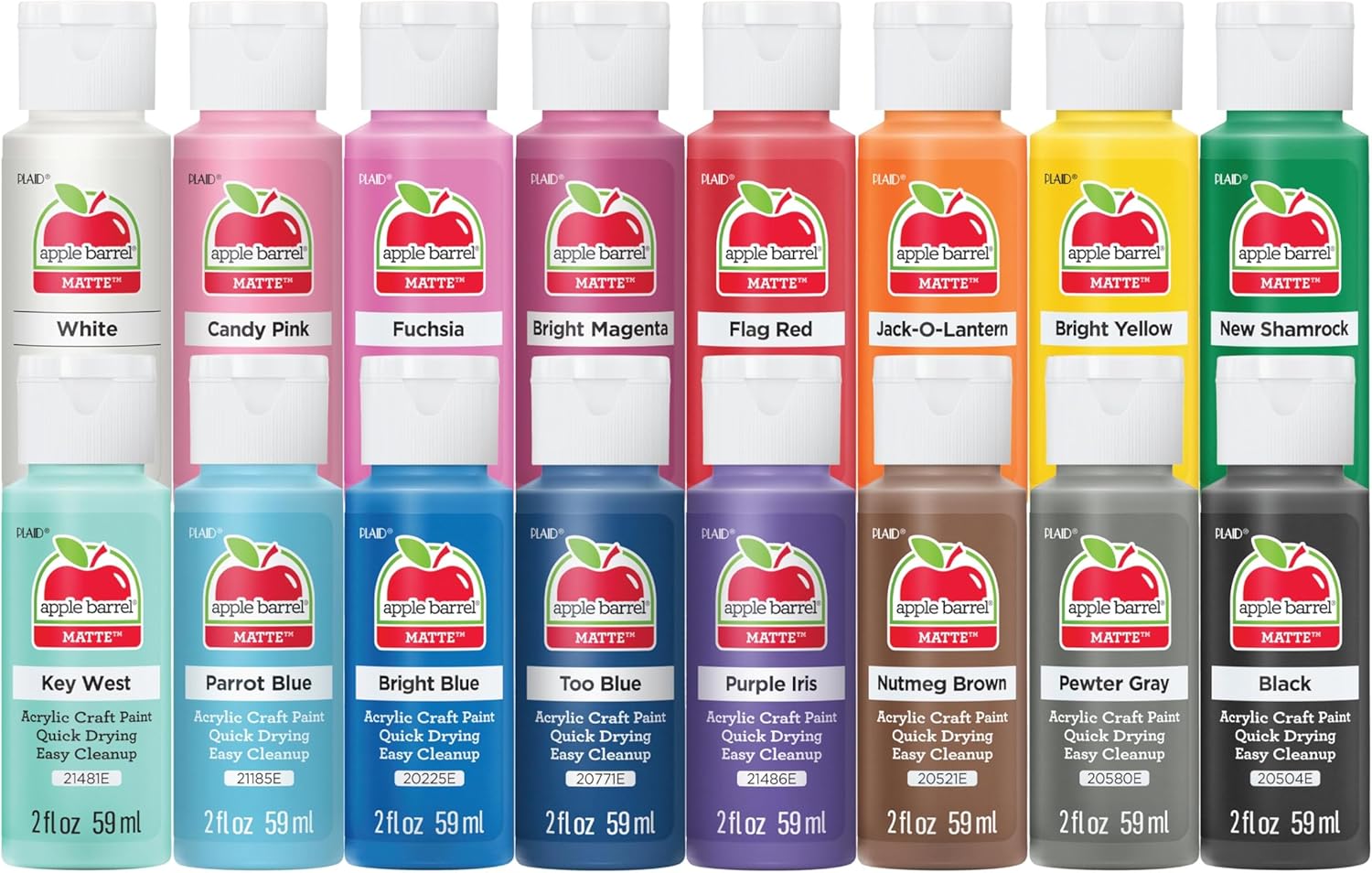
Apple Barrel is a long-standing American craft paint brand, and this 16-bottle collection is designed for exactly the kind of decorative surfaces air dry clay resembles. The listing names plaster and terra cotta, both porous materials that behave much like dried clay, and every color dries to a matte finish.
That flat sheen is the reason to pick it. Unsealed matte acrylic on clay reads like bisque or earthenware, which suits rustic planters, Scandinavian-style ornaments and minimalist trinket dishes. The colors themselves are bright craft hues, including Flag Red, Bright Blue, Candy Pink, Fuchsia and New Shamrock, plus black and white for mixing.
Best suited for: crafters who want an understated matte surface, or who plan to stamp, stencil or sponge patterns onto clay.
Key features:
- 16 colors in 2 fl oz bottles (32 fl oz total)
- Matte finish on all colors
- Suitable for brushing, stamping, stenciling and sponging
- Made in the USA; non-toxic
Pros:
- Plaster and terra cotta listed, both close cousins of air dry clay
- Squeeze bottles are easy for children to handle
- Consistent matte look across the whole set
Cons:
- Craft-paint consistency often needs two or three coats on raw clay
- No earth tones such as ochre or sienna in this assortment
Buying consideration: Craft acrylics like this one are thinner than artist-grade tubes. A white gesso or acrylic primer coat first will cut down on the number of color layers you need.
4. GOTIDEAL Acrylic Paint Set, 18 Colors — Best Mid-Size Set for Family Crafts

GOTIDEAL sits neatly between the tiny tube set and the 24-color kits. Eighteen 2 oz bottles cover the popular colors without a drawer full of shades you’ll never use, and the box includes 10 brushes. The listing calls out AP, ASTM D-4236 and EN71-3 certification, which is a reassuring line for parents running a clay-painting afternoon.
The formula is described as creamy and high-pigment with good covering power for both large areas and fine details. Ceramic, canvas, stone and wood are listed as surfaces; clay is not named outright, but acrylic of this type is the standard choice for dried clay.
Best suited for: households and classrooms where several people paint at once and safety labeling is a priority.
Key features:
- 18 colors in 59 ml / 2 oz bottles
- 10 brushes included
- Water-based; AP, ASTM D-4236 and EN71-3 (CE) labeling
- Organized storage box
Pros:
- Broad safety certifications for shared or kids’ use
- Sensible color count for most craft projects
- Fast-drying formula supports quick layering
Cons:
- Clay isn’t specifically listed as a surface
- Fewer earth tones than the Caliart set
Buying consideration: Choose this over the 24-color sets if you value safety marks and organization more than maximum palette range.
5. Shuttle Art Acrylic Paint Set, 15 x 12 ml Tubes — Best Budget Pick for Small Pieces

Shuttle Art’s tube set is the cheapest way into painting clay, and it is honestly a good fit for small work. Clay earrings, beads, charms and miniature figures use very little paint, so 12 ml tubes go further than you’d expect. The listing mentions clay by name in its title and says the pigment is deliberately thick for better coverage.
Tubes also have an advantage for detail painting: you squeeze out only a pea-sized amount, and the rest stays sealed and fresh. The trade-off is volume. Basecoating a large planter would empty a tube quickly.
Best suited for: jewelry makers, miniature sculptors and anyone trying clay painting before spending more.
Key features:
- 15 colors in 12 ml (0.4 oz) tubes
- 3 bonus brushes
- Matte finish; described as permanent, waterproof and fade-proof once dry
- Conforms to ASTM D-4236
Pros:
- Lowest cost on the list
- Thick paint is helpful on porous clay
- Tubes keep unused paint from drying out
Cons:
- Small volumes are impractical for large pieces
- Only three brushes
Buying consideration: White runs out first in nearly every set because it is used for priming and tinting. With 12 ml tubes, a separate larger white is worth adding.
6. EIGTWEN Air Dry Clay Glaze, 100ml — Best Gloss Sealer

This is not a color paint; it is the topcoat that makes painted clay last. EIGTWEN’s glaze is an acrylic varnish that dries transparent with a high-gloss finish, designed to protect air-dried pieces from scratches, scuffs and abrasion. The listing outlines a sensible three-step process: prime with white acrylic, paint your colors, then apply the glaze, allowing 24 hours for a full dry.
The glaze is described as waterproof and usable on plaster, wood, pre-painted metal and jewelry as well as clay. Read that with care, though. The coating can help a dish shrug off a splash, but the clay underneath is still unfired, so nothing sealed this way should hold food or drinks, a limit the listing itself states.
Best suited for: anyone who wants a ceramic-glaze shine on trinket trays, ornaments and jewelry without a kiln.
Key features:
- 100 ml bottle, acrylic-based
- Transparent, high-gloss finish
- Full dry in about 24 hours
- Works on clay, plaster, wood, jewelry and artificial flowers
Pros:
- Formulated specifically for air dry clay
- Clear step-by-step directions on the listing
- Gloss makes acrylic colors look deeper and richer
Cons:
- Not food safe
- Gloss only; no matte or satin version in this listing
- Long cure time before handling
Buying consideration: Thick coats of gloss can stay tacky or cloud in humid rooms. Two thin coats, each fully dry, give a clearer result than one heavy layer.
7. EIGTWEN Air Dry Clay Glaze and 29-Piece Clay Tools Kit — Best Sealer Bundle for New Sculptors

This bundle pairs the same style of 100 ml gloss glaze with 29 sculpting tools for carving, cutting, smoothing, texturing and poking holes. If you’re new to clay, a smoother surface before painting is the single biggest upgrade to the final look, and these tools help you get there.
The glaze directions here skip the primer step and go straight from dry clay to color to glaze, again with about 24 hours of drying for the topcoat. Either route works; a primer simply reduces how many color coats you need.
Best suited for: beginners who don’t own sculpting tools yet and want shaping and sealing covered together.
Key features:
- 100 ml transparent high-gloss glaze
- 29 clay tools for modeling, trimming and texturing
- Tools suit air dry, polymer and modeling clay
Pros:
- Good value if you need both tools and a sealer
- Smoother sculpting leads to cleaner paint results
Cons:
- Redundant if you already own clay tools
- Same food-safety limits as any air dry clay sealer
Buying consideration: Pick the standalone glaze if your toolbox is already stocked; pick this bundle if you’re building a clay kit from scratch.
Buying Guide: How to Choose Paint for Air Dry Clay
Air dry clay behaves differently from canvas, wood or fired ceramic. It is porous, a little dusty, and sensitive to moisture, so the right paint is about chemistry and finish as much as color.
Stick with water-based acrylic
Acrylic is the standard for a reason. It bonds to dried clay, dries quickly, and becomes water-resistant once cured. Tempera and washable kids’ paint stay powdery and can rub off on fingers. Oil paint takes days to dry and can leave an oily halo on porous clay. Alcohol inks and markers work for accents, but acrylic should do the heavy lifting.
Match the volume to the project
Small tubes in the 12 ml range are ideal for beads, earrings and miniatures where each color covers a fingernail-sized area. For planters, bowls, coasters or batches of ornaments, 2 oz bottles are more economical and easier to pour. White and black disappear fastest in every set, so consider a larger bottle of each.
Look at pigment load and coverage
Raw clay absorbs the first coat like a sponge. Paints described as thick, creamy or high-pigment will cover in fewer passes. Thin craft paints still work, but expect two or three coats, or prime first with white gesso or white acrylic to create an even base.
Decide on your finish early
Most acrylic sets dry matte. Leave them unsealed or use a matte varnish if you want a soft, earthenware look. For a ceramic-glaze shine, a gloss sealer like EIGTWEN’s is the final step. Gloss also deepens colors, so darker shades read richer after sealing.
Plan for sealing and moisture
Air dry clay can soften if it gets wet, even after painting. A sealer slows that down and protects against scratches, but it doesn’t turn the piece into fired ceramic. Keep painted clay away from standing water, outdoor rain and anything food-related.
Check the safety labeling
For kids’ crafts or classroom use, look for ASTM D-4236 conformity on the listing, and AP or EN71-3 marks where available. Every acrylic set on this list is water-based and cleans up with soap and water before it dries.
Consider the brushes you’ll need
Included brushes are fine for basecoats. Detail work like eyes on figurines or thin lines on beads needs a small synthetic round with a sharp point. A flat brush helps with smooth coverage on larger pieces, and a cheap sponge dabber is great for texture.
Learn the Technique Before You Paint
Choosing the paint is half the job; prep and application are the other half. Our walkthrough on how to paint air dry clay crafts step by step covers sanding, priming, layering and sealing in order. If you want aged or textured highlights on sculpted details, read what dry brushing is and how it works, since it is one of the easiest ways to make carved texture pop.
Looking for project ideas next? Try these painted clay pot ideas for planters, or browse our guide to painting pottery at home if you are moving toward fired ceramics.
Common Mistakes to Avoid
- Painting before the clay is fully dry. Trapped moisture leads to cracking and peeling. Thick pieces can need 48 to 72 hours, sometimes more.
- Skipping light sanding. Fingerprints and ridges show through paint. A quick pass with fine sandpaper makes a visible difference.
- Using too much water in the paint. Watery acrylic soaks into the clay and can soften the surface. Use paint close to bottle consistency.
- Loading on one heavy coat. Thick layers crack and stay soft longer. Build color in two or three thin coats.
- Sealing too soon. Give acrylic time to dry completely before varnishing, or the sealer can smear or cloud.
- Treating sealed clay as food safe. Air dry clay and acrylic sealers are for decorative use only.
- Displaying pieces outdoors. Rain and humidity will eventually break down unfired clay, even with a topcoat.
FAQs
What kind of paint works best on air dry clay?
Water-based acrylic paint is the best match. It adheres to the porous surface, dries quickly and becomes permanent and water-resistant once cured. Seal it afterward with a clear varnish or glaze for extra protection and shine.
Do I need to prime air dry clay before painting?
It isn’t required, but it helps. A coat of white gesso or white acrylic evens out the absorbency of the clay, so colors look brighter and need fewer layers. It is especially useful with thinner craft paints and light colors.
Can I use watercolor or tempera on air dry clay?
You can, but neither is durable. Tempera can rub off once dry, and watercolor reactivates with moisture. If you like the soft watercolor look, thin acrylic slightly and seal it well instead.
How do I make painted air dry clay shiny?
Apply a gloss varnish or glaze once the paint is fully dry. Use thin coats and let each one dry completely. A product like EIGTWEN’s air dry clay glaze dries transparent with a high-gloss finish in about 24 hours.
Will sealing make air dry clay waterproof?
Sealing makes it more water-resistant, not truly waterproof. A sealed piece can handle a quick wipe or splash, but soaking or regular contact with water will eventually damage the clay underneath.
Is painted air dry clay safe for kids?
Choose non-toxic, water-based acrylics that conform to ASTM D-4236, supervise younger children, and keep sealed pieces decorative rather than using them for food. Most kid-friendly acrylic sets clean up with soap and water while wet.
Final Recommendation
There’s no single paint for air dry clay that suits every project, but the choice narrows quickly by what you’re making. For the widest range and a listing that names clay directly, the Caliart 24-color set is the best all-rounder. Beginners who need brushes and a palette should go with Nicpro. If you prefer a quiet matte, earthenware look, Apple Barrel fits that style, while GOTIDEAL suits families who prioritize safety marks.
Working small? The Shuttle Art tube set is plenty for beads and miniatures. Whatever color set you choose, finish with a clear sealer: the standalone EIGTWEN glaze if you already sculpt, or the glaze-and-tools bundle if you’re building your first clay kit. Paint, dry fully, seal thinly, and your pieces will hold their color for years on the shelf.




