

PaintingProGuide is reader-supported. When you buy through links on this page we may earn an affiliate commission at no extra cost to you.
A plain ceramic or terracotta planter is one of the most satisfying things to paint: a curved surface, a practical object, and a finished piece you will see every day. The catch is that pots live with water. Soil gets damp, saucers fill up, and outdoor pots face rain and sun. For decorative painting, the best paint for ceramic pots is a good multi-surface acrylic applied over a properly prepared surface, then sealed. The paint provides color and adhesion; the sealer provides the water resistance a pot needs.
Quick answer: For most painted planters, the Artkey 24-color acrylic set is a strong all-round choice, with ceramics and clay listed among its recommended surfaces. The Shuttle Art 36-color set adds metallic gold and silver and a gloss finish for brighter designs. If you are painting large pots or many of them, the Nicpro bulk 500 ml set gives you far more paint per color.
This guide compares six acrylic paint sets for ceramic and terracotta pots, then covers surface prep, sealing, and how to keep painted pots looking good indoors and out.
Our Top Picks at a Glance
- Artkey Acrylic Paint Set, 24 Colors — Best overall for ceramic pots
- Shuttle Art Acrylic Paint Set, 36 Colors — Best color range with metallics
- Caliart Acrylic Paint Set, 36 Colors — Best for matte designs with metallic accents
- Nicpro Acrylic Paint Set, 24 Colors with Brushes — Best starter kit with brushes and palette
- Nicpro Bulk Acrylic Paint Set, 14 x 500 ml — Best for large pots and base coats
- MicoSim Mini Acrylic Paint Strips, 10 Pack — Best for kids and pot-painting parties
| Product | Best For | Key Spec | Key Strength | Price Tier |
|---|---|---|---|---|
| Artkey 24 | All-round pot painting | 24 x 2 oz, semi-gloss | Ceramics and clay listed as surfaces | $$ |
| Shuttle Art 36 | Bright, glossy designs | 36 x 2 oz incl. metallic gold and silver, gloss | Wide color range | $$ |
| Caliart 36 | Matte with metallic accents | 36 x 2 oz, 12 brushes | Matte finish plus metallics | $$ |
| Nicpro 24 kit | Beginners | 24 x 2 oz, 12 brushes, palette | Complete starter kit | $$ |
| Nicpro bulk 14 | Large pots | 14 x 16.9 oz (500 ml), gloss | Large volume per color | $$ |
| MicoSim minis | Kids and groups | 10 packs of 12 colors, 20 brushes | Individual kits | $ |
How We Chose
We based these picks on the Amazon listing details and specifications checked in October 2026, how well each paint set fits decorative painting on ceramic and terracotta pots, and how widely each product is reviewed by Amazon buyers. We have not painted pots with these sets, so we rely on listed surfaces, finishes and sizes, and on well-established practice for painting ceramics with acrylic.
- Listed surface compatibility: ceramics, clay or terracotta named in the listing.
- Coverage: creamy, pigmented paint that covers in two coats on a curved surface.
- Finish: matte, semi-gloss or gloss to suit the design (sealer can change it later).
- Volume: 2 oz bottles for designs; larger bottles for base coats.
- Safety: non-toxic, water-based formulas for indoor and family projects.
We excluded a washable kids’ paint kit from our research. Washable paint is designed to come off, which is the opposite of what a planter that gets watered needs.
Best Paint for Ceramic Pots Reviewed
1. Artkey Acrylic Paint Set, 24 Colors — Best for all-round pot painting
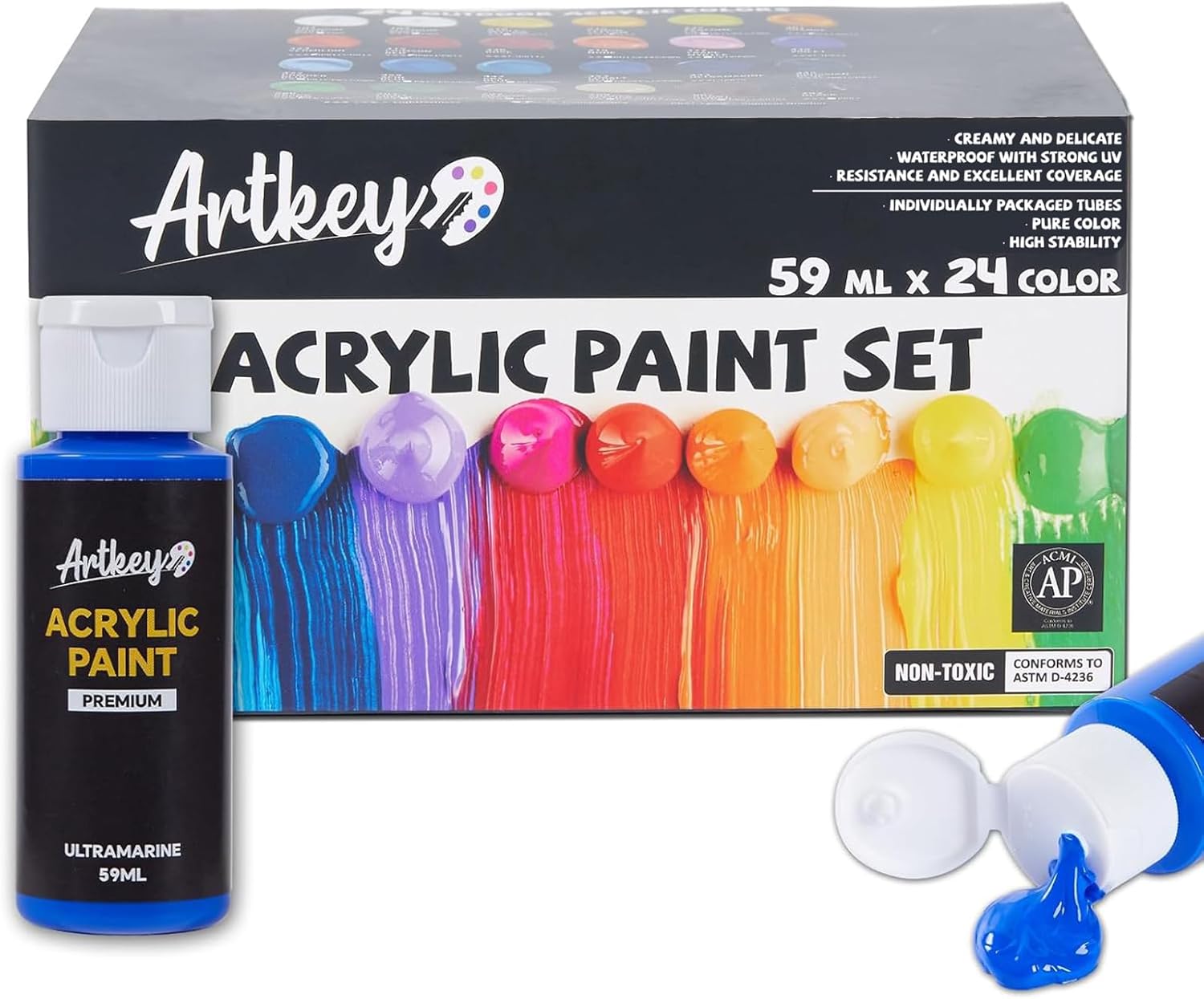
Artkey’s listing names canvas, wood, rock, clay, fabric and ceramics as recommended surfaces, and its description adds metal, plastic and plaster. That breadth is useful for pots, where you might paint a ceramic planter, a terracotta pot and its wooden plant stand in one project. The paint is described as artist quality with strong coverage for large areas and fine detail.
The bottles have tightly screwed caps to prevent leaks and drying, and the paint is listed as non-toxic and water-based. The semi-gloss finish gives a soft sheen that suits most planter designs and can be adjusted with your choice of sealer.
Best suited for: Most pot painters, from simple color blocks to detailed patterns.
Key features:
- 24 colors in 2 oz / 59 ml bottles
- Semi-gloss finish
- Ceramics and clay among listed surfaces
- Non-toxic, water-based
Pros:
- Good surface range for pots and stands
- Coverage for base coats and detail
- Leak-resistant caps
Cons and limitations:
- Not marketed as outdoor or waterproof without sealing
- No brushes included
Buying consideration: Prime terracotta first so the porous clay does not soak up the paint, and finish with a clear sealer.
2. Shuttle Art Acrylic Paint Set, 36 Colors — Best for bright, glossy designs

With 36 colors, including metallic gold and silver, Shuttle Art gives you room for patterned and multicolor pots without mixing every shade. The listing describes the paint as dry fast, water-proof and fade-resistant once dry, suitable for wood, rock, canvas, ceramic, fabric, glass and more, with a gloss finish noted in the details.
Metallic gold and silver are especially popular on planters for rims, geometric lines and accents. The set also includes brushes and a palette, and is listed as ASTM D-4236 conforming, non-toxic and acid-free.
Best suited for: Painters who want lots of colors and metallic accents for decorative pots.
Key features:
- 36 colors in 2 oz / 60 ml bottles
- Includes metallic gold and silver
- Gloss finish
- Brushes and palette included
Pros:
- Big color range
- Metallics for accents
- Ceramic listed as a surface
Cons and limitations:
- Still benefits from a sealer on pots that get wet
- Gloss may show surface flaws
Buying consideration: For a crisp metallic rim, use painter’s tape around the pot and apply two thin coats.
3. Caliart Acrylic Paint Set, 36 Colors — Best for matte designs with metallic accents

Caliart’s set includes 36 colors in 2 oz bottles with metallic gold and silver, plus 12 brushes. The listing describes creamy paint with good coverage, water-proof and fade-resistant once dry, with a matte and metallic finish noted in the details.
A matte finish suits modern, Scandinavian-style planters and terracotta looks. You can always add a gloss sealer later if you want shine.
Best suited for: Painters who want a modern matte look with metallic details.
Key features:
- 36 colors, 2 oz each
- Matte plus metallic finishes
- 12 brushes
- ASTM D-4236, non-toxic
Pros:
- Matte finish for modern designs
- Brushes included
- Large palette of colors
Cons and limitations:
- Matte surfaces show fingerprints until sealed
- Ceramic not specifically named in details
Buying consideration: Choose a matte sealer to keep the flat finish while adding protection.
4. Nicpro Acrylic Paint Set, 24 Colors with Brushes — Best for beginners

Nicpro’s 24-color kit includes 2 oz bottles, 12 brushes and a palette, which is everything you need to start painting pots except the pots themselves and a sealer. The listing describes creamy, quick-drying, water-proof and fade-resistant paint with a semi-gloss finish, conforming to ASTM D-4236.
For a first pot-painting project, a kit removes the guesswork about brushes.
Best suited for: First-time pot painters who need brushes too.
Key features:
- 24 colors, 2 oz each
- 12 brushes and a palette
- Semi-gloss finish
- Crack- and fade-resistant per listing
Pros:
- Complete starter kit
- Easy to blend and layer
- Semi-gloss suits most pots
Cons and limitations:
- Fewer colors than 36-color sets
- Kit brushes are basic
Buying consideration: Use the larger flat brushes for base coats and small rounds for patterns.
5. Nicpro Bulk Acrylic Paint Set, 14 x 500 ml — Best for large pots and base coats

Large planters eat through 2 oz bottles quickly, especially base coats. Nicpro’s bulk set includes 14 essential colors, including white, Mars black, red, yellow, blue, green and burnt umber, in 16.9 oz (500 ml) bottles. The listing describes a creamy consistency, quick-dry, fade-resistant formula with a gloss finish.
Fourteen colors is enough to mix a wide range, and you will not run out halfway through a big pot.
Best suited for: Painting large planters, many pots at once, or classroom projects.
Key features:
- 14 colors in 500 ml bottles
- Gloss finish
- Includes white, black, primaries, earth tone
- Non-toxic
Pros:
- Large volume per color
- Good for base coats
- Economical for big projects
Cons and limitations:
- Fewer pre-mixed colors
- Large bottles take space
Buying consideration: Mix custom colors in a lidded container so you can match them on later coats.
6. MicoSim Mini Acrylic Paint Strips, 10 Pack — Best for kids and group pot painting

For a classroom or birthday party where everyone paints a small pot, individual kits avoid sharing bottles. MicoSim includes ten packs of 12 colors in small strip containers plus 20 brushes, ten pointed and ten flat. The paint is described as fast-drying with a matte finish.
Each strip holds only a small amount of paint, so these suit small pots and simple designs.
Best suited for: Kids’ parties, classrooms and group crafts with small pots.
Key features:
- 10 packs x 12 colors
- 20 brushes (10 pointed, 10 flat)
- Matte finish
- Sealed strip containers
Pros:
- One kit per child
- Low cost per person
- Easy cleanup
Cons and limitations:
- Very small paint volume
- Not for large pots
Buying consideration: Have an adult apply sealer after the kids finish and the paint has fully dried.
Preparing a Ceramic or Terracotta Pot for Paint
Preparation decides how long a painted pot lasts. Glazed ceramic and unglazed terracotta need different treatment.
Glazed ceramic pots
Glaze is slick, so paint can peel if applied directly. Clean the pot with soap and water, let it dry, then wipe with rubbing alcohol to remove oils. Lightly scuffing the glaze with fine sandpaper gives paint more grip. A primer suited to glossy surfaces improves adhesion further.
Unglazed terracotta pots
Terracotta is porous and absorbs water. Brush off dust, wash and let it dry completely. Sealing the inside of the pot helps reduce moisture wicking through to the painted outside, which can lift paint over time. A coat of primer or a white base coat on the outside gives colors more brightness.
Base coat, then design
Apply one or two thin base coats, letting each dry. Then add your design. Thin coats dry faster and resist cracking better than one thick coat.
Step-by-Step: Painting a Ceramic Pot
- Gather supplies. Paint, a flat brush for base coats, small rounds for detail, painter’s tape, fine sandpaper, rubbing alcohol, primer and a clear sealer.
- Clean the pot. Wash with soap and water, rinse and let it dry completely, ideally overnight for terracotta.
- Prep the surface. Lightly scuff glazed ceramic, wipe with alcohol, and prime. For terracotta, seal the interior and prime the exterior.
- Base coat. Apply a thin, even coat with a flat brush, working around the pot. Let it dry and add a second coat if needed.
- Mark the design. Use tape for stripes and color blocks, or sketch lightly with a pencil.
- Paint details. Work from large shapes to small details, letting each color dry before painting next to it.
- Remove tape carefully. Pull it at a low angle while the last coat is just dry to the touch.
- Seal. Apply several thin coats of clear sealer, following the drying time on the label.
- Cure. Leave the pot to cure fully before planting and watering.
A turntable or lazy Susan makes painting round pots much easier, because you can rotate the pot instead of reaching around it. Painting the rim last, with the pot upside down on a jar, keeps your fingers off wet paint.
Sealing Painted Pots
Craft acrylics form a water-resistant film when dry, but planters face constant moisture. A clear sealer adds a protective layer and helps prevent peeling and fading. Choose an outdoor-rated, UV-resistant sealer for pots that live outside, and a matte, satin or gloss finish to suit your design. Apply several light coats and let the pot cure fully before planting.
For food-safe items like bowls, acrylic paint is not appropriate. Pots for plants are fine, but avoid painting the inside surfaces that hold soil if you want the longest-lasting finish.
Buying Guide: How to Choose Paint for Ceramic Pots
Choose acrylic for decorative pots
Multi-surface acrylic is the easiest, safest option for most pot painting. It is water-based, cleans up with soap and water, and comes in endless colors.
Check the listed surfaces
Look for ceramic, clay or terracotta in the listing. Paints formulated for multiple surfaces tend to grip better.
Pick a finish for the look
Matte reads modern and earthy; gloss looks bright and glazed. Your sealer can change the final finish, so pick the paint for color first.
Buy enough for base coats
Base coats on large pots use a lot of paint. Larger bottles of white and your main colors save money.
Think indoor versus outdoor
Outdoor pots need UV and weather resistance, which mainly comes from the sealer. Indoor pots are more forgiving.
Consider brushes and tools
Flat brushes for base coats, small rounds for patterns, sponges for texture, and painter’s tape for clean stripes make pot painting easier.
Design Ideas and Further Reading
Geometric color blocks, dipped-look bases, dot patterns and simple botanicals all work well on curved pots. For inspiration, browse our ceramic painting ideas, and if you enjoy pattern work, the techniques in our guide to painting DIY ceramic tile patterns transfer directly to pots.
Common Mistakes to Avoid
- Painting a dirty or greasy pot. Clean and degrease first or the paint will peel.
- Skipping primer on glazed ceramic. Slick glaze needs extra grip.
- Not sealing. Unsealed acrylic on a watered planter wears and lifts faster.
- Applying thick coats. They crack and take longer to dry. Use thin layers.
- Planting too soon. Let paint and sealer cure fully before adding soil and water.
- Using washable kids’ paint. It is designed to wash off.
FAQs
What kind of paint works on ceramic pots?
Multi-surface acrylic paint works well for decorative ceramic and terracotta pots. Prepare the surface, use thin coats, and finish with a clear sealer for durability.
Do I need to seal acrylic paint on ceramic pots?
Yes, for pots that are watered or kept outdoors. A sealer protects the paint from moisture, scuffs and UV fading.
Can I paint glazed ceramic pots with acrylic?
Yes, but clean, lightly sand and ideally prime the glaze first so the paint adheres. Seal the finished design.
How do I stop paint peeling on terracotta?
Seal the inside of the pot to limit moisture wicking through, prime the outside, use thin coats and seal the finished paint.
Is acrylic paint on pots safe for plants?
Painting the outside of a pot is generally fine for plants. Avoid painting inside surfaces that hold soil and let everything cure fully before planting.
How long should painted pots dry before planting?
Let acrylic dry thoroughly and the sealer cure according to its label, which may take a few days, before adding soil and water.
Final Recommendation
For most pot projects, the Artkey 24-color set is the most balanced choice, with ceramics and clay among its listed surfaces. Choose Shuttle Art for a glossy, multicolor look with metallics, or Caliart for matte designs with metallic accents. The Nicpro 24-color kit is the easiest start if you also need brushes.
If you are painting large planters, the Nicpro bulk set saves money on base coats, and for kids’ parties the MicoSim mini kits keep everyone painting at once. Whatever you pick, prep the surface and seal the finished pot.





One Comment