

PaintingProGuide is reader-supported. When you buy through links on this page we may earn an affiliate commission at no extra cost to you.
Paint is expensive to waste. An acrylic pour artist mixes a quart of custom color and uses half. A muralist decants gesso from a gallon tub that skins over every time the lid is opened. A crafter owns sixty 2 oz bottles that live in a jumbled drawer, so the same blue gets bought three times. The best paint storage containers solve those problems by keeping air out, making colors visible and putting the right amount of paint in the right size container.
This guide looks at storage from an artist’s and crafter’s point of view: organizers for bottled craft paint, small airtight cups for custom mixes, quart and gallon containers for pouring paint, gesso and mediums, and collapsible bags that squeeze out air. Several of these products are sold mainly for leftover wall paint, but they work just as well in a studio, and we explain which suit which kind of paint.
Quick answer: For craft paint bottles, the Shuttle Art 7-layer clear acrylic paint organizer holds up to 56 2 oz bottles in view. For custom-mixed colors, the Touch Up Cup 13 oz containers have built-in mixing balls and label space. Pour painters and anyone decanting gesso should look at the Stock Your Home 1-quart plastic cans (6-pack).
Our Top Picks at a Glance
- Shuttle Art 7-Layer Acrylic Paint Organizer — Best for organizing craft paint bottles
- Touch Up Cup 13 oz Containers, 3-Pack — Best for custom-mixed colors
- Stock Your Home 1-Quart Plastic Paint Cans, 6-Pack — Best for pouring paint and gesso batches
- Paint Hero 1-Quart Storage Bags, 8-Pack — Best airtight option that removes air
- Stock Your Home Quart & Gallon Combo, 4-Pack — Best mixed sizes for studios
- Lauco 1-Gallon Plastic Paint Cans, 2-Pack — Best gallon containers for bulk mediums
| Product | Best For | Key Spec | Key Strength | Price Tier |
|---|---|---|---|---|
| Shuttle Art Organizer | Bottle storage | 7 layers, holds up to 56 x 2 oz bottles | Clear, tool-free assembly | $$ |
| Touch Up Cup 3-Pack | Custom mixes | 3 x 13 oz clear cups | Mixing ball, labels | $$ |
| Stock Your Home Quart 6 | Pour paint, gesso | 6 x 32 oz polypropylene cans | Triple-lock seal | $$ |
| Paint Hero Bags | Air-free storage | 8 x 1-quart pouches + funnel | Squeeze out air | $$ |
| Stock Your Home Combo | Studios | 2 x quart + 2 x gallon | Two sizes, bail handles | $$ |
| Lauco Gallon 2-Pack | Bulk mediums | 2 x 1-gallon cans with handles | Snap-on lids | $$ |
How We Chose
We did not store paint in these containers for this article. The picks are based on Amazon listing details and specifications checked in October 2026, how well each container’s size, seal and visibility suit artists’ and crafters’ paints, and how widely each product is reviewed by Amazon buyers. A second Stock Your Home gallon-only 2-pack appeared too; the quart and gallon combo covers the same need with more flexibility, so we list that instead.
- Seal quality: airtight lids or air-removal design that limit skinning.
- Size fit: small cups for mixes, quarts for pours, gallons for bulk gesso and mediums.
- Visibility: clear walls or labels so you can identify colors fast.
- Material: rust-proof plastic that suits water-based paints.
- Organization: racks and stackable designs that save space.
Match the Container to the Paint
| Paint or Material | Typical Amount | Best Container |
|---|---|---|
| Craft acrylic in 2 oz bottles | Dozens of bottles | Tiered organizer rack |
| Custom-mixed acrylic colors | 2 to 12 oz | Small airtight cups with labels |
| Acrylic pouring mixes | 8 to 32 oz per color | Quart cans or squeeze bags |
| Gesso, gel medium, modeling paste | Quart to gallon | Decant into quarts from a gallon |
| Mural or large-canvas base colors | Quart to gallon | Quart or gallon cans with handles |
| Oil paints and solvents | Any | Original tubes; solvent-rated metal or glass containers only |
One important caution: the plastic containers here are designed for water-based paints. The Stock Your Home listings, for example, describe their cans as perfect for water-based and latex paints. Keep oil-based mediums and solvents in containers rated for them.
Best Paint Storage Containers Reviewed
1. Shuttle Art 7-Layer Clear Acrylic Paint Organizer — Best for organizing craft paint bottles

If your paint collection is mostly 2 oz craft bottles, an organizer will save more paint than any airtight container, simply because you will stop buying duplicates. Shuttle Art’s rack has 7 tiered layers and holds up to 56 of the brand’s 2 oz acrylic bottles, according to the listing.
It snaps together without tools or screws and is made of scratch-resistant acrylic. The clear, stepped design lets you see every color label at a glance. It also works for model paints, nail polish-sized bottles and small craft supplies. The listing gives dimensions of about 11.7 x 12.3 x 7.2 inches.
Best suited for: Crafters and acrylic painters with large collections of 2 oz bottles.
Key features:
- 7 tiered layers
- Holds up to 56 x 2 oz bottles
- Clear, scratch-resistant acrylic
- Tool-free snap assembly
- About 11.7 x 12.3 x 7.2 inches
Pros:
- Instant visibility of colors
- Compact footprint
- Easy assembly
Cons and limitations:
- Does not seal paint; bottles must be capped
- Sized for 2 oz bottles
- Clear acrylic can scratch with rough use
Buying consideration: Store bottles cap-down if the brand recommends it, so paint stays near the nozzle; otherwise upright.
2. Touch Up Cup Paint Storage Containers, 13 oz, 3-Pack — Best for custom-mixed colors

Touch Up Cup containers hold 13 oz each and are clear with label space for color and date. The listing highlights a mixing ball inside each cup to keep paint from clumping, and a design that lets you store just the right amount rather than a mostly empty can.
For artists, these are ideal for a custom color you will need again, such as a sky mix for a series of paintings, a skin tone for portrait commissions, or a pouring mix. The mixing ball lets you shake the paint back to a smooth consistency before use.
Best suited for: Painters who mix custom colors and want to reuse them across sessions or projects.
Key features:
- 3 x 13 oz containers
- Clear with label space
- Built-in mixing ball
- Plastic, rust-free design
Pros:
- Right size for custom mixes
- Mixing ball restores consistency
- Easy to label
Cons and limitations:
- Only 3 cups
- Higher cost per container
- Not for oil or solvent
Buying consideration: Write the exact mixing recipe on the label as well as the color name; you will thank yourself later.
3. Stock Your Home 1-Quart Plastic Paint Cans, 6-Pack — Best for pouring paint and gesso batches

These 32 oz polypropylene cans are a practical size for acrylic pour artists who mix colors in volume and for anyone who decants gesso or medium from a gallon so the main tub stays sealed. The listing describes a triple-lock press-fit lid that clicks when sealed, reducing paint skinning and locking in odors.
The cans are made in the USA from recycled material, are dent, damage and chemical resistant, and will not rust like metal tins. Dimensions are about 4.25 inches in diameter and 5 inches tall with the lid on. The listing notes they are for water-based and latex paints and do not include handles.
Best suited for: Acrylic pour painters, muralists and studios that keep gesso and mediums in working quantities.
Key features:
- 6 x 32 oz cans
- Triple-lock airtight press-fit lids
- Polypropylene, rust proof
- Made in USA from recycled material
- About 4.25 x 5 inches
Pros:
- Six cans for multiple colors
- Airtight seal reduces skinning
- Will not rust
Cons and limitations:
- No handles
- Opaque sides hide contents; label lids
- For water-based paints only
Buying consideration: Label both the lid and the side, since lids get swapped when several cans are open at once.
4. Paint Hero 1-Quart Paint Storage Bags, 8-Pack — Best for airtight storage that removes air

Air is what dries paint in a half-full container. Paint Hero’s pouches let you squeeze out the air before capping, according to the listing, which helps prevent drying and skinning. The set includes 8 one-quart bags and a twist-on funnel with a large spout for spill-free filling.
The bags are clear with customizable labels. They store flat, so a shelf of pouring colors takes up far less room than a row of cans.
Best suited for: Pour artists and painters storing larger batches of mixed acrylic who want to minimize air exposure.
Key features:
- 8 x 1-quart pouches
- Twist-on funnel
- Airtight cap
- Clear with label area
- Refillable
Pros:
- Removes air from storage
- Space-saving
- Easy to see color and quantity
Cons and limitations:
- Thick paint and gesso are harder to squeeze out
- Pouches can be punctured
- Cleaning for reuse takes effort
Buying consideration: Use these for fluid paints like pouring mixes; keep thick gesso and paste in rigid containers.
5. Stock Your Home Quart & Gallon Combo, 4-Pack — Best for a studio that needs two sizes

This combo includes 2 one-quart cans and 2 one-gallon buckets with ears, snap-on lids and bail handles, built with the same triple-lock seal and rust-proof polypropylene as the quart 6-pack. The listing gives gallon dimensions of about 6.7 inches in diameter.
For a studio, the logic is simple: keep bulk gesso or base color in a gallon, decant working amounts into quarts, and open the gallon as rarely as possible.
Best suited for: Studios and classrooms that buy gesso, medium or base colors by the gallon.
Key features:
- 2 x 1-quart cans
- 2 x 1-gallon buckets with bail handles
- Triple-lock seal
- Rust-proof polypropylene
- Made in USA
Pros:
- Two practical sizes
- Handles on gallons
- Airtight seal
Cons and limitations:
- Only two of each size
- Bulky to store
- For water-based paints only
Buying consideration: Fill gallons near the top; the less air space, the slower paint skins over.
6. Lauco 1-Gallon Plastic Paint Cans with Lids, 2-Pack — Best for bulk mediums and supplies
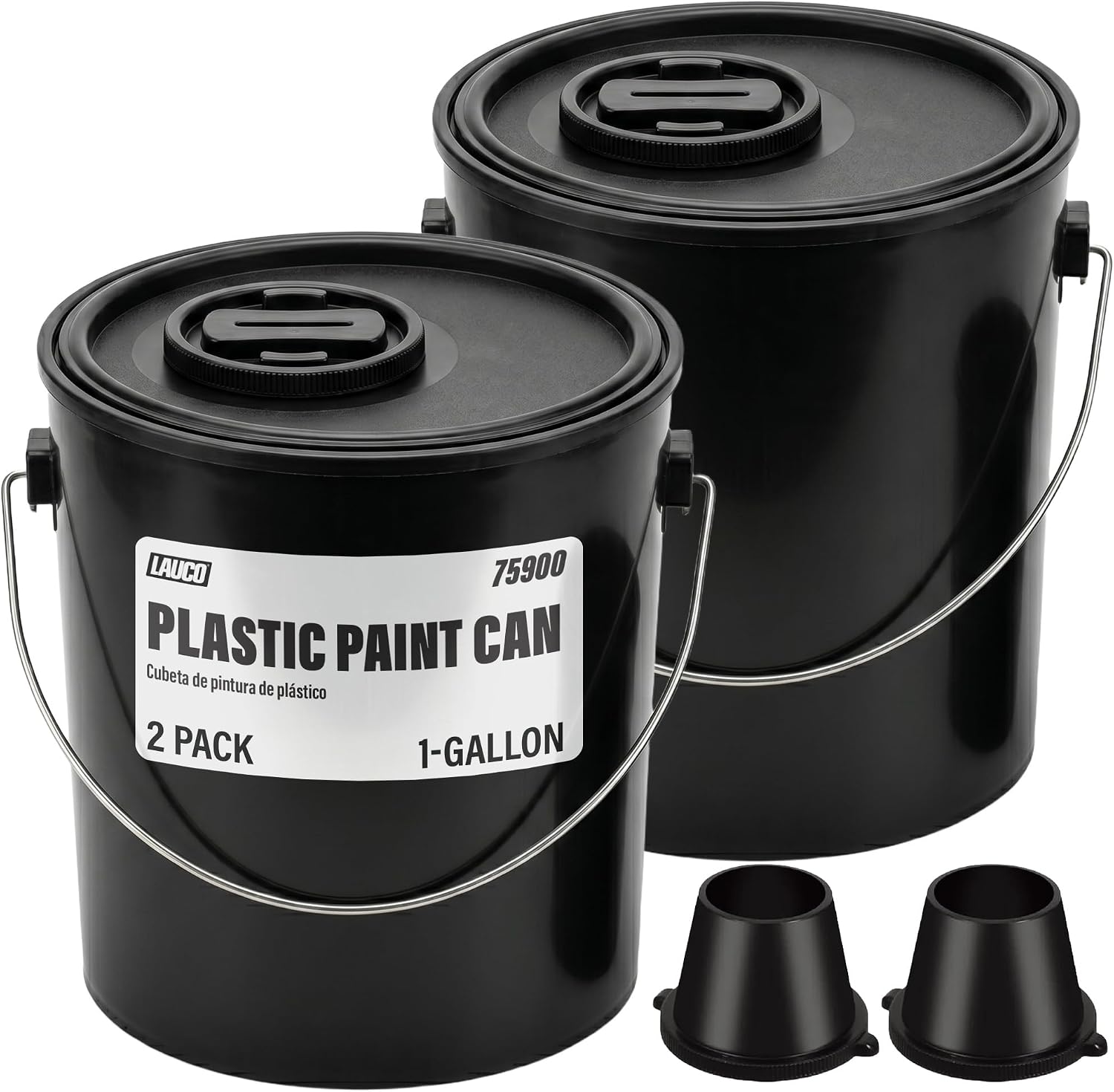
Lauco’s gallon cans have snap-on lids that seal tightly, according to the listing, and sturdy metal handles for carrying and pouring. The listing describes strong polypropylene that resists dents, corrosion and chemicals, and suggests them for paint, primers, varnish, adhesives and other liquids.
Note that the product title mentions tinplate while the description says polypropylene plastic, so confirm the material in the product photos if it matters for what you plan to store.
Best suited for: Studios storing bulk gesso, PVA glue, varnish or water-based mediums.
Key features:
- 2 x 1-gallon cans
- Snap-on lids
- Metal carry handles
- Polypropylene per listing description
Pros:
- Handles make pouring easier
- Tight-sealing lids
- Versatile for many studio liquids
Cons and limitations:
- Inconsistent material description
- Only two cans
- Larger than most artists need
Buying consideration: Label gallons with the purchase date; mediums and gesso keep best when used within the maker’s recommended time.
Buying Guide: How to Choose Paint Storage Containers
Size it to the amount you keep
Air in a container is what dries paint. Choose the smallest container that fits the paint, and move leftovers to a smaller one as you use them up.
Check the seal
Press-fit lids that click, screw caps and squeeze-out-the-air bags all limit air exposure. Loose lids invite skinning and mold.
Plastic for water-based paint
Acrylic, gesso and tempera are water-based and can rust metal cans. Polypropylene is a safe choice. Solvents and oil mediums need containers rated for them.
Visibility and labeling
Clear containers and labels prevent mix-ups. For opaque cans, label the lid and side with color, recipe and date.
Organization for bottles
Tiered racks keep bottle collections visible. Measure your bottles; racks are often sized for 2 oz craft paint.
Handles and portability
Handles matter for gallons and for carrying paint to murals or classes. Small cups are better for portable kits.
Don’t Forget the Palette
Containers handle paint before and after a session, but a lot of acrylic is lost on the palette itself. A stay-wet palette, which keeps paint on damp paper over a sponge under a lid, can hold squeezed-out acrylic usable for days. A simpler trick is to cover a plastic palette with plastic wrap pressed directly onto the paint and store it in the refrigerator overnight; bring it back to room temperature before painting. For oils, a palette with a lid slows drying, and some painters keep it in the freezer between sessions to slow drying further.
Combining good palette habits with right-sized containers is how studios cut paint waste the most. Squeeze out less, mix only what you need for the day, and move larger leftovers into a labeled cup before they start to skin.
How to Keep Stored Paint Fresh
- Wipe container rims before closing so lids seal fully.
- Store at room temperature; avoid freezing garages and hot cars.
- Shake or stir before use to remix settled pigment.
- Never pour used paint from a palette back into clean stock.
- Discard paint that smells sour or shows mold.
- For tubes, squeeze from the bottom and wipe caps before closing.
Good storage is part of a well-run studio. While you are organizing, give your gear some attention too: see our guides on cleaning and maintaining a wooden easel and using a tabletop easel correctly.
Common Mistakes to Avoid
- Storing a little paint in a big can: the air space dries it out.
- Using metal tins for acrylic: water-based paint can cause rust.
- Skipping labels: unlabeled mixes are nearly impossible to match.
- Keeping solvents in plastic: use solvent-rated containers.
- Letting paint freeze: freezing can ruin acrylic and latex.
- Dipping dirty brushes into stock: it contaminates and can introduce mold.
FAQs
What is the best way to store mixed acrylic paint?
Use small airtight containers that the paint nearly fills, and label them with the color recipe and date. For fluid pouring mixes, squeeze-out-the-air bags also work well.
How long does stored acrylic paint last?
Sealed and kept at room temperature, acrylic can last a long time. Discard paint that smells sour, grows mold or has turned rubbery.
Can I store paint in plastic containers?
Yes, for water-based paints such as acrylic, gesso and tempera. Polypropylene containers will not rust. Store oil mediums and solvents in containers rated for them.
How do I organize craft paint bottles?
A tiered rack keeps labels visible. Group bottles by color family and keep the most-used colors at the front.
How do I stop paint from skinning over?
Reduce air in the container by choosing a smaller size, filling it close to the top or removing air from bags, and make sure lids seal fully.
Should paint be stored upside down?
Some painters store sealed cans upside down so paint forms a seal at the lid. Only do this with lids you trust not to leak, and follow any manufacturer guidance.
Final Recommendation
For a craft paint collection, the Shuttle Art organizer is the simplest upgrade. For custom colors you will reuse, Touch Up Cups are the right size and the mixing ball helps. Pour painters and anyone decanting gesso should buy Stock Your Home quarts, and Paint Hero bags are the best way to remove air from fluid mixes. Studios buying in bulk can pair the Stock Your Home combo or Lauco gallons with smaller working containers.




