

PaintingProGuide is reader-supported. When you buy through links on this page we may earn an affiliate commission at no extra cost to you.
Watercolor is mostly water, so the palette has to handle puddles. It needs wells deep enough to hold tube paint that dries into reusable cakes, mixing areas big enough for a wash that covers a whole sky, and a surface that lets water spread instead of beading into droplets. The best palette for watercolor painting is either white porcelain, which never stains and never beads, or a well-designed plastic palette with deep wells, generous mixing wells and an airtight or folding lid for storage and travel.
Quick answer: For studio watercolor, the MEEDEN 12-Well Porcelain Palette is our top pick: heavy, stable and smooth, so paint spreads without beading. For a large, portable color layout, the Junreox 24-Well Palette with Lid opens flat with five big mixing spaces, and the Mr. Pen Airtight 18-Well Palette keeps paint moist between sessions.
If you are unsure which type suits you, our explainer on what kind of palette is best for watercolor covers the basics. This guide compares seven palettes and then explains how to fill, use and maintain them.
Our Top Picks at a Glance
- MEEDEN Porcelain Watercolor Palette, 12 Wells — Best overall studio watercolor palette
- Junreox Large Watercolor Palette with Lid, 24 Wells — Best large folding palette
- Mr. Pen Airtight Watercolor Palette, 18 Wells — Best for keeping paint moist
- MEEDEN Ceramic Watercolor Palette, 8 Wells — Best porcelain palette for big mixing wells
- ZROSDSGY 5 Inch Porcelain Palette with Lid — Best small porcelain palette with a lid
- Sweaty Pony 20 Well Palette, 13 x 10 Inches — Best large flat plastic palette
- DUGATO 20-Well Plastic Palette, 2 Pack — Best value pair for studio and travel
| Product | Best For | Key Spec | Key Strength | Price Tier |
|---|---|---|---|---|
| MEEDEN Porcelain 12 | Studio | 7 in diameter, 12 wells, porcelain | No beading, stable weight | $ |
| Junreox 24 | Large color layout | 24 deep wells, 5 mixing areas, lid, thumbhole | Opens flat, brush compartment | $ |
| Mr. Pen Airtight 18 | Moist storage | 18 wells, 2 mixing areas, airtight lid | Keeps pans moist | $ |
| MEEDEN Ceramic 8 | Big washes | 7 x 7 in, 8 wells, ceramic | Larger wells | $$ |
| ZROSDSGY 5 in | Small kit | 5 in porcelain, plum blossom design, lid | Portable porcelain | $ |
| Sweaty Pony 20 | Flat studio surface | 13 x 10 in, 20 wells incl. 4 large circles | Plenty of mixing space | $ |
| DUGATO 2 pack | Value | 2 x 10 x 13 in, 20 wells each | Two palettes | $ |
How We Chose
We did not paint with these palettes. Our picks are based on the Amazon listing details and specifications checked in October 2026, how well each palette’s material, well layout and lid suit watercolor painting, and how widely each product is reviewed by Amazon buyers.
Criteria for watercolor:
- Surface behavior: porcelain and good plastics that let water spread instead of beading.
- Well depth and count: room for tube paint to dry into reusable cakes.
- Mixing areas: large, preferably sloped wells for washes.
- Lids and storage: airtight or folding lids for dust-free storage and travel.
- Stability: weight or footprint that keeps the palette from sliding.
- Stain resistance: porcelain does not stain; plastic varies.
Best Palette for Watercolor Painting Reviewed
1. MEEDEN Porcelain Watercolor Palette, 12 Wells — Best for studio watercolor

MEEDEN makes this 12-well palette from white, eco-friendly ceramic, 7 inches in diameter and 1 inch high. The listing says it has enough weight that it will not flip around, and a smooth white surface on which paint spreads without beading and wipes perfectly clean with a tissue. It is listed for watercolor, gouache, acrylic, oil and tempera.
Porcelain is the classic watercolor palette for good reason. The smooth glaze lets water flow into an even puddle, which makes mixing smooth washes easier, and white porcelain shows true color. It never stains, so cadmiums and phthalos leave no ghosts.
Twelve wells hold a full working palette, while the weight keeps it steady as you load a big brush.
Best suited for: Studio watercolor and gouache painters who want true color and smooth mixing.
Key features:
- 12 wells
- 7 inch diameter, 1 inch high
- White porcelain
- Weighted, non-slip
Pros:
- No beading
- Does not stain
- Stable
- Easy to wipe clean
Cons and limitations:
- Breakable
- No lid
- Too heavy for light travel kits
Buying consideration: Fill the wells with tube paint, let them dry for a day, and the palette becomes a set of reusable pans.
2. Junreox Large Watercolor Palette with Lid, 24 Wells — Best for a large folding palette
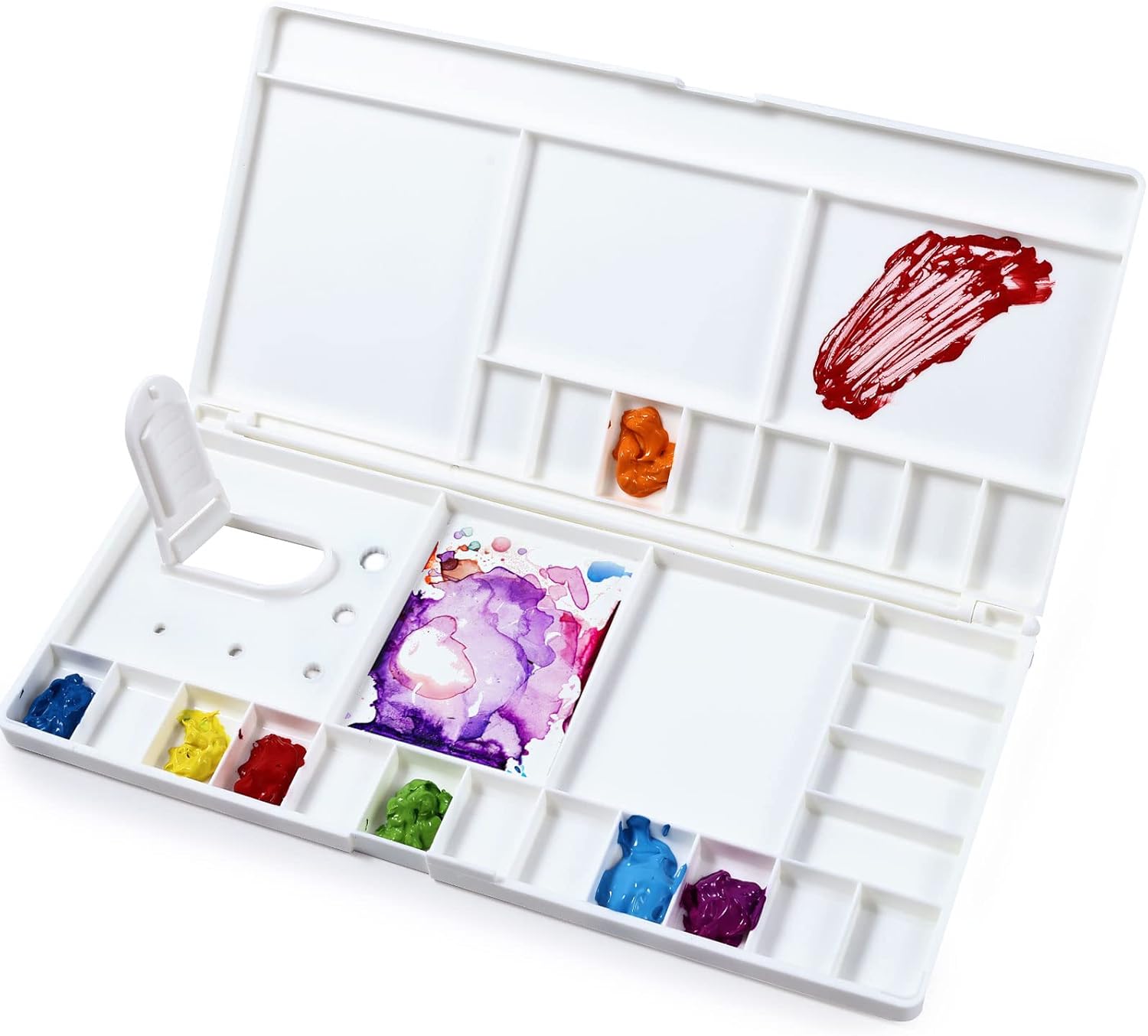
Junreox lists 24 flat, deep wells, 5 large blending spaces, a compartment for travel-size brushes and a thumbhole. It opens flat and folds to 11.8 x 5.35 x 0.78 inches, unfolding to 11.8 x 10.63 inches. The listing says the deep wells hold more paint and prevent spills into the mixing area.
Twenty-four wells let you lay out a full color range with room to spare, and five large blending spaces give room for big washes. Folding closed keeps dust off between sessions and makes it a practical travel palette.
Best suited for: Watercolorists with a large color collection, and anyone painting both at home and on the go.
Key features:
- 24 deep wells
- 5 large mixing areas
- Folding lid, opens flat
- Brush compartment and thumbhole
Pros:
- Large layout
- Portable when closed
- Brush storage
Cons and limitations:
- Plastic may bead until broken in
- Strong pigments can stain over time
Buying consideration: If water beads on new plastic, scrub gently with a mild abrasive or a little toothpaste to break the surface tension.
3. Mr. Pen Airtight Watercolor Palette, 18 Wells — Best for keeping paint moist

Mr. Pen offers an 18-well palette with 2 large mixing areas and an airtight lid, made of sturdy white plastic. The listing says the lid keeps paint pans moist and easy to clean, and suggests the palette for classrooms, travel and plein air.
An airtight lid slows drying, so freshly squeezed paint stays soft between sessions, and it protects dried pans from dust.
Best suited for: Students, classroom use and painters who prefer softer, moist paint.
Key features:
- 18 wells
- 2 large mixing areas
- Airtight lid
- White plastic
Pros:
- Keeps paint moist
- Affordable
- Portable
Cons and limitations:
- Only two mixing areas
- Airtight storage of wet paint can encourage mold if left for weeks
Buying consideration: Open the lid occasionally to air the palette if paint is stored wet for long periods.
4. MEEDEN Ceramic Watercolor Palette, 8 Wells — Best for big mixing wells

MEEDEN also makes an 8-well ceramic palette, 7 x 7 x 0.9 inches. Fewer wells means each is larger, which the listing says provides enough mixing area. The white smooth surface does not bead and cleans with water and a tissue.
Larger wells suit painters who mix big puddles of wash for skies and backgrounds, and work with a limited palette.
Best suited for: Watercolorists who use a limited palette and mix large washes.
Key features:
- 8 wells
- 7 x 7 x 0.9 inches
- White ceramic
- Smooth, non-beading surface
Pros:
- Big wells for washes
- No staining
- Easy cleanup
Cons and limitations:
- Fewer colors at once
- Breakable
- No lid
Buying consideration: Use alongside a small well palette: color storage in one, big washes in this.
5. ZROSDSGY 5 Inch Porcelain Palette with Lid — Best for a small porcelain palette with a lid

ZROSDSGY lists a 5 inch ceramic palette with a plum blossom design and a lid. The listing says it suits watercolor and gouache, has a smooth, non-porous surface that wipes clean, and the lid keeps paints fresh and protected for transport.
It brings porcelain performance to a small format, good for a minimal palette of a few colors, or for gouache.
Best suited for: Painters who want porcelain quality in a small, lidded palette.
Key features:
- 5 inch porcelain
- Lid included
- Decorative plum blossom design
- For watercolor and gouache
Pros:
- Porcelain surface
- Lid for protection
- Compact
Cons and limitations:
- Small capacity
- Breakable for travel
Buying consideration: Wrap in a cloth when traveling; ceramic chips if knocked.
6. Sweaty Pony 20 Well Palette, 13 x 10 Inches — Best for a large flat plastic palette

Sweaty Pony offers a 13 x 10 inch white plastic palette, slightly larger than A4, with 20 wells: 8 squares, 4 large circles and 8 small circles. It weighs 0.35 pounds and is reusable and easy to clean.
The large circles are effectively mixing wells for washes, while the squares and small circles hold colors. At 13 inches, it gives a lot of working space for the price.
Best suited for: Studio watercolorists on a budget who want lots of mixing space.
Key features:
- 13 x 10 inches
- 20 wells including 4 large circles
- White plastic
- 0.35 lb
Pros:
- Large surface
- Light
- Very affordable
Cons and limitations:
- No lid
- Plastic may stain with strong pigments
Buying consideration: Cover with plastic wrap or a sheet of card between sessions to keep dust off.
7. DUGATO 20-Well Plastic Palette, 2 Pack — Best for a value pair

DUGATO packs two 10 x 13 inch palettes, each with 20 wells, in sturdy, non-toxic white plastic with a smooth, non-stick surface that rinses clean. The listing names watercolor, acrylic, gouache and more.
Two palettes let you keep one for watercolor and one for gouache or acrylic, or a clean one for each painting.
Best suited for: Painters who use more than one water medium, or teachers.
Key features:
- 2 palettes, 10 x 13 inches
- 20 wells each
- Non-toxic white plastic
- Smooth, easy rinse
Pros:
- Two for the price of one premium palette
- Plenty of wells
- Light
Cons and limitations:
- No lids
- Plastic may bead initially
Buying consideration: Label one palette for watercolor only so acrylic residue never contaminates it.
Buying Guide: How to Choose a Palette for Watercolor Painting
Porcelain or plastic
Porcelain does not stain, never beads and shows true color, but it is heavy and breakable. Plastic is light, cheap and portable, but can bead when new and may stain with strong pigments over time.
Wells for storage, wells for mixing
Look for two types of wells: smaller ones to hold paint and larger, shallow or sloped ones to mix washes. A palette with only small wells is frustrating for washes.
Lid or no lid
Lids protect dried paint from dust, keep paint moist, and make a palette portable. Studio porcelain palettes usually have no lid; cover them with a cloth.
Number of wells
Beginners need 8 to 12 colors. Experienced painters may want 18 to 24 for a wider range. More wells also let you separate warm and cool versions of each color.
Size and stability
A palette that slides around while you load a brush is annoying. Heavy porcelain stays put; light plastic can be placed on a non-slip mat.
Travel and plein air
Folding palettes with thumb holes and brush compartments suit outdoor work. Airtight lids help in dry climates.
How to Fill a Watercolor Palette with Tube Paint
- Plan your layout. Group colors by family: yellows, reds, blues, greens, earths. Many painters arrange warm to cool.
- Label the wells. Write color names on tape along the edge or keep a swatch card in the lid.
- Squeeze paint into wells, filling each about halfway to two-thirds.
- Let it dry for a day or more with the lid open. The paint becomes a cake that re-wets with a damp brush.
- Top up as needed by squeezing fresh paint on top of the dried cake.
For more on working this way, see our guide on how to use a dry watercolor palette, and for everyday technique, how to use a watercolor palette.
Mixing Washes on Your Palette
Mix more wash than you think you need: running out halfway across a sky leaves a hard edge. Use a large mixing well, add water first, then pick up pigment and stir until the color is even. Test on a scrap of paper before painting. For graded washes, prepare two or three wells at different strengths in advance.
A Sample Watercolor Palette Layout
If you are filling a 12-well palette for the first time, this layout covers most subjects: a warm yellow and a cool yellow; a warm red and a cool red; a warm blue and a cool blue; a green; two earths such as yellow ochre and burnt sienna; a dark such as a neutral tint or Payne gray; and two spare wells for a favorite convenience color. Arrange them in that order around the palette so mixing neighbors makes sense.
Cleaning and Maintenance
Wipe mixing areas with a damp sponge or paper towel at the end of each session, leaving the color wells untouched. Porcelain stains wipe off easily; plastic may need a gentle scrub. If water beads on a new plastic palette, rub it lightly with a mild abrasive cleaner or toothpaste to break surface tension. See our full guide on how to clean a painting palette, and learn how to keep a palette from drying out if you prefer moist paint. If you work in acrylic or gouache too, read about wet palettes, which suit those faster-drying media.
Common Mistakes to Avoid
- Choosing a palette with tiny mixing areas and running out of wash.
- Using acrylic in a watercolor palette, which dries permanently in the wells.
- Letting dust and hair settle on uncovered dried paint.
- Overfilling wells so colors run together when wet.
- Ignoring beading on new plastic instead of breaking the surface tension.
- Packing a porcelain palette loosely in a travel bag.
FAQs
What type of palette is best for watercolor?
White porcelain is the classic choice because it does not stain or bead. Good plastic palettes with deep wells and lids are lighter and more portable.
Why does water bead on my plastic palette?
New plastic often has a slick surface. Scrubbing gently with a mild abrasive or toothpaste usually solves it.
Can I let watercolor dry in the palette?
Yes. Tube watercolor dries into cakes that re-wet with a damp brush, which is how most palettes are used.
How many wells does a watercolor palette need?
8 to 12 for beginners; 18 to 24 for painters with larger color collections.
Is a porcelain palette worth it?
For studio work, yes. It is stable, never stains and shows true color. For travel, light plastic or tins are more practical.
Can I use a watercolor palette for gouache?
Yes. Gouache re-wets like watercolor, so the same palette works, though some painters keep them separate.
Final Recommendation
For studio watercolor, the MEEDEN 12-well porcelain palette offers true color, no beading and stable weight, with the 8-well version for larger washes. For a big, portable layout, choose the Junreox 24-well folding palette, or the Mr. Pen airtight palette if you like moist paint. The ZROSDSGY palette brings porcelain to a small lidded format, and the Sweaty Pony and DUGATO palettes give generous mixing space at a low cost.


One Comment